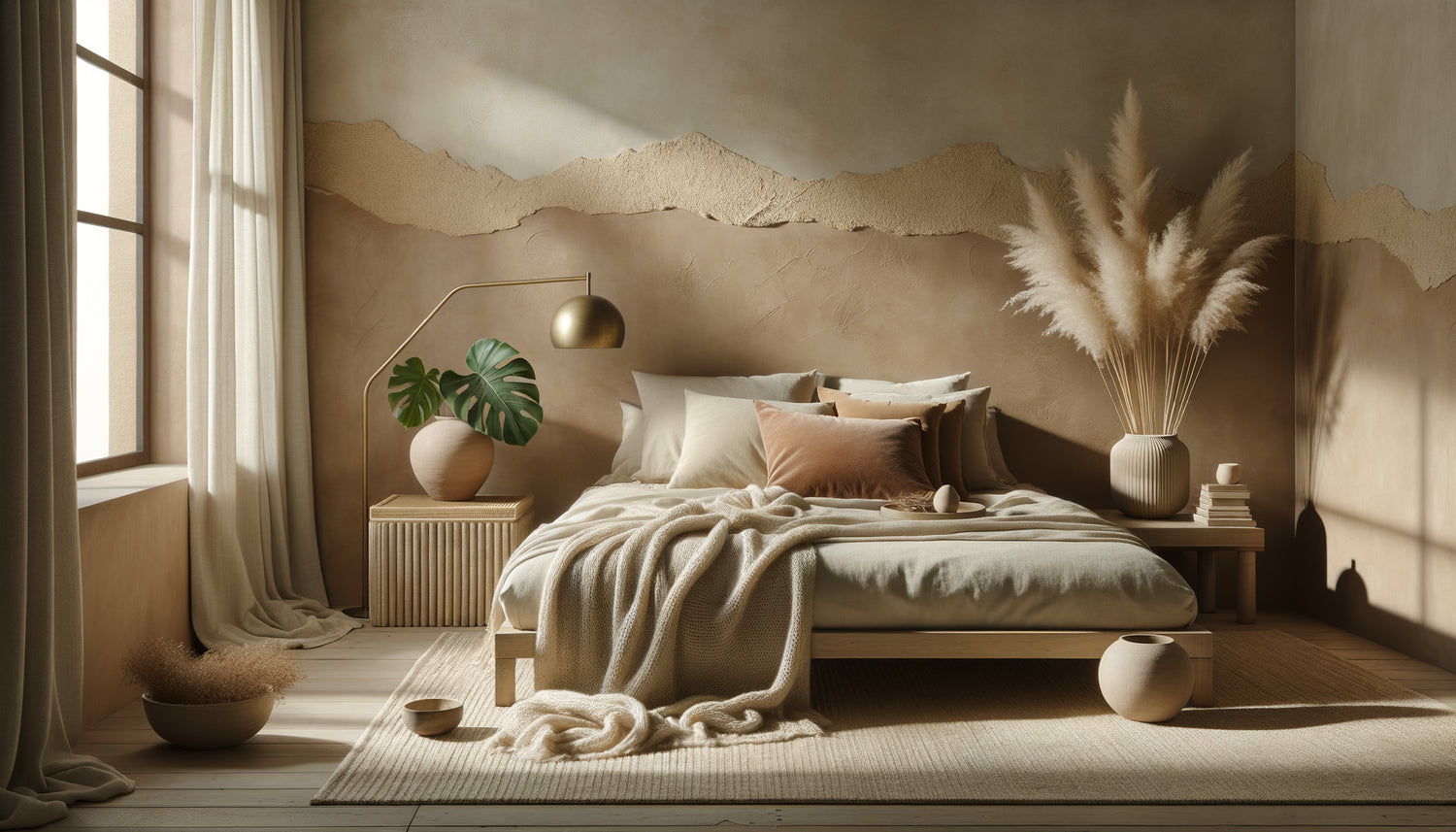
The door closes. The outside world fades away. In this room, everything should whisper to your body that it can finally let go, and to your mind that it has the right to desire. Yet, how many rooms resemble impersonal waiting rooms more than intimate sanctuaries? Harsh lighting, colors that scream, materials that irritate the skin... Nothing invites deep relaxation or awakens the senses.
Here's what styles evoking serenity and sensuality bring to your bedroom: an atmosphere that naturally slows down heart rate, textures that invite touch and being touched, a subtle balance between soothing and sensory awakening. These decorative universes transform the most intimate space in your home into a refuge where the body completely relaxes and the senses flourish without restraint.
The good news? Creating this alchemy requires neither pharaonic work nor an excessive budget. Some styles have naturally encoded within their DNA this fascinating duality between calm and sensuality. I will guide you through these aesthetic universes that instinctively understand that true rest and desire share the same foundations: softness, controlled dimness, and an invitation to touch.
The Japanese wabi-sabi: when imperfection becomes caress
Wabi-sabi represents more than a decorative style: it is a philosophy that celebrates beauty in imperfection and impermanence. In a bedroom, this approach creates a almost meditative serenity while awakening a terribly earthy sensuality.
Raw materials reign supreme: crumpled linen with irregular folds that tell the story of your nights, patinated wood whose veins draw rivers under your fingers, ceramics with imperfect glazes that capture light like living skin. Nothing is smooth, everything is alive. Colors borrow from the earth after rain: deep beiges, warm stone grays, earthy browns, sometimes punctuated by a soothing moss green.
Lighting is soft and indirect: paper lanterns that diffuse a milky glow, candles whose flame dances and projects moving shadows on the walls. This golden dimness simultaneously invites letting go and intimacy. The bed, placed low, almost to the floor, reinforces this feeling of reassuring gravity, anchorage.
Textiles are layered without ostentation: washed linen sheets that soften with each machine wash, chunky wool throws, hemp cushions. Each texture tells a different tactile story, inviting the hand to explore, the body to surrender.
How the sensual bohemian style transforms intimacy
Sensual bohemian does not look like these bedrooms overloaded with disparate ethnic objects. It is a refined, adult version that retains the nomadic soul while cultivating a deliberate sensuality.
The color palette plays on warm and enveloping tones: terracotta reminiscent of skin in the sun, powdery pink that softens daylight, deep ochre that absorbs tension, cream that breathes life into the whole. These colors do not stimulate, they embrace.
Textiles become architectural: ethereal sheers that filter natural light and create a hazy atmosphere, Berber rugs with geometric patterns that define a perimeter of softness around the bed, macramé wall hangings whose fringes invite touch. Layering remains controlled – each element has its own breathing space.
The bed transforms into a horizontal nest: rattan headboard bringing an organic texture, reasoned accumulation of cushions in varied fabrics (ribbed velvet, raw linen, crinkled cotton), throws draped with that studied carelessness which suggests one has just emerged from them. Natural materials dominate: jute, hemp, organic cotton, bamboo – everything that breathes and naturally regulates temperature.
Lighting multiplies low sources: strings of lights hidden behind the headboard, ceramic bedside lamps with fabric shades creating warm halos, candles grouped on wooden trays. Light never comes from above, always from the side, always soft.

The mineral-vegetal universe: earth and chlorophyll
This hybrid style combines the quiet strength of stone with the living sensuality of plants. It evokes those suites in boutique hotels where one feels immediately at home, protected and revitalized.
Mineral materials structure the space: polished concrete with soothing gray nuances, natural stone as a headboard that keeps coolness in summer and warmth in winter, terrazzo tile with colored inclusions that add a playful touch without breaking the serenity. These smooth and cool surfaces delightfully contrast with the warmth of textiles.
Plants don't play supporting roles: hanging ferns whose fronds cascade like wet hair, monstera with cut leaves that project graphic shadows, pothos running along a shelf. Their living presence purifies the air, but above all creates that feeling of a breathing room, of space that evolves with the seasons.
Colors oscillate between mineral neutrality and vegetal accents: base of off-white, mouse gray, taupe, highlighted by sage green, olive green, or even a deep forest green on a wall panel. This biophilic palette soothes the nervous system while maintaining a vital connection to nature.
Water sometimes makes an appearance in sound: small indoor fountain whose trickle creates white noise, essential oil diffuser that mists an aromatic vapor. These aquatic elements add an additional sensory dimension, engaging hearing and smell in the experience of the room.
Neo-Art Deco: geometry and sensuality
The revisited Art Deco style offers something rare: a sophisticated sensuality that never sacrifices serenity to dramatic effect. It's the style of bedrooms that whisper their elegance rather than shout it.
Softened geometric shapes structure the space: arched walls framing the headboard, mirrors with rounded edges multiplying light without harshness, chevron patterns on textiles guiding the eye without tiring it. Geometry always remains curved, never angular.
Noble materials converse with each other: brushed brass with muted golden reflections, ribbed velvet whose texture captures changing light, veined marble in small touches (nightstand tray, lamp base). These materials reflect without dazzling, creating a flattering ambient luminosity that gives the skin a natural glow.
The color palette plays on soft contrasts: deep midnight blue with touches of brass, mauve pink with anthracite gray, muted emerald green with cream. Saturated colors always remain slightly desaturated, never garish, creating a cozy atmosphere that envelops rather than stimulates.
Lighting becomes jewelry: opal glass pendant light diffusing milky light, wall sconces with sculptural design projecting indirect beams, bedside lamps with translucent alabaster bases. Each light source is a desirable object in itself, beautiful even when off.

The secrets of a bedroom that soothes and awakens simultaneously
Beyond specific styles, certain universal principles create this alchemy between serenity and sensuality. Understanding these mechanisms allows you to adapt any style to your intimate needs.
The rule of three textures
Each zone of the bedroom should offer at least three contrasting textures: smooth against rough, soft against structured, cold against warm. This tactile variety keeps the senses gently awake without ever creating dissonance. The bed in particular benefits from this stratification: smooth percale sheets, textured knitted blanket, silky velvet throw.
Layered emotional lighting
Forget the single ceiling light. A bedroom that cultivates serenity and sensuality offers multiple lighting scenarios: functional light for getting dressed (neutral, indirect), relaxation light (warm, dimmed, at eye level or lower), intimacy light (candlelight, string lights, a unique source creating areas of shadow). The dimmer switch becomes your best ally.
Strategic Empty Space
Paradoxically, a sensual bedroom is never cluttered. Visual emptiness allows the eye to rest and the mind to slow down. Prioritize clear surfaces, walls that breathe, a floor that is largely visible. Every object present must justify its place by its beauty or its use – ideally both.
Your bedroom deserves a work that breathes with it
Discover our exclusive collection of wall art for bedroom that captures this rare duality between soothing and awakening the senses, creations designed to transform your walls into invitations to dream.
The finishing touches that make all the difference
Invisible details often create the strongest emotional impact. An ambient fragrance with woody and powdery notes (sandalwood, cedar, iris) creates an olfactory signature that instantly triggers relaxation as you step through the door. Essential oils of true lavender, bergamot or ylang-ylang add an aromatherapy dimension.
Bedding deserves a thoughtful investment: prioritize quality natural materials (long fiber cotton percale, European washed linen, cotton satin) in weights suitable for the seasons. The initial sensation when getting into bed – that moment when skin meets the sheet – conditions all the quality of rest and intimacy to come.
Wall art actively participates in the atmosphere: black and white photographs with soft contrasts, abstract watercolors in soothing colors, delicate botanical illustrations. Avoid overly figurative or narrative images that keep the mind in analytical mode. Prefer compositions that invite dreamy blurriness.
Finally, consider the temperature and air quality: a slightly cool bedroom (between 16 and 19°C) promotes deep sleep while making cozy textiles irresistible. A silent air purifier or simply daily ventilation maintains a healthy atmosphere that allows the body to truly regenerate.
Close your eyes for a moment. Imagine yourself stepping through the threshold of this transformed bedroom. The golden light welcomes you, the textures beckon, the very air seems to envelop you in a protective softness. Your body already knows it can let go here. Your senses awaken effortlessly, naturally. This room is no longer just a place of passage between two exhausting days – it becomes the sanctuary where you truly find yourself, where rest and desire coexist in perfect harmony. Start with a single change this week: a new light source, a sumptuous textile, a work that makes you breathe differently. Transformation always begins with a detail that resonates perfectly.
Frequently Asked Questions
Can you really create a serene AND sensual atmosphere, or do you have to choose?
This false opposition comes from a cultural confusion. True sensuality is not aggressive or overly stimulating – it is born precisely in deep relaxation, when defenses fall. The styles I presented prove that serenity and sensuality share the same ingredients: softness of materials, subdued lighting, enveloping colors, attention to tactile details. A truly soothed body naturally opens itself to subtle sensations. A successful bedroom orchestrates this dance without you having to choose a side. The trick lies in quality rather than intensity. Prefer sumptuous velvet to garish colors, candlelight to bubblegum lighting, crumpled linen to shiny synthetic fabrics. Calm sophistication always beats dramatic effect.
I have a small bedroom, do these styles still work?
Absolutely, and sometimes even better. A small bedroom naturally transforms into a protective cocoon, which perfectly serves the goal of serenity and intimacy. The key is to adapt the scale rather than the principle. In a reduced space, opt for the wabi-sabi or mineral-vegetal Japanese style that values simplicity and emptiness. Prioritize light colors as dominant (beige, pearl gray, off-white) with deeper accents on a single wall or in textiles. Use strategic mirrors that multiply natural light without creating a disco effect. Limit furniture to the essentials: a beautiful bed becomes the centerpiece without competition. Hanging plants free up the floor while adding the vegetal touch. And above all, invest everything in the quality of textiles – in a small space, you will see and touch them constantly, so they become the most emotionally rewarding investment.
What should I start with to transform my bedroom?
Start with lighting, as it's the quickest and most spectacular transformation. Replace your harsh ceiling light with a soft pendant or remove it altogether in favor of bedside lamps with warm white bulbs (2700K maximum) and dimmer switch. This single modification dramatically changes the atmosphere for less than one hundred euros. Next, invest in quality bedding made from natural materials – you spend a third of your life in it, the return on investment in well-being is immediate. Third step: create a calming focal point with a wall art piece or textured headboard that anchors the chosen style. Fourth movement: introduce three easy plants (pothos, sansevieria, fern) which bring the living dimension. Finally, ruthlessly declutter – remove anything that is neither beautiful nor useful nor full of meaning. This five-step progression spread over a few weeks profoundly transforms the space without requiring work or excessive budget. Observe how you feel after each change before moving on to the next.