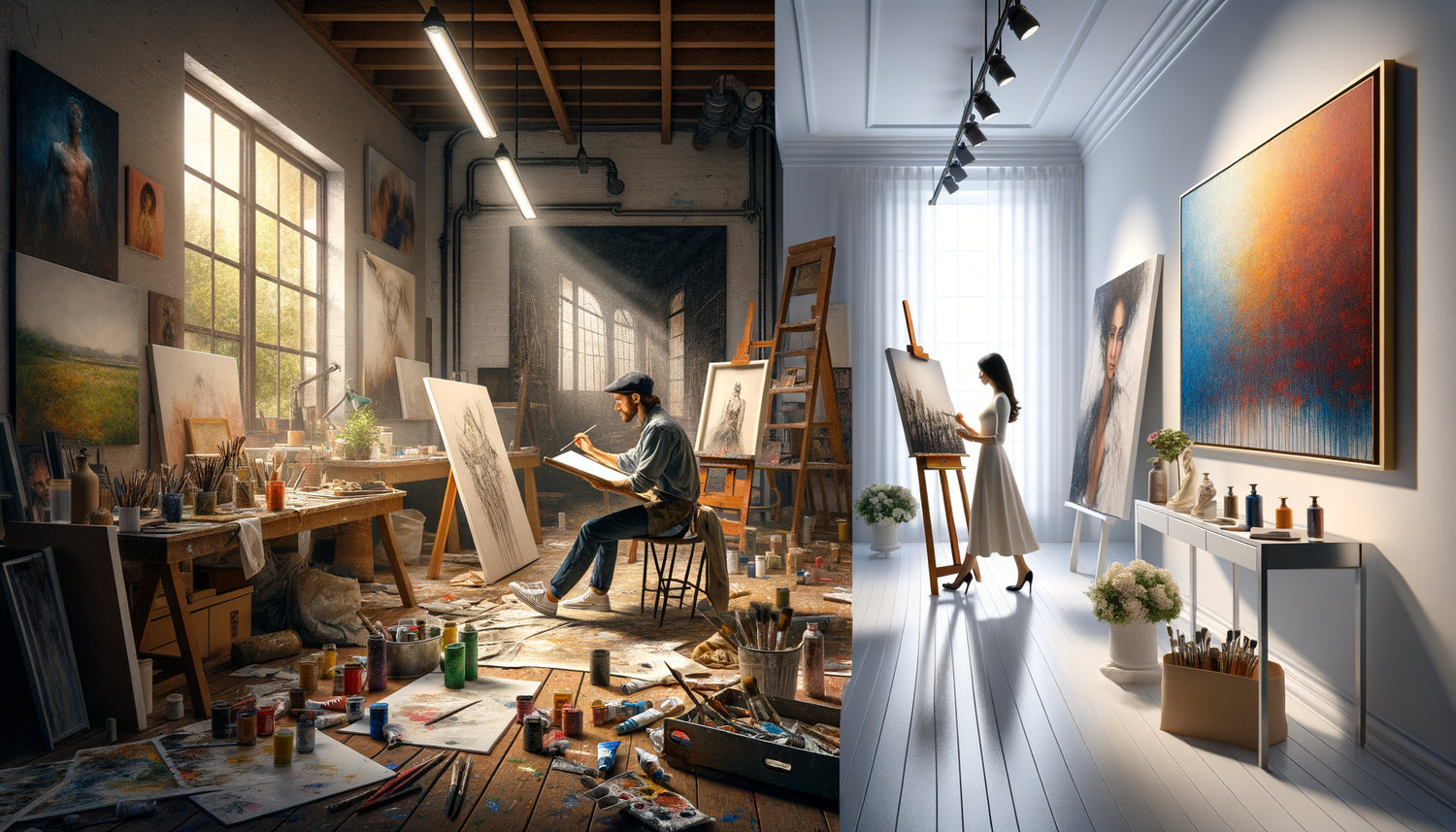
This Saturday morning, in the bright studio of an emerging artist, a ceramic sculpture caught your eye. Its price: €800. The next day, you find a similar piece in a Marais gallery, priced at €2,400. Between frustration and perplexity, a question arises: where and how to acquire art without making a mistake?
Here's what the choice between artist and gallery brings you: a direct relationship and controlled prices on one hand, professional expertise and a guarantee of value on the other, plus the certainty of investing in works that will stand the test of time.
Too often, novice collectors hesitate between these two paths, paralyzed by the fear of paying too much, lacking expertise or making the wrong choice. Some are afraid of offending artists by negotiating, others dread the high margins of galleries. This indecision deprives them of pieces they love and turns buying art into an anxiety-provoking journey.
Yet, understanding the specific advantages of each approach dispels these fears. Whether you're looking for the authenticity of a direct exchange or the security of professional support, each model meets legitimate needs. I will reveal how to navigate between these two universes to build a collection that reflects you, without regret or compromise.
Buying directly from artists: authenticity within reach
Stepping into an artist's studio provides an incomparable emotion. You discover the works in their creative environment, surrounded by sketches, pigments and tools still warm. This total immersion in the creative universe establishes a deep connection that no gallery, however refined it may be, can reproduce.
Direct purchase offers undeniable financial advantages. Without an intermediary, prices reflect the artist's work directly, generally 40 to 60% lower than in galleries. For a work sold for €3,000 in a gallery, you could acquire it between €1,200 and €1,800 directly from the creator. This substantial saving allows you to acquire more ambitious pieces or diversify your collection.
Beyond price, you build a personal relationship with the artist. During a studio visit, I saw a collector spend three hours discussing technique and inspiration with a painter. This conversation transformed her view of the purchased work: each brushstroke now tells a story she knows intimately. Some artists even offer custom commissions, adapting format, palette or theme to your interior.
Open studio days, artist residencies and specialized online platforms facilitate these direct encounters. You actively participate in the career of a creator, a support that goes beyond a simple commercial transaction to become a true accessible patronage.
Art galleries: expertise and security at the service of the collector
Stepping through the door of an established gallery, you immediately benefit from professional curation. Gallery owners select their artists based on strict criteria: artistic consistency, quality of execution, career potential. This expert curation saves you hours of research and significantly reduces the risk of a disappointing acquisition.
The support provided by galleries goes far beyond sales. A good gallery owner becomes your personal advisor, understanding your tastes, your interior design, and your budget to suggest works perfectly suited to you. At a contemporary art fair, I observed a gallery owner spending forty minutes with a couple, analyzing the lighting in their living room via photos to recommend the most flattering pictorial techniques for their space.
Galleries also offer essential services: detailed certificates of authenticity, provenance history, conservation expertise, installment payment facilities, and sometimes even home trial periods. Some offer a repurchase or exchange service, securing your investment. This professional infrastructure particularly protects novice collectors from common pitfalls in the art market.
The appreciation is another major advantage. A work purchased from a recognized gallery has traceability and legitimacy that facilitate its resale later on. Galleries participate in major international fairs, building the notoriety of their artists and, by extension, the value of works acquired from them.

When to prioritize direct purchase: three winning situations
Purchasing directly from artists naturally imposes itself in certain circumstances. Firstly, when you discover an emerging talent whose style deeply resonates with you. These artists, not yet represented by major galleries, offer accessible prices for works that may potentially increase significantly in value. I met a collector who acquired six canvases from a young graduate of the School of Fine Arts for 600 euros each; five years later, her work is exhibited in institutions and sells for 4,000 euros.
Secondly, for custom projects. If you are considering a large-scale work, architecturally integrated or thematically specific, direct dialogue with the artist allows for creative collaboration impossible via gallery. An architect told me how she co-commissioned a sculpture from a sculptor for the lobby of an office building, adjusting materials and proportions over fifteen workshop meetings.
Thirdly, when your budget is limited but your desire for authentic art remains. Rather than a reproduction or a second-choice artwork from a gallery, buying directly allows you to acquire original pieces of quality. Limited editions, small formats, or works on paper directly from established artists offer financially reasonable entry points into recognized artistic worlds.
When galleries become essential
Certain situations require the intervention of a professional gallery. For established artists whose market value is set, the gallery guarantees authenticity and traceability, crucial when reselling. Acquiring a painting by an artist valued at €15,000 directly, without professional certification or documentation, compromises its future value and drastically complicates any subsequent transaction.
Galleries are also valuable for novice collectors who are developing their eye and expertise. The education provided by a good gallerist – historical context, artistic movements, comparisons between styles – structures your approach and gradually refines your sensitivity. One collector confided in me that her first three years of purchases exclusively through a gallery gave her the necessary foundations to then explore workshops with discernment.
Finally, for heritage acquisitions intended to last across generations, the gallery offers essential legal and documentary infrastructure. Inheritance, insurance, loans to exhibitions: all these aspects require impeccable provenance that only established institutions can fully guarantee.

The hybrid strategy: combining the best of both worlds
The most discerning collectors do not choose between artist and gallery, they strategically alternate according to opportunity. This hybrid approach optimizes budget, discovery, and security. You can start by visiting workshops during open days to understand creative processes, then acquire major works by the same artist through their gallery to benefit from professional documentation.
Some collectors establish lasting relationships with a few artists they have followed since their beginnings, complementing their collection with gallery acquisitions to diversify styles and periods. This dual approach builds a personal and coherent collection, blending the intimacy of direct relationships and the legitimacy of institutional acquisitions.
Social media has blurred traditional boundaries. Many artists represented by galleries maintain an active Instagram presence, allowing for exchanges and discovery before a potential acquisition through their official representative. This new transparency facilitates emotional connection while respecting established professional frameworks.
Feel free to openly question artists about their relationship with galleries. Many appreciate this frankness and will direct you themselves to their gallerist for certain pieces, while offering direct access for specific formats or series. This mutual honesty builds lasting relationships, far more rewarding than one-off transactions.
Ready to transform your walls into a personal gallery?
Discover our exclusive collection of wall art for bedroom that enhances your intimacy with works selected by true art enthusiasts.
Your first acquisition: a ritual, not a transaction
Whether you choose the studio or the gallery for your first artwork, transform this moment into a memorable experience. Take the time to contemplate, ask all your questions, imagine the work in your daily life. A successful art acquisition is never impulsive but always passionate.
In a few months, when your gaze crosses this work as you walk down a hallway, you will remember that conversation with the artist in their light-filled studio, or that suspended moment in the silent gallery when you knew that this piece already belonged to you. It is this emotional memory, more than the market value, that makes an acquisition a true treasure.
Start modestly if necessary, but start. A €200 print purchased directly at an affordable art fair is worth infinitely more, for your artistic education and daily pleasure, than the paralyzing wait to be able to acquire a major work in five years. Your collection grows with you, visually documenting the evolution of your sensitivity.
Frequently asked questions about buying artwork
Can I negotiate prices directly with an artist?
Absolutely, negotiation remains acceptable in direct purchases, but with tact and respect. Unlike galleries where margins allow for flexibility, artists often set their price based on their actual costs and the valuation of their work. Rather than a brutal discount, prioritize other approaches: propose a payment plan, ask if more accessible works exist in their catalog, or negotiate a preferential rate if you purchase multiple pieces. Some artists spontaneously offer a 10-15% discount to collectors who faithfully follow them. The key is to engage this conversation with transparency, explaining your budgetary constraints. Most creators appreciate this honesty and seek solutions for their art to find a loving home, even if it involves an adjustment in price. Never forget that behind every price lies hours of work, years of training, and considerable material investments.
Do galleries really take 50% of the sale price?
The standard gallery commission actually ranges between 40 and 60%, depending on their prestige, services, and the artist's career stage. This margin, often perceived as excessive, nevertheless finances substantial services: rent in prestigious neighborhoods, salaries of teams, participation in international fairs sometimes costing 30,000 euros per event, communication campaigns, vernissages, exhibition catalogs, climate-controlled storage of artworks. A recognized gallery also invests in the long-term career of its artists, strategically placing their works with influential collectors or in institutional collections. This professional ecosystem builds notoriety that subsequently values all of the artist's works, including those sold directly. Some emerging or cooperative galleries practice reduced commissions of 30-35%, offering an interesting compromise between direct purchase and professional support. Find out about these alternative structures that democratize access to contemporary art.
How to verify that an artist or a gallery is reliable?
Several indicators can be used to assess the credibility of an art seller. For artists, examine their professional presence: well-designed website, consistent portfolio, participation in recognized fairs, artist residencies, mentions in specialized press. Check their social networks to verify the authenticity of their approach and the existence of an engaged community. For galleries, prioritize those adhering to the Comité Professionnel des Galeries d'Art or recognized unions, guaranteeing ethical practices. Visit the space physically if possible, assess the quality of past exhibitions visible on their website. Always request a detailed certificate of authenticity mentioning title, dimensions, technique, year, signature. Be wary of abnormally low prices for established artists, often a sign of counterfeits. Finally, word-of-mouth remains valuable: discuss with other collectors, join specialized forums, check online reviews. A reputation is built slowly in the art world, and serious players always leave verifiable traces of their journey.