It's three a.m. You stare at the ceiling, unable to fall asleep. Your gaze drifts to the artwork hanging opposite your bed – this dynamic urban scene purchased on a whim. Beautiful, certainly. But something feels off. The energy of this piece clashes with your need for rest. You just realized an essential truth: in a bedroom, every artwork radiates a vibration that deeply affects us.
Here's what a well-chosen artwork brings to your bedroom: it creates a soothing cocoon that promotes sleep, it reflects your deepest identity in your most intimate space, and it generates daily emotions aligned with your aspirations.
The problem? We are told that a bedroom should be zen, minimalist, neutral. The result: we hang bland canvases that don't look like us, or worse, we leave the walls sadly bare. Between conflicting advice from magazines and the fear of making a mistake, it’s difficult to know which artwork to choose for this very personal space.
Good news: evaluating an artwork's energy doesn't require any artistic training. Just an authentic connection with yourself and a few sensory guidelines that I will share with you. You will discover how to transform your bedroom into a sanctuary perfectly attuned to your essence.
The energy of a work begins with its color palette
Close your eyes for a moment. Think about the colors that currently inhabit your bedroom. How do they make you feel? Colors are not simply decorative choices – they act directly on your nervous system, your hormone production, and your ability to relax.
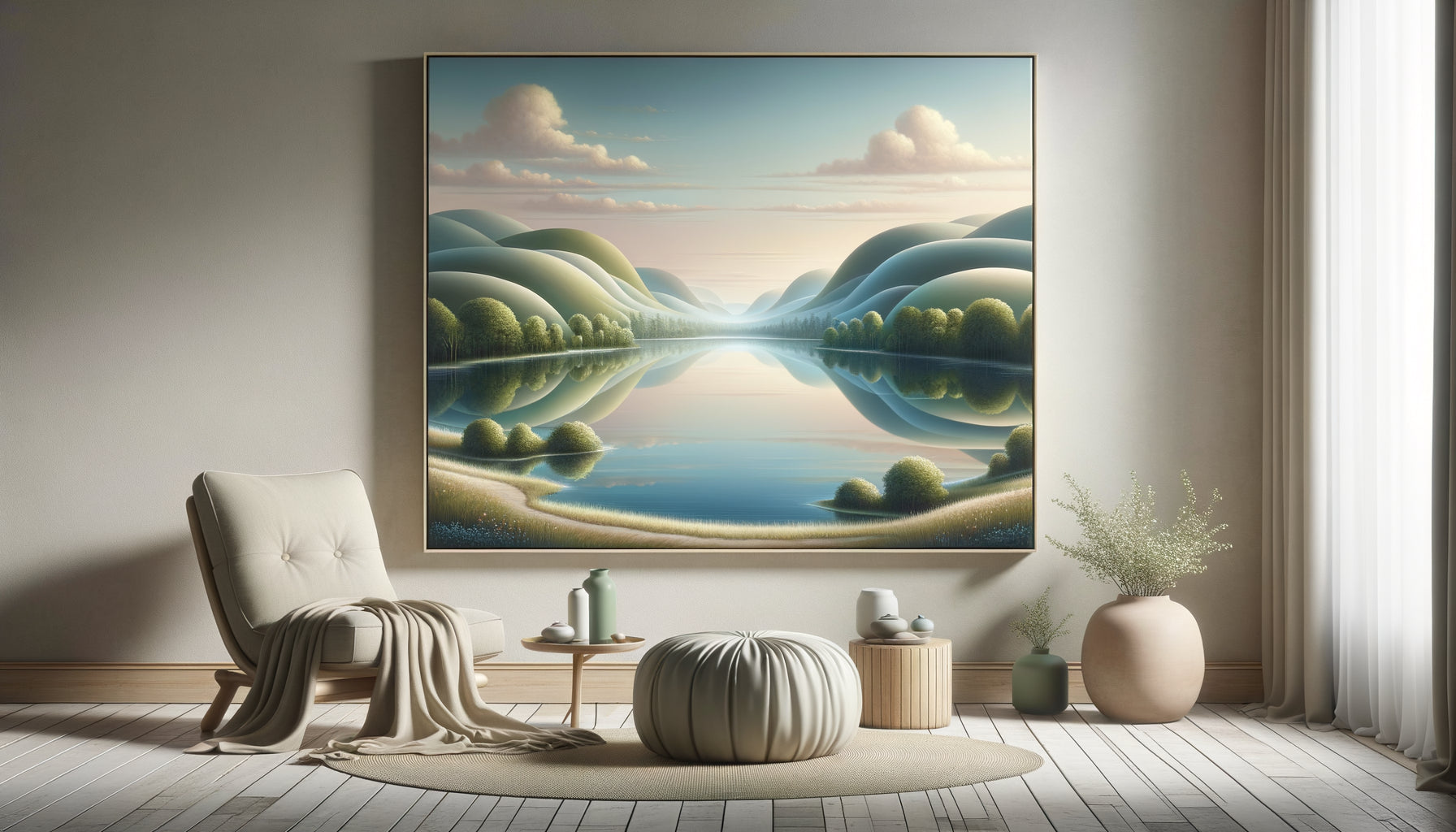
When I observe a work intended for a bedroom, I always start by identifying its dominant color. Deep blues and emerald greens naturally slow the heart rate. They evoke the ocean, the forest, those natural spaces where our bodies instinctively calm down. A watercolor in shades of midnight blue will radiate a contemplative energy, conducive to nighttime reading and falling asleep.
Conversely, intense reds, vibrant oranges, and bright yellows stimulate. They awaken, energize, activate. These are not enemies – simply, their place may not be in a bedroom dedicated to rest. Unless your intention is different: a bedroom can also be a space of morning creativity, passion, vitality.
Saturation counts as much as the shade itself. A delicate powder pink is nothing like an electric fuchsia, even though they share the same family. Desaturated hues, almost faded, create a muffled atmosphere. Saturated colors, even cool ones, generate intensity.
My personal test: imagine waking up in front of this artwork every morning for a year. Do the colors make you want to get out of bed gently, or do they propel you abruptly into the day? Your first visceral reaction is often the most accurate.
The subject and composition tell an energetic story
Beyond colors, what a work represents carries a considerable emotional charge. A raging maritime storm, however masterfully painted, diffuses an energy of movement, chaos, and power. It can inspire you... or subtly disrupt your sleep.
I have learned to decode subjects according to their energetic dynamics. Horizontal landscapes – marine horizons, endless fields – invite expansion, deep breathing. They open up the mental space. Vertical compositions – redwood forests, slender architectures – create elevation, a form of ascending spirituality.
Figurative works with characters require particular attention. What is their emotional state? A serene face, bodies entwined tenderly, a silhouette meditating facing the ocean: these subjects reflect states that we unconsciously absorb. Conversely, tense expressions or scenes of intense action keep our brain in an alert state.
Visual density influences your mental rest
Now observe the compositional complexity of the work. How many elements does your gaze have to process? A minimalist abstraction with three fluid shapes requires little cognitive effort. Your brain can rest while contemplating it. A bustling urban scene with thirty architectural details stimulates analysis, discovery, and mental activity.
No choice is bad in itself – it all depends on the energy sought. If your daily life is already overloaded with information, a clean bedroom with simple works becomes a sensory refuge. If your life lacks stimulation, richer compositions can nourish your nocturnal imagination.

Your own energy is the ultimate compass
Here's the method I systematically use before hanging a work in a bedroom. The body resonance test. Stand facing the artwork, about two meters away. Breathe calmly. Now scan your body from head to toe.
What happens physically? Do your shoulders relax or tense up? Does your breathing deepen or become shorter? Do you feel an opening in your chest or a contraction? Your body knows before your mind if an energy suits you.
I’ve seen people light up in front of artworks that I personally found too dark for a bedroom. And conversely, canvases that I judged perfectly soothing left some completely indifferent. There is no universal rule – only your inner truth.
Intention transforms the energy of a space
Ask yourself this fundamental question: what version of yourself do you want to nurture in your bedroom? The person who rests and recovers? The one who dreams and imagines? The one who reconnects with their sensuality? The one who meditates and introspects?
Each intention calls for different energies. A cocoon-like bedroom to recover from burnout may require artworks with earthy tones, soft organic shapes, soothing natural subjects. A bedroom for a couple seeking to rekindle passion will welcome bolder compositions, deep reds, sensual abstractions.
The common mistake? Choosing based on what a bedroom should be according to trends. Your bedroom is not a magazine page – it’s the reflection of your inner landscape. The artwork that corresponds to your energy is the one that echoes your deepest need at the moment, not the one that fits current aesthetic codes.
Textures and techniques add a tactile dimension to energy
This aspect is often neglected, yet crucial: the materiality of an artwork influences its energetic radiance. A thick oil painting, with generous impasto, has a powerful physical presence. It absorbs and reflects light in a changing way. It almost invites touch.
Watercolors, with their transparency and lightness, diffuse a more ethereal energy, almost vaporous. Photographs offer an anchoring in reality, a form of tangible testimony. Modern digital prints may seem more energetically neutral – which is neither a defect nor a quality, simply a characteristic.
I’ve noticed that artworks with visible textures – exposed brushstrokes, glued materials, reliefs – create a particular intimacy. You perceive the artist's gesture, their creative energy frozen in the material. This human presence can be comforting in a resting space.
Light reveals or transforms the energy of an artwork
Here’s an essential test before validating your choice: observe the artwork at different times of the day. The morning light, soft and grazing, reveals certain nuances. The evening light, warm and orange, completely transforms its atmosphere. At night, under your artificial lighting, the artwork can become unrecognizable.
A canvas with deep blues can seem soothing during the day and oppressive at night. Conversely, warm golden tones may appear too stimulating during the day but enveloping in the evening. If possible, live with the artwork for a few days before permanently hanging it. Some platforms allow returns – use this option to test the actual energy compatibility.

The balance between coherence and energy renewal
Last dimension to consider: the overall harmony of your bedroom. A work of art does not live in isolation – it dialogues with your furniture, your textiles, your other decorative objects. It can either amplify the existing energy or create a balancing counterpoint.
If your bedroom is already very clean, minimalist, with neutral tones, an artwork with color and movement can breathe life into it without breaking harmony. On the contrary, if your space is already rich in patterns and textures, a simple and contemplative work will offer a visual resting point.
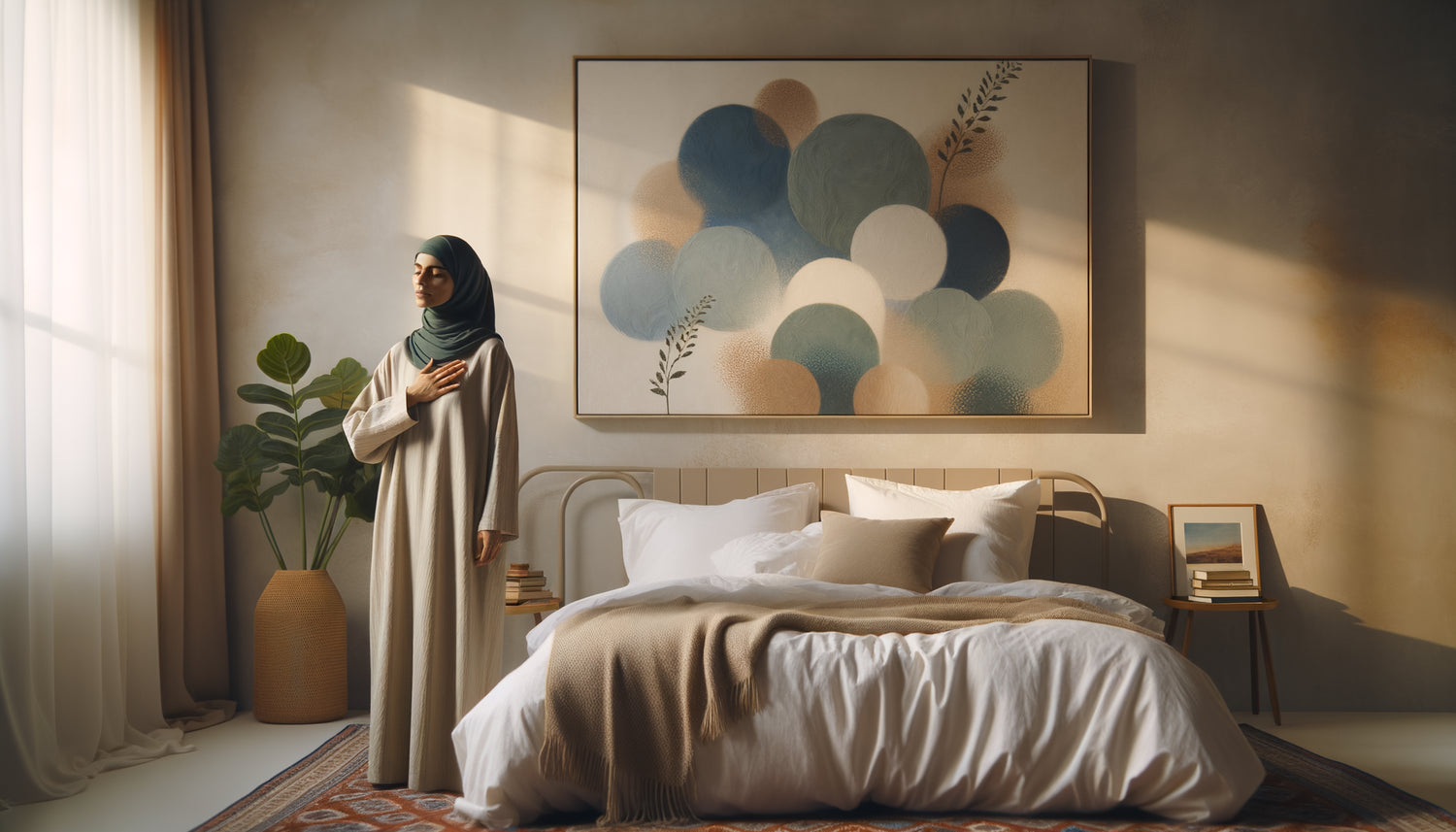
Think about the precise location of the artwork. Facing the bed, it will be your first and last vision of the day – its energy must be aligned with your bedtime and wake-up routines. On a side wall, it can be more daring, since you will contemplate it by choice rather than obligation.
The trap to avoid: accumulating works without a common thread. Three paintings with contradictory energies create a visual and emotional cacophony. It is better to have one perfectly aligned work than several that neutralize each other.
Ready to transform the energy of your bedroom into a personal sanctuary?
Discover our exclusive collection of bedroom wall art that have been selected for their ability to create soothing, inspiring and perfectly balanced atmospheres.
Your bedroom becomes a reflection of your inner world
You understand: evaluating the energy of an artwork for your bedroom is not an exact science with rigid rules. It's a dialogue between your sensitivity, your deep needs and the silent language of colors, shapes and subjects.
The next time you consider a work of art, close your eyes after observing it for a few minutes. What sensation lingers? Peace? Excitement? Melancholy? Inspiration? This emotional imprint is your answer.
Your bedroom deserves better than default choices or aesthetic compromises. It can become that place where every element, including the art on your walls, quietly works to enhance your balance. Start with a single piece – one that resonates deeply within you. The rest will follow naturally.
Trust your feelings. Your body and intuition know what energy you need to invite into your most intimate space.
Frequently Asked Questions
Can you really put bright colors in a bedroom or should you stick to neutral tones?
Absolutely, you can incorporate bright colors if they align with your personal energy. The idea that bedrooms must be beige or white is a decorative myth. What matters is the effect those colors have on you specifically. Some people find a deep red enveloping and comforting, while others find it too stimulating. The key is to test your bodily reaction to colors: if a bright yellow makes you smile and fills you with morning optimism, it has its place in your bedroom. The important thing isn't to follow decorative rules, but to create a cocoon that reflects who you are. Perhaps start with a medium-sized piece to assess how the color transforms the atmosphere before committing to large surfaces.
How do I know if an abstract work without a defined subject corresponds to the energy of my bedroom?
With abstract art, your compass becomes even more instinctive since there's no obvious narrative to decode. Focus on three elements: the movement suggested by the shapes, the emotional temperature of the colors, and the sense of space that the artwork creates. An abstraction with soft, flowing lines generates a soothing, almost meditative movement. Sharp geometric forms create mental order. Chaotic compositions can be stimulating or anxiety-inducing depending on your sensitivity. Ask yourself this question: if this work were music, what would its rhythm and atmosphere be? Smooth jazz or energetic rock? Your answer reveals whether the energy corresponds to what you're looking for in your relaxation space. The advantage of abstract art is that it allows your imagination to project what you need, creating a very personal relationship with the artwork.
Should I change artworks regularly or keep the same one for years?
Your relationship with a work of art evolves naturally with you. Some people need regular renewal to feel that their space remains alive and aligned with their personal transformations. Others develop a deep and lasting connection with a work that becomes a reassuring emotional landmark. There is no universal good frequency. However, I recommend consciously assessing your feelings every six months or so. Ask yourself this simple question: Does this work still nourish me, or have I become indifferent to its presence? If it has become invisible, it may be a sign that it has completed its energetic work for you. On the contrary, if it continues to move you, soothe you, or inspire you, it remains in place. Your bedroom can evolve with your seasons of life – and it is perfectly healthy to allow it. The important thing is that each piece on display actively serves your well-being, rather than passively decorating.