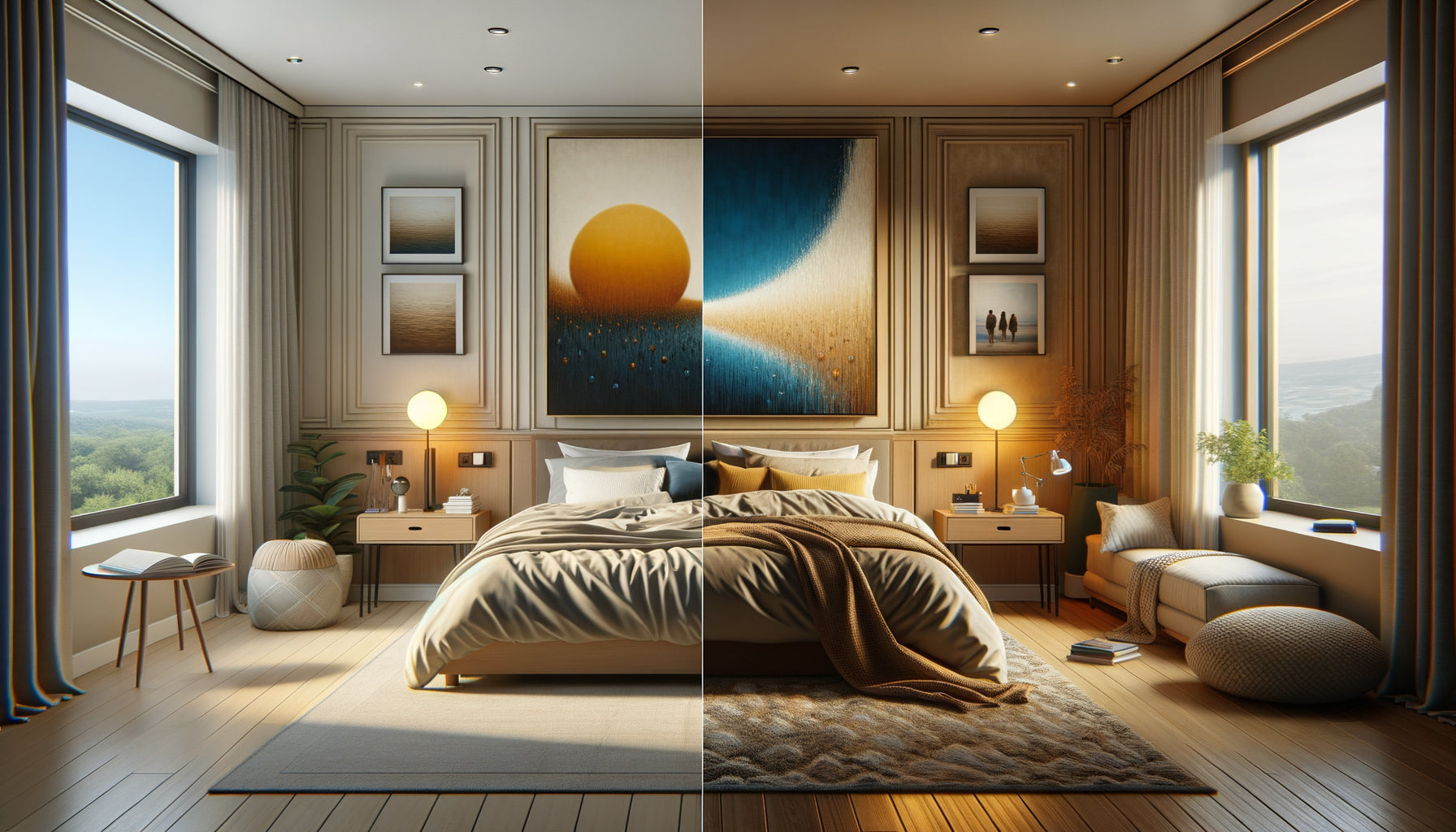
I've moved seven times in ten years. Paris, Berlin, London, then back to Lyon. Each time, the same questions haunted me: what to keep, what to leave behind, how to recreate that feeling of home in a new space? My first mistakes were costly. Furniture sold at a loss, works of art left with friends, decorations that no longer matched my new living room. Until the day I understood the essential: beauty is not the enemy of mobility. It simply requires a different approach to decoration. Here's what a selection adapted to frequent moves brings: the freedom to move without sacrificing your style, substantial savings at each transition, and a home that looks like you, wherever you are. You might think that investing in decor is risky when you change environments often. That creating a harmonious interior requires permanence. I completely understand. But let me show you how to turn this constraint into a creative advantage. In this article, you will discover the principles that allowed me to create beautiful interiors, even knowing that I would move in two years.
The philosophy of the permanent core
During my fourth move, a revelation struck me. Rather than starting from scratch each time, I identified my key pieces: those that define my style, that adapt to different spaces, that transcend trends. This approach of a permanent core has transformed my way of investing in decoration. My abstract triptych with neutral tones? It shone in an industrial loft as much as in a Haussmannian apartment. My modular lighting fixtures? They adjust to ceilings of 2.40 m as well as ceiling heights of 4 meters.
The secret lies in visual versatility. Choose works and objects that dialogue with different architectural styles. Timeless creations, neutral palettes enriched with touches of color, medium formats that do not depend on a specific wall. This core represents 60% of your decoration and goes everywhere with you. The remaining 40%? Light, adaptable elements that you renew according to your new place of life.
Invest wisely in durability
In Berlin, I learned an expensive lesson. I had bought a huge oil painting on a rigid frame. Magnificent, imposing, perfect for my large living room. Three years later, the move required professional packaging costing 300 euros, and my new Parisian apartment simply couldn't accommodate it. Now, I prefer transportable formats: museum-quality rolled canvases, prints on lightweight aluminum, detachable frames. Mobility requires no compromise on quality, only on format.
Selection criteria for stylish nomads
Each decorative acquisition must now pass my five-question test. First question: does this piece fit into at least three different spatial configurations? A large horizontal painting can become vertical depending on the space. Modular works in diptychs or triptychs separate to dress several rooms if necessary.
Second question: will transport be simple and economical? I have developed a personal rule: if the object requires more than two people to move it or specialized packaging, it really must justify the emotional and financial investment. Framed textiles, contemporary prints on lightweight supports, photographs under thin plexiglass perfectly meet this criterion.
Third question: does this selection resist fleeting trends? Decorating trends evolve rapidly, but certain aesthetic principles remain. Timeless geometric compositions, black and white photography, minimalist abstractions cross decades. Your selection should reflect your deep personality, not the snapshot of an Instagram trend.
The balance between coherence and flexibility
Fourth question: can I create a visual family? Rather than a hodgepodge collection, develop an aesthetic signature. Works that share a palette, a style, an emotion. In my home, it's a dominant of deep blues and emerald greens, with golden accents. This coherence allows me to easily rearrange my selection in any space, instantly creating a recognizable atmosphere.
Fifth question: does this investment justify the constraints? Some pieces absolutely deserve the logistical complications. This antique Venetian mirror that belonged to my grandmother travels with me despite its fragility. But these exceptional acquisitions must remain minority within your overall selection.

When modularity becomes your best ally
In London, my 35 m² studio forced me to completely rethink my selection. The large compositions that I loved in Berlin stifled the space. That's where I discovered the power of modular sets. Three medium canvases create an impressive visual impact on a large wall, but disperse elegantly into a reduced space, one in the entrance, one above the bed, one in the office corner.
This flexibility radically transforms your relationship with decoration. You are no longer a prisoner of a single configuration. A rearrangement becomes a creative opportunity, not a constraint. I even started reorganizing my selection every six months in the same apartment, just to renew my perspective and environment.
Adaptable supports that change everything
Abandon the idea that wall art must be permanently fixed. Modular hanging systems revolutionize mobile decoration: discreet rails that allow you to move artworks without drilling new holes, wall shelves that become improvised galleries, elegant easels that transform any corner into an exhibition space. My current Lyon apartment only has twelve holes in the walls, while I display twenty-three works. This ease of installation also facilitates your departure when the time comes.
The strategy of decorative layers
Imagine your interior as a composition in three layers. The fundamental layer includes your permanent pieces, those that define your style and go with you everywhere. Invest generously here: quality, timelessness, versatility. This is your portable visual identity.
The adaptation layer reacts to the specificities of each place. In Berlin, I had added industrial elements that dialogued with the exposed metal beams. In Paris, classic touches responded to Haussmannian moldings. These additions represent 30% of your decoration budget and are partially renewed with each move. Prioritize local acquisitions, artists from your new city, finds in neighborhood flea markets.
The seasonal layer brings freshness and dynamism. Textiles, small framed prints, light decorative objects. This selection evolves over the months and desires, without ever representing a major investment. It is your creative playground, where you experiment without risk.
Anticipating transitions
Whenever I acquire a new piece, I mentally visualize its integration into three different spaces. My next apartment may be smaller, or brighter, or with colored walls. Will my selection always work? This mental gymnastics avoids impulsive purchases and gradually builds a truly resilient collection. Photograph your current walls, then simulate different configurations. This practice develops your decorative agility, that ability to constantly reimagine your possessions in new contexts.

The art of traveling light without sacrificing beauty
My personal record? Recreating a complete and harmonious interior in one day after an international relocation. Impossible? No, simply the result of a selection designed for mobility. My most precious works travel in professional transport tubes. My frames disassemble into three pieces. My wall textiles fold into a suitcase.
This lightness does not mean forced minimalism. My current apartment breathes visual richness, varied textures, sophisticated compositions. But each element has been chosen with the intention of being able to leave tomorrow if necessary. It's an incredible freedom, almost philosophical: to possess without being possessed.
Temporary storage solutions between two homes have also revolutionized my practice. Rather than selling at a loss during a move to a smaller space, I store my pieces in climate-controlled storage units, knowing that they will find their place in my next home. This strategy preserves the financial and emotional value of your selection.
Create an interior that reflects you, wherever you are
Discover our exclusive collection of wall art for bedroom that adapts to all your spaces, current and future. Works designed to travel with your life.
Documenting and planning your decorative evolution
A transformative habit: photographing each configuration of my interior. Not for social networks, but to build a personal visual memory. These archives show me how my tastes evolve, which pieces remain constant in my selection, which have disappeared naturally. They also help me anticipate my future needs.
Before each relocation, I create a decorative action plan. My fundamental pieces are listed as top priority. Adaptation elements are evaluated: some will leave, others will stay depending on my new context. This planning considerably reduces the stress of transitions and avoids impulsive decisions that I would later regret.
Cultivate mental flexibility
The biggest challenge of frequent moves isn't logistical; it's psychological. Accepting that your London living room will never look exactly like your Berlin apartment. Embracing this evolution as a richness, not a loss. Your selection then becomes the thread connecting your personal story, the visual constants that accompany you through your different lives.
This approach paradoxically allowed me to develop a more defined style. By identifying what remains when everything changes, I discovered my true decorative essence. The elements that survive seven moves truly reveal who you are.
Transforming constraint into a personal signature
Today, I no longer perceive my frequent moves as a limitation. It has become my creative signature. My friends instantly recognize my style, this ability to create a consistent atmosphere in any space. This ocean-toned triptych that has followed me everywhere? It now tells a decade of adventures. This lamp found in London dialogues beautifully with this Parisian mirror and these Berlin cushions.
Your selection becomes a nomadic collection, a personal museum that travels with you. Each new installation is an exhibition you commission, reinterpreting your works in a new spatial context. This perspective completely transforms the experience of moving.
Imagine yourself in six months, in a new space, unpacking your boxes. Your favorite pieces emerge one by one. In a few hours, this unknown place begins to look like you. The empty walls come alive with your colors, your shapes, your story. You haven't sacrificed your style to mobility; you've simply freed it from the constraints of immobility. It is this feeling of instant home that a selection truly adapted to frequent moves provides. A sensation I wish you will discover very soon, wherever life takes you.