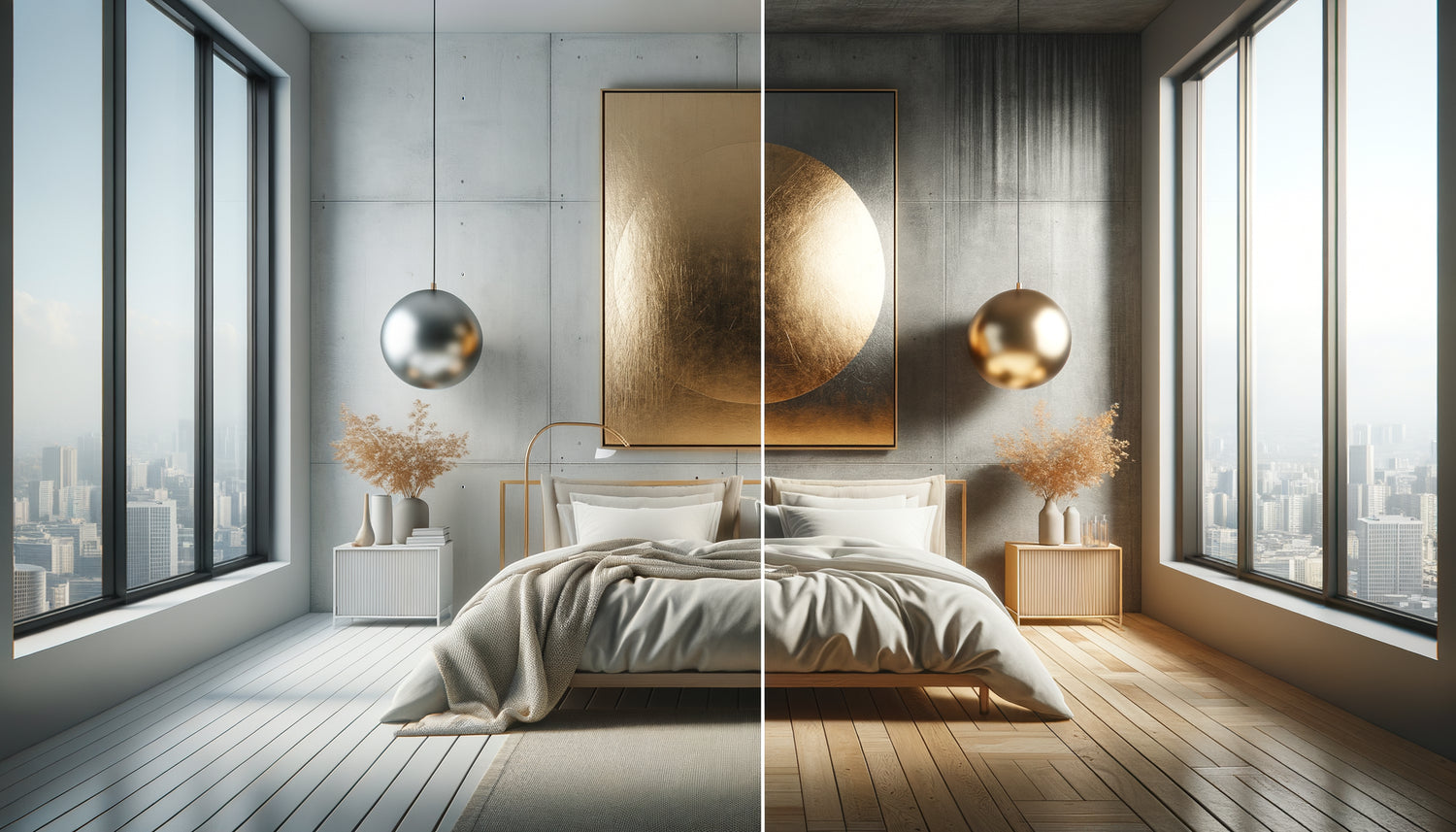
A few months ago, a client called me in an emergency. She had just hung a magnificent golden-toned painting above her bed, convinced of bringing that final touch to her minimalist bedroom. The result? She couldn't sleep. Not because of the noise, not because of the outside light, but because of this painting which, according to her words, « screamed in the silence of the room ». This anecdote perfectly illustrates the trap into which many decoration enthusiasts fall: underestimating the impact of metallic finishes in a space dedicated to rest.
Here's what golden or silver paintings can bring to a minimalist bedroom: an immediate visual break, constant light stimulation and a stylistic contradiction that transforms your sanctuary of rest into a decorative tension space. Far from being a simple aesthetic detail, the choice of a metallic artwork in a minimalist bedroom is a real balancing act.
You may have felt this frustration: your bedroom was perfect, minimalist, soothing. Then you added that silver painting that caught your eye in store. And now, something feels off. The atmosphere isn't the same. Your gaze is constantly drawn to that bright spot, like a visual magnet that won't let you be.
Rest assured, you are not alone in this situation. Understanding why these metallic finishes disrupt the harmony of a minimalist bedroom is giving yourself the keys to make informed choices and create the restful space you truly dream of.
I will reveal the hidden mechanisms that explain this disturbance, based on years of observations and consultations with clients facing the same dilemma.
The light trap of metallic surfaces
Golden or silver paintings act like partial mirrors in your bedroom. Unlike matte surfaces which absorb light, these metallic finishes reflect it unpredictably. In a minimalist bedroom, where every element has been thought to create a cozy atmosphere, this light reflection becomes a major disruptive factor.
Imagine the scene: you are lying in bed, seeking relaxation. The light from a streetlight filters slightly through your curtains. On a wall painted in off-white or light gray, this light would be soft and diffused. But on your silver painting, it bounces back, creating flashes that capture your attention despite yourself. Your brain, programmed to detect movement and changes in light, remains alert.
I have measured this phenomenon in several bedrooms: a golden painting can increase the perception of brightness by up to 40% within a radius of two meters. In a minimalist bedroom, designed precisely to minimize stimulation, this effect completely contradicts the initial intention of the space.
When gold and silver scream in the visual silence
A minimalist bedroom rests on a fundamental principle: chromatic consistency. Neutral tones, natural textures, soft nuances create what is called a "visual silence." In this environment, gold or silver artworks act as dissonant notes in a minimalist symphony.
Gold and silver belong to the family of "warm artificial" and "bright cool" colors. They carry within them a defined decorative dimension, almost ceremonial. In baroque or art deco interiors, these finishes find their place because they dialogue with other opulent elements. But in a minimalist bedroom, where linen, raw wood, and sand tones dominate, they create a brutal stylistic break.
One of my clients had invested in magnificent washed beige linen bedding, solid oak bedside tables, and clay-painted walls. Everything breathed softness. She then hung a large silver abstract artwork. Instantly, this element took all the attention, eclipsing the discreet beauty of the whole. The painting was not ugly in itself; it was simply in the wrong context.
The contrast that fatigues the eye
Neuroscience teaches us that our brain processes matte and glossy surfaces differently. The former allow for visual rest, the latter require additional processing effort. In a minimalist bedroom, every element is designed to reduce cognitive load. Introducing a gold artwork is like asking your brain to constantly recalibrate visually.
I observed this phenomenon strikingly in a couple who complained of difficulty falling asleep. Their room was perfectly minimalist: white walls, light ash furniture, white bed linen. The only shiny element: a triptych with golden accents. By temporarily removing it, they noticed a significant improvement in their sleep quality in less than a week.
The psychological effect of precious metals in intimacy
Beyond the purely visual aspect, gold or silver artworks convey a strong symbolism. Gold evokes wealth, prestige, celebration. Silver suggests modernity, technology, urban refinement. These mental associations conflict with the primary function of a bedroom: to offer an intimate and soothing refuge.
In my consultations, I often use this analogy: imagine wearing a tuxedo or evening gown to sleep. Uncomfortable, right? That's exactly how many people subconsciously feel about these metallic finishes in their relaxation space. Gold and silver carry an "outgoing" energy, whereas a subdued bedroom calls for an "intropective" energy, turned inward.
An interior architect I collaborate with regularly puts it another way: "In a subdued bedroom, every element should whisper. Gold and silver, on the other hand, speak loudly." This sound metaphor perfectly illustrates the energetic disconnect created by these artworks.
Invisible Sensory Overload
We live in a world saturated with stimulation: screens, notifications, urban noises. The subdued bedroom represents a necessary counterpoint to this sensory aggression. Metallic finishes, with their changing reflections depending on the time and light, add an extra layer of stimulation, albeit subtle, but undeniably present.
I've noticed that people most sensitive to gold or silver artworks are often those who work in visually charged environments: open-plan offices, stores, dense urban settings. Their need for visual rest is more acute, and the disruption caused by these shiny elements quickly becomes unbearable.
When Material Betrays Decorative Intent
Subdued decor relies on valuing authentic materials and natural textures. Wood, linen, wool, ceramics, Japanese paper: these materials share a common quality, the ability to age gracefully, to develop a patina that enriches their beauty.
Gold or silver finishes, on the other hand, retain their artificial sheen. They do not soften with time, nor do they develop character. In a subdued bedroom where material authenticity is paramount, this constant brightness creates a sense of artificiality that contradicts the spirit of the place.
I accompanied a client passionate about Japanese minimalism. She had created a beautiful bedroom: tatami mats, futon, rice paper screens, discreet ikebana arrangement. She then brought back from a trip an artwork with silver inclusions representing the moon. Despite the poetic theme, the metallic silver clashed completely with the wabi-sabi aesthetic of the whole ensemble. We replaced it with a print on traditional paper, and harmony was immediately restored.

Alternatives to maintain balance
Fortunately, giving up golden or silver artworks doesn't mean giving up on wall decor altogether. Many options allow you to enrich a minimal bedroom without disrupting its harmony.
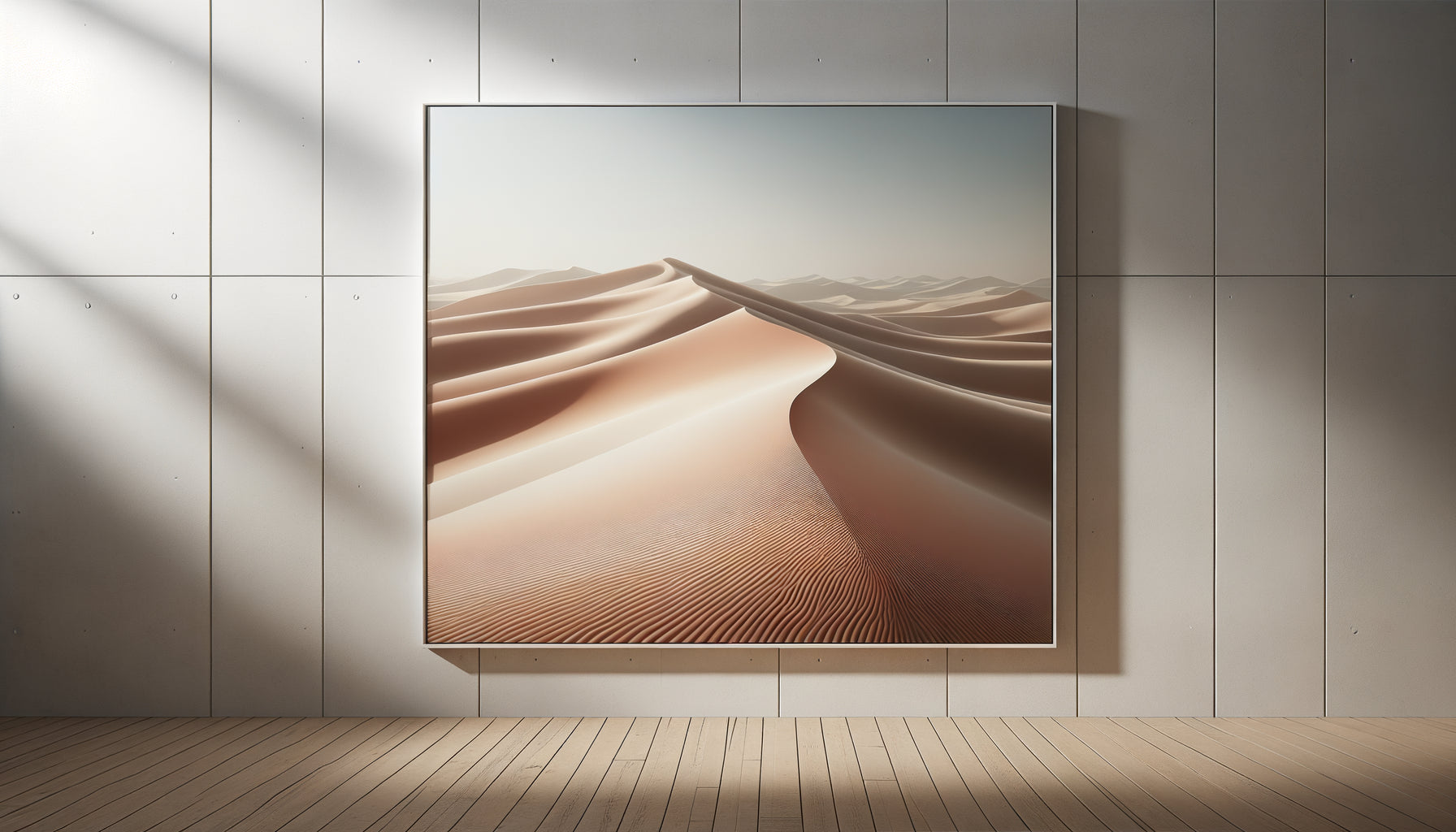
Earthy-toned works – ochre, sienna earth, stone gray – naturally integrate into a minimalist universe. Techniques such as watercolor, charcoal or engraving offer matte finishes that respect visual silence. Black and white photographs, botanical prints, woven wall hangings made of natural fibers are excellent alternatives.
For those who absolutely want a touch of brightness, I recommend works playing on shades of white, subtle reliefs or light wood frames. These solutions add depth without creating a visual break.
The revisited 80/20 rule
If you absolutely want to integrate a golden or silver element, apply the following rule: 80% minimalism, 20% accent maximum. And still, this accent should be small in size and placed strategically, away from the direct line of sight from the bed. A small 15x15 cm silver frame on a side shelf will have a different impact than a large golden artwork of 80x100 cm above the headboard.
Position makes all the difference. Peripheral areas of the bedroom better tolerate these shiny elements than the main walls. I've seen successful compromises where a small silver artwork found its place on an adjacent wall, creating a point of interest without dominating the space.
Do you dream of a bedroom that finally breathes serenity? If you have already installed a golden or silver artwork in your minimal bedroom and feel this disruption, several solutions are available to you. The most radical: remove it and find a place for it in a more suitable space – an eclectic living room, a sophisticated entrance or a contemporary office. If you're attached to the artwork, consider changing its frame. A raw wood frame or painted in a neutral tone can significantly reduce the impact of metallic finishes. Some framers even offer solutions with slightly tinted under glass that soften reflections. Another option is to rethink the room's lighting. A silver artwork is more disruptive under direct lighting. By favoring indirect light sources, dimmable lamps or candles, you reduce problematic reflections. Finally, some of my clients have chosen to gradually transform their bedroom to better accommodate the metallic work. This generally involves abandoning a subdued aesthetic in favor of a more maximalist or eclectic style. This is a legitimate choice, provided you are aware of the compromise on the initial soothing atmosphere. After years of observation and support, one conviction has been reinforced: the understated bedroom is not a fleeting trend, but a deep response to a contemporary need. In a world of hyperstimulation, we need spaces that allow us to let our guard down, reduce alert levels. Gold or silver artworks are not inherently problematic. In the right contexts – an art deco living room, a festive dining room, an inspiring office – they shine with all their brilliance. But in an understated bedroom, they represent a fundamental contradiction between the energy they carry and the function of the space. Respecting this consistency is not a matter of aesthetic dogmatism, but of listening to your deep needs. If you sleep poorly, if your gaze is constantly drawn to that bright spot, if you feel an inexplicable tension in your bedroom, these signals deserve to be heard. The beauty of an understated bedroom lies in its ability to fade away to put you, yourself, at the center. Every element should serve your well-being, not the other way around. An artwork that attracts too much attention becomes a competitor to your rest, and in this competition, it is always your sleep that loses. Now imagine yourself in your redesigned bedroom. The walls breathe softness, natural materials envelop you, the mural work – chosen with care – dialogues harmoniously with the whole. Your gaze can finally settle without snagging, your mind relax without parasitic stimulation. You have created this visual sanctuary you needed, this space where every detail whispers the same promise: here, you can truly rest. Start by observing your bedroom with a fresh eye. Identify elements that capture too much of your attention. And give yourself permission to readjust, even if it means recognizing that a purchase was not suitable. Your well-being deserves this honesty. Absolutely, and the effect is often disproportionately more significant with smaller formats than one might imagine. In a minimal bedroom, our brains are conditioned to perceive a homogeneous and soothing environment. A small gold artwork of 20x20 cm, even discreet, creates what is called a “visual hot spot” – an element that attracts disproportionately attention by its contrast. It's like a drop of ink in a glass of clear water: even tiny, it’s immediately visible. Size isn't the only determining factor; it's mainly the chromatic and luminous contrast that counts. I have seen entire bedrooms unbalanced by a single small silver frame placed unfortunately. If you want to keep a small metallic element, position it in a peripheral area, never facing the bed, and surround it with other decorative objects to dilute its visual impact. Yes, but with important nuances. Not all metallic finishes are equal. Bright gold and polished silver are the most problematic because they intensely reflect light. On the other hand, some alternatives can work in a minimal bedroom: aged or patinated gold, which has lost its aggressive shine; brushed brass, more matte and warm; antique bronze, with its greenish tones; or even very thin Japanese gold leaf that creates a subtle effect rather than a frank glare. These “soft metallic” finishes integrate better because they do not create direct reflections. The key is to prioritize textures that partially absorb light rather than reflect it entirely. Before buying, observe the artwork under different lighting conditions. If it “flashes” or immediately attracts your eye from more than two meters away, it will probably be too dominant for your minimal space. If it subtly reveals its metallic nuances up close, it is more likely to harmonize. This question is legitimate and the answer is twofold: even if it's "psychological," the impact is real. Our visual environment directly influences our nervous system and our ability to relax. To objectively assess the effect of your gold or silver artwork, I suggest this simple test: remove it for two full weeks (do not replace it, leave the wall bare). Note your sleep quality, how easily you fall asleep, and your general feeling in the room. Then reinstall it and observe again for two weeks. If you notice a difference, even slight, then the element does have an impact. Another indicator: does your gaze consistently settle on this artwork when you enter the room or when you are lying down? If so, it captures too much attention. In an ideal understated bedroom, no element should visually dominate. Your gaze should be able to move freely without being "caught" by a particular point. Trust your feelings: if something bothers you, even unconsciously, your body is sending you a signal that you should listen to.
Discover our exclusive collection of wall art for bedroomRestoring harmony after the mistake
The understated bedroom as a visual sanctuary
FAQ : Your questions about metal artworks in the bedroom
Can a small gold artwork really disrupt an entire understated bedroom?
Are there gold or silver finishes compatible with a minimal bedroom?
How do I know if my metallic artwork is really disrupting my sleep or if it’s psychological?