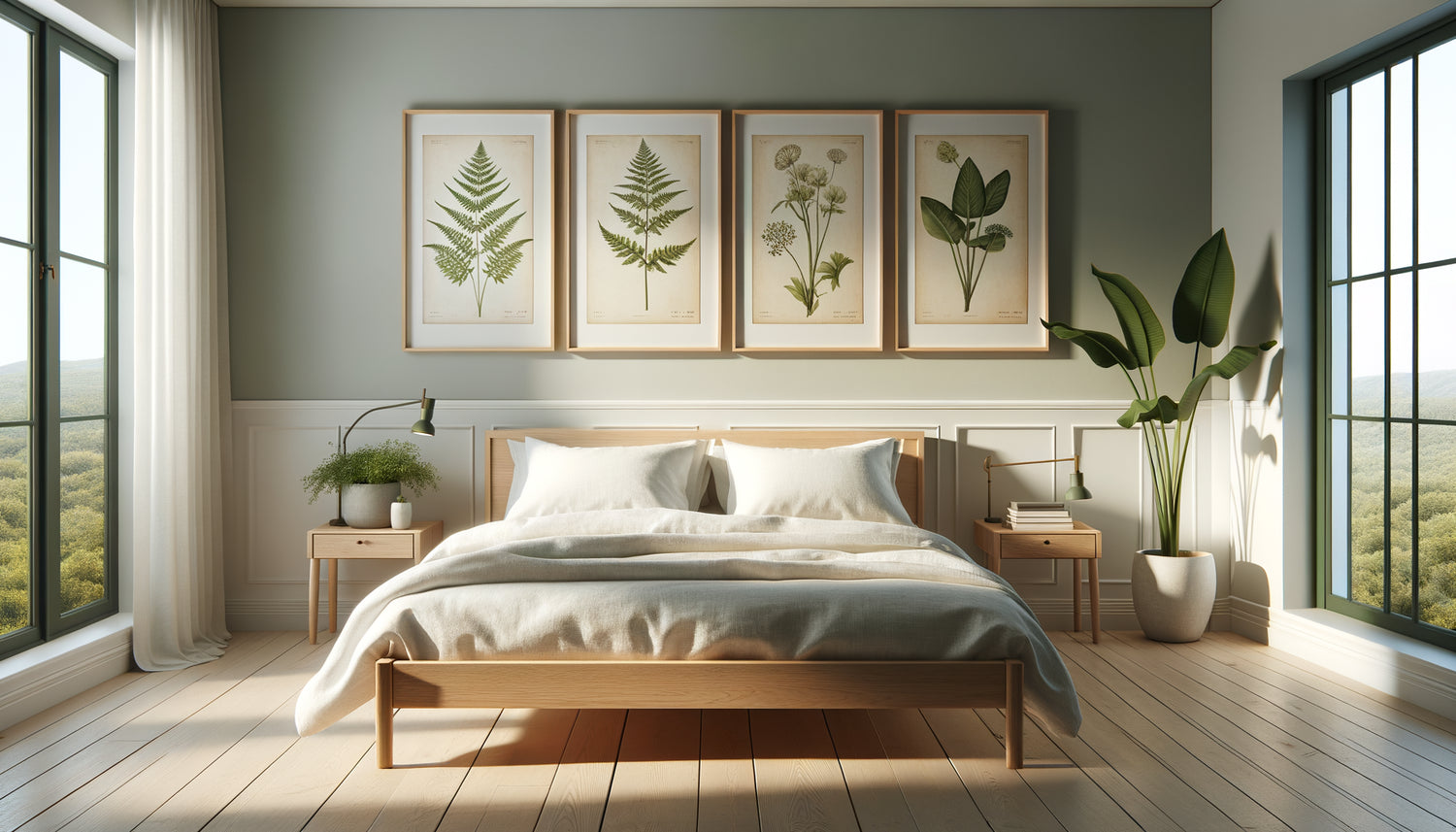
This morning, while delivering a floral arrangement to a client, I noticed three framed botanical prints above her bed. Delicate illustrations of ferns, monstera leaves, and eucalyptus, in soothing green tones. She confided that she slept better since hanging them. This observation keeps coming back: botanical wall art transforms bedrooms into true havens of peace. Here's what these illustrations bring: a direct connection with nature even in the heart of the city, a timeless aesthetic that transcends trends, and an atmosphere conducive to rest and regeneration. Many hesitate to decorate their bedrooms, fearing they will overload the space or create a too stimulating ambiance. Rest assured: botanical art has this rare quality of soothing without boring, decorating without invading. I'm going to reveal why these vegetal works conquer contemporary bedrooms and how they respond to our deep needs for serenity.
A return to nature in a hyperconnected world
We spend an average of seven hours a day in front of screens. Our eyes get tired, our minds overheat, and our nervous system remains permanently on alert. The contemporary bedroom then becomes that sanctuary where we seek to disconnect and regain a natural rhythm. Botanical wall art precisely responds to this visceral need for nature.
Unlike living plants which require maintenance and natural light, these illustrations offer a constant vegetal presence. They capture the very essence of the plant world: its organic shapes, subtle nuances, harmonious growth. In my shop, I see urban dwellers looking for this reconnection. They seek palm leaves, olive branches, meticulously drawn herbariums.
This trend is part of a broader movement: biophilic design, an approach that integrates nature into our interiors. Studies show that the simple view of natural elements reduces cortisol, the stress hormone. A botanical print in a bedroom acts like a window open onto an imaginary garden, accessible even on the tenth floor of a building without a balcony.
The timeless elegance of herbarium prints
Botanical illustrations have a fascinating history. Born in the 18th century to catalog plant species, these scientific prints combined documentary precision and graphic beauty. Botanists drew each vein, each petal with the meticulousness of a goldsmith. Today, this aesthetic crosses centuries without aging.
In contemporary bedrooms, these works bring a discreet sophistication. Their clean style integrates as well into a minimalist Scandinavian interior as into a loft industrial or a bedroom with vintage accents. The generally neutral background — off-white, beige, aged paper — makes the subject stand out without assaulting the eye.
I’ve noticed that my clients particularly appreciate triptych compositions: three botanical paintings aligned create a soothing visual rhythm. A sequence of three different leaves, or the stages of flowering of the same plant, tell a silent story that gently guides you towards sleep.
Hues that speak to the brain
Green naturally dominates the botanical universe. This color has scientifically proven calming properties: it is located at the center of the light spectrum, requiring little adaptation effort for our retina. In a bedroom, botanical paintings with green tones physiologically prepare you for rest.
But variations also count. Sage and eucalyptus greens evoke Mediterranean softness. Deep fern greens create a cocooning atmosphere. Lighter shades, almost aniseed, subtly energize without exciting. This natural palette harmonizes with bedding textiles, light or dark woods, white or colored walls.

When decoration becomes visual therapy
One of my clients, a chronic insomniac, told me that she had consulted a sleep specialist. The first advice received was to remove all stimulating elements from the bedroom. Exit bright colors, aggressive geometric patterns, and abstract works that are too dynamic. She replaced her old posters with soothing botanical paintings. Six months later, she fell asleep more easily.
This anecdote illustrates a reality: our visual environment directly influences the quality of our rest. The organic and curved shapes of the plant world activate brain areas associated with relaxation. Conversely, sharp angles and strong contrasts keep our alert system on high alert.
Plant illustrations also offer a gentle point of focus for moments of insomnia. Rather than staring at the ceiling anxiously, observing the details of a leaf, following a slender stem with your eyes, soothes the mind. It is a form of visual meditation accessible to all.
Visual pure air
In my shop, I like to talk about visual pure air. Just as we ventilate our bedrooms to renew oxygen, botanical paintings aerate our perception of space. They create a visual breathing, a feeling of spaciousness even in small urban bedrooms.
A large format depicting a palm tree or olive branch brings verticality, creating the illusion of higher ceilings. Several small formats arranged in a gallery wall create depth, an open window onto a secret garden. This sense of space directly contributes to sleep quality.
Chameleon adaptability to decorative styles
The beauty of botanical paintings lies in their incredible versatility. In a Scandinavian-style bedroom, they reinforce the natural and refined aesthetic. Paired with light wood frames and linen textiles, they perfectly complement the hygge atmosphere.
For a bohemian interior, illustrations of exotic plants—banana trees, monstera, birds of paradise—evoke travel and escape. Framed in gold or rattan frames, they harmonize with macramé and ethnic textiles.
Even in a contemporary bedroom with very clean, almost minimalist lines, a large black and white botanical painting provides the necessary focal point without breaking the sobriety. The line drawing, almost architectural in its precision, dialogues with modern design.
I have also observed their success in industrial-style bedrooms. Against a brick or bare concrete wall, the delicacy of a botanical print creates a striking contrast. This juxtaposition of vegetation and minerals, delicate and raw, generates a fascinating aesthetic tension.

The evolving collection that tells your story
Unlike wallpaper or wall color, botanical paintings allow for an evolving decoration. You start with one piece, then add another that complements it. This progression creates a personal narrative.
Some of my clients collect plants from their region of origin: lavender from Provence, Breton oak, alpine edelweiss. Others create imaginary herbariums of their travels: Greek olive tree, Japanese cherry tree, Mexican cactus. Each painting becomes a memory, a marker of a stage.
This approach transforms decoration into an exercise in affective memory. Your contemporary bedroom is unlike any other. It tells your story through these carefully chosen botanical fragments. And unlike vacation photos that may seem too personal in a bedroom, plant illustrations remain sufficiently universal not to tire.
Plant Transmission
I've noticed that botanical prints often pass down through generations. A grandmother bequeaths her pressed flower boards to her granddaughter who incorporates them into her contemporary bedroom. These works possess the rare quality of being simultaneously old and modern, classic and current.
This heritage dimension adds emotional depth to your decor. You're not simply buying a decorative object, but a piece that can accompany your life, move with you, adapt to your changing styles, and perhaps one day decorate your children’s room.
Ready to transform your bedroom into a plant oasis?
Discover our exclusive collection of bedroom wall art that combines botanical beauty and contemporary serenity.
Composing Your Plant Symphony
The arrangement of botanical prints in a bedroom follows some simple but effective principles. Above the bed, prioritize symmetry: a large format centered or two medium formats on either side create a reassuring balance. This layout visually frames the headboard and structures the space.
On a side wall, dare to create an asymmetrical composition: several varied sizes arranged in a constellation create movement without agitation. The eye wanders from one illustration to another, creating a gentle dynamic.
Height also matters. Position your prints so that their center is at eye level when you are standing. Too high, they seem to float unstably. Too low, they visually weigh down the space. This simple rule radically transforms the impact of your decor.
Don't forget lighting. A discreet spotlight directed towards your botanical print turns it into a nocturnal artwork. In the bedroom’s dimness, these illuminated leaves become almost magical, creating an atmosphere conducive to dreaming before sleep.
Conclusion: Cultivating Serenity Through Image
Botanical prints are not simply a fleeting decorative trend. They respond to a deep need of our time: reconnecting with life, slowing down our frenetic pace, creating spaces for regeneration. In the contemporary bedroom, they play the role of guardians of rest, windows open onto interior gardens.
Their success lies in their unique ability to combine timeless aesthetics, psychological benefits and decorative adaptability. Whether you live in an urban studio or a spacious house, whether your style leans towards minimalism or eclecticism, a botanical illustration will naturally find its place.
Start simply: choose a plant that speaks to you, a leaf whose shape soothes you, a flower that evokes a happy memory. Hang it facing your bed. Observe it for a few evenings. You will then understand why so many contemporary bedrooms now welcome these fragments of drawn nature. They silently cultivate that precious thing we all seek: serenity.
FAQ: Your questions about botanical prints
What size of botanical print to choose for a small bedroom?
In a small bedroom, prioritize one large format over several small ones. This may seem counterintuitive, but a 70x100 cm botanical print creates more depth and amplitude than an accumulation of small formats that visually fragment the space. Choose an airy illustration, with plenty of light background, to maximize the feeling of breathability. A large monstera leaf or a sprig of eucalyptus on a light white background will visually enlarge your space while bringing this soothing vegetal touch. If you really prefer several paintings, limit yourself to a diptych aligned horizontally which will create an elegant visual line without overloading.
Are botanical prints suitable for a child's bedroom?
Absolutely, and it’s even an excellent idea for several reasons. Botanical illustrations introduce nature into the child's world in an educational and soothing way. Unlike cartoon characters that quickly become outdated, a painting representing a tree, a flower or leaves transcends childhood ages without requiring changes. For younger children, prioritize colorful and simple illustrations: an apple with its flower, a sunflower, a mushroom. For pre-teens, more sophisticated black and white botanical prints mark a transition to a more mature universe. This decorative continuity accompanies their growth while maintaining an atmosphere conducive to sleep and concentration.
How to combine botanical prints and living plants in a bedroom?
Combining botanical paintings and living plants creates a magnificent continuity between art and nature, but requires some thought. Avoid direct redundancy: if you have a real monstera on your dresser, choose a painting depicting another species to enrich your indoor garden rather than duplicating it. Create a dialogue instead: illustrations of exotic plants that are difficult to grow (rare orchids, carnivorous plants) complemented by easy-care houseplants (pothos, sansevieria) offer the best of both worlds. Position your living plants in bright locations and your botanical paintings in darker areas, creating a harmonious plant distribution throughout the room. This strategy ensures a constant natural presence, even where light is lacking to grow real plants.