I long believed that the glow-in-the-dark stars stuck to the ceiling of my first teenage bedroom were the most magical thing in the world. Until the day, years later, a chronobiologist asked me this unsettling question during an interview: “Do you know that your walls might be shining against your sleep?” This sentence transformed my perception of luminous paintings that adorn so many contemporary interiors today.
Here's what luminous and phosphorescent paintings really bring to your space: a captivating nocturnal atmosphere, reassuring visual security in the dark, and a unique contemporary aesthetic. But the real question remains: at what cost to your rest?
You fell for this magnificent LED painting with illuminated borders, or for this phosphorescent artwork that reveals secret patterns at night. Except that for a few weeks now, your sleep seems more fragile, your nocturnal awakenings more frequent. You wonder if these nocturnal lights, however poetic they may be, are subtly disrupting your body.
Rest assured: understanding the real impact of luminous paintings on your circadian rhythm doesn't require a degree in neuroscience. And above all, solutions exist to reconcile luminous aesthetics and restorative sleep. I am going to share with you what eight years of observing sleep environments have taught me about this fascinating tension between decoration and biology.
Night light: this silent conversation with your brain
Your brain has an ancestral relationship with light. For millennia, it has associated darkness with rest and brightness with wakefulness. This biological programming works thanks to melatonin, the sleep hormone secreted by your pineal gland as soon as brightness decreases.
Luminous paintings, whether LED or phosphorescent, emit luminous signals during the night. Even weak, these sources can be perceived by ganglion cells in your retina, specially designed to detect light and transmit this information to your internal biological clock.
The crucial nuance lies in light intensity and color spectrum. A phosphorescent painting that glows softly with a green hue at 2 lux will not have the same impact as an LED white-blue painting at 50 lux. The difference? It is measured in deep sleep quality, number of micro-awakenings, morning fatigue sensation.
Blue light: the invisible enemy of your nights
Not all luminous paintings are equal when it comes to your circadian rhythm. Blue light, which dominates screens and some cold white LEDs, has a wavelength particularly effective in suppressing melatonin production. As little as 30 minutes of exposure can delay your sleep onset by nearly an hour.
Classic phosphorescent phosphorescent paintings, which typically glow in shades of green or yellow-green, have a less disruptive spectrum. Their luminescence, resulting from a phosphorescence chemical reaction, gradually decreases after the ambient light is extinguished, creating a smooth transition to darkness.
Lighted paintings: understanding the impact according to technology
I've observed three main categories of lighted paintings in contemporary bedrooms, each with its own profile of impact on sleep.
Electric LED paintings offer constant and controllable brightness. Their main advantage? You can turn them off completely or use a dimmer. Their disadvantage: many emit blue-white light, particularly disruptive to the circadian rhythm. If you opt for this technology, be sure to choose models with warm color temperature (below 3000K) and a programmed shutoff function.
Passive phosphorescent paintings accumulate light during the day to gradually release it at night. Their decreasing glow has a biological advantage: it somewhat mimics sunset, this prolonged twilight that naturally signals your brain about approaching sleep. Problem: you don't control their initial intensity, which depends on daylight exposure.
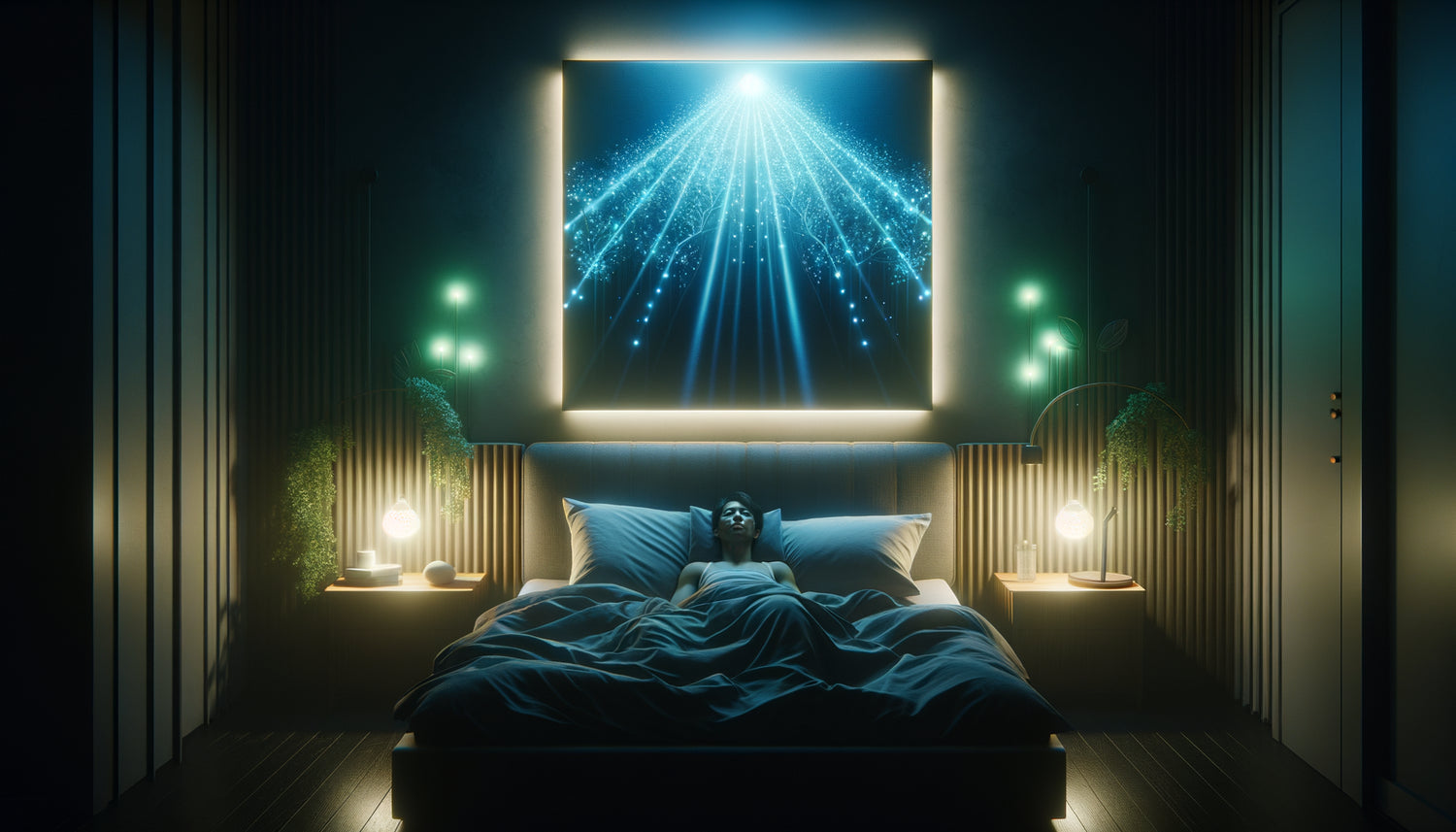
Indirectly backlit artworks project light onto the wall rather than directly into the room. This configuration significantly reduces direct eye exposure, limiting the impact on your retina and melatonin production. It is often the best compromise between aesthetic lighting and respect for sleep.

The signals your body sends you
Your organism communicates with remarkable precision when a lighted painting disrupts your circadian rhythm. Learn to recognize these messages.
An extended sleep latency is the first indicator. If you toss and turn for more than 20 minutes after going to bed, while your room is otherwise conducive to sleep, this constant glow in your peripheral vision could inhibit your natural melatonin rise.
Frequent nighttime awakenings between 2 am and 4 am, especially if you open your eyes towards the light source, often signal a disruption of deep sleep. Your brain, detecting this luminous anomaly, interrupts its natural recovery cycles.
Persistent morning fatigue, despite theoretically sufficient sleep duration, often reveals degraded sleep quality. You slept eight hours, but your body did not experience the restorative deep sleep phases it needed.
The 5 lux rule: your alertness threshold
Modern chronobiology has established a consensus: below 5 lux, the impact on melatonin remains minimal for most individuals. Above that, effects begin to manifest, proportionally to intensity and duration of exposure.
To put it in context: a candle produces about 12 lux at one meter, a quality phosphorescent painting oscillates between 2 and 8 lux depending on its charging, while an LED painting can easily exceed 50 lux. This scale helps you objectively assess the disruptive potential of your luminous decor.
Reconciling luminous aesthetics and restorative sleep: strategies that work
The good news? You don't have to choose between nocturnal beauty and quality rest. Smart adjustments allow you to retain the poetic soul of luminous paintings while protecting your circadian rhythm.
The progressive timer technique radically transforms the experience. Program your LED painting to automatically turn off 30 minutes after your usual bedtime. You enjoy its soothing ambiance during your evening ritual, then your brain switches to deep sleep mode in complete darkness. This transition mimics the natural sunset that our biology expects.
Strategic orientation changes everything. A luminous painting placed behind you, out of your direct field of vision when lying down, reduces its impact by 60 to 70% according to ergonomics studies on sleep. Your ganglion cells primarily detect frontal light; a lateral or posterior source influences melatonin production much less.
The amber filter represents an elegant solution for LED paintings. By adding an amber film or panel in front of the light source, you eliminate blue wavelengths while retaining a warm glow. This technique, borrowed from darkroom photographers, preserves aesthetics while neutralizing circadian impact.
The nighttime gradient rule
Here's a principle I consistently apply: create a decreasing light gradient in your sleeping space. Two hours before bedtime, prioritize warm lighting at medium intensity. One hour before, reduce to soft and indirect sources. At bedtime, keep only your illuminated artwork in minimal mode. Thirty minutes after, complete darkness.
This luminous choreography naturally guides your brain towards sleep, rather than abruptly jolting it with a light-dark transition or, worse, constant exposure to light throughout the night.

Illuminated artworks suitable for bedrooms: selection criteria
If you're considering incorporating an illuminated artwork into your relaxation space, certain technical criteria deserve your attention before any aesthetic choice.
Absolutely prioritize models with dimmer switch. This function allows you to adapt the brightness to your personal sensitivity and the evolution of the evening. Some people tolerate 10 lux perfectly all night long, others require less than 3 lux.
Check the color temperature: demand 2700K or less for an LED artwork. This ultra-warm light, close to candlelight, minimizes impact on your melatonin. Avoid mentions of “neutral white” (4000K) or “cool white” (6000K) for nighttime use.
For phosphorescent artworks, find out about the type of pigment used. Strontium-aluminate phosphors offer durable but gentle luminescence, ideal for a bedroom. Zinc-sulfide pigments, more intense but shorter-lived, are better suited to passageways.
Do you dream of a bedroom that inspires calm without disrupting your sleep?
Discover our exclusive collection of bedroom artworks that balance visual beauty and respect for your natural circadian rhythm.
When illuminated artwork becomes an ally of sleep
Paradoxically, some illuminated artworks can even improve your relationship with sleep, provided you follow a few key principles.
People suffering from nyctophobia or nocturnal anxiety find in low-intensity phosphorescent paintings a reassuring compromise. This minimal glow soothes the anguish of total darkness without reaching the threshold that disrupts melatonin. The brain perceives a safe environment, which facilitates falling asleep.
Lighted paintings also create excellent anchoring rituals. Turning on a warm LED painting, systematically associated with your evening routine, becomes a Pavlovian signal for your brain: "It's time to slow down." This daily repetition reinforces your sleep hygiene.
For children, a well-chosen phosphorescent painting advantageously replaces traditional electric nightlights, often too intense and in unsuitable spectra. The soft, decreasing luminescence naturally accompanies the child towards sleep, without keeping their brain alert all night.
Beyond sleep: the unexpected benefits of controlled light
Protecting your circadian rhythm with suitable lighted paintings produces a cascade effect on your overall quality of life.
Preserved sleep improves your emotional regulation. People who sleep in complete darkness or with minimal light sources (<5 lux) report better stress management and more stable mood. Melatonin, beyond its role in sleep, has natural anxiolytic properties.
Your metabolism also benefits from a respected circadian rhythm. Studies show that excessive nocturnal light exposure disrupts blood sugar regulation and increases cravings. By choosing non-disruptive lighted paintings, you indirectly protect your metabolic balance.
The quality of your awakenings radically transforms. Deep sleep not interrupted by micro-light alerts allows you to emerge naturally at the end of a cycle, rather than in the middle of paradoxical sleep. Result: that feeling of morning freshness, even after only seven hours.
I have observed these transformations in so many people who simply adjusted their nocturnal lighting environment. A Parisian businessman resolved his chronic insomnia by replacing his white LED painting with an amber version with a timer. A Lyon-based architect regained her creative energy after orienting her phosphorescent painting out of her direct field of vision. These small adjustments, these attentions paid to biology as much as aesthetics, weave the difference between a space that fatigues you and a sanctuary that regenerates you.
The real question is therefore not "should lighted paintings be banned from bedrooms?", but rather "how can they be integrated intelligently?". The answer lies in this new awareness: every photon that strikes your retina at night dialogues with your biological clock. Make this dialogue a harmonious conversation, and your nights will become what they should always be: a restorative journey towards dawn, accompanied by beauty rather than hindered by it.
Questions you have about luminous paintings and sleep
My phosphorescent painting purchased six months ago shines too brightly for my bedroom?
Phosphorescence naturally decreases over time and charging cycles. If your painting is six months old, its light intensity has likely already decreased by 20 to 30% compared to its initial state. To assess whether it disrupts your sleep, perform this simple test: lie down in your bed, lights off, and observe whether the phosphorescent glow involuntarily attracts your gaze. If your eyes are constantly drawn to the painting, its intensity probably exceeds your comfort threshold. Immediate solution: reduce its exposure to light during the day by partially closing your shutters or covering it for a few hours before bedtime. This will decrease its nocturnal light load without requiring replacement. If after three weeks of adjustment you sleep better, you were indeed exceeding your circadian tolerance level.
LED paintings with a “night mode” function are they really different from classic models?
Absolutely, and the difference is considerable for your circadian rhythm. LED paintings equipped with a true night mode integrate three protective features: a drastic reduction in light intensity (usually below 5 lux), automatic filtering of blue wavelengths in favor of an amber-red spectrum, and sometimes programmable gradual extinction. These functions transform a potentially disruptive device into a light source compatible with melatonin production. However, be careful: some manufacturers use the term “night mode” for a simple dimmer, without modification of the color spectrum. Check that the color temperature actually drops below 2700K in night mode, ideally towards 2200K. This information should appear in the technical specifications. A real night mode gives light a distinctly orange, almost reddish hue, never white or warm white.
I sleep very well with my luminous painting on all night, does that mean it doesn't bother me?
It’s a fascinating question that touches on the difference between quantitative and qualitative sleep. You can indeed sleep your eight hours and feel relatively rested, even with a constant light source. However, studies using polysomnography reveal that the sleep structure often changes: less time in deep sleep (stages 3 and 4), more transitions between cycles, micro-awakenings of which you have no conscious memory. These subtle disturbances do not prevent sleep, but reduce its restorative power over the long term. To check the real impact, try this experiment: for two weeks, turn off your light panel completely at night. Note your energy level in the late afternoon, your need for caffeine, and your ability to concentrate. If you notice an improvement, even slight, then your light panel was indeed impacting the deep quality of your sleep, despite your subjective impression of sleeping well. Our consciousness only perceives a fraction of nocturnal biological processes.