In the cozy living rooms of grand homes in the 19th century, a painting was never just a decoration. When a patron hung an Impressionist canvas in his reading room, or an enlightened bourgeois gave a Symbolist work to a friend, this gesture went far beyond the present moment. It was a public statement, a cultural stance, almost a silent manifesto on the wall.
This is what truly offering a painting from your artistic school brought: the affirmation of a shared worldview, integration into a circle of initiated culture, and the transmission of an assumed aesthetic heritage. This gift was never trivial – it sealed intellectual alliances and redrew the boundaries of taste.
Today, we offer paintings for pleasure, for taste, sometimes by chance. But we have lost that keen awareness that our ancestors possessed: each work carried within it the DNA of a movement, a philosophy, a silent revolution. Offering an Impressionist painting rather than an academic one in 1880 meant choosing your side in a cultural battle that tore Paris apart.
Rest assured: understanding these lost codes requires neither a doctorate in art history nor frequent attendance at auctions. It is enough to immerse yourself in the intimacy of these forgotten gestures, of those living rooms where art shaped the contours of a social identity. And you may discover that your own decorative choices, even unconscious ones, perpetuate this centuries-old tradition of affiliation through image.
When a painting became an ideological calling card
At the turn of the 20th century, the artistic school to which a work belonged functioned as a seal of identity. Giving a Barbizon painting to a friend revealed your attachment to naturalism, a certain rural nostalgia, and a rejection of rampant industrialization. It was not just a question of technique or colors – it was a philosophy of life condensed in pigments and canvas.
Collectors of the time were not mistaken. Possessing several works by the same artistic school affirmed intellectual coherence, an ability to defend an aesthetic vision over time. Aesthetic affiliation then became a social marker as powerful as a title of nobility or industrial wealth. In enlightened circles, you were judged as much on your paintings as on your conversation.
Take the example of the Nabis in the 1890s. Giving a lithograph by Bonnard or Vuillard meant that you belonged to this avant-garde that rejected dusty academicism. You were modern, daring, capable of recognizing genius before it became mainstream. The artistic school functioned as a coded language between initiates, a system of mutual recognition that transcended words.
The living rooms where alliances were sealed through painting
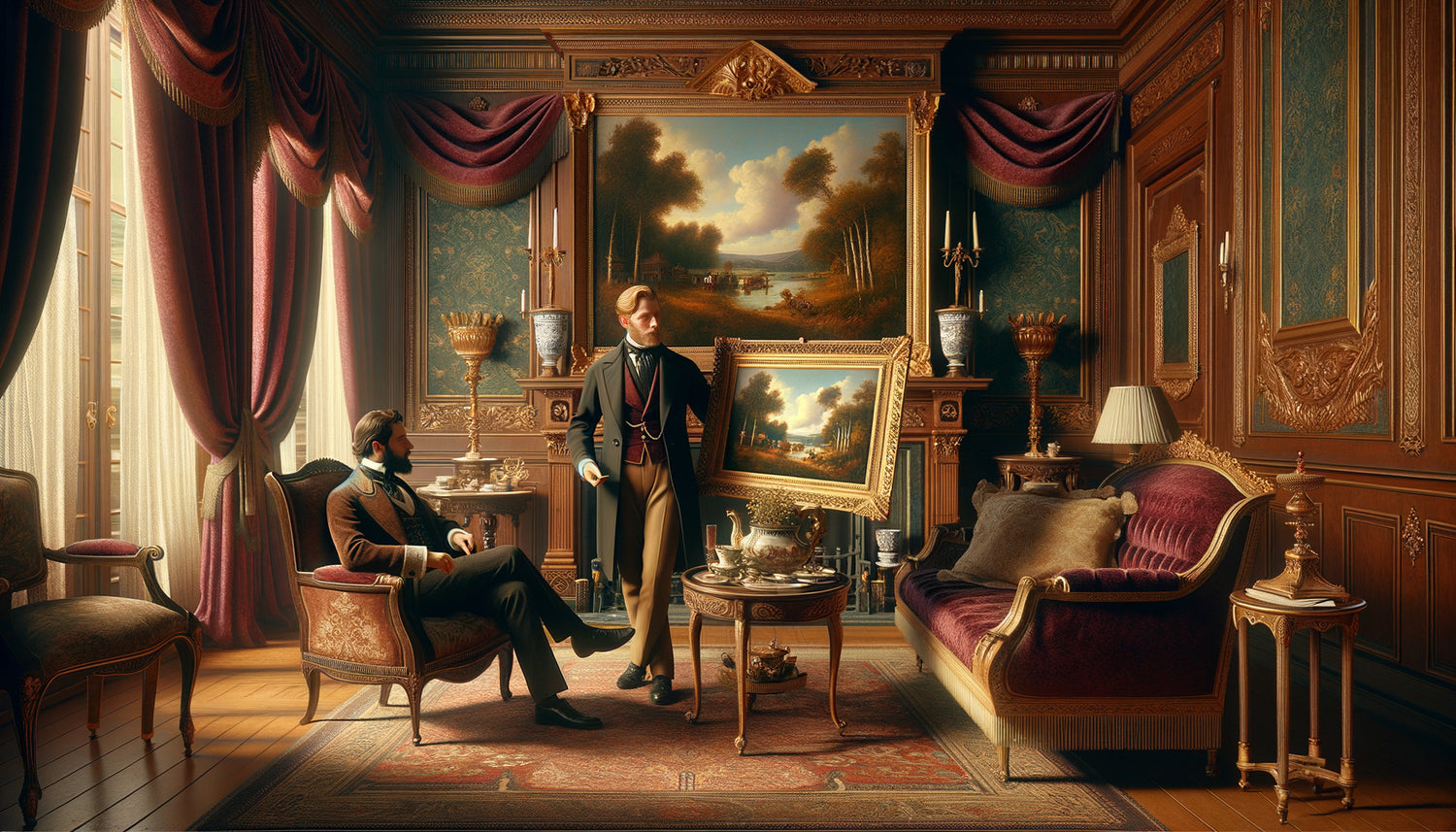
In cultivated circles of the 19th and early 20th centuries, social evenings resembled aesthetic battlefields. Each wall told a story, each frame marked a territory. When a guest gave a painting to his host, this gesture was part of a meticulous social choreography.
Impressionists particularly understood this well. Monet offering one of his Seine views to a collector was not only conveying a canvas – he was integrating him into the select circle of defenders of fragmented light, revolutionaries of vibrant touches. Offering a painting thus became a political act, a way to recruit allies in the fight to impose a new vision of art.
This aesthetic affiliation created powerful networks. Dealers like Durand-Ruel had perfectly grasped this: by convincing a few influential collectors to buy and offer Impressionist works, he transformed them into ambassadors of a movement. Their homes became militant galleries, their gifts tools of artistic proselytism.
The ritual of donation as a transmission of cultural heritage
But beyond social positioning, offering a painting from one's artistic school was also akin to an initiation. A father bequeathing a Cubist still life to his son was not giving him just a decorative object – he was entrusting him with a way of looking at the world, of deconstructing reality into geometric volumes, of rejecting academic illusion.
This pedagogical dimension of artistic donation crossed all cultivated social classes. In intellectual circles, the taste of younger generations was shaped by offering them works that embodied the aesthetic values of the family clan. A child growing up surrounded by Expressionist paintings naturally developed a sensitivity to exaggerated colors, tormented forms – their reference artistic school was built through daily impregnation.

Belonging to a community of viewers
What makes this practice fascinating is that it created invisible but powerful communities. Lovers of Symbolism, for example, formed a scattered confraternity united by a shared fascination with mystery, dreams, and Baudelairean correspondences. Offering a symbolic painting to someone was like saying to them: “You are one of us, you understand this language of symbols.”
This aesthetic affiliation functioned like the religious or political affiliations of the time – it structured social identity and created bonds of solidarity. The Surrealists pushed it to the extreme in the 1920s-1930s, transforming each gift of artwork into an act of rallying to their poetic revolution. Breton offering a drawing to a young artist would enshrine them within the movement, conferring immediate legitimacy.
These communities of vision shared more than just an aesthetic taste – they defended a common view of society, spirituality, and the role of art in human existence. The artistic school thus became a banner under which kindred spirits gathered, beyond national borders or traditional social divisions.
When the frame becomes manifest
Let's now turn to the materiality of the gesture itself. The choice of giving a painting rather than another work of art – a sculpture, a vase, a precious book – carried a specific meaning. The painting, hung on the wall, visible to all, assumed a declarative function that lesser arts or collectibles displayed in vitrines did not possess.
The frame itself participated in this aesthetic affiliation. A gilded antique-style frame around a modern canvas created a deliberate tension, an ironic commentary. A simple and contemporary frame around a Fauvist work highlighted the radicality of the chromatic choice. Every detail counted, every element contributed to the message sent.
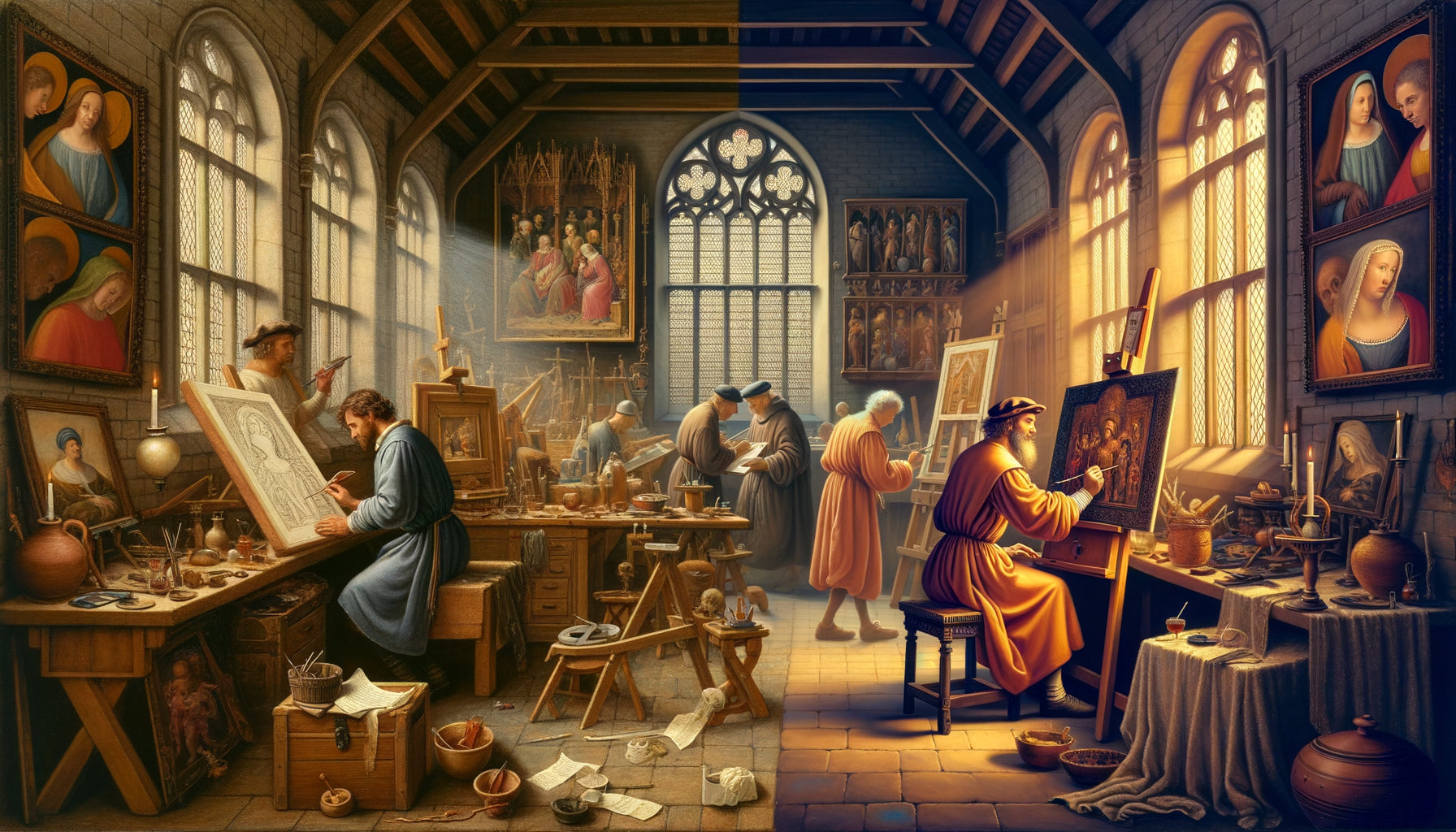
In artists' workshops, this awareness was acute. Picasso meticulously chose the works he gave to his friends, knowing that each carried a part of his stylistic evolution. Giving a canvas from his blue period or his cubist period did not mean the same thing – it meant orienting the perception the other would have of his work, entrusting him with a precise fragment of his artistic journey.
The silent codes of the militant collector
Some collectors became famous for systematizing this practice of giving as an affirmation of identity. Gertrude Stein, in her Parisian salon, gave works by Matisse or Picasso to carefully selected visitors, thus transforming them into disciples of her avant-garde vision. Her brother Leo did the same, creating a transatlantic network of enlightened enthusiasts.
This strategy of calculated gifting made it possible to multiply the points of diffusion of an artistic school. Each gifted work became a satellite, a point of radiation in a new home, a new social circle. Artistic movements thus spread by capillary action, carried by these gifts that were never really so.

Contemporary resonances of a forgotten practice
What remains of this tradition today? Less than you might believe, but more than you imagine. When you offer a Klimt reproduction rather than a Hopper, you unconsciously perpetuate this logic of aesthetic affiliation. You say something about your relationship with the person, about the values you want to share with them.
Contemporary art lovers have partially revived this practice. Giving a work by a young emerging artist to a collector friend still functions as a recommendation, a sharing of discovery, a way of saying: “Here is what moves me, join me in this sensibility.” The artistic school may have become more diffuse, less codified, but the gesture retains its symbolic charge.
In creative circles, we are even witnessing a return to this awareness. Galleries organize events where offering a painting from their roster becomes an activist act, a way of collectively supporting a vision of art against widespread commodification. The community dimension of artistic giving is being reborn in new forms, adapted to our fragmented era.
Your walls tell your story – write it with intention
Discover our exclusive collection of wall art to gift that perpetuates this tradition of aesthetic affiliation and creates connections through shared beauty.
Art as a common language beyond words
What makes this historical practice so fascinating is that it reveals a profound truth about our relationship with art: works are never neutral. They carry within them universes of meaning, implicit positions, invitations to join a certain way of inhabiting the world.
Offering a painting from one's artistic school affirmed much more than an aesthetic affiliation – it was creating an elective affinity, drawing the contours of a chosen spiritual family. In a world where traditional affiliations were waning with modernity, art offered new tribes, new totems around which to gather.
Today, as we desperately seek meaning and authenticity in our relationships, perhaps we should rediscover this ancient wisdom. Not to mimic the customs of a bygone era, but to reinvent our own rituals of aesthetic sharing, our own ways of asserting, through the works we choose and offer, who we are and with whom we want to journey.
The artistic schools of yesteryear have disappeared, fragmented into a thousand individual currents. But the need for shared vision remains intact. It is up to us to cultivate it, one gift painting at a time, a silent conversation between two walls that respond across distances.
Frequently Asked Questions
Can we still affirm an aesthetic affiliation by offering a painting today?
Absolutely, even if the codes have evolved. Today, offering a painting retains a strong identity dimension. When you choose an abstract work rather than a figurative one, a contemporary photograph rather than a classic painting, you convey a message about your aesthetic values. The difference from the time of the great artistic schools is that categories are less rigid and more personal. But the gesture still makes sense: you create a link through shared taste, you invite the other to join your visual universe. In creative and cultural circles, this practice remains very conscious and assumed, perpetuating this beautiful tradition of aesthetic affiliation through art given.
How to choose a work that truly reflects my aesthetic convictions?
Start by identifying what genuinely moves you, without worrying about trends or the opinions of others. Visit galleries, museums, browse online catalogs, and note the works that provoke an immediate resonance in you. Often, your artistic school of choice emerges naturally: perhaps you are consistently drawn to geometric compositions, or conversely to organic and fluid forms. Your favorite color palette also reveals itself over time. Once these preferences have been identified, offering a painting becomes an authentic act: you truly transmit a part of your sensitivity. The essential thing is the sincerity of the choice – your aesthetic affiliation must be experienced, not calculated, for the gift to carry all its meaning.
Does this tradition of offering paintings according to one's artistic school exist in all cultures?
This practice has taken different forms depending on cultures, but the principle of aesthetic affiliation through the gift of artworks indeed crosses many civilizations. In Japan, the tradition of painted scrolls offered according to the painting school (Kano, Tosa, Rinpa) fulfilled a similar social function. In China, scholars would offer each other calligraphy that revealed their belonging to certain philosophical and artistic currents. In the Arab-Muslim world, Persian miniatures exchanged between patrons signaled specific cultural affiliations. What is fascinating is this constant anthropological element: wherever art has structured itself into schools and movements, offering a painting or artwork has become a coded social language, a way of asserting shared values beyond words. Our Western tradition therefore fits into a universal cultural dynamic, proof that art has always been much more than a simple decorative object.