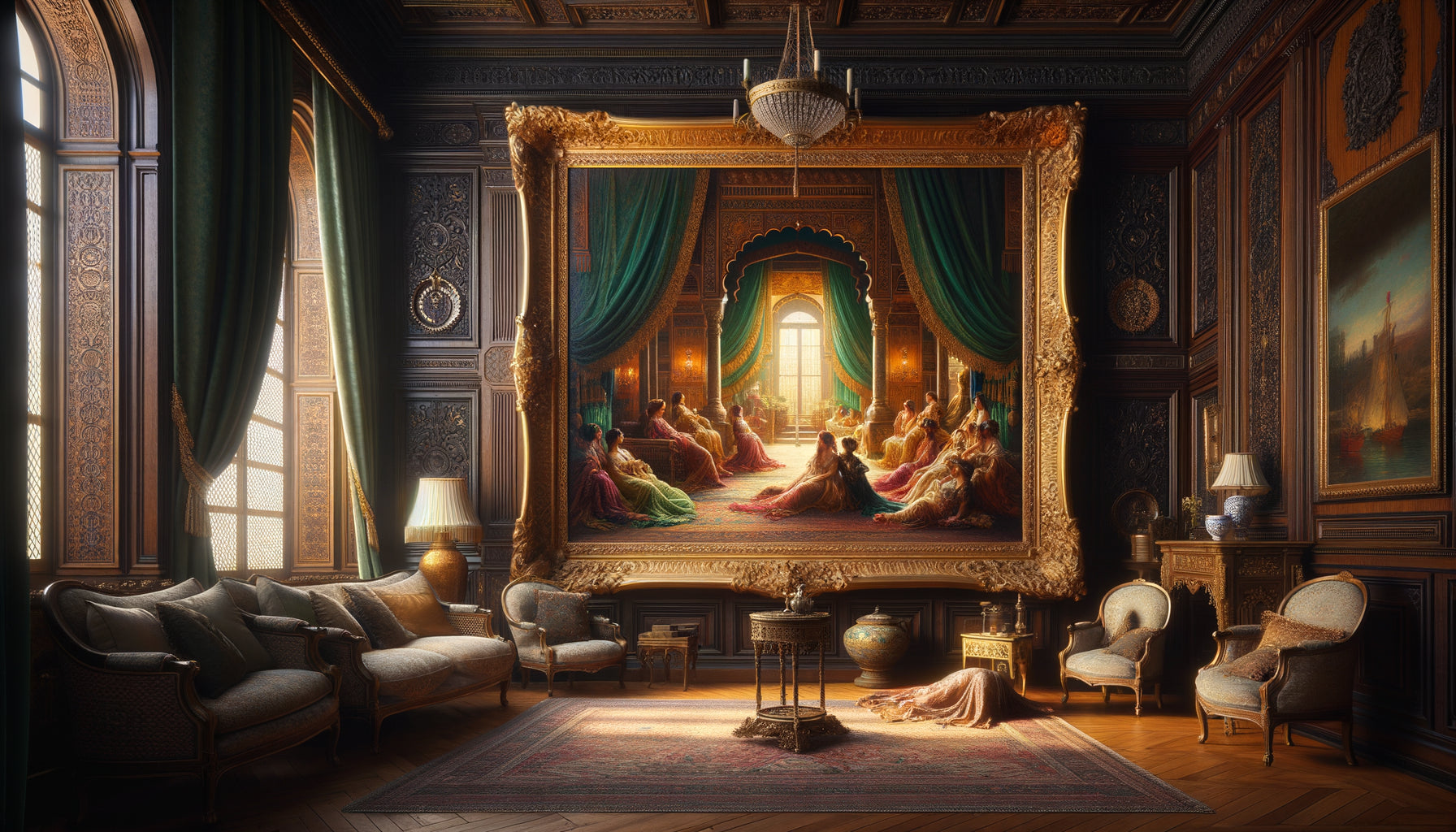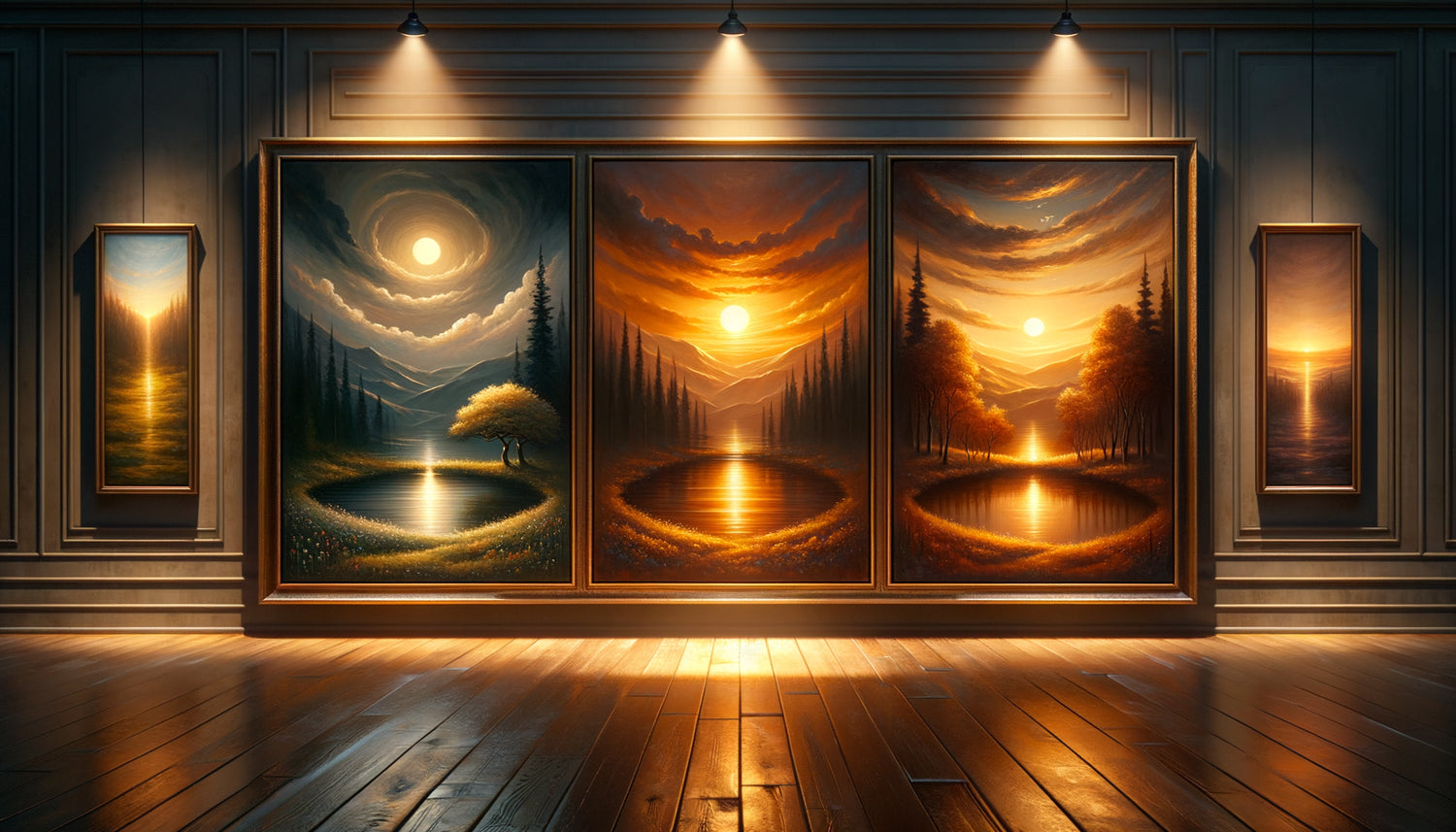
I've accompanied hundreds of clients in choosing artworks intended as gifts. And each time they hesitate between a unique artwork and a multi-panel composition, I ask them this question: “What do you want to tell?” Because the number of canvases is never insignificant. It carries an intention, a silent message that completely transforms the symbolic scope of the gift.
Here's what offering a diptych or triptych versus a unique artwork truly reveals: a unique painting celebrates the moment and individuality, while a diptych or triptych symbolizes continuity, connection, and shared evolution. One says “I offer you this precious moment,” the other whispers “our story unfolds over time.”
You may be facing this dilemma right now. You want to give an artwork that truly marks the occasion, but you wonder if multiplying panels is too bold, too engaging, or conversely if a single painting will suffice to express what you feel. This hesitation is legitimate, because these formats tell fundamentally different stories.
The good news? Once you understand the deep symbolism of each option, the choice becomes obvious. You just need to listen to what your heart really wants to say, and let the format become the natural extension of your intention.
I promise that by the end of this article, you will know exactly which format to choose according to the message you want to convey. And above all, you will understand why certain moments in life naturally call for a fragmented artwork, when others require the absolute unity of a unique painting.
The unique painting: the art of absolute presence
The unique painting possesses a force that nothing can equal: that of concentration. All energy, all emotion, all message crystallize in a single focal point. It is the artwork that immediately captures the eye and doesn't let go.
Symbolically, offering a unique painting means saying: “Here is this moment, in its fullness.” It’s celebrating the present moment, here and now. This unique artwork becomes an emotional anchor, a visual landmark that marks a specific event in life. A diploma obtained, a first apartment, a personal victory.
I've seen clients give a unique painting for a significant birthday, to symbolize the culmination of a journey. The artwork then becomes a personal monument, a unique precious stone that says “you have arrived somewhere important.” It doesn’t seek to tell a sequence, it celebrates completeness.
The unique painting is particularly suitable for contemplative spaces: a bedroom where one seeks peace, an office where one needs concentration, a reading corner where one recharges. Its presence is enough; it does not need any complement to fully exist.
When life is told in several chapters: the magic of the diptych
The diptych completely changes the conversation. With two panels, you are no longer in the moment, but in dialogue. In duality, in complementarity. And this geometry of two voices carries a powerful symbolism.
Offering a diptych is acknowledging that the most beautiful things exist in relation. Day and night. Before and after. Yin and yang. You and me. This two-part composition says: "We are different, but we form a harmonious whole."
I often recommend the diptych for couple gifts. Not obviously, but for that very reason: it symbolizes two individualities creating something greater together. The two panels can be similar or contrasting, it doesn't matter. It is their dialogue that creates meaning.
The diptych works wonderfully in shared living spaces: a living room where you receive guests, a dining room where you come together. It naturally invites conversation; its format itself suggests exchange. The eyes travel from one to the other, creating movement, a visual dynamic that brings the space to life.
The subtle balance of duality
What fascinates about the diptych is this creative tension between separation and union. The two canvases are physically distinct, but visually inseparable. This characteristic makes it a powerful symbol for relationships: recognition of individuality within unity.
Designers often use this property to create depth effects impossible with a single canvas. The eye naturally completes the space between the panels, actively engaging the viewer's imagination. It is a work that requires participation, which does not give itself entirely at first glance.

The triptych: when the story becomes a narrative
With three panels, we enter another symbolic dimension. The triptych tells a story. It has a beginning, a middle, and an end. Or a past, a present, and a future. This structure in three parts is deeply rooted in our way of understanding stories.
Offering a triptych is offering more than just an image: it's offering a visual narrative. You say: "Our relationship has a history, it evolves, it transforms." It is the format of evolution, the journey taken and to come.
I often see clients choosing the triptych for wedding anniversary gifts, particularly for significant dates. Ten years, twenty years, thirty years. Because these milestones naturally call for reflection on the path traveled together. The triptych then becomes a silent witness to this progression.
The triptych also possesses a dimension almost sacred. Historically, this format was reserved for religious altarpieces, major works that told great mysteries. Even in a contemporary secular context, this resonance remains. A triptych lends the space a certain solemnity, an importance.
The architecture of the triptych
Technically, the triptych creates a central focal point framed by two side panels. This structure naturally guides the eye to the center, creating a clear visual hierarchy. The central panel often becomes the emotional heart of the work, while the sides provide context and depth.
This composition works particularly well in large spaces: above a generous sofa, in a spacious entrance hall, on the main wall of a dining room. The triptych needs space to breathe, for its three voices to unfold without constraint.
What the format reveals about your intention
Choosing between a single artwork and a multiple composition is never arbitrary. This choice reveals your perception of the relationship with the person you are giving the work to.
The single painting says: You are celebrated in your uniqueness. It honors the individual, their singularity, their unique and irreplaceable character. It is a deeply personal gift that does not seek to create a narrative link beyond the present moment.
The diptych affirms: We create something beautiful together. It recognizes interdependence, complementarity, the strength born of union. It is a gift that speaks of relationship, placing the connection at the center.
The triptych proclaims: Our story deserves to be told. It values time, duration, evolution. It is a gift that inscribes the relationship in temporality, giving it an almost epic dimension.
The symbolic commitment of multiple formats
Let's be honest: offering a diptych or a triptych is a more engaging gesture than offering a single painting. These formats take up more space, require more reflection in their installation, and create a more marked presence.
But it is precisely this “taking of space” that makes their symbolic strength. You implicitly say: You deserve for this work to occupy an important place in your daily life, for our connection to be visible and present. It is a gift that does not hide in a corner, that affirms its presence.

How to choose according to the occasion
Some occasions naturally call for one format rather than another. Here's how I guide my clients in their decision based on the emotional context of the gift.
For a first apartment or installation : a single artwork is often more appropriate. The person discovers their new home, they need clear anchor points, not a complex composition to tame.
For a housewarming party for a couple : the diptych naturally imposes itself. It celebrates the union while respecting each individual's identity. This is the format that says "two lives merging while remaining distinct."
For a significant wedding anniversary : the triptych finds its full meaning. It allows you to symbolize the journey traveled, the evolution of the couple, the stages crossed together. This is the format of memory and projection.
For a professional achievement : the single artwork concentrates all the energy of accomplishment. No need for narration, just the pure celebration of victory.
For a long-standing friendship : the diptych or triptych recognizes the depth and duration of the relationship. It says "our friendship has a history, it is inscribed in time."
Ready to choose the artwork that will tell your story?
Discover our exclusive collection of wall art to gift that transform your intentions into a memorable visual presence.
The spatial and emotional long-term impact
Beyond the initial symbolism, it is necessary to consider how the artwork will live in the space on a daily basis. Because a work of art gift is not frozen in time of the offer: it continues to communicate silently for years.
The single artwork often becomes a point of meditation, a visual reference point that we return to regularly. Its constant and unified presence creates a form of reassuring stability. This is the work we look at during moments of doubt, reminding us who we are.
The diptych, for its part, continues to activate this visual dialogue day after day. The eyes naturally travel from one to the other, creating movement that energizes the space. It's the artwork that evolves according to our state of mind: sometimes we focus on one panel, sometimes we embrace the whole.
The triptych displays an almost architectural presence. It doesn't just decorate a wall, it structures the space, creates a rhythm, and imposes a certain majesty. This is artwork that truly transforms a room, giving it a strong identity.
Flexibility in the evolution of space
An often overlooked aspect: multi-panel compositions offer a valuable adaptability. In case of moving or rearranging, the possibilities for layout multiply. The panels can be brought closer or further apart, aligned or offset, creating a different dynamic each time.
A single painting, on the other hand, offers an appreciable simplicity of management. A single hanging, a single element to position. For spaces that change often or for people who like to rearrange regularly, this simplicity becomes an asset.
Imagine yourself in six months, in a year, contemplating the artwork you gave as a gift. See the smile it still provokes, the memories it revives, the conversations it sparks. This image already indicates which format best suits your deep intention.
The choice between a single painting and a multiple composition is not a question of trend or taste, but of alignment between form and intention. Listen to what you really want to say, and the format will naturally impose itself. Because the most beautiful gifts are those that faithfully translate what words struggle to express.
So, what story do you want to tell?
Frequently Asked Questions
Is a diptych or triptych more difficult to hang than a single painting?
Not really, but it requires a little more preparation. The trick is to treat the whole as a single work: first measure the total width you want to occupy, then distribute the panels keeping a regular spacing between them (usually between 5 and 10 cm). Lightly trace the markings with pencil before hanging, and start with the central panel if it's a triptych. Once the first panel is in place, the others align naturally. The satisfaction of seeing the whole installed largely compensates for the few extra minutes invested. And if you really prefer to delegate, any professional installer perfectly masters this type of installation.
Can a diptych or triptych be given for a small room?
Absolutely, provided we adjust the dimensions. Multiple formats are not reserved for large spaces; it's the total size that matters. A diptych of two 30x40 cm canvases ultimately takes up less space than a single 100x70 cm painting. In a small room, multiple compositions can even create an impression of scale by visually structuring the wall. The trick is to choose panels with modest dimensions and airy visuals rather than overloaded ones. A minimalist triptych can enhance a small living room where a large unique painting would have overwhelmed it. It's really a question of proportions and visual choice, not the format itself.
Is a diptych or triptych a gift that is too personal?
This question touches on the heart of the intention of the gift. Yes, offering a composition in multiple panels is an emotionally more committed gesture than a single painting, but that's precisely what makes it strong for relationships that really matter. If you are hesitating, just ask yourself: does this person deserve me to offer them something exceptional, which stands out from the ordinary? If the answer is yes, then the multiple format is perfectly appropriate. There is nothing too personal when the gesture is sincere and the relationship justifies it. On the contrary, these are often the gifts that we remember for a lifetime, those that really mark. And if you really prefer something more neutral for a less intimate relationship, the single painting remains an excellent option.