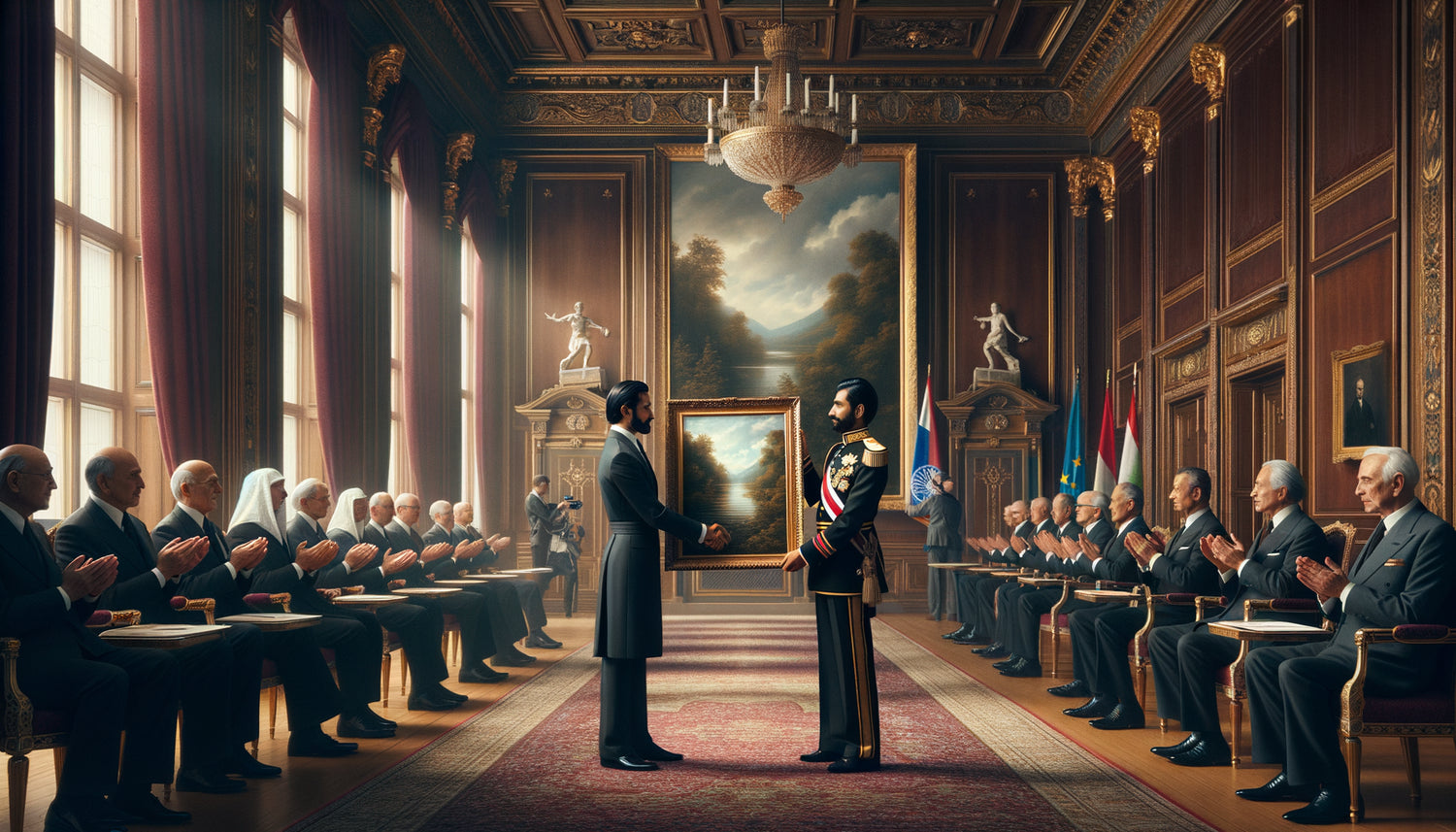
When two heads of state shake hands after years of tension, a painting often changes hands. This gesture, captured by photographers around the world, goes beyond simple diplomatic courtesy. Behind each gifted canvas lies a millennial strategy of reconciliation, a universal language that transcends linguistic and cultural barriers. But do these works of art truly have the power to appease conflicts?
Here's what diplomatic paintings reveal: They transform hostility into dialogue through their symbolic neutrality, they create a reciprocal moral debt between parties, and they visually immortalize peaceful commitment before history. You might think that a simple object cannot alter the course of international relations. Yet, from the Renaissance to the G20 summits, diplomatic archives are full of examples where a well-chosen work has paved the way for historic treaties. I will show you how these artistic gifts function as true tools of peace, and why their influence endures far beyond the official ceremony.
The silent language of diplomatic works
Unlike political speeches that divide, paintings offered during reconciliations speak a universal language. When French President François Mitterrand gave Helmut Kohl a painting depicting an Alsatian landscape in 1984, he did not choose randomly. This border region, disputed for centuries, suddenly became a symbol of shared beauty rather than territorial conflict.
The pacificatory function of these works lies in their ability to express without words. A pastoral scene evokes serenity, a historical portrait recalls ancestral ties, an abstract composition suggests openness to new perspectives. Diplomats know: a well-chosen painting bypasses linguistic sensitivities and contradictory interpretations that often sabotage negotiations.
The colors themselves carry soothing meanings. Blue inspires confidence and stability, green symbolizes growth and renewal. When Japan offered China a work dominated by azure tones after the tensions of 2012, protocol experts saw it as an explicit invitation to serene dialogue. These chromatic choices unconsciously influence the emotional disposition of leaders.
The moral debt: when receiving implies giving
Anthropology teaches us that receiving a gift creates an obligation of reciprocity. This psychological mechanism, studied since Marcel Mauss, applies as powerfully to relations between states as it does between individuals. When a leader accepts a valuable canvas, he implicitly contracts a moral debt towards the donor.
Paintings offered during political reconciliations activate this ancestral lever. In 1972, during Nixon's historic visit to China, Mao received an American porcelain depicting wild horses. This gesture symbolically obliged the Chinese leader to respond favorably to diplomatic overtures. The following year, Sino-American relations experienced a spectacular thaw.
The Subtle Balance of Value
The pacificating function of a painting also depends on its perceived value. Too modest, it insults; too sumptuous, it intimidates or suggests an attempt at corruption. Diplomatic protocols precisely calculate this scale. A work by a recognized contemporary artist without being unaffordable, a historically significant canvas but not priceless: this delicate balance manifests respect without creating discomfort.
The archives of the Quai d'Orsay reveal that cultural advisors spend weeks selecting the perfect artwork. Every detail counts: the size of the frame, the origin of the pigments, even the texture of the canvas. These offered paintings become vectors of reconciliation precisely because they demonstrate attention to the other.

When Art Immortalizes Peaceful Engagement
A treaty can be repudiated, a speech forgotten. But a painting hung in a presidential palace testifies daily to reconciliation. This is perhaps where lies the deepest pacificating function of these works: their physical permanence anchors the momentary commitment over time.
Each time a leader crosses the room where the received painting stands, they mentally review the handshake, the ceremony, the promises exchanged. This constant presence acts as a moral reminder. Successive politicians also inherit these works, perpetuating the memory of reconciliation beyond individual mandates.
The American diplomatic museum preserves paintings offered during reconciliations dating back two centuries. These collections tell an alternative history of international relations, where artistic gestures mark the path to peace as surely as formal treaties.
The Real Limits of This Image Diplomacy
Let's be clear: no painting has ever stopped a war on its own. The pacificating function of these works remains symbolic, and the symbol does not replace political will. When Saddam Hussein offered a canvas to George Bush Sr. in 1990, it did not prevent the Gulf War a few months later.
Paintings offered during reconciliations act as emotional catalysts, not as magic solutions. They prepare the psychological ground, create a conducive atmosphere, humanize the adversary. But without concrete negotiations, without substantial compromises, they remain beautiful objects with no real impact.
When gesture becomes manipulation
Some leaders cynically use these artistic gifts to mask their true intentions. A painting presented with emphasis in front of cameras can serve as a smokescreen while hostile maneuvers continue behind the scenes. The peacemaking function then turns into a propaganda tool.
Diplomatic analysts learn to distinguish genuine reconciliations from communication operations. A painting accompanied by concrete concessions differs radically from a work offered in isolation. Context determines sincerity, and art alone does not guarantee peace.

What these diplomatic rituals teach us
Beyond high politics, paintings offered during reconciliations reveal a universal truth to us: objects carry intentions. In our own lives, a well-chosen artistic gift can repair a broken friendship, ease family tension, or celebrate a new beginning after a conflict.
The peacemaking function of art is not limited to presidential palaces. How many couples reconciled have sealed their new beginnings by hanging a new canvas together in their living room? How many companies have marked the merger of two rival teams by installing a collaborative work in their offices?
These gestures echo, on our scale, the millennial wisdom of diplomats: offer beauty to build peace. A painting then becomes more than just decoration; it materializes the hope of a peaceful future.
Transform your reconciliations into unforgettable moments
Discover our exclusive collection of wall art to offer that carry messages of harmony and renewal, to celebrate each new beginning with elegance.
The future of artistic diplomacy
In the digital age, some predicted the end of these ancestral rituals. Yet, paintings offered during reconciliations are experiencing a resurgence in importance. Precisely because everything is virtualized, a rare and precious physical object regains symbolic value.
New generations of diplomats are rediscovering the peacemaking function of art. At the Paris Climate Summit in 2015, several heads of state exchanged contemporary works representing nature, visually anchoring their ecological commitment. These paintings continue today to silently testify to the collective promise.
Contemporary art also offers new possibilities. Participatory installations, evolving works that complement each other between countries, augmented reality creations that add layers of meaning: artistic diplomacy is reinventing itself while preserving its millennial essence.
Imagine your home office, where a meaningful canvas daily recalls a personal commitment. Imagine the entrance to your company, where a work symbolizes the shared values of the team. Like leaders who rely on the peacemaking function of paintings, you can use art to anchor your own reconciliations and new beginnings. Beauty possesses this rare power to transform intentions into tangible reality, to make a fragile moment a lasting promise. Start today: choose a work that embodies the harmony you want to cultivate, and let it quietly work to soothe and inspire.