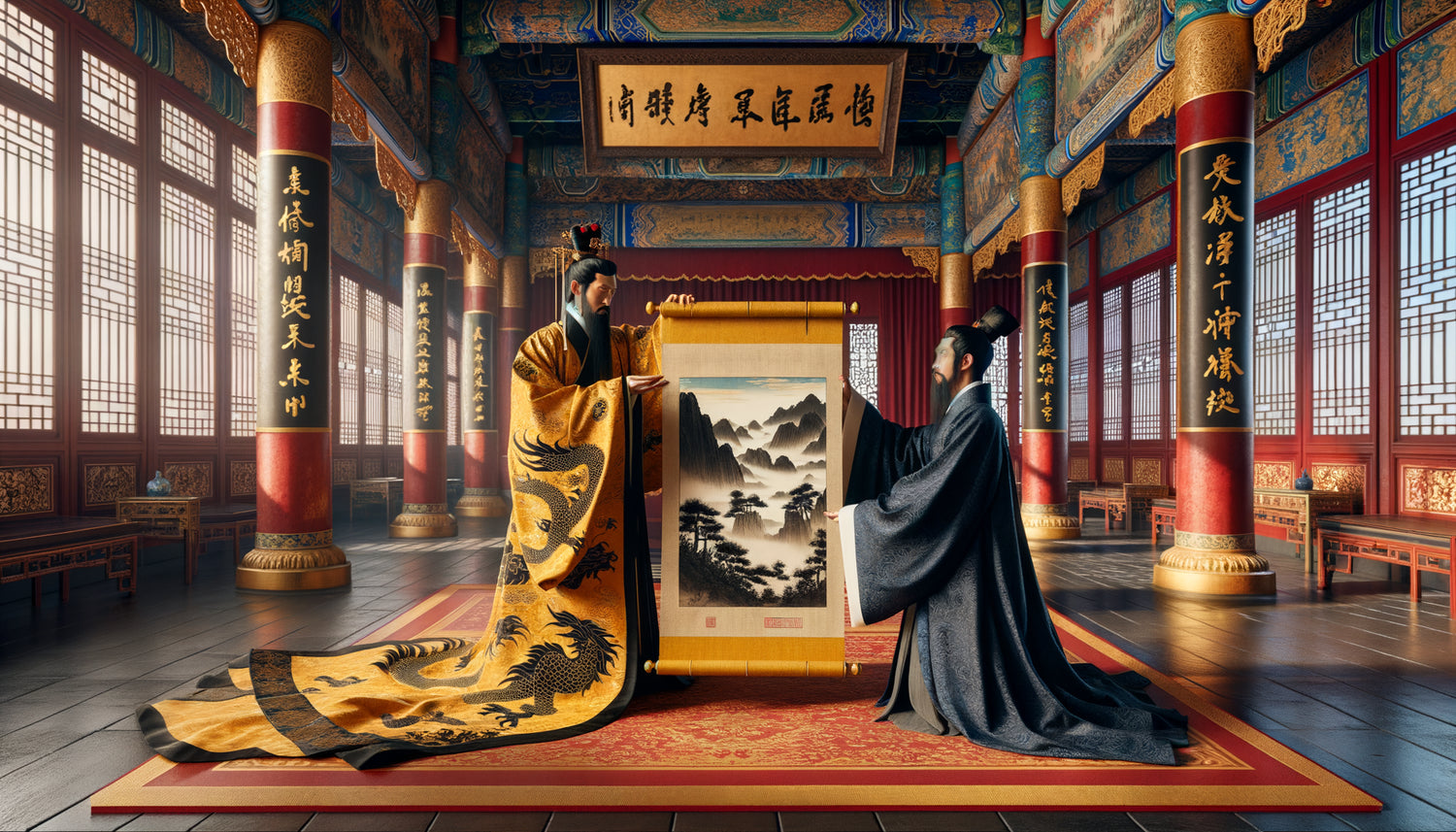
Within the Forbidden City, at the heart of imperial power, a mandarin kneels before the Son of Heaven. The emperor offers him neither gold nor jade, nor land. Between his gloved hands, he unfurls a scroll of paper where dance a few strokes of black ink: a branch of plum blossom in the mist, accompanied by a calligraphic poem. This seemingly simple gesture seals a recognition that transcends all material wealth. For in imperial China, offering a scholar's painting represented the pinnacle of honor, a spiritual communion between the sovereign and his most deserving servant.
This is what this millennial tradition reveals to us: an art of giving that values spirit over matter, transforms beauty into currency of recognition, and makes cultural gesture an instrument of power. How could these ephemeral works be worth more than treasures? Why did a simple painting scroll provoke tears of gratitude? And above all, what does this practice teach us today about the real value of the gifts we offer?
Let's plunge into the secret corridors of Chinese imperial diplomacy, where ink and brush forged bonds stronger than golden chains.
The Secret Language of Imperial Brushes
When a Chinese emperor decided to reward a civil servant, a victorious general or a brilliant scholar, he did not consult his treasurer. He went to his private study, personally selected a scholar's painting from his collection, or even better, took the brush himself. This revealed an extraordinary cultural intimacy.
Scholar’s paintings, or wenrenhua, embodied the very essence of refined Chinese culture. Unlike court paintings, majestic and narrative, these works favored suggestion over description, emptiness over fullness, inner emotion over external representation. A bamboo bent under the snow expressed the resilience of the sage. A mountain shrouded in mist evoked the mystery of knowledge.
By offering these paintings, the emperor was not distributing a decorative object. He was sharing an intellectual universe, recognizing in the recipient the same aesthetic sensitivity, the same spiritual depth. It was saying: “You understand this silent language. You belong to the restricted circle of cultivated souls.”
When Ink is Worth More Than Gold: The Subtle Hierarchy of Rewards
In the imperial archives, we discover a fascinating gradation. Chinese emperors had an arsenal of material rewards at their disposal: precious silks, imperial porcelain, racehorses, fertile lands. Yet, at the top of this pyramid of honors stood the scholar's painting.
Why? Because it required a shared understanding. Offering a gold ingot rewards service. Offering a painting celebrates a soul. The recipient had to possess the necessary education to decipher poetic allusions, recognize the calligraphic style, appreciate the balance of the composition. This cultural requirement transformed the gift into mutual recognition.
The chronicles of the Song dynasty recount that a high-ranking official, receiving a bamboo painting from Emperor Huizong (himself an accomplished painter), wept for three days. Not out of material joy, but because his sovereign had recognized in him a refined spirit, worthy of contemplating this work.
The three circles of pictorial honor
Imperial tradition established a subtle hierarchy in paintings offered:
The first circle: the emperor painted the work himself. This extremely rare gesture signified total spiritual intimacy. The emperor invested his qi, his vital energy, into each brushstroke. The recipient literally received a share of imperial essence.
The second circle: the emperor selected a painting by a master from his personal collection and added his calligraphy, a poem, an imperial seal. This intervention transformed the work, imbuing it with a double artistic and political aura.
The third circle: the emperor offered a literati painting created by a renowned court artist, accompanied by an imperial certificate of authenticity. Even this level, considered “inferior,” surpassed most material rewards in prestige.

The secret ritual of the gift: when a donation becomes a ceremony
Offering a painting followed a meticulous protocol that amplified its meaning. It was never a simple administrative transaction. In the tradition of Chinese emperors, every step counted.
First, the summons. The recipient was invited to a private pavilion, away from the court crowd. This intimacy underscored the personal nature of the recognition. Then came the progressive unveiling: the work remained rolled up, protected in a silk brocade case. The emperor slowly unrolled the scroll, creating dramatic tension.
During this unveiling, the emperor often commented on the work: why he had chosen it, what virtue it embodied, what quality of the recipient it celebrated. This narration transformed the painting into a mirror: the recipient saw himself through the imperial gaze, embellished, idealized.
The recipient then had to compose an impromptu poem in response, demonstrating that he understood the coded message of the work. This poetic improvisation completed the circle: the emperor offered beauty, the subject responded with wit. The gift became dialogue.
Beyond the Palace: When Imperial Paintings Shaped Destinies
Receiving a scholar’s painting from the imperial hands was not merely an aesthetic grace moment. It socially and politically transformed the recipient. In the Chinese imperial bureaucracy, where every sign counted, owning a work gifted by the emperor instantly modified your status.
Chronicles recount officials building special pavilions to display their imperial painting, inviting scholars and officials to contemplate it. These sessions became major social events. Each visitor composed a poem of homage, calligraphed in the margin of the original scroll. Thus, the gifted painting came alive, enriched with successive cultural strata.
This practice also created a form of refined clientelism. The protégés of a mandarin honored by the emperor benefited from the radiance of this distinction. It was said: “He serves who has received the Winter Bamboos”, referring to a famous imperial painting. The work became a totem of power.
The Sacred Transmission: Family Treasures
Paintings gifted by emperors were passed down from generation to generation like relics. Entire families based their prestige on a work received three centuries earlier by a deserving ancestor. These scrolls came out of their chests for special occasions: weddings, promotions, funerals.
This transmission transformed the imperial gift into ancestral memory. Descendants did not simply possess a beautiful painting, but the material embodiment of family virtue, tangible proof that their ancestors had mingled with greatness. The gifted work thus became immortal, perpetuating imperial recognition through the centuries.

The Modern Legacy: Rediscovering the Art of Meaningful Gifting
What does this millennial tradition of Chinese emperors gifting paintings teach us today? Essentially, this: the value of a gift lies not in its price, but in the depth of the message it carries.
In our era where corporate gifts often boil down to standardized objects, and professional rewards become impersonal bonuses, the Chinese imperial tradition invites us to reinvent the gift as a language. Offering a work of art, personally chosen for its resonance with the recipient, creates a connection that no financial bonus can match.
This practice is now finding new life in contemporary interiors. Giving a painting that captures the essence of a relationship, an accomplishment, or a shared aspiration reconnects us with this imperial wisdom. The artwork then becomes much more than just decoration: it is a permanent witness to recognition, friendship, and admiration.
Transform your acts of recognition into unforgettable moments
Discover our exclusive collection of wall art to gift that carries within it the nobility of imperial gifts, to honor those who truly matter.
When the gesture surpasses the object: an imperial lesson for today
The tradition of Chinese emperors gifting paintings by scholars reveals a timeless truth: the most beautiful gifts do not satisfy material needs, they nourish the soul. In the Forbidden City as in our modern homes, a work offered with intention becomes a bridge between two sensibilities, a silent testimony that transcends time.
Imagine the moment when you hand someone a painting specially chosen for them, reflecting their personality, their aspirations, your unique bond. In their eyes, you will see the same emotion that made imperial mandarins cry: the profound recognition of being truly seen, understood, and honored.
The Chinese emperors knew it: when you offer beauty, you give more than an object. You share a vision of the world, you create a shared memory, you weave a bond that resists the years. So, who will you offer your next “imperial painting” to? What message will it carry? And how will it transform a simple relationship into lasting communion?
Imperial wisdom simply awaits us to reinvent it, one gifted artwork at a time.