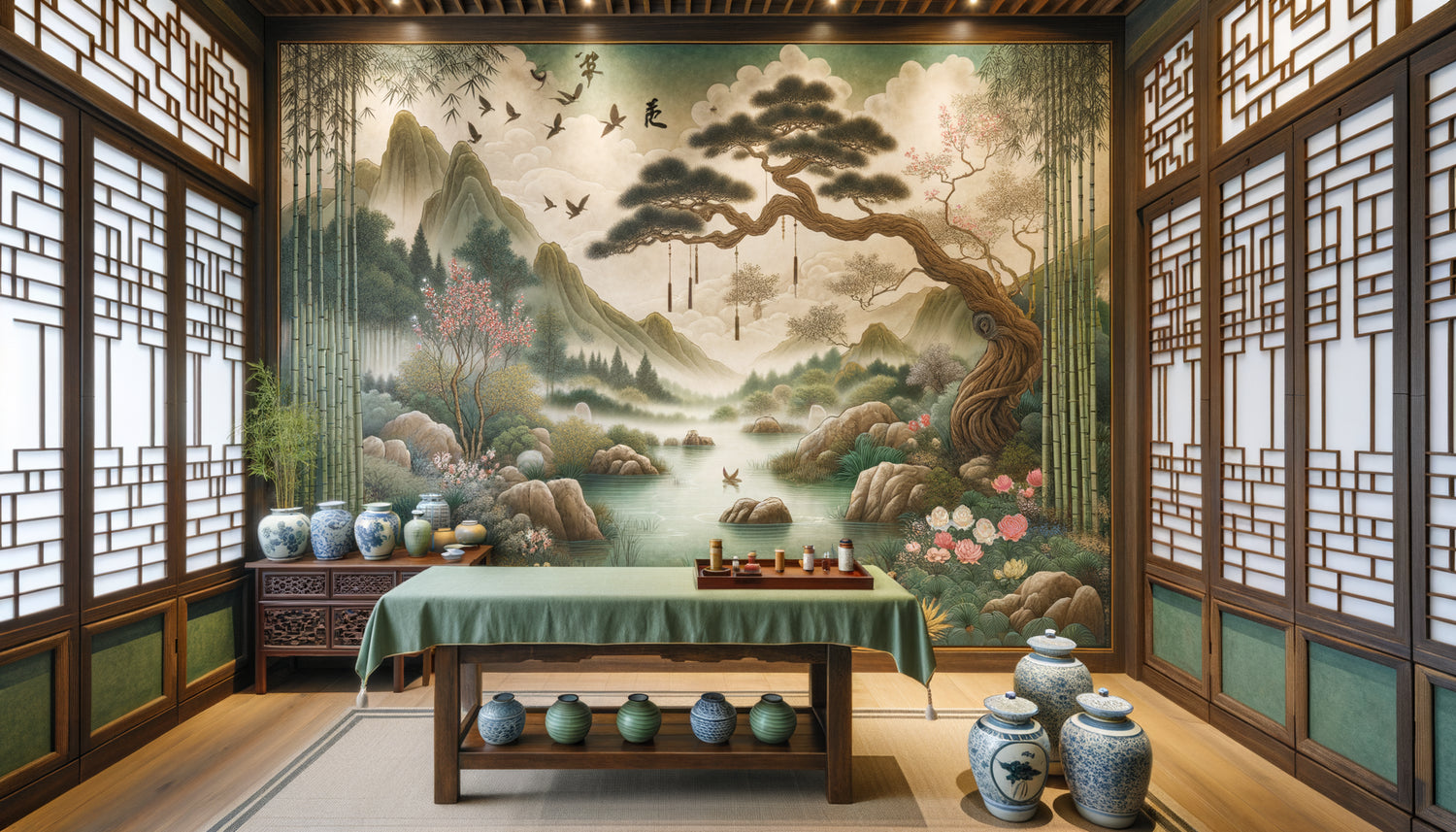
The first time I crossed the threshold of a traditional Chinese medicine clinic in Shanghai, my gaze was instantly captured by a mural depicting a lush garden. Not just an aesthetic decoration, but a true universe where every element – the bamboo bent by the wind, the koi carp gliding between water lilies, the misty mountains on the horizon – seemed to breathe serenity. This discovery transformed my perception of therapeutic space.
Here's what the symbolism of gardens painted in traditional Chinese medicine clinics brings: a visual bridge to energetic harmony, an invitation to inner calm that prepares the body for healing, and a deep connection with the principles of Qi circulating freely in nature. These frescoes are not mere wall ornaments, but millennia-old therapeutic tools integrated into the very architecture of care.
Yet, faced with these complex compositions, one often feels overwhelmed. How do you decipher these symbols? Why a twisted pine rather than a cherry blossom? What do these pierced rocks and arched bridges mean? This misunderstanding deprives us of an essential dimension of the therapeutic experience, that where the visual environment actively prepares the ground for healing.
Rest assured: the symbolism of painted gardens follows a clear logic, rooted in the philosophical principles of Taoism and traditional Chinese medicine. Each pictorial element corresponds to an organ, an emotion, a season, creating a visual ecosystem that dialogues with our energetic physiology. By understanding this language, you will discover how these painted gardens become true visual prescriptions.
In this article, I take you behind the scenes of this ancestral pictorial tradition, to decode the hidden messages behind each vegetal, mineral and aquatic element of these therapeutic gardens.
The garden as a therapeutic microcosm: the philosophy of Qi embodied
In classical Chinese thought, the garden is never just a decorative composition. It represents the universe in miniature, a concentrate of cosmic forces where Qi circulates, this vital energy that animates all forms of life. The gardens painted in traditional Chinese medicine clinics extend this philosophical vision by creating a visual environment where the patient can observe, even immobile on a treatment table, the natural dance of energies.
Each element of the painted garden corresponds to the Five Elements (Wu Xing) that structure cosmology and Chinese physiology: Wood, Fire, Earth, Metal and Water. Flexible bamboo evokes Wood and nourishes the liver, organ linked to harmonious Qi circulation. The red peony flowers embody Fire and stimulate the heart, seat of the spirit (Shen). Stable rocks symbolize Earth, anchoring the spleen and digestion.
This symbolic mapping transforms the simple act of looking into an active meditative practice. While an acupuncture needle stimulates a specific meridian, the patient's gaze can follow the tracing of a painted stream, mentally accompanying the flow of Qi that the practitioner seeks to unlock. The symbolism of painted gardens thus creates a synergy between physical treatment and mental harmonization.
The three planes of the garden: depth and energy circulation
Painted gardens in clinics traditionally adhere to a composition with three visual planes. In the foreground, perennial plants and nearby stones evoke rooting and immediate presence – the patient's physical body. In the intermediate plane, pavilions, bridges, and trees symbolize transition, movement, the circulation of Qi between interior and exterior. In the background, misty mountains represent the spiritual horizon, connection with the Tao, infinity.
This spatial progression unconsciously guides the gaze and mind towards a progressive broadening of consciousness, essential to the deep relaxation sought by traditional Chinese medicine. The symbolism of painted gardens acts as a visual breath, alternating between precise details and vast hazy perspectives.
Therapeutic plants: each plant, a symbolic prescription
In the painted gardens of clinics, no plant appears by chance. Each species possesses a precise therapeutic symbolic charge, inherited from centuries of observation of correspondences between nature and health.
Bamboo, omnipresent in these compositions, embodies flexibility in the face of adversity. Its hollow sections evoke the free circulation of Qi, while its ability to bend without breaking inspires emotional resilience. In traditional Chinese medicine, observing a painted bamboo helps to soften liver blockages related to anger and frustration.
The crooked pine, with its gnarled branches and legendary longevity, symbolizes endurance and persistent vitality despite difficult conditions. Its presence in painted gardens encourages therapeutic perseverance, particularly for patients facing chronic illnesses.
Lotus flowers, emerging immaculate from muddy water, represent transformation and rediscovered purity. This plant, central to the symbolism of painted gardens, illustrates the very principle of treatment in traditional Chinese medicine: extracting health from imbalance, clarity from confusion.
The plum tree in bloom, which braves the winter cold to blossom first, evokes the awakening of Yang, the ascending energy that warms and revitalizes. In clinics, these painted flowering branches symbolically stimulate kidney energy, a reservoir of deep vitality.
Plant colors and their organic resonance
The chromatic palette of painted gardens strictly follows the correspondences between colors and organs. The green of the foliage nourishes the liver and soothes irritability. The red of the peony flowers strengthens the heart and revives joy. The yellow of chrysanthemums stabilizes the spleen and harmonizes digestion. The white of magnolias purifies the lungs and facilitates letting go. The deep blue-black of the rocks anchors the energy of the kidneys.
This symbolic chromotherapy, integrated into painted gardens, subtly acts on the vegetative nervous system, preparing the psychophysiological ground for the treatment that will follow.

Water and stone: the dialogue of therapeutic Yin and Yang
If plants structure the symbolism of painted gardens, mineral and aquatic elements create the fundamental dynamic that animates these compositions. Water and stone embody the eternal dialogue between Yin and Yang, between fluidity and stability, between movement and rest.
Water, in its multiple pictorial manifestations – meandering streams, cascading waterfalls, peaceful ponds – represents adaptability, the fluid intelligence of the body that naturally seeks balance. In traditional Chinese medicine, water also symbolizes the ancestral energy of the kidneys, a source of all vitality. Observing a painted stream mentally encourages the free circulation of organic fluids and the dissolution of stagnation.
The stones, often pierced and eroded in painted gardens, do not symbolize rigidity but permanence transformed by time. These Taihu rocks, with tormented shapes, evoke wisdom acquired through trials, inner stability that remains despite storms. Their presence reassures the nervous system, offering a visual anchor while the treatment reorganizes disturbed energies.
Koi carp: symbols of therapeutic perseverance
Frequently depicted in painted ponds, koi carp carry a powerful symbolism in traditional Chinese medicine clinics. Legend has it that a carp having ascended the waterfalls of the Dragon's Gate transforms into a celestial dragon. This metamorphosis symbolizes the therapeutic journey itself: patient effort, perseverance in the face of obstacles, and ultimately transformation into a more vital version of oneself.
The circular movement of the painted carp also evokes the harmonious circulation of blood and Qi, a central objective of many treatments. Their vibrant colors – red, white, gold – visually stimulate the various organic systems.
When architecture meets nature: pavilions, bridges and circular windows
The painted gardens in clinics often integrate architectural elements that enrich their therapeutic symbolism. These constructions are never mere decorations, but precise philosophical markers.
Octagonal pavilions, frequent in these compositions, evoke the eight trigrams of the I Ching (Book of Changes), a foundational divinatory system of Chinese medical thought. Their presence recalls that health results from a dynamic balance between opposing and complementary forces.
Arched bridges, spanning painted streams and ponds, symbolize transition and connection. In the symbolism of painted gardens, mentally crossing this bridge is equivalent to moving from a state of imbalance to a state of harmony, from symptom to healing. This symbol accompanies the patient psychologically in their therapeutic process.
Circular windows (moon windows) cut out from the composition create frames within frames, inviting focused contemplation. This pictorial technique naturally guides attention towards specific details – a plum blossom branch, an open water lily – facilitating entry into a meditative state conducive to treatment.

Painted seasons: harmonizing inner time with the natural cycle
The symbolism of painted gardens in traditional Chinese medicine clinics subtly integrates seasonal markers, recalling that human health is inscribed within natural cosmic rhythms.
A spring garden, with its bursting buds and young shoots, stimulates the ascending energy of the liver, the organ of renewal and creativity. The soft greens and delicate flowers encourage the release of accumulated tension during winter.
A summer garden, lush and colorful, nourishes the expansion of the heart and active circulation of blood. The deep reds of peonies and the dense shadows under the foliage evoke the energetic fullness of this Yang season.
An autumn garden, with its golden chrysanthemums and russet foliage, accompanies the descending movement of Qi towards the inside, a process linked to the lungs. This painted season facilitates emotional letting-go.
A winter garden, purified and silent under light snow or mist, invites deep kidney rest and the preservation of vital essence. The minimalism of these winter compositions soothes an overloaded mind.
Adapt the painted garden to the treated imbalance
Experienced practitioners sometimes choose treatment rooms based on the painted garden they house, creating a total therapeutic coherence. A patient suffering from hepatic stagnation will benefit from a dynamic spring garden, while an exhausted person will find rejuvenation in a silent winter garden. This subtle personalization is an integral part of the symbolism of painted gardens as a medical tool.
Transform your care space into a therapeutic sanctuary
Discover our exclusive collection of wall art for medical offices that incorporates the ancient principles of Chinese therapeutic symbolism to create an atmosphere conducive to healing.
Integrate this wisdom into your own space
Imagine yourself now in your waiting room or office, the walls animated by a painted garden that breathes serenity. Your patients, before treatment even begins, feel their shoulders drop, their breathing deepen, and their minds calm. This transformation is not magical but results from the millennial convergence between art, philosophy, and medicine crystallized by the symbolism of painted gardens.
You don't need to become an expert in Chinese cosmology to benefit from this wisdom. Simply start: choose a garden image that resonates with your therapeutic intention. Favor compositions balanced between Yin elements (water, shadow, soft curves) and Yang (rocks, light, vertical lines). Observe how your own inner state changes when contemplating it – that's exactly what your patients will experience.
The symbolism of painted gardens in traditional Chinese medicine clinics teaches us a profound truth: the visual environment is not neutral, it actively participates in the healing process. By creating spaces that speak to the nervous system, that dialogue with our energetic physiology, we prepare the fertile ground where health can flourish again.
Take some time this week to consciously observe your therapeutic space. What energies circulate there? What symbols are present? And above all, what transformation do you want to infuse through the images that will inhabit your walls?
Frequently asked questions about the symbolism of painted gardens
Can we really feel therapeutic effects by looking at a painted garden?
Absolutely, and this effectiveness relies on documented psychophysiological mechanisms. The symbolism of painted gardens acts on several levels simultaneously. First, contemplating natural scenes activates the parasympathetic nervous system, responsible for relaxation and regeneration. Secondly, specific colors and organic shapes reduce cortisol production, the stress hormone. Finally, in the context of traditional Chinese medicine, the therapeutic intention associated with the symbols creates a mental framework favorable to healing, a phenomenon close to positive placebo effect but culturally rooted. Regular patients in Chinese clinics frequently testify to a faster entry into relaxation in rooms decorated with symbolic painted gardens, facilitating the effectiveness of acupuncture or pharmacopoeia treatments.
Do I need to understand all the symbols to benefit from their effect?
No, and that's where the subtlety of the symbolism of painted gardens in traditional Chinese medicine clinics lies. These compositions work at two levels: conscious and unconscious. A connoisseur will intellectually appreciate the correspondence between bamboo and the Wood element, enriching their contemplative experience. But a person completely ignorant of these references will still feel the soothing effects of organic shapes, balanced color palettes, and harmonious spatial composition. The human nervous system has an innate sensitivity to natural patterns – sinuous lines of streams, plant fractals, alternation of light and shadow – which activate universal relaxation responses, regardless of cultural knowledge. Symbolism adds an additional dimension for those who are sensitive to it, without excluding others from its fundamental benefits.
Can I integrate this symbolism into a Western medicine practice?
This integration is not only possible but increasingly sought after in integrative therapeutic approaches. The symbolism of painted gardens transcends cultural boundaries as it relies on universal principles: connection to nature, visual balance, invitation to contemplation. In a Western practice, you can adopt a streamlined approach by choosing garden compositions that simply speak of serenity and harmony, without necessarily displaying all traditional Chinese codes. The essence lies in the quality of presence these images generate. Many integrative health centers now combine Asian and Western elements, creating hybrid spaces where a painted garden meets modern anatomy. Contemporary patients, accustomed to multicultural references, generally appreciate this openness which honors different traditions of wisdom while serving a common goal: to create an environment conducive to deep healing.