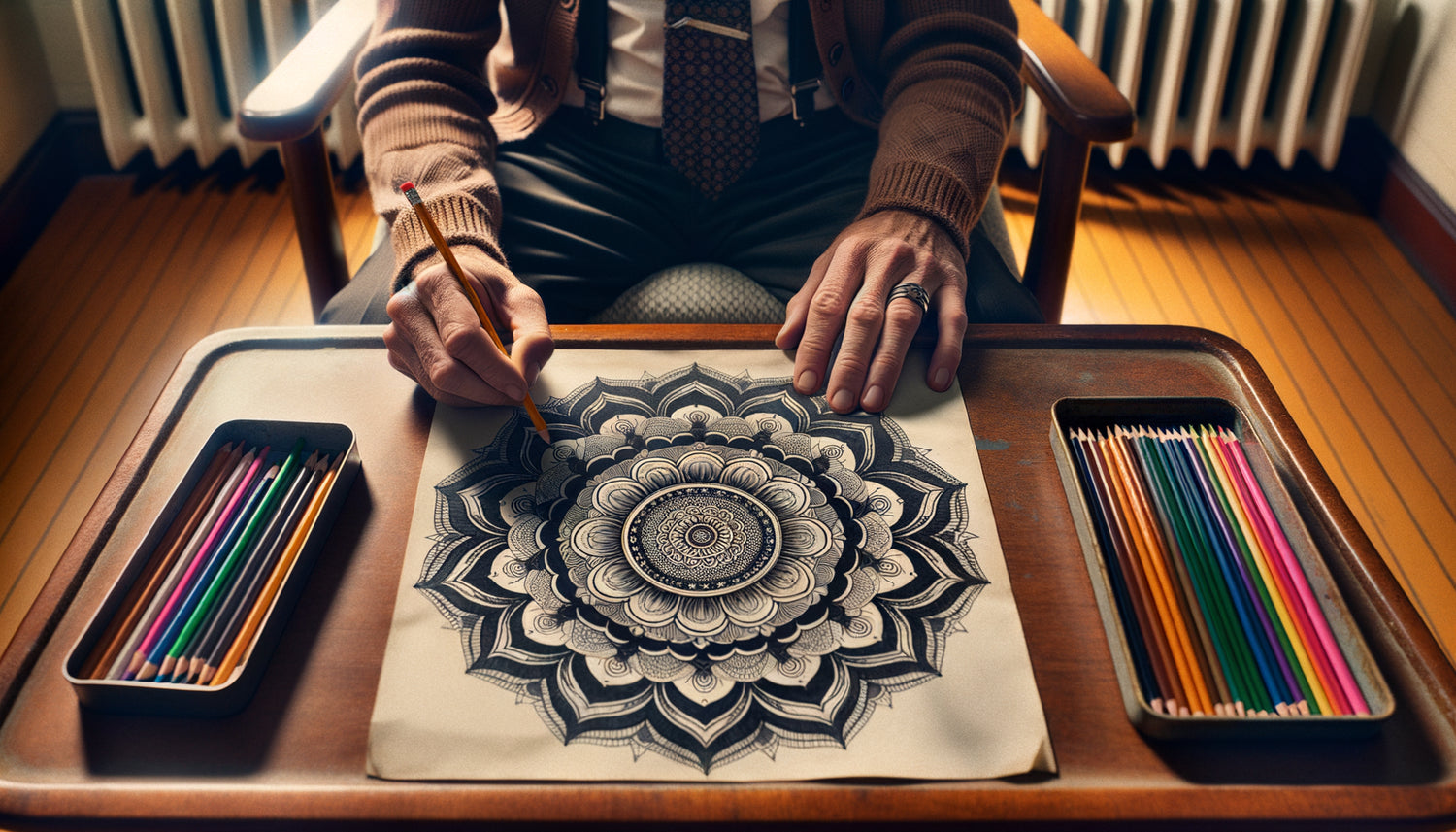
I discovered this practice twelve years ago, during a visit to a psychiatric clinic in Basel. On a coffee table, some colored pencils and sheets printed with concentric circular patterns. A patient was drawing, silently, focused. Her therapist then explained to me that these mandalas were not simple coloring pages, but therapeutic tools with fascinating origins, rooted in Jungian psychology and Eastern contemplative practices.
Here's what using mandalas in psychiatric waiting rooms brings: an immediate grounding in the face of anxiety, an active meditation accessible to all, and a symbolic space for inner exploration. These therapeutic circles transform passive waiting into a moment of recentering.
Many people feel intense tension in these medical spaces. Waiting becomes oppressive, thoughts race, the body tenses up. How to soothe this state without medication, without external intervention? How to offer a mental refuge in a place charged with emotions?
The answer lies in the unlikely encounter between modern Western psychiatry and ancient spiritual traditions. Mandalas have found their place in therapeutic environments thanks to a conceptual bridge built by Carl Gustav Jung, and this integration reveals a deep understanding of the human psyche.
I invite you to discover how these circular patterns have become essential therapeutic allies, and why their presence in psychiatric waiting rooms responds to fundamental psychological needs.
Carl Jung and the personal discovery of mandalas
The story begins in 1916, when Carl Gustav Jung goes through a period of profound existential crisis after his split with Freud. The Swiss psychiatrist spontaneously begins to draw circular shapes in his notebooks, without immediately understanding their meaning. Every morning, he traces a new circle, inscribing motifs that seem to reflect his psychological state at the moment.
This personal practice becomes a revelation when Jung discovers Tibetan and Hindu mandalas. He realizes that these sacred circular representations, used for millennia in Buddhist and Hindu traditions, exactly correspond to the drawings he was producing intuitively. The term mandala, which means circle in Sanskrit, refers to these symbolic diagrams representing the universe, the inner and outer cosmos.
For Jung, this synchronicity was not a coincidence. He saw it as an expression of a universal archetype, a psychic structure common to all humanity. Mandalas thus become manifestations of the Self, the organizing center of the psyche. Their circular form symbolizes totality, integration, movement towards individuation.
From Jung's office to psychiatric institutions
Jung gradually incorporates mandalas into his therapeutic practice. He encourages his patients to create their own circular representations, observing that this process promotes the expression of unconscious content difficult to verbalize. Drawing mandalas becomes a projective method, allowing for the externalization of inner conflicts, anxieties, and repressed desires.
In the 1950s-1960s, this Jungian approach gradually spreads throughout European psychiatric institutions, particularly in Switzerland, Germany, and the Netherlands. Therapists note that psychotic patients, often disconnected from reality, find in the circular structure of the mandala a containing and reassuring framework. The closed shape of the circle offers a symbolic limit, a defined space where the fragmented psyche can attempt to reorganize itself.
Waiting rooms then become strategic places. Rather than leaving patients anxious while waiting, they are offered pre-drawn mandalas to color. This simple activity has several immediate therapeutic benefits: it occupies hands, focuses attention, calms the mind and prepares psychologically for consultation.

Why the circle soothes: psychological mechanisms
The circular shape has particular psychological properties. Unlike straight lines and angles which generate a dynamic of tension, the circle evokes completeness, protection, return to center. In the collective imagination, the circle represents the maternal womb, the original egg, the natural cycle of the seasons.
When an anxious person begins to color a mandala, several processes occur simultaneously. First, focused attention: the repetitive gesture of filling in the delimited spaces creates a form of active meditation. The mind, occupied by this simple task, ceases to ruminate. This is what neuroscience now calls the state of flow, that state of optimal concentration where the notion of time disappears.
Next, motor control: holding a pencil, choosing a color, respecting the outlines requires fine coordination which activates the prefrontal areas of the brain. This activation counteracts the hyperactivity of the amygdala, the center of fear and anxiety. Literally, coloring calms the emotional storm.
Finally, the symbolism of order: gradually transforming a black and white drawing into a harmonious colored composition provides a sense of accomplishment. For patients whose psychic life is chaotic, this experience of mastery, even minimal, is profoundly restorative.
Global expansion: from ashrams to hospitals
In the 1970s and 1980s, the movement of transpersonal psychology and the growing interest in Eastern meditative practices accelerated the adoption of mandalas in Western therapeutic settings. Psychiatrists like Stanislav Grof, a pioneer of psychedelic therapy, used mandalas to help patients integrate intense psychic experiences.
At the same time, art therapy developed as a discipline in its own right. Mandalas became one of the preferred tools of art therapists, who observed their effectiveness with diverse populations: hyperactive children, depressed patients, people suffering from post-traumatic stress, chronic illnesses.
Psychiatric waiting rooms widely adopted this practice because it addresses a concrete issue: how to transform an anxiety-provoking waiting area into a therapeutic preparation space? Mandalas offer an elegant, non-invasive and inexpensive solution. They do not replace medical treatment, but create a soothing environment.

Mandalas today: science and clinical validation
Contemporary research in neuroscience and clinical psychology scientifically validates what Jung had intuited. Recent studies demonstrate that coloring mandalas significantly reduces levels of cortisol, the stress hormone. Other works show an improvement in mood and a decrease in intrusive thoughts after only twenty minutes of practice.
A study published in 2005 in the
In modern psychiatric facilities, mandalas are no longer confined to waiting rooms. They are an integral part of therapeutic protocols in units for treating anxiety disorders, depression, eating disorders and addictions. Some services even offer custom mandala creation workshops, where patients draw their own circle rather than coloring pre-established models, thus reinforcing the individuation process dear to Jung.
Creating a soothing waiting area: design principles
Successfully integrating mandalas into waiting rooms goes beyond simply placing a few leaves on a table. The most advanced establishments think globally about the 'therapeutic environment'. Mandalas are part of a broader approach to patient-centered design.
The choice of models is important: overly complex mandalas can frustrate or cause anxiety, while too simple models do not engage attention sufficiently. Therapists generally select designs of moderate complexity, with clearly defined sections but varied enough to maintain interest.
The visual environment also plays a crucial role. Soft wall colors, natural lighting and the presence of natural elements (plants, organic materials) amplify the soothing effect of mandalas. Some institutions hang finished mandalas created by former patients, transforming the waiting room into a therapeutic gallery that testifies to the possible journey.
Transform your medical space into a haven of peace
Discover our exclusive collection of wall art for medical offices that combines contemporary aesthetics and soothing virtues for your patients.
Beyond the medical: the mandala as a universal practice
The history of mandalas in psychiatric waiting rooms reveals a broader truth: we all need 'grounding tools' in an accelerated and fragmented world. What began as a specialized therapeutic practice has spread into popular culture: adult coloring books have been a global success since 2010, with tens of millions of copies sold.
This democratization is evidence of a collective need for slowing down, re-centering, reconnecting with oneself. In our interiors, mandalas in the form of paintings, rugs, or even wall projections create focal points that invite contemplation. They are no longer reserved for therapeutic spaces but invest living rooms, bedrooms, and personal meditation areas.
Interior designers now integrate these symbolic circular forms into their projects, aware of their psychological impact. A large mural mandala in a living room becomes an energy center, a daily invitation to presence and harmony. In offices, these motifs provide a visual break from professional hustle.
Imagine your own space transformed. A waiting room, a consultation office, or even your living room where a mandala welcomes the gaze, instantly soothes the mind, recalls possible completeness. This millennial circle, crossing cultures and eras, continues to offer what we need most: a return to center, a visual refuge in chaos, a promise of totality.
Start simply. Choose a mandala that speaks to you, place it in a daily passage location, observe how your gaze naturally rests on it during moments of stress. You will then experience what Jung and millions of patients have discovered: the soothing power of the sacred circle.
Frequently Asked Questions About Therapeutic Mandalas
Do you need to have artistic knowledge to use therapeutic mandalas?
Absolutely not, and that's precisely their strength. Therapeutic mandalas require no prior artistic skills. Unlike free painting or drawing which can be intimidating, coloring mandalas offers a reassuring framework: the outlines are already drawn, all you have to do is choose colors and fill in the spaces. This simplicity is intentional. The goal is not to create an aesthetically perfect work, but to experience a soothing process. Even patients who haven't held a colored pencil since childhood quickly rediscover this simple gesture and can benefit from it immediately. The mandala welcomes all levels, all sensitivities, without judgment or expectation of performance.
How long do you need to color a mandala to feel a soothing effect?
Clinical research shows that the first anxiolytic effects appear after fifteen to twenty minutes of focused coloring. This is the time it takes for the brain to gradually switch to a state of active relaxation, comparable to meditation. However, there is no universal optimal duration. Some people feel soothed after just five minutes, while others prefer sessions of forty-five minutes to reach a deep flow state. In psychiatric waiting rooms, even short interactions with mandalas are enough to reduce pre-consultation anxiety. The essential thing is to respect your own rhythm, without forcing or timing the experience. The mandala invites you to move out of the logic of performance and into that of presence.
Can mandalas be used at home or are they reserved for medical settings?
Mandalas can be absolutely integrated into your daily life. Their therapeutic origin in psychiatry has revealed their effectiveness, but their use requires no medical setting. Many people incorporate mandala coloring into their evening ritual to unwind after a stressful day, or in the morning to start in a state of calm focus. You can create a small dedicated space at home with quality pencils and a selection of varied mandalas. Beyond coloring, installing representations of mandalas in your interior decoration extends their benefits: a mandala painting in your bedroom or meditation space becomes a daily focal point that recalls harmony and balance. The principles discovered in psychiatry apply to everyone: we all need accessible grounding tools.