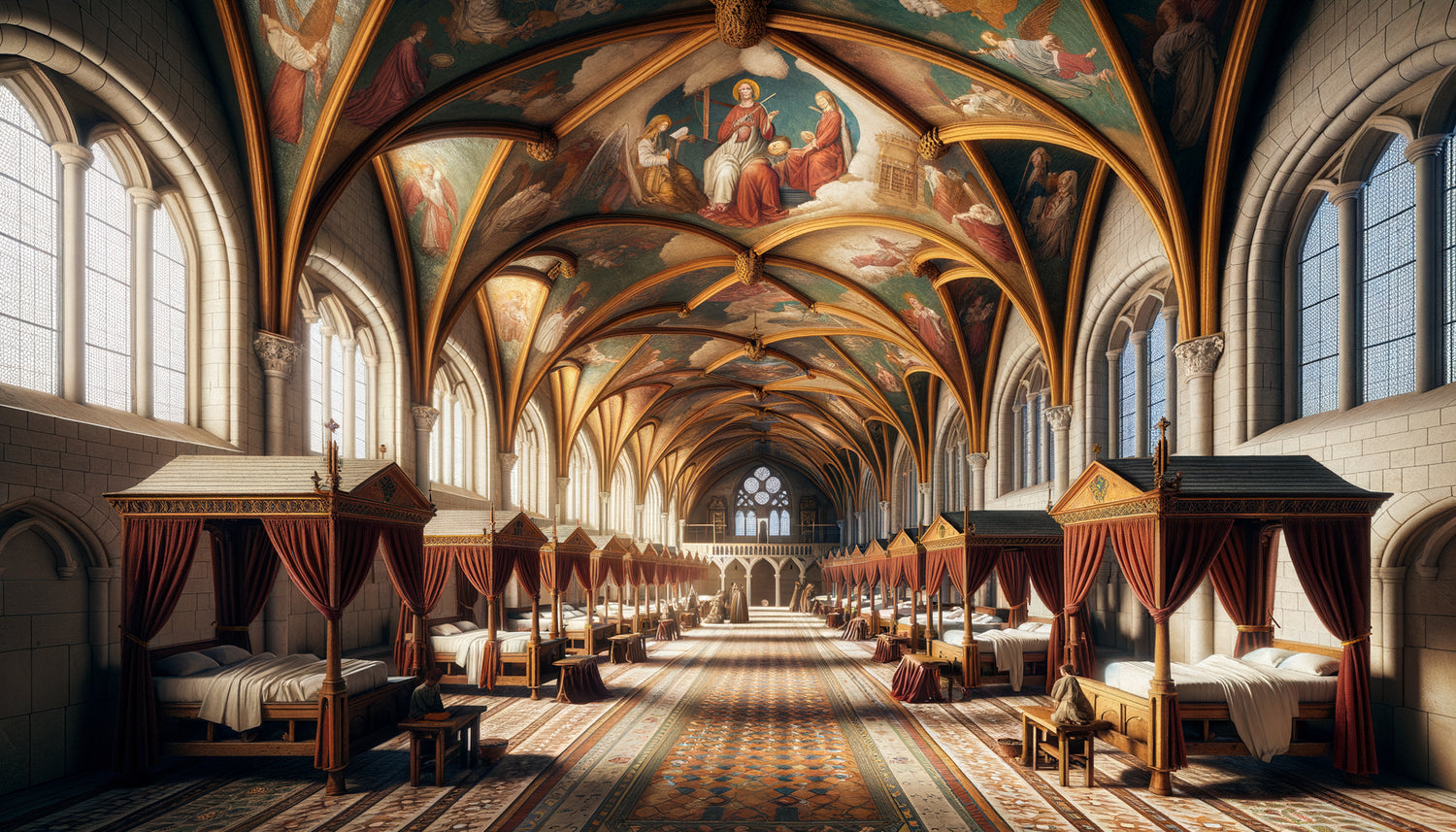
Imagine a moment: you are ill, lying on a wooden bed in an immense vaulted room from the 15th century. Your gaze rises to the ceiling, and there, you discover a striking sight. Scenes of the Last Judgment unfold before your feverish eyes, in an explosion of colors and monumental figures. Angels weigh souls, Christ reigns majestically, the damned scream while the elect rise towards the light. It's not a hallucination. It’s the daily life of the sick at the Hôtel-Dieu de Beaune, this Burgundian architectural masterpiece.
Here is what the frescoes of the Hôtel-Dieu de Beaune brought to medieval patients: spiritual preparation for death, psychological comfort in the face of suffering, and a holistic healing environment where the soul mattered as much as the body. Far from being simple decorations, these monumental works constituted a true medieval therapeutic protocol.
Today, when we visit this heritage gem, we admire the architecture, marvel at Rogier van der Weyden's polyptych, but rarely understand that these images were not intended for tourists. They healed. They soothed. They cured, in their own way. How could a painting have a medical function? What role did these frescoes play in the medieval conception of health?
Rest assured: you don't need to be an art historian or medievalist to understand this fascinating connection between art and medicine. I will reveal how, in the Middle Ages, the body was not separated from the soul, and how images actively participated in the healing process.
Prepare to discover an approach to care that could well transform your view of contemporary medical art.
Medieval medicine: when the soul precedes the body
To understand the medical function of the Beaune frescoes, you must first grasp the medieval vision of illness. In the 15th century, becoming ill was never simply a biological accident. It was a spiritual event, often interpreted as divine trial, punishment for sins, or an opportunity for redemption.
In this omnipresent Christian cosmology, the salvation of the soul took precedence over the healing of the body. A medieval doctor did not simply seek to lower the fever: he had to prepare his patient for a good death, one that opens the gates of Paradise. Physical treatments – bloodletting, decoctions, cataplasms – were systematically accompanied by prayers, confessions and spiritual preparation.
The Hôtel-Dieu de Beaune, founded in 1443 by Nicolas Rolin, chancellor of the Duke of Burgundy, perfectly embodied this philosophy. It was not just a hospital: it was a place of passage between earthly life and the afterlife, an anteroom to the Last Judgment. The sick entered there to be treated in their entirety: body, soul and spirit.
The Last Judgment polyptych: a monumental therapeutic tool
At the back of the Great Hall of the Poor, facing the rows of beds for the sick, stood the famous polyptych of the Last Judgement by Rogier van der Weyden. This masterful work, commissioned specifically for the hospital, was not hung in a private chapel or museum. It was exposed to the feverish gazes of the dying, day after day.
Why install such a terrifying representation of the Last Judgement before people already weakened by illness? The answer lies in the educational and preparatory function of this fresco. It reminded the sick of the possible imminence of their death and the need to repent, confess their sins, reconcile with God before the final passage.
This confrontation with the afterlife was not considered cruel, but as an act of medical charity. By encouraging the patient to put their conscience in order, the image contributed to their inner peace, reduced their existential anxiety and, according to medieval logic, facilitated physical healing or prepared for a serene death.
How images healed: therapy by contemplation
The medical function of the frescoes at the Hôtel-Dieu was not limited to spiritual preparation. It was part of a true image therapy, an ancestral form of what would now be called art therapy or positive psychology.
Vibrant colors, shimmering gold, harmonious compositions created a soothing visual environment. In the dimness of medieval hospital rooms, lit by candlelight, these luminous frescoes offered points of fixation for the eye and mind. They gave the sick something beautiful to contemplate, diverting their attention from physical suffering.
The scenes depicted – benevolent angels, protective saints, representations of Paradise – provided tangible psychological comfort. Seeing the elect welcomed into eternal blessedness offered hope. Observing holy figures interceding for sinners gave a feeling of being protected, accompanied in trial.
Architecture as medical prescription
The overall architectural design of the Hôtel-Dieu de Beaune functioned as a global therapeutic device. The Great Hall of the Poor, with its cathedral-like dimensions, its barrel vault polychrome arch, its painted beams with plant and heraldic motifs, created an atmosphere conducive to contemplation and healing.
The wall frescoes and decorated ceilings transformed the hospital space into a celestial microcosm. The sick were not abandoned in a cold and austere place: they were welcomed into a setting of beauty, a foretaste of Paradise that they hoped to join. This aesthetic dimension actively participated in the healing process.
Even the arrangement of the beds, all facing the altar and polyptych, followed a therapeutic logic. Each patient could, from their bed, visually participate in mass, contemplate the sacred images, maintain a constant connection with the divine. This spiritual continuity was considered a healing factor in its own right.

The hidden medical symbols in the frescoes
A careful observation of the frescoes of the Hôtel-Dieu reveals fascinating details, directly related to medieval medical practices. The saints depicted were not chosen at random: many were healing saints, invoked for specific illnesses.
Saint Roch, protector against the plague, regularly appears in medieval hospital iconography. Saint Cosmas and Saint Damian, 3rd-century martyr physicians, were the patrons of surgeons and apothecaries. Their presence in the frescoes served as a permanent invocation, a visual prayer for the healing of the sick.
The colors themselves had medical significance. Blue, obtained from lapis lazuli, was associated with the Virgin Mary and considered soothing. Red symbolized the blood of Christ, promise of redemption and eternal life. Gold, omnipresent, represented divine light, that which chases away the darkness of disease and death.
The cathartic function of the Last Judgement
The polyptych of the Last Judgment also fulfilled an essential cathartic function. By confronting patients with the representation of the afterlife, it triggered a process of introspection and psychological purification. Patients were encouraged to verbalize their fears, regrets, faults – a primitive but effective form of talk therapy.
This visual confession freed the patient from a considerable emotional burden. In a society where guilt and fear of damnation weighed heavily on consciences, this liberation had measurable physiological effects: stress reduction, better sleep, improved appetite, strengthening of the immune system according to current knowledge in psychoneuroimmunology.
The contemporary legacy: when art still heals
Today, as Western medicine rediscovers the importance of environment in the healing process, the example of the Hôtel-Dieu de Beaune takes on a particular resonance. Neuroscience research confirms that exposure to beauty, harmonious colors and soothing images reduces stress, decreases pain perception and accelerates recovery.
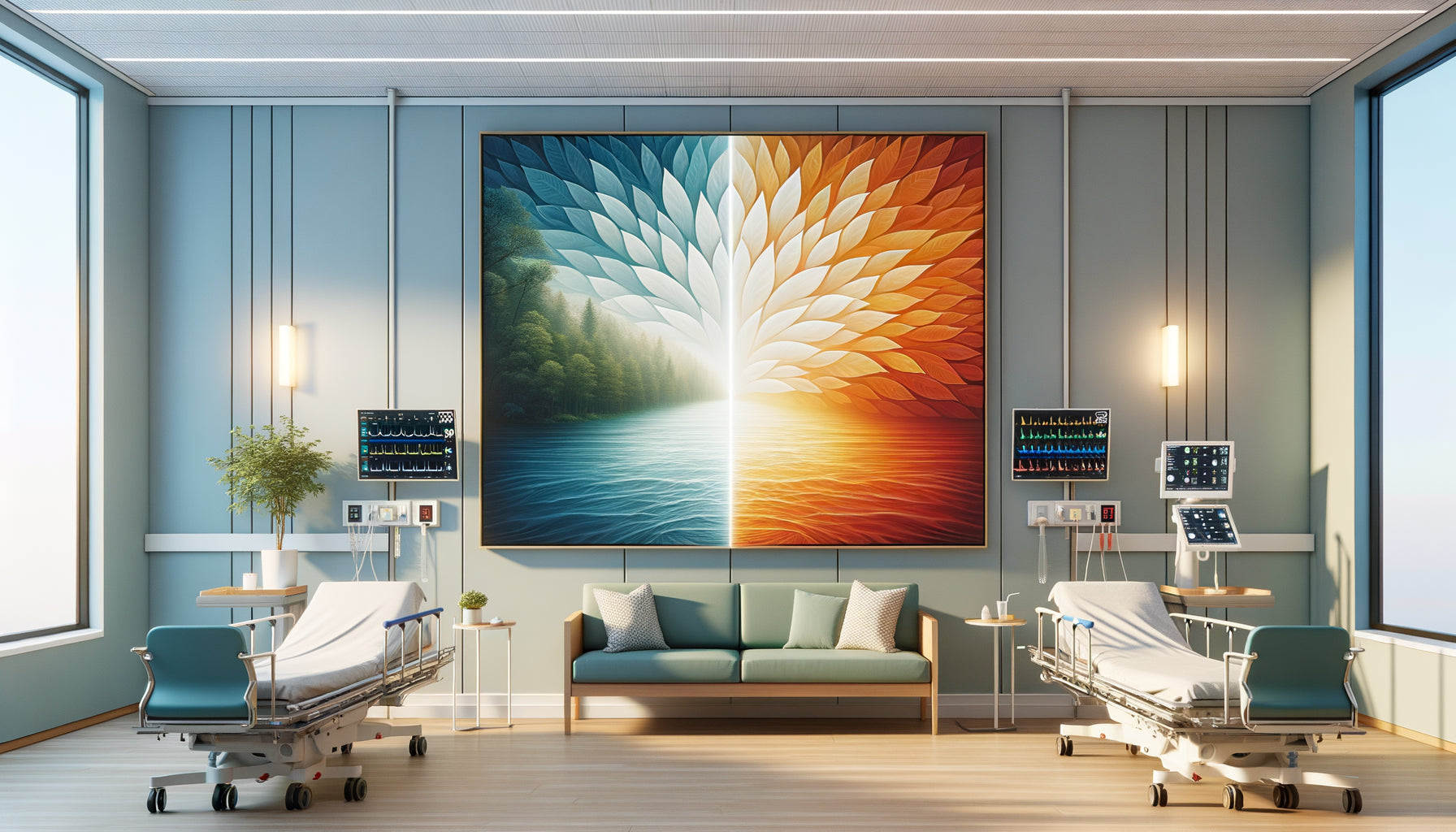
Many contemporary hospitals now integrate art into their care spaces. Wall artworks in the corridors, frescoes in the rooms, therapeutic gardens – all echoes of this medieval wisdom which considered beauty as a healing factor. The holistic approach of the Hôtel-Dieu, which treated both body and mind, inspires today's integrative medicine practices.
Modern medical offices that carefully choose their wall decorations are, in essence, perpetuating a centuries-old tradition. A waiting room adorned with soothing images, a hospital room brightened by soft colors, a consultation office decorated with care: these aesthetic choices are not superficial. They actively contribute to the psychological comfort of patients and, indirectly, to their healing.
Transform your medical space into a holistic care environment
Discover our exclusive collection of wall art for medical offices that combines refined aesthetics and psychological benefits, in the pure tradition of great historical hospitals.

Beaune and beyond: the revolution of care through image
The frescoes of the Hôtel-Dieu de Beaune were not an isolated case. Throughout medieval Europe, hospital institutions decorated their walls with religious and edifying scenes. The Santa Maria della Scala Hospital in Siena, the Ospedale degli Innocenti in Florence, the Hôtel-Dieu in Paris: all shared this conviction that the visual environment contributed to care.
This medical function of art extended beyond the hospital setting. In private homes, wealthy families hung images of healing saints in the bedrooms of the sick. Ex-votos, these small votive paintings commissioned in thanks for a cure, covered the walls of sanctuaries. The image was everywhere present in the medieval therapeutic process.
Today, as we redecorate our interiors, choose our paintings, create our living spaces, we can draw inspiration from this ancient wisdom. Our aesthetic choices are never neutral: they influence our mood, our energy, our well-being. A carefully chosen painting in a bedroom, living room or office is not just a decorative element. It's a daily companion that nourishes our psyche, soothes our tensions, elevates our spirit.
The Beaune frescoes remind us that beauty is not a superfluous luxury, but an essential necessity. In a world where we spend most of our time indoors, surrounded by screens and neutral surfaces, reintroducing the contemplation of images full of meaning and harmony becomes an act of self-care.
Your space, your healing sanctuary
Now imagine your own interior transformed according to these revisited medieval principles. No need for monumental frescoes or Flemish polyptychs to benefit from these benefits. A carefully chosen painting, with harmonious colors, depicting soothing or inspiring scenes, can create the same effect of comfort and elevation.
In your bedroom, a work in soft tones will promote restorative sleep. In your living room, a balanced composition will create an atmosphere conducive to serene exchanges. In your workspace, a stimulating image will support your creativity and concentration. Each room can become a therapeutic micro-environment, like these great medieval hospital halls.
The lessons of the Hôtel-Dieu de Beaune are universal and timeless. They teach us that taking care of our visual environment is taking care of ourselves. That beauty is not vanity, but medicine. That the images we contemplate daily shape our state of mind, our resilience, our ability to overcome trials.
So, the next time you choose a work for your interior, think of the sick of Beaune looking up at these magnificent frescoes. Ask yourself: does this image soothe me? Does it inspire me? Does it give me hope, strength, serenity? If the answer is yes, you have just found your own artistic prescription, your personal fresco for a more harmonious life.
Did the frescoes of the Hôtel-Dieu de Beaune have a medical function? Absolutely. They healed the soul to heal the body, soothed the mind to relieve the flesh, prepared for death to better celebrate life. And this medieval wisdom still resonates today, reminding us that art and health have always been, and will always be, intimately linked.