

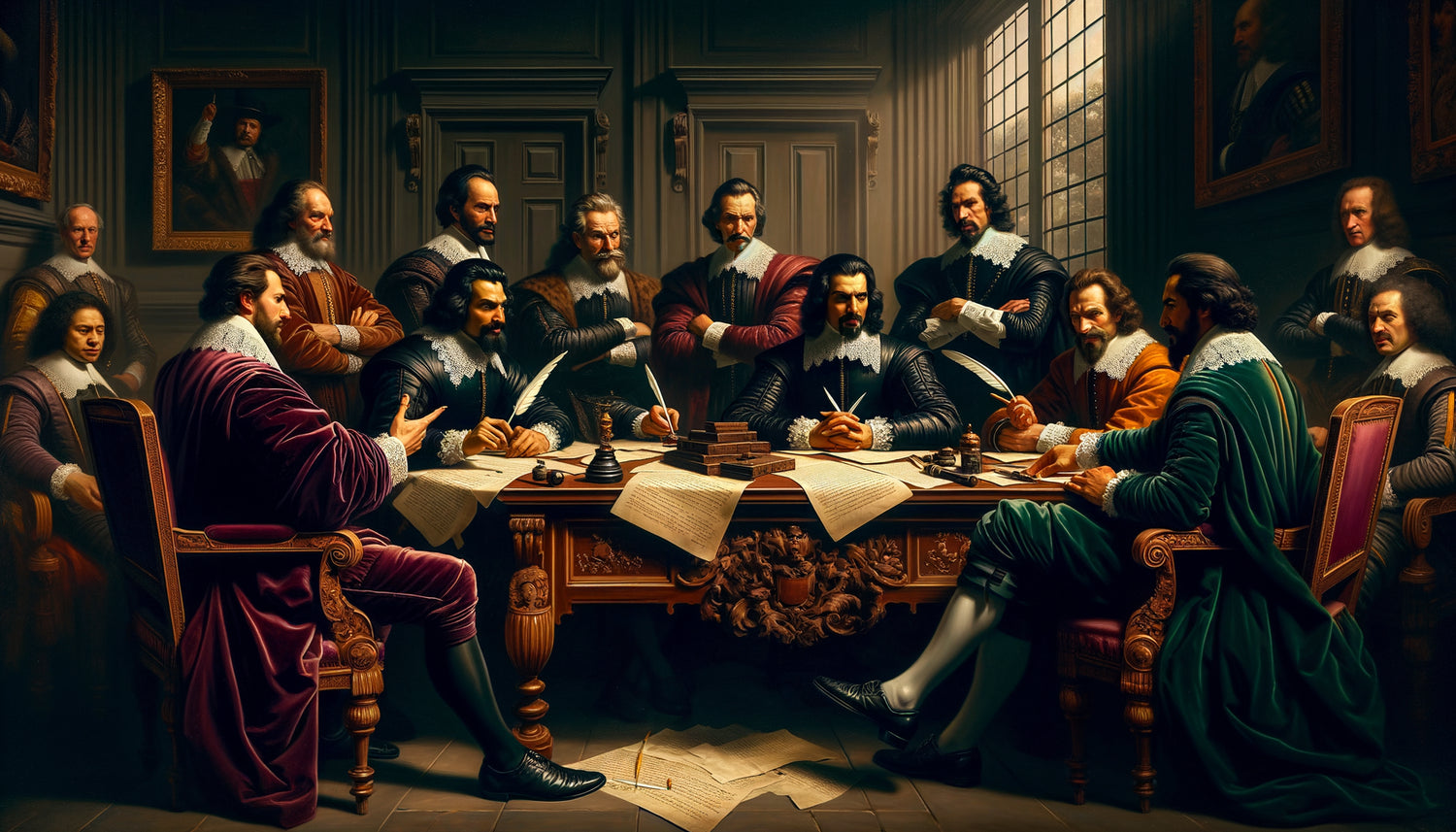
In the hushed silence of a Parisian law firm, a young lawyer looks up from his file. Facing him, hanging on the wainscoted wall, is a 17th-century painting depicting merchants in full negotiation. Their hands frozen in eloquent gestures, their intense gazes, this palpable tension... Something about this scene resonates deeply with his own daily practice.
Here's what negotiation paintings bring to legal professionals: a source of psychological inspiration to better decode human dynamics, a symbolic anchor that strengthens the legitimacy of their professional space, and a subtle mental preparation tool before decisive meetings.
Yet, many lawyers still hesitate to invest in meaningful wall decor. Due to lack of time, fear of making too personal a choice, or simply because they don't measure the silent impact these images have on their state of mind and that of their clients. Their office remains functional but impersonal, like an empty shell that tells nothing about their approach, their values.
Rest assured: choosing works depicting negotiation scenes is not reserved for enlightened collectors. It is above all a strategic decision, a way to transform your professional environment into a daily ally. I will show you how these paintings become much more than simple decorative elements.
When art history meets legal practice
Negotiation scenes have crossed the centuries in Western painting. From Flemish commercial exchanges of the 16th century to diplomatic negotiations immortalized by court painters, these compositions reveal a fascinating constant: body language always takes precedence over words.
In a classic negotiation painting, observe the hands. They point, weigh, measure, argue. Artists spent hours perfecting these gestures because they knew they carried all the narrative tension. A merchant who firmly places his palm on the table does not negotiate in the same way as one whose fingers nervously tap on a document.
For a lawyer, contemplating these details daily unconsciously sharpens observation. Before a difficult mediation, this trained gaze will capture the clenching of a jaw, the hesitation in a backward movement, the precise moment when the other party becomes receptive. Negotiation paintings thus become silent manuals of non-verbal communication.
The symbolism of objects in painted scenes
Old masters always integrated objects charged with meaning into their negotiation scenes. A balance suggests the fairness sought. An hourglass recalls the urgency of time. Sealed documents evoke formal commitment. This symbolic richness creates multiple levels of reading that nourish professional reflection.
A law firm specializing in commercial law might prefer paintings depicting trade exchanges, while a family mediator would identify more with intimate scenes of reconciliation. The choice thus becomes a visual extension of your area of expertise.
The psychological impact on your professional state of mind
I remember this social law lawyer who had hung in her office a reproduction of a 19th-century union negotiation. She confided to me that this painting reminded her every morning why she had chosen this profession: to find solutions where conflict reigns.
Negotiation scenes have this unique ability to maintain productive tension without tipping into aggression. The characters are focused, determined, but rarely hostile. This contained energy inspires an ideal state of mind for legal practice: firm yet open to dialogue, strategic but ethical.
Unlike portraits of stern judges or allegories of Justice that can seem rigid, negotiation paintings show the law in action, in its most human and pragmatic dimension. They remind us that behind each case are people seeking an acceptable agreement.
A visual anchor before decisive moments
Some lawyers develop a simple but powerful ritual: before an important negotiation, they take thirty seconds to observe their painting. This moment of visual centering acts as a discreet mental preparation. The brain aligns with the energy of the scene depicted: calm, focus, strategy.
This practice is akin to the visualization techniques used by high-level athletes. By visually immersing yourself in a successful negotiation, even fictional or historical, you positively condition your own performance. Negotiation scenes in your environment become triggers for professional excellence.

How these paintings transform your clients' perception
Your nervous client waits in the waiting room. Their gaze wanders, looking for somewhere to settle down to calm their anxiety. If they come across a painting depicting a historical negotiation scene, something subtle happens.
First, a sense of professional legitimacy emerges. The artistic choice reveals that you don't consider your office as a mere functional space, but as an area for reflection on your profession. This inspires confidence: if you pay this attention to your environment, you will do so for its file.
Next, these paintings implicitly communicate your approach. Negotiation scenes suggest that you prioritize dialogue and solution-finding. For a client fearing a long and costly trial, this visual message reassures them before even the first exchange.
A conversation starter that relaxes the atmosphere
Negotiation scenes also offer a practical advantage often underestimated: they are excellent icebreakers. A particularly tense client can be invited to observe the painting, to imagine the story behind the scene. This cultural digression of a few moments lowers emotional defenses and then facilitates entry into the legal matter.
I have seen lawyers use their negotiation painting to concretely illustrate their strategy: 'You see how this character keeps his cards close to him? That's exactly what we're going to do with this sensitive information until the right time.' The work becomes an unexpected teaching tool.
Finding the negotiation scene style that suits you
Not all negotiation scenes are equal according to your professional personality. A criminal defense lawyer with a combative temperament may identify with tense, almost theatrical negotiations where each protagonist fiercely defends their position.
Conversely, a notary or family law attorney will prefer calmer scenes showing parties visibly reaching common ground. The body language of the characters is relaxed, their faces show relief. These paintings project the positive outcome of the process.
Contemporary negotiation scenes, with their more refined aesthetics and modern colors, are particularly suitable for corporate law or intellectual property firms. They evoke the current corporate world while retaining that timeless dimension of human negotiation.
The balance between inspiration and professional decoration
A trap to avoid: choosing a negotiation painting that is too dramatic or conflictual. You are looking for inspiration, not daily anxiety. The best works maintain a productive tension without tipping into confrontation. Observe the lighting of the scene, the overall composition: do they generate stimulating or oppressive energy?
The color palette also matters. Warm tones (ochres, browns, golds) create a reassuring atmosphere that suits mediation spaces. Cooler tones (blues, grays) evoke seriousness and intellectual rigor, ideal for a personal office where you prepare your files.
Transform your law firm into a daily source of inspiration
Discover our exclusive collection of wall art for law firms that combine professional legitimacy and visual impact to support your legal excellence.

Integrating negotiation scenes into different areas of the law firm
Your law firm has several rooms with distinct functions. Each deserves specific consideration regarding the appropriate type of negotiation scene.
In the waiting room, prioritize scenes showing negotiations clearly leading to an agreement. You want to project a positive outcome, reassuring your clients about your ability to solve their problem. A scene depicting hands shaking after a successful negotiation works perfectly.
In your private office, dare to use more complex, intellectually stimulating compositions. These paintings will only be seen by you and your close colleagues. They can be more subtle, more ambiguous, reflecting the true complexity of legal negotiations. A scene with multiple protagonists with divergent interests will stimulate your strategic thinking.
For the meeting room where your negotiations actually take place, the choice becomes almost strategic. Some lawyers deliberately opt for scenes showing the importance of compromise and dialogue. The painting becomes a silent actor in the negotiation, subconsciously reminding parties that finding an agreement is an ancient and noble art.
Beyond aesthetics: an investment in your professional excellence
Considering negotiation paintings as mere decorative elements would be reductive. They represent an investment in your cognitive and emotional environment. You spend thousands of hours in your law firm: every visual detail imperceptibly influences your state of mind, your creativity, your resilience.
Imagine yourself in six months, preparing a particularly thorny file. Your gaze naturally rises to the negotiation painting you have chosen. For a few seconds, you observe the posture of the lead negotiator, their way of holding their documents, the attention they pay to their interlocutor. An idea arises to unlock your own situation. This moment of visual connection has just transformed your approach.
It is this accumulation of daily micro-inspirations that justifies investing in meaningful works. Negotiation scenes do not shout their presence; they whisper timeless lessons about the art of dialogue, persuasion, and finding acceptable compromise.
By consciously choosing to surround your professional practice with these powerful images, you create an environment that elevates you. Your office ceases to be a simple workplace to become a space for cultivating legal excellence. And this transformation, your clients intuitively perceive it as soon as they walk through your door.
Frequently Asked Questions about Negotiation Paintings for Lawyers
Could these paintings risk appearing too intellectual or intimidating to some clients?
This is a legitimate concern, but experience shows exactly the opposite. Negotiation scenes, unlike abstract legal symbols such as scales or codes, represent deeply human and universal situations. Even without particular artistic culture, your clients instinctively recognize these dynamics: people discussing, evaluating, seeking common ground. This familiarity reassures rather than intimidates. Moreover, you can always choose reproductions in an accessible style, with warm colors and a clear composition, rather than too dark or complex works. The goal is not to impress with your erudition but to create an environment that communicates your approach centered on dialogue and solutions.
What size painting should I choose for a medium-sized law office?
For a standard professional office (between 12 and 20 m²), aim for a medium to large format that asserts itself visually without dominating the space. An ideal dimension is between 80x60 cm and 120x80 cm for the main wall behind your desk or facing your client reception area. This size allows you to appreciate the details of the negotiation scene without having to approach too closely. Rule of thumb: the painting should occupy about one-third to half the width of the wall on which it is hung. If your office is smaller, several medium formats (60x40 cm) in composition can create an interesting gallery effect. The essential thing is that the painting is large enough to distinguish the expressions and gestures of the characters represented, because that is where the inspiring power of these scenes lies.
Is it better to invest in an original artwork or a quality reproduction?
This decision depends on three factors: your budget, the image you want to project, and your personal relationship with art. A high-end reproduction of a famous historical negotiation scene (printed on canvas with protective varnish) offers excellent value for money and allows access to iconic compositions for just a few hundred euros. It is perfectly suited to most offices and sacrifices nothing to the daily visual impact. An original contemporary artwork, on the other hand, represents a more significant investment (generally several thousand euros) but brings a unique dimension: you are the only one who owns this specific piece. This can favorably impress a high-end clientele and demonstrates an authentic cultural commitment. My advice: start with one or two quality reproductions for the main spaces, then gradually invest in originals for your personal office if the subject really inspires you.


