The phone rings at 6 a.m. It's your insurer. Your office has been burglarized during the night. The furniture is intact, as is the computer equipment. But the wall in the managing director’s office is bare: your 19th-century oil painting, inherited from your grandfather and valued at €45,000, has disappeared. I've lived this scene three times in fifteen years as a consultant specializing in securing artworks for professional firms. And I can tell you that the pain far outweighs the market value.
Here’s what effective protection of a valuable painting brings: peace of mind to display your works without constant anxiety, preservation of your family or business heritage, and assurance that your cultural investment remains where it enhances your spaces. Because yes, a wall art transforms an office into an exceptional place, but this precious presence also attracts envy.
You may have already felt this nagging worry: is the painting that illuminates your meeting room really safe? Is that signed lithograph in your office truly secure? Every unknown visitor, every technical intervention becomes a source of diffuse stress. You find yourself avoiding certain publications on social media for fear of exposing your treasures to malicious eyes.
Rest assured: effectively protecting a wall art doesn't mean turning your office into a bunker or giving up the pleasure of displaying it. Modern solutions combine discretion, effectiveness and respect for the artwork. I’m going to share with you the devices that I have tested and validated in dozens of offices, from the most accessible to the most sophisticated.
Invisible anchoring: the first barrier against opportunism
The majority of painting thefts in offices are not committed by seasoned professionals, but by opportunists who seize an opportunity. A frame simply hung on a nail, even heavy one, can be detached in seconds during a late visit or moment of inattention.
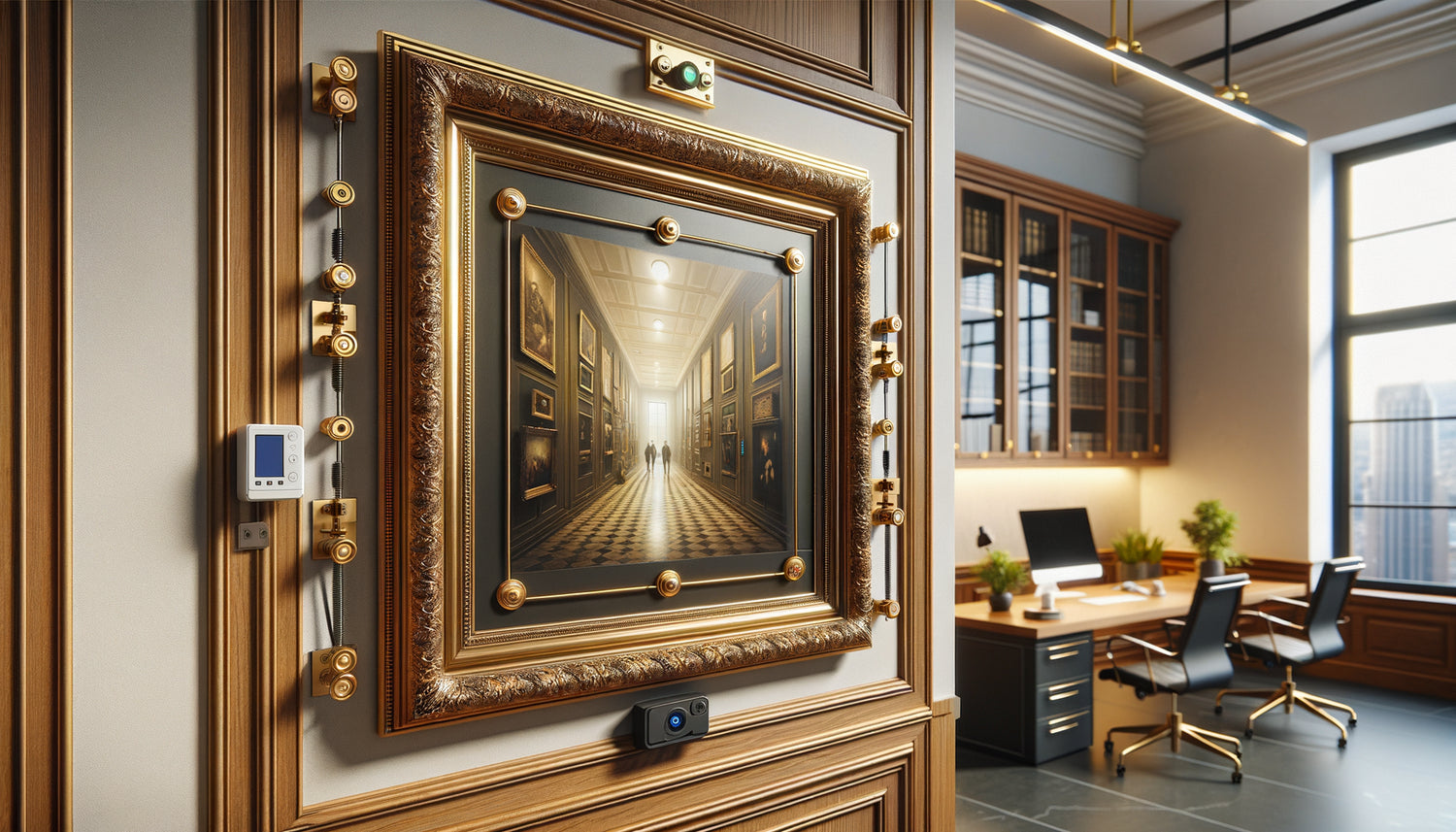
Secure anchoring systems constitute your first line of defense. I systematically recommend anti-theft screw fixings, with special heads requiring a proprietary tool for disassembly. These devices are completely hidden behind the frame and do not alter the aesthetics of your wall display.
For paintings of great value, I install wall fixing plates fixed directly into the wall studs, onto which the painting locks with a secure rail system. The frame seems to float naturally against the wall, but it is impossible to lift it without the appropriate key. This solution, which I implemented in a Parisian notary's office for a collection of antique engravings, offers an excellent balance between effectiveness and discretion.
Security cables: when discretion meets robustness
For offices receiving a large amount of public traffic, I often add steel braided safety cables connecting the frame to a reinforced wall anchor. Current models are remarkably thin and can be painted to match the color of the wall. They are practically invisible from more than a meter away, but offer considerable resistance to any attempt to pull them off. An architectural firm I work with has secured fifteen paintings in its open space without compromising the elegance of the premises.
Electronic detection: turn your painting into a sentinel
Mechanical anchors excel against impulsive theft, but when facing determined thieves with time, electronic detection becomes essential. These systems create a second layer of protection by turning any attempt at theft into an immediate alarm.
I favor detachment sensors for their ease of installation. Discreetly attached to the back of the frame, they trigger a loud alarm as soon as the painting is lifted or tilted beyond a predefined angle. Some models communicate directly with your central alarm system and send an alert to your smartphone. In a Brussels law firm, this solution allowed intercepting an attempted theft in flagrante delicto, with police arriving while the thief was still trying to disable the sensor.
For artworks of very high value, frames equipped with integrated sensors offer even greater protection. These devices continuously monitor the position of the painting, the ambient temperature and even abnormal vibrations. Any suspicious change generates an instant notification. I have equipped a collection of masterpieces in a corporate law firm: the manager receives a photo of his artwork every six hours and can remotely verify that everything is fine, even while traveling abroad.
Integration with video surveillance
An electronically protected painting is considerably more secure when coupled with targeted video surveillance. A discreet camera aimed at your artwork not only deters malicious intentions, but also provides irrefutable evidence in the event of an incident. Current connected models automatically detect suspicious movements around the painting and record in high definition. This approach has transformed the peace of mind of a specialized medical practice where a collection of contemporary art photographs represents an investment of over €80,000.

Protective Glazing: The Transparent Armor
Few owners think about it, but protective glazing is a remarkably effective physical barrier, particularly for artworks under glass. Replacing standard glass with security laminated glass or anti-break polycarbonate significantly complicates any attempt at quick theft.
These materials resist violent impacts without shattering into dangerous shards. A hurried thief attempting to rip the artwork from the wall would be faced with an intact surface, even after several blows. I have seen this solution save a rare watercolor during a nighttime break-in: the frame was damaged, but the glazing held, completely preserving the work.
For non-glazed oil paintings, custom-made transparent protective cases offer an elegant alternative. These high-transparency polycarbonate casings wrap the artwork in a practically invisible shell that simultaneously protects it from theft, splashes and unauthorized handling. A Parisian accounting firm displays three Impressionist paintings in its reception hall, completely secured without their clients noticing the protection.
When Your Environment Becomes Your Ally
Securing an artwork is not limited to the frame itself. The strategic placement of your work plays a decisive role in its overall protection. A painting displayed in an isolated passageway or near an exit will always be more vulnerable than a work visible from a permanently staffed reception desk.
In my security audits, I systematically recommend placing valuable paintings in naturally monitored areas: facing the desk of an assistant, in the line of sight of the reception desk, or in a room with controlled access. This arrangement costs nothing but significantly multiplies the psychological obstacles for a potential thief.
Dedicated lighting also plays a protective role that is often underestimated. A properly lit painting by spotlights naturally attracts attention. Anyone approaching it suspiciously will be immediately noticed. In a Lyon dental practice, this simple change in lighting, combined with secure fixings, was enough to deter two theft attempts in six months.
Discretion as a Strategy
Paradoxically, the less you draw attention to the value of your paintings, the better they are protected. Avoid ostentatious publications on social networks showing exactly where your valuable artworks are displayed. Limit the information given to occasional visitors about the provenance or price of your acquisitions. A professional thief often carries out reconnaissance by posing as a client or potential service provider.

Insurance and documentation: administrative protection
Even with the best physical security measures, an appropriate insurance coverage remains essential. Standard professional office insurance policies rarely cover artworks beyond very low ceilings. To truly protect your artistic heritage, a specific extension or a policy dedicated to valuable objects is necessary.
Create a comprehensive documentation file for each valuable painting: high-resolution photographs from multiple angles, certificates of authenticity, purchase invoices, expert reports. Keep these documents in a safe place, ideally digitized in a secure cloud. In the event of theft, this documentation will greatly facilitate procedures with your insurer and the authorities, and increase your chances of recovering the artwork.
Have your valuations regularly updated. The art market evolves, and a painting purchased for 15,000 euros ten years ago may now be worth three times as much. Your insurance coverage must follow this valuation. An architect's firm I work with updates its valuations every three years, guaranteeing fair compensation in all circumstances.
Your firm deserves artworks that inspire trust and excellence
Discover our exclusive collection of paintings for law firms that combine artistic prestige and formats designed for secure display in your professional spaces.
Smart solutions: when technology protects art
The latest innovations in artwork security incorporate surprising technologies. Invisible RFID tags inserted into the frame allow you to track your work remotely. If it crosses the threshold of your office, an alarm is triggered automatically. Some systems even communicate with international databases of stolen artworks, making resale practically impossible.
Miniaturized biometric locks represent the ultimate protection for exceptional collections. Discreetly integrated into the mounting system, they only unlock via fingerprint recognition. I have installed this solution in a family collection office where three generations of artistic acquisitions coexist: only the four partners can move the paintings.
For multi-site offices exhibiting valuable works, centralized management platforms allow you to monitor all your artworks simultaneously from a single dashboard. You visualize the status of each painting in real time, receive geolocated alerts and can even remotely activate enhanced protection protocols in case of identified threats.
Peace of mind restored: when protection becomes invisible
Imagine entering your office tomorrow morning. Your gaze rests on this magnificent oil painting that dialogues so well with the architecture of your study. This time, no anxiety comes to spoil this moment. You know that your painting is protected by discreet but highly effective devices. You can proudly share it with your clients, photograph it for your communication supports and even go on vacation with peace of mind.
This serenity is not an inaccessible luxury. It stems from protection choices adapted to the value of your works, the configuration of your spaces and your budget. Start with the fundamentals – secure fixings and strategic positioning – then gradually enrich your system according to your needs. The essential thing is to act now, before a 6 am phone call turns your nightmare into reality.
Your artistic heritage tells your story, your values, your vision. It deserves protection that matches it, invisible but relentless, which simultaneously preserves its beauty and presence. Because a protected painting is a painting that can finally fully express itself, without the shadow of risk tarnishing its brilliance.
Frequently asked questions about painting protection in offices
Will security systems damage my valuable painting?
This is a legitimate concern that all my clients share during our first meeting. The reality is reassuring: modern security devices are designed to fully preserve your works. Fixings are positioned exclusively on the frame, never on the canvas or support of the artwork itself. Electronic sensors are fixed by gentle adhesion, totally reversible and residue-free. I have secured 18th century paintings with systems that we removed five years later without any trace. The key is to call upon experienced professionals who understand the heritage value of your works. During installation, I systematically recommend the presence of an art restorer for exceptional pieces, guaranteeing impeccable handling. Your painting deserves protection that respects it as much as it secures it.
What budget should you allocate to effectively secure a painting worth 20,000 euros?
The question of budget always comes up, and my answer often surprises: you can obtain robust protection from as little as 200-300 euros for a work of this value. This amount covers professional anti-theft fixings, a discreet security cable and a quality autonomous detachment sensor. This is what I call fundamental protection, already infinitely superior to a standard hanging system. For 800-1200 euros, you gain access to complete securing with connected sensors, custom-made safety glazing and integration into your existing alarm system. High-end solutions with biometrics and intelligent monitoring start around 2500 euros, or about 12% of the value of your work. By comparison, an insurance excess after theft often represents 10-15% of the value, not to mention future increases in your premiums and irreplaceable emotional loss. Investing in preventative protection is always more sensible than dealing with a claim. And remember that some devices are eligible for discounts on your insurance premiums, partially amortizing the initial cost.
My office is small and receives few visitors, is securing it really necessary?
I regularly hear this argument, and I understand the reasoning. Yet, the statistics I have collected over fifteen years tell a different story. Theft of paintings in offices does not primarily target large, frequented spaces, quite the contrary. Small structures are often perceived as more vulnerable: less staff, sometimes basic security systems, predictable moments of solitude. One of my clients, a notary in a rural area with only two employees, was burgled on a Monday morning during the fifteen minutes when reception was empty. The thief clearly knew the structure's habits. The size of your office is not a protective factor; it can even be a vulnerability. In addition, maintenance interventions, cleaning, visits from prospects or evening appointments create as many opportunities in a small office as in a large structure. The real question is not how many people pass through, but what is the sentimental and financial value of your painting. If losing this work would cause you significant distress or economic harm, it deserves appropriate protection, regardless of the size of your office. Securing mainly provides that peace of mind that allows you to fully enjoy your artwork on a daily basis.