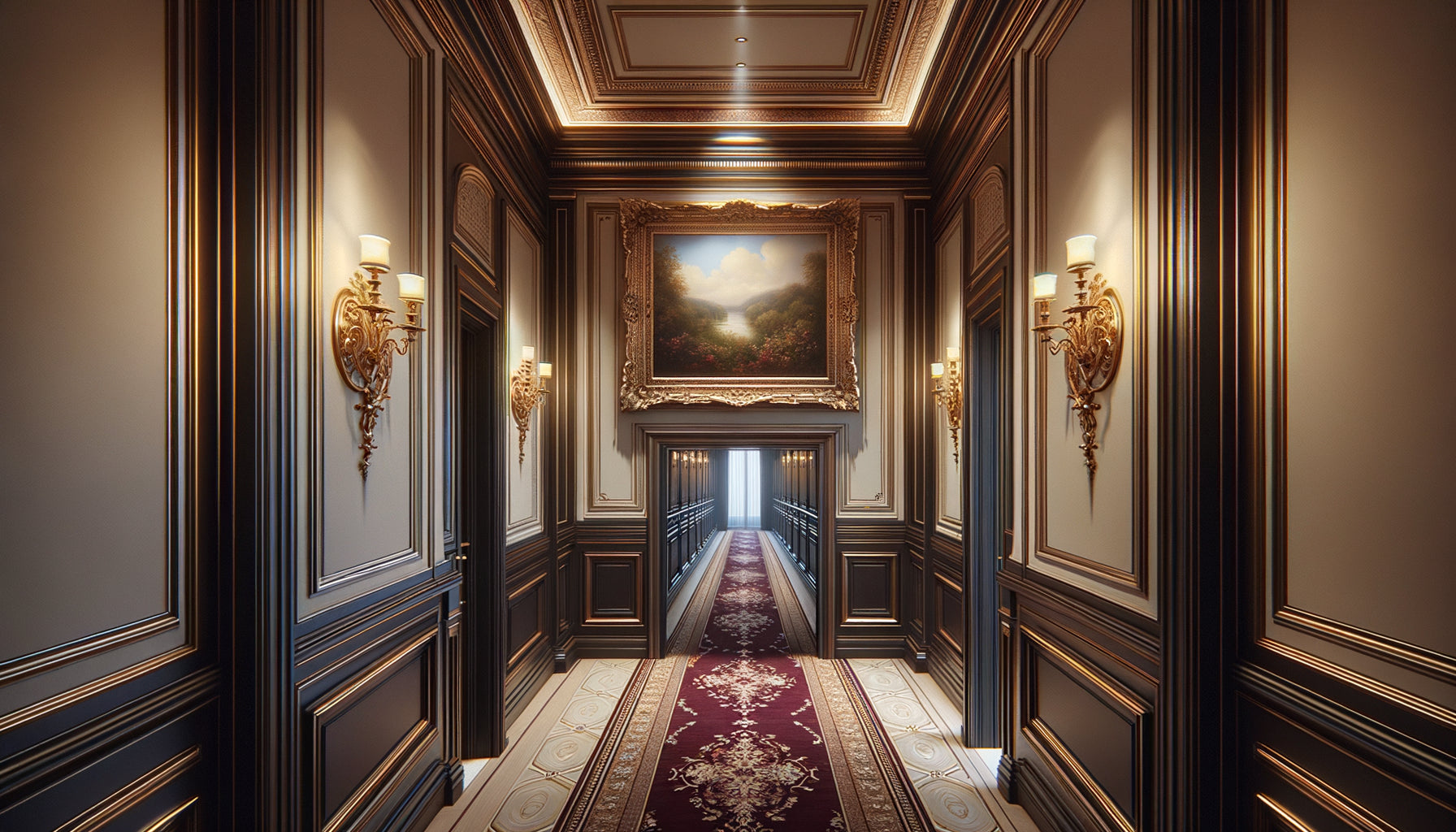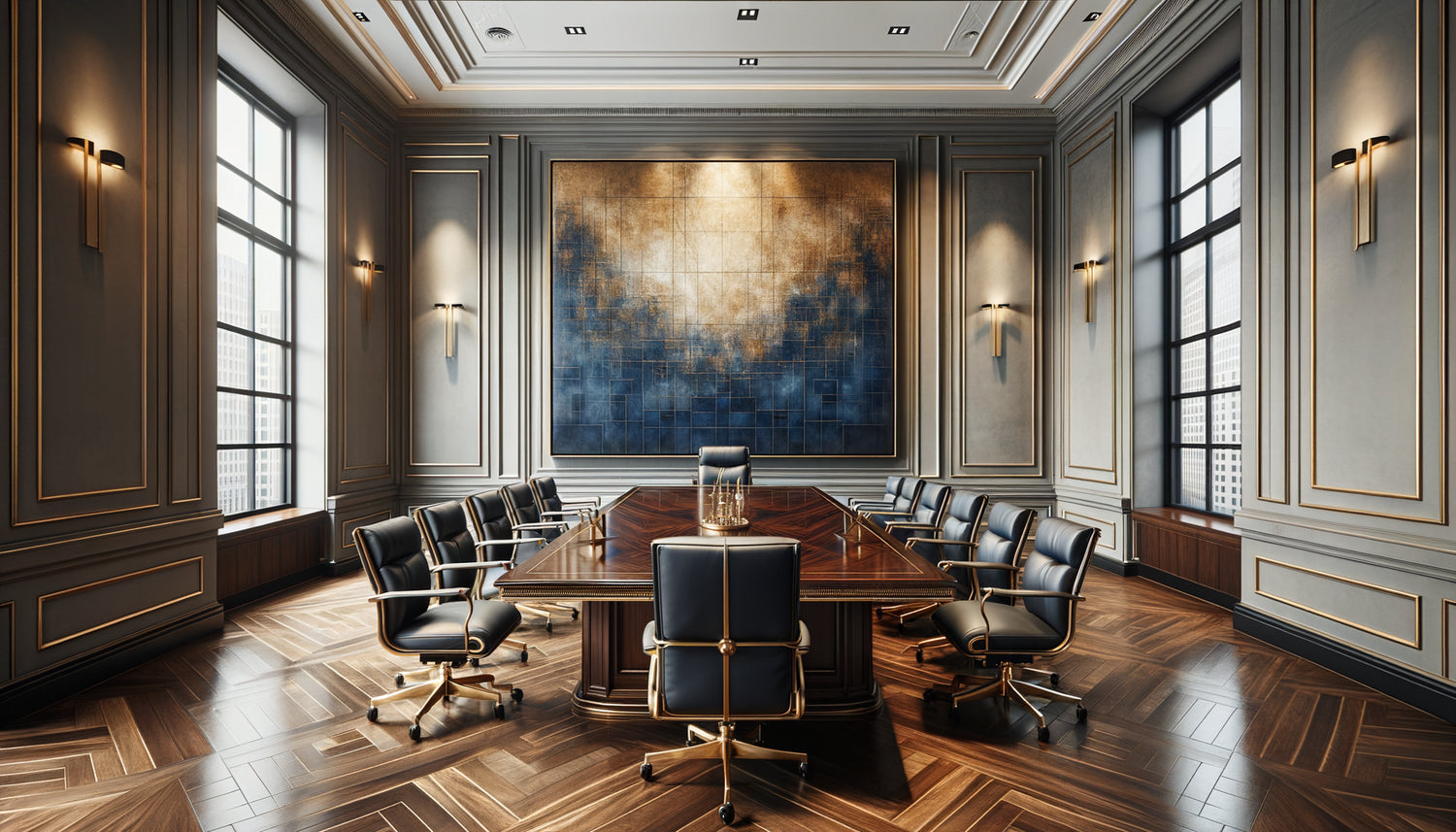
I spent fifteen years equipping prestigious law firms across Europe. From the hushed offices of London's City to the glass towers of La Défense, I observed how a wall art can transform an austere conference room into a reassuring place of power. Because in these spaces where millions are negotiated and destinies are sealed, every detail counts. The choice of a wall artwork is never trivial: it shapes the first impression, soothes tensions, and silently testifies to the firm's stature.
Here's what a strategically chosen wall art brings to your conference room: it immediately establishes your professional credibility, creates an atmosphere conducive to concentration and trust, and distinguishes your firm in a sector where image reflects competence. These three pillars transform a simple meeting space into a sanctuary of legal excellence.
You have probably noticed this discomfort: your conference rooms look like thousands of others. Impersonal white walls, imposing tables, and that visual void which amplifies every tense silence during difficult negotiations. Your wealthy clients, accustomed to refined environments, perceive this neutrality as a lack of identity. And in a sector where trust is built on imperceptible details, this gap may be costing you more than you imagine.
Rest assured: transforming this space does not require an unaffordable collection of contemporary art or pharaonic works. With a few proven principles and a fine understanding of the psychology of places of power, your conference room will become a strategic asset. I am going to reveal the visual codes that distinguish firms of excellence, these aesthetic choices that whisper: "We master every detail, including yours."
The psychology of wall art in the legal space
A wall art in a law firm's conference room does not decorate: it communicates. I measured its impact during renovations where we simply replaced existing artworks. Partners consistently reported smoother negotiations and more relaxed clients from their arrival. The reason? The human brain evaluates an environment in 50 milliseconds. This wall artwork becomes the visual anchor that unconsciously defines the tone of all subsequent exchanges.
In a legal context, this first impression must balance two opposing forces: authority and accessibility. Too austere, your room intimidates and closes dialogue. Too artistic, it distracts and casts doubt on your seriousness. The ideal wall art for a law firm navigates this subtle line, projecting competence without coldness, sophistication without ostentation.
I have observed that geometric abstract works excel in this delicate exercise. Their structured lines evoke order and intellectual rigor – cardinal qualities of your profession. Their balanced compositions convey stability and reliability. And their non-figurative nature avoids any narrative distraction, keeping attention on the crucial discussions taking place in the room.
The chromatic codes of power and confidence
The color palette of a wall art for conference room adheres to precise psychological rules. After equipping more than eighty offices, I have identified three dominant chromatic families that work infallibly.
Blue: serene authority
Wall art in deep blue tones – from navy to cobalt – dominate law firms specializing in business and tax. This color activates the brain areas associated with trust, stability and intelligence. A graduated abstract diptych behind the senior partner's desk instantly transforms their perceived stature. Clients subconsciously associate it with competence and calm under pressure.
I have particularly observed the effectiveness of blue during tense mediations and negotiations. Its visual presence measurably reduces tension in the room, fostering more constructive resolutions. A Parisian law firm specializing in family law saw its amicable settlement rates increase by 23% after installing a series of three slate blue canvases in their main conference room.
Sophisticated neutrals: timeless elegance
Wall art featuring grays, blacks, whites and beiges creates a backdrop of understated elegance. This chromatic approach is particularly suitable for firms cultivating an image of tradition and longevity – real estate law, inheritance, assets. The sophistication lies in the texture and nuances: a textured monochrome with subtle reliefs captures light differently depending on the time of day, creating a living presence without ever distracting.
These neutral palettes also offer strategic flexibility. They harmonize with any furniture, facilitating future changes to your layout. And they cross decades without ever looking dated – a major asset for an investment intended to last.
Golden and copper accents: subtle distinction
A wall art incorporating metallic touches – gold leaf, copper, bronze – immediately signals high-end. This technique works remarkably well for boutique firms serving an ultra-wealthy clientele. The metallic sheen evokes luxury without vulgarity, the reward of success, the value of the expertise you offer.
However, pay attention to dosage: these accents must remain subtle, integrated into a larger composition. A predominantly gray or blue abstraction with golden veins suggests excellence without ostentation. A completely gold painting would risk tipping over into arrogance – dangerous territory for a profession based on trust.

Dimensions and proportions: the art of monumental scale
The most common mistake I observe? Wall artworks ridiculously undersized for the room's scale. A 60x80cm canvas on a four-meter wall creates an effect of insignificance that subtly contaminates the perception of the entire office. In a professional conference room, think monumentally.
The golden rule: your wall artwork should occupy 50 to 75% of the width of the wall it adorns. For a 3.5-meter wall, aim for artworks 2 to 2.5 meters wide. This dimensional generosity projects confidence and ambition – exactly what your clients want to feel when entrusting you with their complex files.
Panoramic formats – triptychs, diptychs, elongated horizontal compositions – work particularly well in conference rooms. Their lateral extension naturally follows the geometry of the meeting table, creating a visual coherence that unifies the space. A 3-meter wide abstract triptych above the buffet or facing the entrance instantly becomes the focal point that structures the entire visual experience of the room.
Also consider the placement height. A wall artwork positioned too high disappears from the field of vision of seated people – exactly where your clients spend 95% of their time in your conference room. The center of the work should be 145-155 cm from the floor, standard eye level for a seated person. This position optimizes its psychological impact throughout meetings.
Artistic styles that reinforce your professional identity
The style of the wall artwork visually translates your strategic positioning. After hundreds of projects, I have mapped out the correspondences between artistic aesthetics and legal specializations.
Geometric abstraction rightfully dominates law firms specializing in business law, mergers-acquisitions, and corporate law. Its rigorous compositions, sharp lines, architectural forms evoke structured thinking and methodical analysis. A wall artwork with cubist or constructivist compositions instantly communicates: “We dissect complexity with surgical precision.”
Lyrical abstraction – these fluid compositions with organic shapes – is better suited to relational practices: family law, mediation, labor law. Its soft curves humanize the environment without compromising professionalism. A large format with soothing gradients creates an atmosphere where difficult emotions can be expressed within a contained framework.
Contemporary minimalism – vast expanses of color, streamlined compositions – projects modernity and efficiency. Ideal for innovative firms specializing in intellectual property, new technologies, startups. These wall artworks affirm: “We look to the future, we understand your world.”
Black and white photographic art – monumental architectures, graphic urban landscapes – works remarkably well for real estate law and urban planning. Photography grounds itself in reality, a reassuring quality when dealing with tangible assets and concrete heritage. A 2.5-meter triptych representing iconic architectural structures subtly reinforces your sector expertise.

Beyond aesthetics: functionality and durability
A wall artwork for a law firm must meet specific functional requirements. Maintenance is paramount: your conference rooms are high-traffic areas where surfaces quickly become dirty. Opt for artworks under glass or with protective varnish, easily cleaned with a slightly damp microfiber cloth. Avoid porous textures that accumulate dust and traces.
Resistance to light also counts. Conference rooms often benefit from large bay windows – an architectural asset that becomes a threat to artworks. Demand wall artworks created with UV-resistant pigments or protected by anti-reflective glass filtering harmful rays. An artwork that fades in three years projects negligence and deterioration – exactly the opposite of the desired message.
Also consider acoustics. Large canvases stretched on frames absorb some sound reverberations, improving auditory comfort during long meetings. This discreet function increases the perceived quality of your facilities without your clients consciously identifying its source.
Your conference room deserves a wall artwork that speaks the language of legal excellence
Discover our exclusive collection of wall art for Law Firms that transform your professional spaces into places of power and trust.
Strategic installation: locations that maximize impact
The placement of a wall art in your conference room radically influences its effectiveness. The optimal position depends on the spatial configuration and the power dynamics you want to create.
The wall facing the entrance is the premium location for a wall art with maximum impact. It's the first surface visible when discovering the room, a crucial moment where the initial impression is formed. A monumental work in this location immediately captures attention and defines the atmosphere of all subsequent interactions. This position is particularly suitable for firms receiving an international or prestigious clientele, where the subtle 'wow' effect reinforces the high-end positioning.
Behind the principal’s seat, the wall art acts as an authority amplifier. Clients seated facing this composition subconsciously perceive the lawyer as part of a visually powerful ensemble. This classic technique of power portraits – think of the paintings behind CEOs in boardrooms – transfers the symbolic authority of the work to the person it frames.
On the long side wall, an extended wall art creates an enveloping presence without dominating. This position is suitable for negotiations where you seek balance rather than asserted hierarchy. The artwork becomes an ambient element rather than a statement of power, facilitating collaborative discussions.
Absolutely avoid placing your wall art directly opposite a bright window. Constant reflections on the protective glass create a visual disturbance that distracts during meetings. Prioritize walls perpendicular to sources of natural light for optimal lighting revealing all the nuances of the work.
Investment and perceived value
Let's talk frankly about investment. A professional-quality wall art for a conference room represents a significant budget – generally between €1,500 and €8,000 depending on the dimensions and complexity. This sum hesitates some partners who perceive it as an optional decorative expense.
Let’s reframe the perspective: this same firm easily bills between €250 and €500 per hour. If this wall art helps secure a single major client who might have chosen a competitor, it pays for itself in a few billable hours. If its subtle impact improves your initial consultation conversion rate by 5%, it generates tens of thousands of euros in additional annual revenue. Considered from this angle, it is one of the most profitable marketing investments at your disposal.
Moreover, unlike advertising expenses or software subscriptions, a quality wall art retains its value. Well-chosen contemporary artworks often appreciate over time. You are not spending: you are reallocating part of your cash flow to a tangible asset that works for your image daily.
The perception of value is as important as the actual value. Your affluent clients subconsciously assess your firm through a thousand visual details. A clearly high-end wall art signals that you do not compromise on quality – a trait they hope to find in your legal work. It's an investment in trust, the raw material of your business.
Visualize Your Transformation
Imagine next time a potential client steps into your conference room. Their eyes immediately focus on that monumental wall art adorning the main wall. The geometric lines in deep blue and anthracite gray evoke structure, intelligence, mastery instantly. Without being fully aware of it, their breathing becomes deeper. The tension compressing their shoulders eases slightly. They think: “I’m in the right place. These people understand what matters.”
During the meeting, during inevitable moments of reflection, their gaze no longer wanders into the anxiety-inducing void of a white wall. They find a soothing visual anchor that maintains their confidence rather than amplifying their doubts. And when they leave your firm to visit two competitors in the afternoon, your environment will remain etched in their memory as the one where they felt safest and most understood.
Transform your conference room this week. Accurately measure your main wall. Identify your specialization and the emotions you want to evoke. Then find that wall art that will become the silent ambassador of your excellence, working for your reputation at every consultation, negotiation, mediation. The investment is modest. The impact, however, is monumental and permanent.
Frequently Asked Questions
What size of wall art should I choose for a standard conference room of 20m²?
For a 20m² conference room, aim for a wall art of at least 150-200cm in width if you install it on the main wall. The classic mistake is to undersize the artwork, creating an effect of insignificance. Measure your wall and multiply its width by 0.6 to 0.75 to get the optimal size of the artwork. If your main wall measures 3 meters, a work of art 180-225cm will work perfectly. For more confined spaces, a triptych or diptych allows you to obtain this monumental presence while maintaining some flexibility in installation. Remember: in the professional world of law where the stakes are high, dimensional generosity projects confidence and stature. A small painting subconsciously suggests timidity and lack of ambition – exactly the opposite of what your clients seek when choosing their legal counsel.
Should I prefer an original work or a reproduction for a law firm?
This question divides associates, and the answer depends on your strategic positioning. Original wall art – unique pieces created by contemporary artists – communicate exclusivity and investment in absolute quality, powerful messages for an ultra-wealthy clientele. They are also potentially financially appreciating assets. However, very high-quality art reproductions – giclée prints on canvas with textured finishes – offer a remarkable impact-to-investment ratio, particularly for growing firms or those with multiple conference rooms. The determining criterion is not original versus reproduction, but perceptible quality versus visible economy. A premium reproduction wall art at €2000 projects infinitely more credibility than a mediocre original artwork at the same price. Always prioritize visual impact and impeccable finish: your clients evaluate apparent quality, rarely artistic authenticity for which they generally lack the expertise to judge.
Can we regularly change wall art or is it better to keep the same work for a long time?
Permanence largely outweighs rotation in the legal context. A wall art that remains in place for years becomes an integral part of your firm's visual identity, a recognition element for regular clients who appreciate stability and continuity – cardinal values in long-term legal relationships. Prestigious firms I have equipped generally keep their major works for a minimum of seven to fifteen years, during which time they truly become iconic and associated with the firm’s reputation. Frequent rotation suggests inconsistency and instability, qualities problematic for a profession based on reliability. Therefore, invest in timeless rather than trendy wall art, favoring abstract compositions and classic palettes that will stand the test of decades without appearing dated. Exception: if you completely rearrange your spaces or radically redefine your positioning, changing the wall art can accompany and symbolize this strategic transformation. But in this case, consider it as reinvestment in a new visual identity rather than simple decorative refreshment.