

When I received the call from Master Durand, his request was clear but tinged with a certain urgency: she had just moved into her new premises and her white walls reflected anything but the atmosphere she wanted to create for her clients. These people who cross the threshold of a family law firm often carry invisible burdens: difficult divorces, contested child custody, intergenerational conflicts. Art on your walls is not simply decoration, it's your first silent gesture of welcome. Here's what a well-chosen painting brings to your firm: it creates a soothing atmosphere that relaxes anxious clients, it projects your professionalism while humanizing your practice, and it subtly communicates your values of listening and kindness. Perhaps you have already felt the frustration of seeing your clients arrive tense, shoulders hunched, eyes downcast. How can you establish a relationship of trust when the environment itself seems hostile or impersonal? Rest assured, this transformation does not require a pharaonic budget or a complete revolution of your visual identity. I will guide you towards artistic choices that will transform your firm into a space where emotion and reason can coexist harmoniously.
Why soft abstraction is your best ally
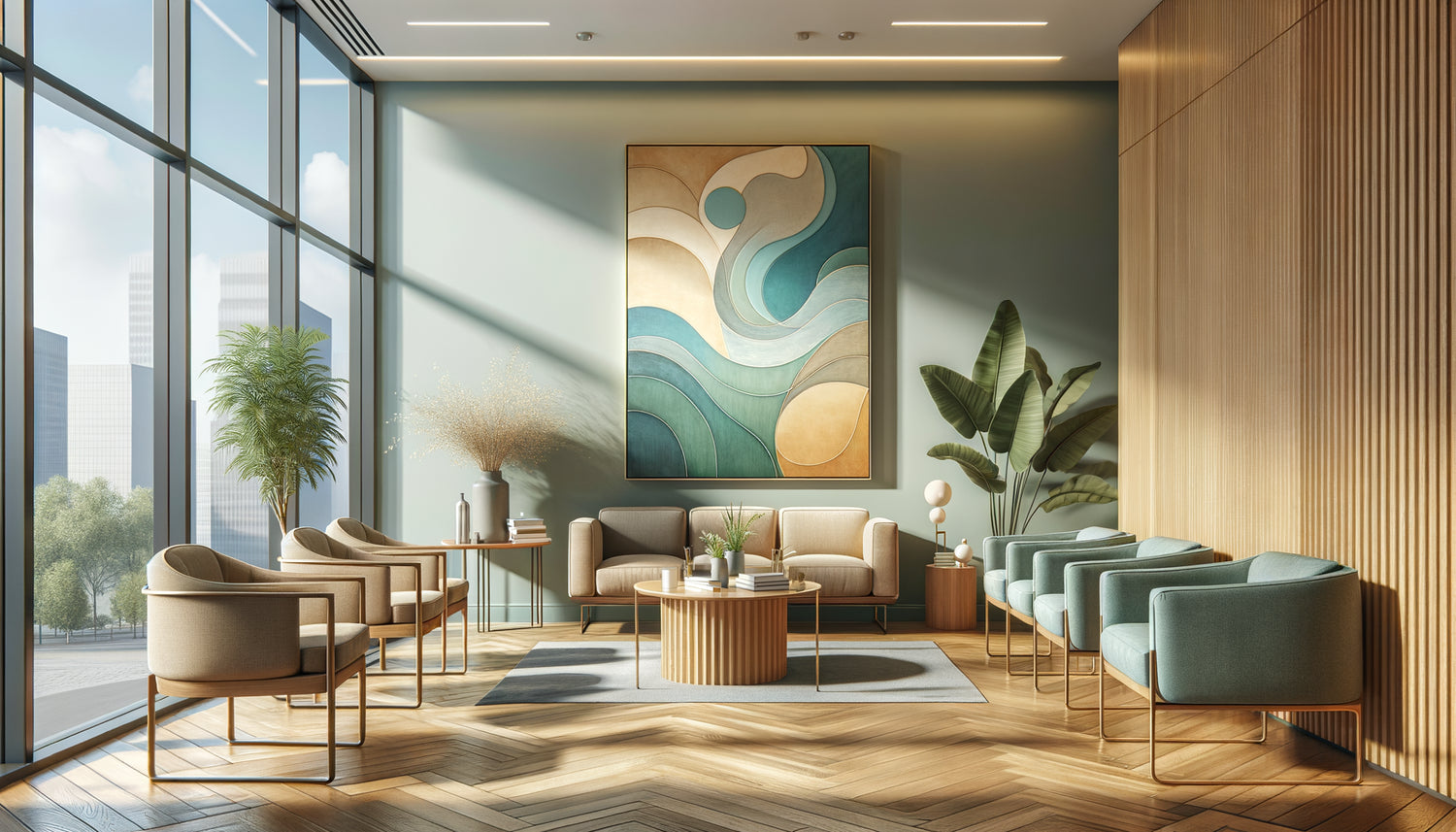
In a law firm specializing in family law, abstract art with soothing tones possesses a virtue that I have observed many times: it allows everyone to project their own interpretation without imposing a narrative. Unlike a figurative scene that could inadvertently recall a painful family situation, abstraction offers a neutral visual refuge. Prioritize compositions with muted shades such as deep blues, sage greens or powdery beiges. These colors possess a scientifically proven ability to reduce heart rate and anxiety.
I recently accompanied a Parisian firm that opted for a series of three abstract paintings featuring organic shapes in gradients of gray-blue. Their clients spontaneously commented on the more serene atmosphere of the waiting room. Soft geometric abstraction, with its flowing lines rather than aggressive angles, creates a visual balance without generating tension. Absolutely avoid chaotic compositions, violent contrasts or dominant reds that subconsciously activate stress responses. Your painting should function as a visual breath, an anchoring point of calm in the emotional storm that your clients are going through.
Contemplative landscapes: a window to serenity
If abstraction does not correspond to your sensitivity, pure and contemplative landscapes constitute a remarkable alternative for a family law firm. I am particularly thinking of minimalist natural scenes: misty forests, twilight seascapes, fields as far as the eye can see. These paintings offer what environmental psychologists call "restorative attention" – that ability that certain images have to rest our overloaded minds.
For a project with a Lyon-based firm, we installed a large canvas depicting a deserted beach at dawn in the mediation room. The client confided in me that several clients had spontaneously mentioned this painting as an element that helped them gain perspective. The choice of landscape must respect a fundamental rule : no visible human presence, no strong narrative elements. You are looking for universality, not anecdote. A snow-capped mountain, a rolling meadow, a forest path disappearing into the perspective – these subjects allow the eye to wander without encountering disturbing details. Horizontal formats, particularly in 100x70 cm or larger, amplify this feeling of openness and space.

Symbolic figurative art: when emotions become language
For firms who want a more narrative approach while remaining professional, symbolic figurative art offers a fascinating third path. I am talking here about compositions representing elements charged with universal meaning: a tree with visible roots, two paths that separate and then rejoin, open hands, bridges. These symbols speak directly to our collective unconscious without needing explanation.
In a Toulouse-based firm specializing in family mediation, I suggested a painting depicting a tree whose branches formed a protective circle. This image of continuity, rooting and growth resonated perfectly with the values of the firm. The key lies in subtlety : your painting should suggest, not impose. Avoid too literal representations of happy families or hands holding – they can create discomfort for clients going through a breakdown. Instead, favor visual metaphors: balance (natural scales, symmetrical compositions), passage (partially open doors, paths), or transformation (butterflies, seasons). These symbols convey discreetly a message of hope and possibility without denying the difficulty of the present moment.
The fatal mistakes to avoid at all costs
After advising more than fifty law firms, I have noticed recurrences in unfortunate choices. First mistake: works that are too personal or eccentric. Your passion for provocative contemporary art has no place in a waiting room where parents cross paths in tense situations. I saw one firm display an expressionist work representing a screaming face – the intention was artistic, the effect disastrous on already fragile clients.
Second pitfall: legal clichés. These reproductions of antique libraries, gilded scales of justice, or pompous Latin quotes. They create exactly the opposite of what a family law client seeks: institutional coldness where they hope to find humanity. Third common mistake: inappropriate formats. A tiny 30x40 cm painting lost on a four-meter wall unintentionally communicates indecision or lack of investment. Conversely, a monumental work in a small waiting room will create a feeling of oppression. The golden rule: your painting should occupy approximately 60 to 75% of the width of the furniture above which it is hung.
Fourth fault that I regularly observe: disordered accumulation. Three paintings of different styles, purchased at different times, coexisting without coherence. In a professional office, it's better to have one perfectly chosen quality painting than an eclectic gallery. Finally, be wary of works with explicit religious messages or cultural connotations – your clientele is diverse, and everyone should feel welcome without implicit judgment.

How to harmonize your paintings with your professional identity
The choice of a painting for your family law firm cannot be done in isolation. It must dialogue with your overall visual identity, your interior architecture and, above all, your philosophical approach to law. If your practice favors mediation and dialogue, opt for balanced compositions, harmonious colors, shapes that complement each other. If you defend a more protective and assertive approach to the interests of your clients, paintings with more defined structures and controlled contrasts can better convey this energy.
I always encourage my clients to consider the complete visual journey: what do you see from the entrance door? What painting welcomes you into the waiting room? Which work accompanies exchanges in your office? A Bordeaux firm I worked with created a true visual narrative: soothing abstraction in the waiting area, meditative landscape in the mediation room, symbol of growth in the main office. This consistency subconsciously reinforces the perception of professionalism and intentionality.
Also consider the lighting for your artwork – an element that is too often overlooked. A poorly lit work loses 70% of its impact. Install, if possible, indirect LED lighting that highlights textures and nuances without creating annoying reflections. The ideal color temperature is around 3000K, offering a warm light without distorting the colors. Well-lit artwork automatically becomes a focal point that structures the space and guides the eye.
The dimensions and formats that really work
The question of format always comes up during my consultations. For a law firm waiting room, I generally recommend formats between 80x60 cm and 120x80 cm. These dimensions offer a significant visual presence without dominating the space. In a consultation office, a slightly more modest format (70x50 cm to 90x60 cm) maintains the balance between artistic presence and professional functionality.
Horizontal horizontal formats create a feeling of openness and calm – particularly valuable in waiting rooms where anxiety can set in. Square formats bring stability and balance, interesting for offices where negotiations take place. Vertical formats, which are rarer in this context, may be suitable for narrow spaces or to create an impression of height and dignity in an entrance.
A technical detail that is often ignored: the frame thickness. A framed artwork with a minimum frame thickness of 4 cm offers a three-dimensional presence that adds perceived value and creates subtle shadow play on the wall. For more comfortable budgets, 6 cm frames truly transform the work into an architectural object. Absolutely avoid glossy glass prints which create annoying reflections and give a cheap impression – prefer canvases on stretcher bars or rigid support prints with a matte finish.
Transform your office into a welcoming and trustworthy space
Discover our exclusive collection of artwork for Law Offices that combines professionalism and human sensitivity, specially designed to create the calming atmosphere your clients need.
Visualize the transformation of your space
Now imagine your waiting room tomorrow morning. Mrs. Lefebvre walks in, her heart heavy, for your first consultation regarding her divorce. Instead of nervously staring at her phone or contemplating a blank impersonal wall, her gaze rests on this soothing seascape that you have chosen. For a few seconds, her breathing slows down. This artwork will not solve her legal problems, but it will create the necessary mental space to approach the conversation with a little more serenity.
Your office is more than just a place for legal transactions – it’s an emotional transition space where people come seeking solutions to their most intimate and painful situations. The artwork you choose contributes to this delicate alchemy between professionalism and humanity. It silently says: here, your story will be heard with respect, here, emotion has its place alongside reason. Start simply: identify the wall that greets your clients first, measure the available space, and choose a work that resonates with your values. This seemingly minor decision could transform the experience of hundreds of people who will walk through your door in the years to come.
Frequently Asked Questions about Choosing Artwork for Family Law Firms
Should I choose original artworks or reproductions for my office?
This question comes up consistently, and my answer may surprise you: for a law firm, perceived quality is more important than certified originality. A high-quality reproduction on textured canvas with a thick frame will create a far greater visual and emotional impact than a mediocre original artwork. The budget for an original work of art typically starts around €800-€1500, while a premium reproduction costs between €150 and €400 depending on the format. Your clients will never verify the authenticity of the artwork – they will simply feel the atmosphere it creates. Invest instead in a generous size, professional quality printing and careful framing. If your budget allows and you want to support local artists, an original work by an emerging creator can indeed add a unique dimension to your identity. But never sacrifice visual impact and suitability for your clients in favor of authenticity that no one will notice.
How do I know if a painting will really suit before buying it?
The fear of making a mistake paralyzes many professionals, and I completely understand it. Here is my proven method: first, always ask for a mock-up in situ. Most reputable suppliers can create a photomontage of the artwork on your wall from a simple photo. Secondly, test your visceral reaction: show the image to three people you trust without context and note their first words. If they use terms like “soothing,” “elegant,” “professional,” or “serene,” you are on the right track. If the reactions are “weird,” “sad,” or “aggressive,” run away. Thirdly, check the return policy – a seller confident in their products will accept a return within 14 to 30 days if the artwork is not suitable in situ. Finally, consider art rental as an option to test for a few months before making a final purchase – several platforms offer this service for €30 to €80 per month. This approach allows you to observe the real reactions of your clients before committing. Trust your professional intuition: you know your clientele better than anyone.
Should you change paintings regularly or keep the same ones for years?
This question touches on something deeper: stability versus novelty in a professional environment. Unlike a fashion boutique that must constantly renew itself, a law firm specializing in family law benefits from a certain visual permanence. Your clients often go through periods of instability – divorce, separation, recomposition of the family – and subconsciously appreciate stable references. A quality painting can remain relevant for 5 to 10 years without any problem. However, I recommend limited strategic rotation: keep your main artwork in the waiting room, but consider evolving the secondary pieces every 2-3 years to avoid your space looking frozen. If you have multiple consultation rooms, rotating between spaces is enough to create novelty without additional investment. The real criterion for change is your own perspective: if you no longer see the painting, if it has become invisible through familiarity, your clients probably feel the same way. But a well-chosen painting that continues to soothe you after years deserves to stay – it's a sign of truly timeless artwork.


