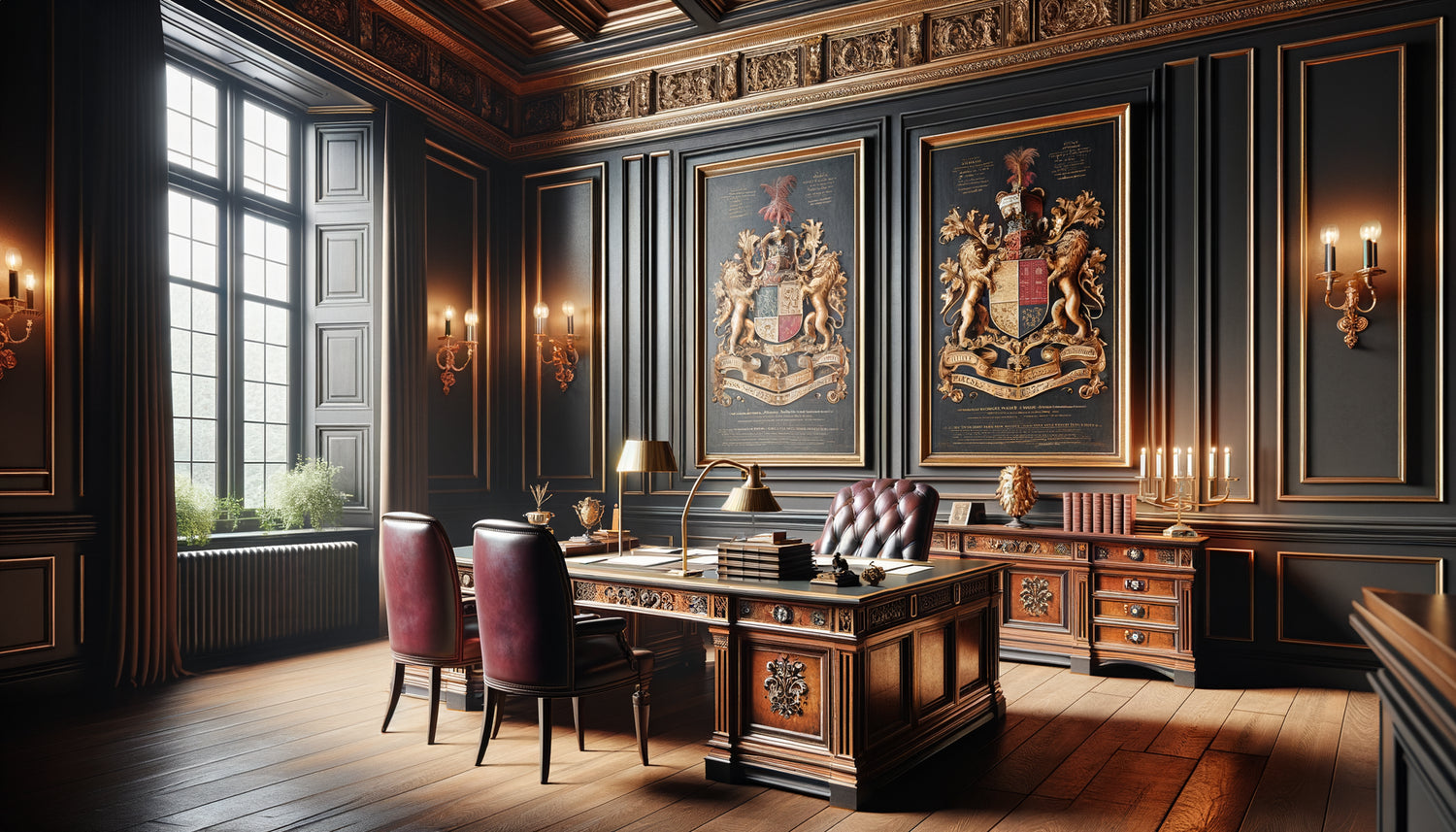
Behind the panelled door of a notary’s office, every detail tells a story of millennia-old trust. The aged woodwork, the floorboards that creak gently, the scent of old bookbindings... And on these walls steeped in history, a poorly chosen painting can disrupt the harmony like a false note in a symphony. I have seen so many beautiful notarial offices spoiled by clumsy frames, and others enhanced by a visionary choice.
Here's what a perfectly adapted frame brings to your traditional notary’s office: it reinforces the historical legitimacy of your role, creates an atmosphere of serenity conducive to important decisions, and demonstrates respect for codes without falling into frozen pastiche. The question of gold versus understated frames is not just aesthetic: it is a strategic decision that influences clients' perception of your expertise.
Many notaries hesitate before this choice, fearing either veering towards ostentation with a frame that is too flashy, or betraying the traditional spirit with an overly minimalist frame. This indecision sometimes leads them to lukewarm compromises that satisfy no one. Yet, the answer exists, rooted in a deep understanding of what a notary’s office truly represents.
Rest assured: there is no universal answer, but a foolproof method for making the right choice according to your specific context. By understanding the historical codes of the profession, the architecture of your office and the message you want to convey, you will transform this decoration into a true tool of silent communication.
The golden heritage: when the frame tells the story of notarial continuity
The gold frame is more than just an ornament: it is a symbol that crosses centuries. In notarial offices established since the 18th century, these gold leaf frames testify to an era when gold represented the perpetuity of commitments. Choosing a gold frame for your traditional notary’s office means joining this prestigious lineage.
Antique or antique-style gold frames possess an incomparable patina. The worked mouldings, often adorned with floral motifs, friezes or pearls, create a play of light and shadow that animates the wall without overwhelming it. In an office with oak panelling, Empire armchairs and period furniture, the gold frame naturally dialogues with the gilding on door handles, the bronzes of chandeliers and the bindings of old codes.
However, be careful: not all golds are equal. A new gold frame, too shiny, too uniform, will clash like a faux pas. Prefer slightly patinated mixoned gold, or even better, frames found in antique shops whose shine time has softened. Gold should whisper tradition, not shout it.
The paintings that flourish in a gold frame
A classic landscape, a 19th-century genre scene, an ancestor's portrait or a Flemish still life find their natural setting in a traditional gold frame. These works, designed at a time when gold framing was the norm, regain their original breath. In your notary’s office, an antique masterpiece in its period gold frame confers a natural authority, recalling that your function is part of the long term.
I accompanied the layout of a Toulouse notary's office where a magnificent Barbizon school landscape, framed in patinated gold with oak leaf decoration, overlooked the reception desk. Clients instinctively took the time to contemplate it before sitting down. This painting and its frame created a moment of pause, slowing down the pace, inviting the thoughtful reflection required by notarial acts.
Contemporary Sobriety: When the Frame Disappears to Better Reveal
The sober frame is not the opposite of tradition: it is another way of respecting it. In some renovated notary offices with finesse, minimalist framing becomes an assumed gesture of modernity that dialogues with ancient architecture without imitating it. A matte black frame, a raw waxed wood frame, or even a simple discreet gold filet can create timeless elegance.
This sobriety works particularly well in notarial firms located in heritage buildings where the architecture itself is spectacular. Why overload a wall when the ceiling moldings, sculpted jambs and marble fireplace are enough to affirm the majesty of the premises? The sober frame then allows the space to breathe, creating essential visual calm zones in an already rich environment.
In a notary's office in Lyon, located in a Renaissance building, I observed a brilliant solution: antique legal engravings from the 17th century, depicting scenes of contracts and justice, simply framed in ebony stained oak. The contrast between the historical content of the works and the modernity of the framing created a fascinating temporal bridge, suggesting that notarial tradition adapts to eras without denying its foundations.
When Sobriety Becomes a Highlight Strategy
A sober frame has a remarkable power: it directs all attention to the work itself. For a contemporary painting by a recognized artist, for a black and white artwork photograph, or for an abstract work with powerful colors, minimalist framing avoids any visual competition. In a notary's office that wants to affirm a certain open-mindedness while respecting professional codes, this approach is remarkably effective.
I was marked by a Bordeaux notary’s office study where a series of large-format photographs of local Haussmannian building facades, framed with simple brushed aluminum moldings, created a subtle link between the notary's mission and urban heritage. The understated frame allowed the images to dialogue with each other, forming a coherent whole that told the architectural history of the city.

The decision criteria: architecture, light and professional message
Your choice between a gold frame and an understated frame should first respond to the architecture of your notary’s office. In an 18th-century townhouse with sculpted paneling, a gold frame almost naturally imposes itself. In a streamlined Haussmannian building with white walls, an understated frame will better respect the pure lines of the space.
Natural light plays a crucial role. A gold frame captures and reflects light, enlivening a wall even in a dark room. It warms up atmospheres, creating a cozy atmosphere conducive to confidence. An understated frame, on the contrary, absorbs light, creating flat areas that structure space more graphically. In an office bathed in natural light, this sobriety avoids visual glare.
Also consider the professional message you want to convey. The gold frame suggests territorial roots, in-depth knowledge of inheritance and real estate law, expertise passed down from generation to generation. The understated frame evokes modern efficiency, openness to new notarial practices, the ability to support innovative projects while guaranteeing traditional legal security.
The intelligent compromise: mastered mixity
Who said we had to choose a side? In the most refined notary’s offices, I observe an exciting trend: the mastered mix of frames. A large masterpiece in its antique gold frame above the fireplace, accompanied by old legal engravings in simple black frames on the side walls. This approach creates a clear visual hierarchy: the main work attracts the eye, the secondary pieces accompany without competing.
This strategy works particularly well in notaries’ offices with multiple spaces. The waiting room can accommodate more subdued and contemporary frames, creating a welcoming and reassuring atmosphere. The notary's main office then features more assertive gold frames, marking the solemnity of the place where important acts are signed. Meeting rooms find a balance between the two, depending on their function.
Mistakes to absolutely avoid in notarial framing
The first fatal mistake: a new and shiny gold frame that screams its recentness. In a traditional notary's office, this faux pas is unforgivable. If you opt for gold, invest in authenticity or careful patination. A good framer will age a contemporary gilding to give it the nobility of time.
The second trap: a subdued frame that becomes sadness. A simple basic black frame, without depth or careful finish, turns any artwork into an administrative display. Sobriety paradoxically requires extreme attention to the quality of materials and the precision of cuts. A successful subdued frame sometimes costs as much as a gold frame, because it is in discreet perfection that its elegance lies.
The third mistake: neglecting proportions. A small painting lost in an immense baroque gold frame or a large format stifled by a frame that is too narrow ruin the visual balance. In a notary's office, where every detail contributes to the impression of professional rigor, these disproportions send a disastrous message of negligence.
Finally, stylistic inconsistency: mixing rococo gold frames, contemporary metallic frames and rustic baguettes creates a visual chaos that undermines professional credibility. Even in a mixed approach, maintain a chromatic and stylistic coherence that unifies the entire decoration of your notary's office.
Your notary's office deserves a decoration worthy of your expertise
Discover our exclusive collection of artwork for law firms that combines tradition and refinement to transform your professional space into an exceptional place.

Creating harmony: the frame as a bridge between yesterday and today
The choice between a gilded frame and a simple frame for your traditional notary's office is never trivial. It's a statement of intent, a professional positioning, a silent but powerful way to tell your vision of notariat. The most beautiful successes I have observed are those where the notary dared to have a clear, assumed, consistent conviction with their identity.
Imagine your clients entering your law firm. Their gaze falls on this beautifully framed artwork. Instantly, without even realizing it, the frame speaks to them. The patinated gold frame whispers the wisdom of generations, the solidity of commitments, the beauty of preserved traditions. The simple and precise frame affirms the clarity of procedures, the effectiveness of advice, the intelligent adaptation to contemporary realities.
In both cases, if the choice is right, your clients feel this reassuring harmony that helps them take the step of important decisions. Because ultimately, that's exactly what they come looking for in your notary's office: the certainty that someone perfectly masters the delicate balance between the strength of tradition and the intelligence of adaptation. Your framing, this seemingly minor detail, precisely testifies to this mastery.
Frequently Asked Questions
Could a gold frame risk appearing too ostentatious in a modern notary's office?
It all depends on the type of gilding chosen. A gold leaf frame, slightly patinated, with classic but not excessively ornate moldings, brings nobility without ostentation. The secret lies in the quality of the patina: prefer matte or semi-matte gildings rather than glossy ones, and Louis XVI or Restoration styles rather than very ornate baroque styles. In a tastefully renovated notary's office, one or two well-chosen gold frames create historical anchors without weighing down the whole. Think of it as jewelry: a beautiful patinated gold frame is like a string of fine pearls, elegant and timeless, while a new and shiny gold frame looks like flashy costume jewelry. The difference is immediately perceptible by your clients, even if they cannot express it clearly.
Can we mix gold frames and simple frames in the same notary's office?
Absolutely, and it’s often the most elegant solution! The key is to create a clear visual hierarchy. Reserve the gold frame for your masterpiece: the large artwork above your desk or the fireplace in the reception room. Secondary works can then receive more subdued frames that do not visually compete with this main work. An effective rule: limit yourself to a maximum of 20-30% gold frames throughout your spaces. This proportion creates precious accents without overload. Also, ensure consistency in tones: if your understated frames are black, make sure they all have the same finish (matte, satin). This discipline creates unity that compensates for the diversity of framing styles. I’ve seen magnificent offices where this mixed approach visually tells the story of the notary's office: antique gold frames for portraits of founding notaries, contemporary understated frames for more recent works.
What budget should you allocate for a quality frame suitable for a notary's office?
For a frame worthy of a traditional notary’s office, allow between 150 and 800 euros for a medium format (60x80 cm), depending on whether you opt for a simple quality frame or a gold leaf frame with worked mouldings. Authentic or very beautiful gold frames naturally cost more due to the artisanal work they require. A genuine gold leaf frame, with careful patina and sculpted mouldings, can easily reach 600 to 1200 euros for a large format. Professional-quality understated frames, in solid wood with impeccable finishes, range from 200 to 500 euros. Beware of gold frames costing less than 100 euros: they usually betray their industrial and cheap nature, which sends exactly the wrong message in a notary’s context. Consider this investment as you would for your office furniture: a good frame lasts decades and contributes daily to the image of your practice. Many notaries underestimate this aspect, spending thousands of euros on furniture while neglecting the framing, when it is precisely the latter that your clients look at during interviews.