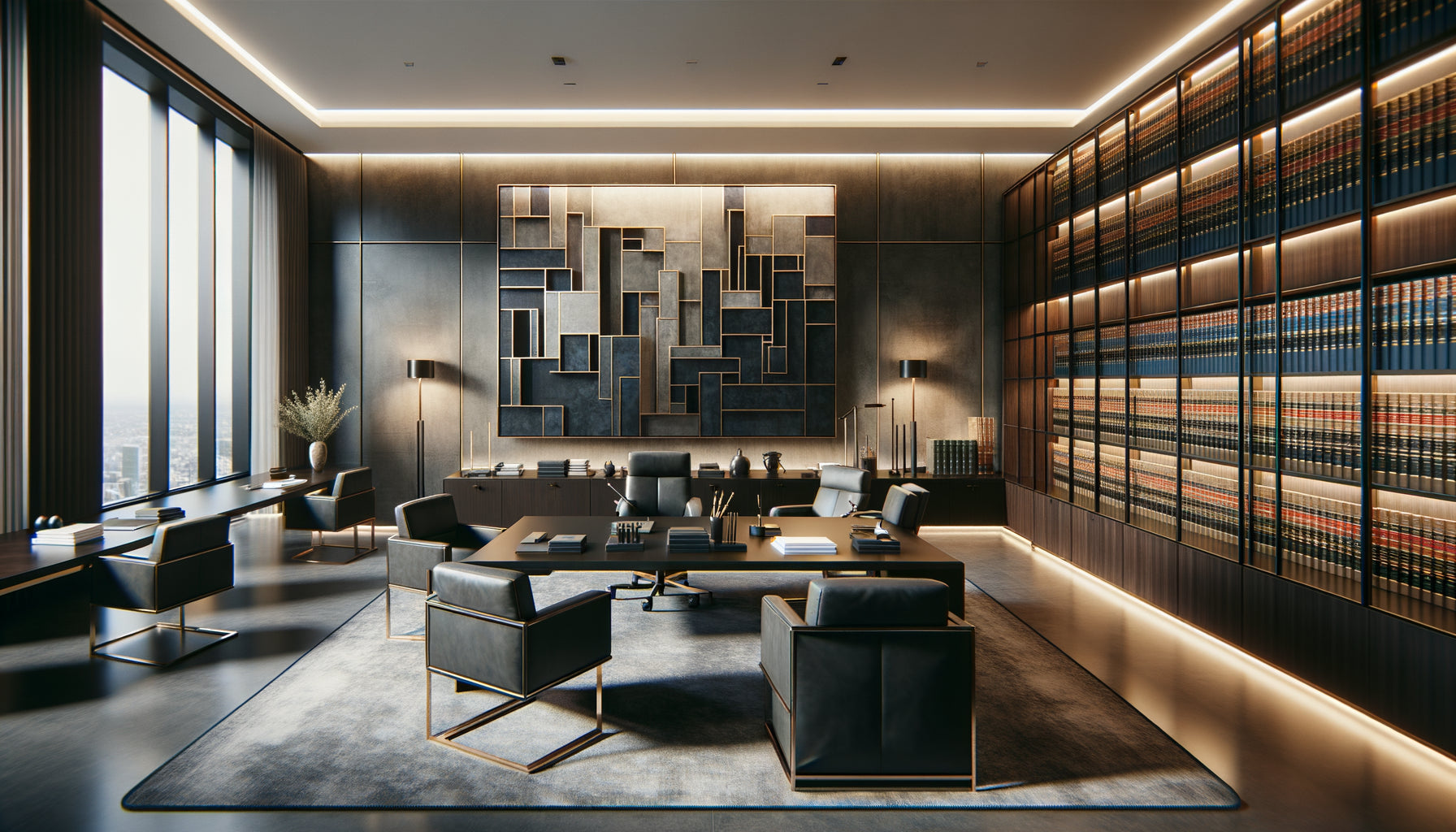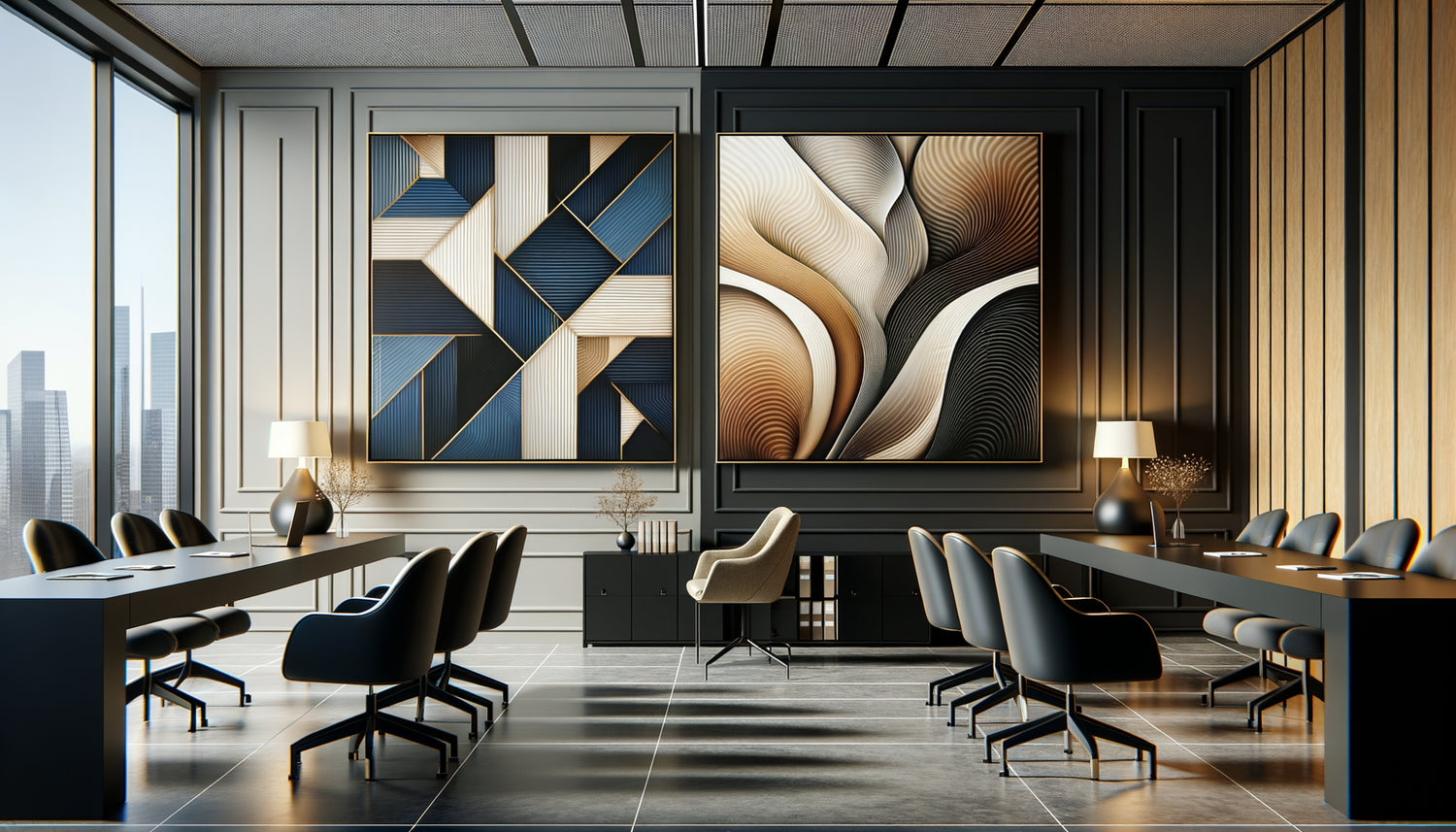
When a client first walks through the door of your corporate law firm, their gaze instinctively scans the space. Before you even speak a word, the artwork on the walls has already told a story: one of your rigor, strategic vision, and ability to navigate complexity. But here's a question that consistently arises during my consultations: should you opt for an abstract geometric painting with its sharp lines, or an organic abstract painting with flowing forms to decorate a law firm?
Here's what the right artistic choice brings to your professional space: instant credibility that reassures clients about your mastery of complex issues, a distinctive atmosphere that differentiates you from competitors, and psychological balance that tempers the natural tension of legal consultations. The frustration? Many business lawyers hesitate, fearing that an abstract painting that is too bold will seem out of place, or that a work that is too tame will fall into administrative banality. Rest assured: there's a rational approach to choosing between geometry and organic forms, based on the identity you want to project. I will guide you through this strategic decision, deciphering how each style interacts with your legal practice.
Geometric abstraction: when visual architecture reflects legal thinking
An abstract geometric painting for a corporate law firm is never an arbitrary choice. Its clean lines, precise angles, and structured compositions immediately evoke the analytical rigor that characterizes your profession. When I observe these works in legal spaces, I find they act as visual metaphors: each delimited form recalls contractual clarity, each intersection symbolizes the convergence of divergent interests.
Firms specializing in mergers and acquisitions or corporate law naturally gravitate towards this aesthetic. A painting with geometric forms exudes a quiet authority, that of the professional who breaks down even the most complex situations into understandable elements. The color palette is just as important: compositions in midnight blue, anthracite gray, and gold project timeless sophistication, while black and white contrasts affirm a decisive, almost judicial position.
The psychological advantage? Your clients subconsciously perceive this geometry as a guarantee of a structured methodology. Faced with an abstract geometric painting, they project themselves into a collaboration where nothing is left to chance, where each clause will be weighed with the same precision as these perfectly aligned lines. This is particularly effective in meeting rooms where high-stakes contracts are negotiated: the artwork then becomes a silent witness of your expertise.
Organic shapes: the art of tempering legal tension
Yet, a corporate law firm is not just a machine for analyzing texts. It's also a space where stressed executives come to seek solutions, where anxiety related to litigation mixes with hopes for development. This is where an abstract organic painting reveals its strategic relevance.
The fluid shapes, soft curves and gradual chromatic transitions of an organic artwork introduce a human and accessible dimension into an environment that could otherwise seem austere. I have observed that firms adopting this approach often attract a clientele of creative entrepreneurs, innovative startups or family-owned SMEs. The subliminal message? You understand that behind each file are human stories, not just legal articles.
An abstract organic painting with terracotta, sage green or ocean blue tones creates a fascinating balance: sophisticated enough to maintain your professional credibility, warm enough to disarm the natural defenses of clients who are often on the defensive. In a waiting room, these works soothe apprehensions. In your office, they signal your ability to navigate with agility in the grey areas of business law.
The psychological dimension of curves in a legal environment
Neuroscience teaches us that our brains process angular and rounded shapes differently. The former activate areas associated with alertness and critical analysis – perfect for a law firm. The latter stimulate responses related to security and trust. An abstract organic painting well positioned in your space can therefore reduce cortisol levels in anxious clients, thus facilitating constructive exchanges.

The hybrid strategy: combining geometry and organic according to spaces
Here's an approach that I frequently recommend: why oppose these two aesthetics when your business law firm has several spaces with distinct functions? True sophistication lies in the strategic articulation of these visual languages.
In your main meeting room, where negotiations and client presentations take place, a striking geometric abstract painting anchors the necessary authority. Its architectural lines reinforce your position as a strategic advisor. On the other hand, in reception areas or your personal office, an organic abstract painting humanizes the experience, creating that essential proximity to build trust.
This duality is not a contradiction: it reflects the reality of your practice. Business law requires both implacable rigor and developed relational intelligence. Your clients need to know that you master both registers. The alternation of geometry-organic in your artistic choices then becomes a non-verbal demonstration of this double competence.
However, pay attention to chromatic consistency: even when varying styles, maintain a harmonious palette. Abstract paintings sharing common tones – for example, bluish grays running through both your geometric and organic works – ensure a professional visual unity.
When legal specialization dictates aesthetic choice
Your area of expertise profoundly influences the perception that clients have of your firm. An attorney in intellectual property or technology law can assume more daring geometric abstract paintings, with compositions almost algorithmic. These works resonate with the digital and innovative universe of their clientele.
Conversely, a firm specializing in family business law or inheritance transmission will benefit from more contemplative organic abstract paintings. These cases involve legacies, generational handovers – emotionally charged moments where fluid forms create an appropriate setting.
Business litigation firms often opt for a defined geometry, sometimes even brutal: marked contrasts, sharp angles that evoke the judicial battle without detours. It's a visual statement of intent: you are not there to round off the edges, but to defend with determination.
The frequent mistake: choosing according to personal tastes rather than positioning
I regularly encounter associates who select an abstract artwork simply because they like it, without considering the strategic message it conveys. Your professional space is not your living room: every visual element contributes to your legal brand identity. A firm positioning its fees in the premium segment must display artistic consistency to that level.

Dimensions and positioning: the spatial impact of your abstract artwork
An abstract artwork that is poorly sized or awkwardly positioned instantly loses its power. In a corporate law firm, proportions count double: they testify to your attention to detail, a fundamental quality in your profession.
For a standard meeting room (20-30 m²), aim for a work of art 120 to 180 cm wide. An abstract geometric artwork of this size structures the space without overwhelming it. In an individual office, a piece measuring 80 to 100 cm is sufficient, ideally positioned behind your chair or on the wall perpendicular to your desk – where clients' gaze naturally falls during discussions.
Orientation also matters. Horizontal geometric compositions visually widen the space and project stability. Vertical formats create elevation, particularly suitable for corridors and circulation areas. An organic abstract artwork in a square format, on the other hand, establishes a soothing balance, ideal for waiting areas.
Hanging height follows a museum rule: the center of the work at 160 cm from the floor, corresponding to the average eye level. In spaces where your clients are mainly seated (waiting rooms, offices), lower this height slightly by 5 to 10 cm for comfortable visual consultation.
Your firm deserves a visual identity worthy of your legal expertise
Discover our exclusive collection of artwork for law firms that transform your professional spaces into true strategic positioning tools.
Crafting Your Visual Identity: Beyond the Binary Choice
The question isn't ultimately about definitively choosing between abstract geometric painting or organic, but understanding what each style brings to your corporate law firm. Your professional identity is likely more nuanced than a simple stylistic divide.
Imagine: a potential client compares three firms for a strategic case. The first displays generic reproductions, the second diplomas only, the third has invested in carefully selected abstract paintings. Which projects the strategic vision and attention to detail that this client seeks? Art in your legal space isn't superfluous luxury: it’s a differentiator signal in a market where technical expertise is presumed.
Geometry positions you as the architect of structured solutions. Organic reveals you as the agile navigator of human and commercial complexities. Your choice – or your combination – must resonate with the promise you make to your clients. A well-chosen abstract painting doesn't simply decorate your walls: it silently amplifies your professional message, consultation after consultation.
Frequently Asked Questions
Isn't an abstract painting too risky for a conservative legal environment?
This concern is understandable, but rests on an outdated conception of legal professionalism. An abstract painting – whether geometric or organic – doesn’t imply eccentricity. On the contrary, quality abstraction evokes the ability to synthesize complexity, a fundamental skill in corporate law. The secret lies in selection: prioritize works with subdued palettes (deep blues, grays, blacks, off-whites, metallic touches) and balanced compositions. These choices project controlled modernity rather than misplaced boldness. Your clients aren't looking for a firm stuck in the past, but advisors capable of navigating a constantly evolving economic environment. Your visual identity should reflect this agility while maintaining institutional credibility. A well-chosen abstract geometric painting accomplishes precisely this balance.
How much should I invest in a painting for my corporate law firm?
Art investment for a law firm should be considered as your communication budget: proportional to your positioning and fees. For a reception area or main meeting room, allow between €800 and €3000 for an original work of gallery quality, signed and authenticated. This amount may seem significant, but relate it to the number of clients who will discover your firm over several years: the cost per impression becomes negligible. High-end art reproductions are a coherent alternative (€300-€800) provided you choose canvas prints or aluminum, with professional finishes. The costly mistake? Buying several mediocre pieces rather than one strong work. In a corporate law firm, a single remarkable piece in the strategic space always surpasses a profusion of insignificant works. Also consider that some artistic acquisitions can be tax-deductible assets – consult your accountant on this specific point.
How to choose between several abstract paintings that I all like?
When multiple abstract paintings seduce you, apply a rational decision grid – exactly as you would advise a client facing contractual options. First, photograph each work and visually project its integration into your specific space (some online tools allow this simulation). Secondly, evaluate each piece according to three criteria: chromatic consistency with your existing visual identity, symbolic message (an geometric painting projects rigor and structure, an organic evokes agility and human approach), and technical execution quality. Thirdly, solicit the opinion of people representative of your target clientele – a partner, a trusted client. Their instinctive reactions often reveal the perception that the work will generate. Finally, question longevity: can you imagine this artwork in your space for five to ten years without boredom? A quality abstract painting improves with time, revealing nuances that the hurried eye does not immediately perceive. It is precisely this depth that distinguishes true art from simple decoration.