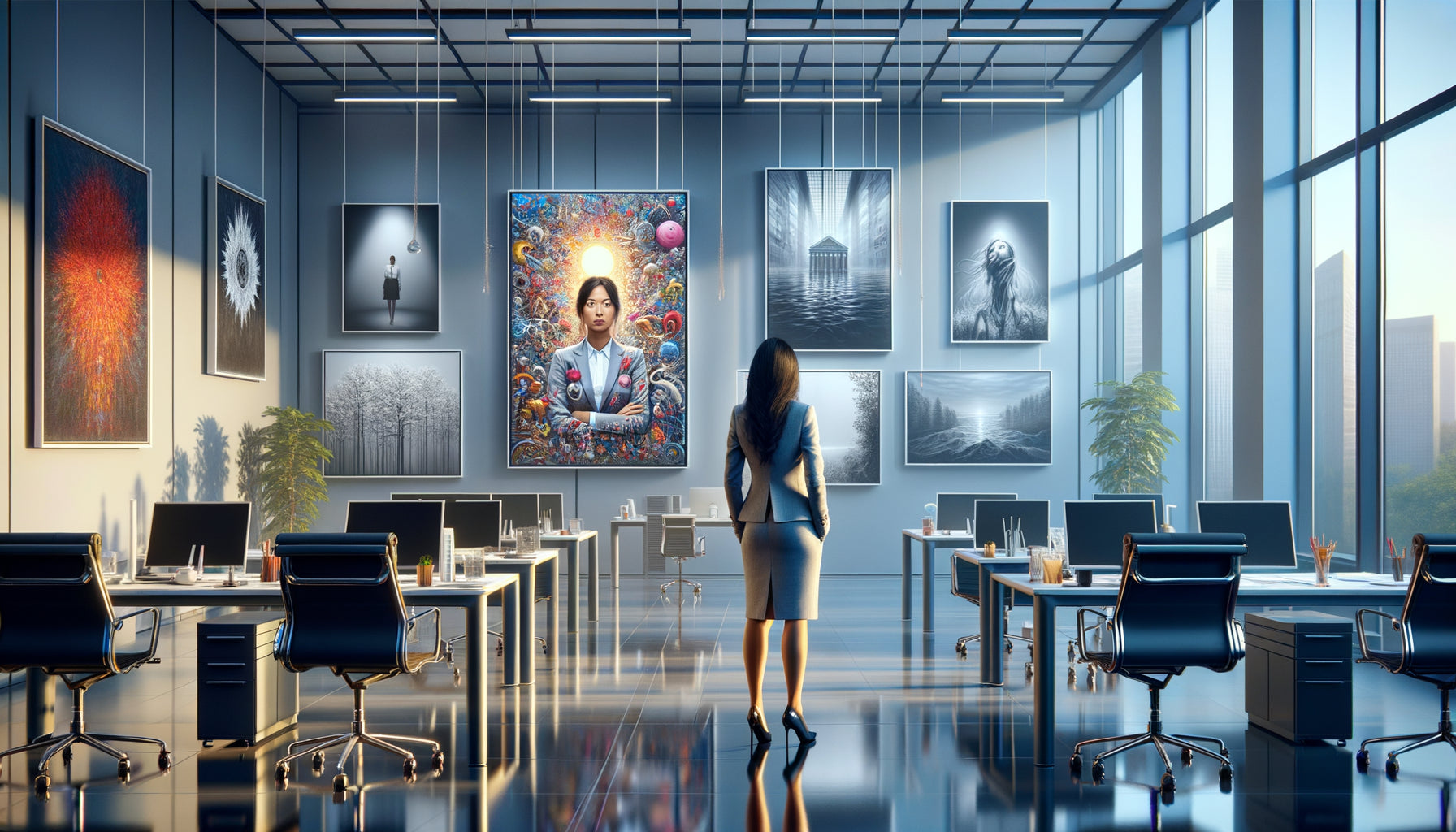
I recently redesigned the office of a senior partner in Brussels. Between two shelves laden with annotated codes, he showed me a Flemish landscape painting from the 17th century that he had just acquired. Magnificent, certainly. But observing the space as a whole – designer offices, LED lighting, ultra-flat screens – this canvas seemed to belong to another time, almost out of sync with the place's contemporary identity.
Here is what legal art photography brings today: an aesthetic consistency with your modern professional environment, a diversity of styles impossible to find in classical painting, and accessibility that allows you to renew your decoration without compromising artistic quality.
Many legal professionals feel this tension. On the one hand, the desire to respect the traditional visual codes of the profession – this notion of authority and longevity evoked by old oils. On the other hand, the need to assert a contemporary identity, open, in line with the expectations of a clientele that values competence as much as modernity.
This hesitation is perfectly legitimate. For decades, law firms have cultivated a specific visual imagination, where classical painting embodied seriousness and tradition. But codes evolve, and photographic art has gained recognition in both museums and the most prestigious professional spaces.
In this article, I propose to explore how legal art photography emerges as a credible – even superior – alternative to classic paintings for dressing your workspaces with authenticity and character.
When the classic shows its limits in the modern legal space
Law firms have long opted for reproductions of masters or paintings inspired by academic art. These choices responded to a clear logic: project an image of historical anchoring, institutional stability. But let's honestly observe these spaces.
Classic paintings often impose a color palette that is difficult to harmonize with contemporary furniture. These ochre tones, deep browns and gilding work wonderfully in a Haussmannian mansion. But facing bleached oak offices, graphite leather armchairs and minimalist luminaires, they sometimes create a disturbing visual dissonance.
I accompanied an intellectual property lawyer who had inherited three 19th-century seascapes. Technically superb, but totally foreign to his activity focused on innovation and new technologies. His clients, often young entrepreneurs, unconsciously perceived a discrepancy between the cabinet's modernist discourse and its outdated visual dressing.
Art photography naturally solves this equation. An architectural black and white image immediately dialogues with the purity of a contemporary space. A cityscape captured at dusk brings the emotional depth sought, without the historical weight that can seem artificial in some modern professional contexts.
Visual authority no longer lies in seniority
Let's be frank about what worries some professionals: does photography have the same artistic legitimacy as painting? This question reveals an outdated conception of the hierarchy of arts.
Major cultural institutions settled this long ago. The MoMA, the Centre Pompidou, the Tate Modern grant photographic art the same museum status as painting. Signed photographic prints are sold in auction houses at prices comparable to those of contemporary masters' oils. Ansel Adams, Sebastião Salgado, Andreas Gursky: their works embody an artistic requirement that is second to none compared to painters of their generation.
In a law firm, this cultural legitimacy translates differently. It no longer comes from the apparent age of the work, but from its ability to create a consistent atmosphere that inspires confidence. A photographic triptych of landscapes related to law – contemporary courthouses, legal libraries, architectural symbols of justice – speaks directly to your profession without falling into simplistic illustration.
I observed this phenomenon during the transformation of a family firm passed down through three generations. The son, newly associated, wanted to modernize without betraying his father's heritage. We replaced classic courtroom scenes with black and white art photographs of antique scales, neoclassical columns, architectural details of international supreme courts. The father immediately recognized the symbols of his profession, treated with a contemporary gaze that seduced new clients.
The narrative power of the photographic image
Photography has a unique narrative quality: it captures a real moment, even stylized. This documentary authenticity creates a different emotional connection than painting. Faced with a photograph of an ancestral library, the viewer almost imagines smelling the scent of old leather and paper. This sensory immediacy generates a more direct connection with the professional space.
For a law office, this narrative dimension offers endless possibilities. You can visually tell your professional philosophy: geometric rigor of brutalist architecture, humanism of an environmental portrait, international openness of a composite urban landscape. Legal art photography thus becomes a visual communication tool that strengthens your identity.

Stylistic diversity: a decisive advantage of photography
Classic painting imposes obvious stylistic limitations. Unless you invest considerable sums in varied original works, you end up with a sometimes monotonous chromatic and thematic consistency. How many offices display three or four similar landscapes, creating visual redundancy rather than a thoughtful collection?
Art photography explodes this constraint. You can combine in the same space a minimalist architectural portrait, a grandiose atmospheric landscape, and a geometric urban abstraction, provided you respect certain principles of color coherence and framing. This diversity enriches the visual experience without creating cacophony.
In an international law firm office that I furnished, we created a photographic journey through the meeting rooms. Each space represented a global legal capital: New York in graphic black and white, London under a poetic misty light, Tokyo in a nocturnal urban abstraction. Clients unconsciously evolved within a visual narrative that reinforced the firm's international expertise.
This thematic flexibility also allows you to adapt your decoration to your legal specialization. Environmental law? Powerful natural landscapes in large format. Business law? Dynamic city views or architectural compositions. Family law? More intimate, luminous scenes evoking continuity and protection.
Financial accessibility without artistic compromise
Let's address a pragmatic reality that every professional understands: the budget. An original oil painting of museum quality represents a considerable investment, often out of reach for a young firm or a professional just starting out. Accessible reproductions, on the other hand, lack character and presence.
Limited edition art photography elegantly solves this equation. You access authentic, numbered and signed works at prices that allow you to decorate several spaces consistently. This accessibility does not mean inferior quality – simply an economy of means inherent in the photographic medium.
A professional photographic print on Fine Art paper, mounted under a museum mat and carefully framed, has an impressive wall presence. I have regularly observed that clients do not distinguish, in terms of visual legitimacy, a well-presented art photograph from a painting of equivalent value. What matters: the quality of execution, the relevance of the subject, the consistency with the space.
This financial accessibility also offers a valuable freedom: that of renewal. Your visual identity can evolve with your professional practice. A specialization that refines, a growth that changes your spaces, an aesthetic sensitivity that matures – art photography allows you to accompany these transformations without the prohibitive investments that would require a collection of original paintings.
Formats and wall presence: photography takes the lead
A technical advantage often overlooked: photography naturally lends itself to large formats without exploding costs. An oil painting two meters wide represents hundreds of hours of artistic work. A photographic print of equivalent dimensions remains within reasonable budgetary proportions.
These large formats radically transform the perception of a legal space. In a meeting room or behind an executive desk, a panoramic photograph three meters long creates an immersive focal point that visually structures the room. This monumentality was once reserved for institutions with substantial budgets for pictorial commissions.

Consistency with contemporary interior architecture
Modern law firms are gradually adopting architectural codes far removed from the wood paneling and thick carpets of yesteryear. Open spaces, glass partitions, raw materials such as polished concrete or brushed steel, integrated vegetation – these choices reflect a profound evolution in legal professional culture.
In these environments, classic painting often creates an awkward stylistic break. It belongs to a different decorative language, designed for compartmentalized, warm, traditional interiors. Contemporary photography, on the other hand, naturally dialogues with these materials and volumes.
I particularly noticed this synergy in a firm located in a converted loft. Exposed metal structures, polished concrete floor, Scandinavian design furniture. The partners hesitated to decorate, fearing to overload this architectural purity. We opted for large-format black and white photographs, mounted on framed dibond, creating a perfect continuity with the industrial aesthetic of the place.
This aesthetic coherence is not just a matter of personal taste. It contributes to the readability of your professional identity. A harmonious space, where each element converses with the others, subconsciously inspires trust and serenity. Conversely, stylistic breaks can generate subtle discomfort, an impression of tinkering or lack of mastery.
How to choose your legal art photography?
Let's move on to practical considerations. Faced with the immensity of photographic offerings, how do you identify works that will truly serve your professional space?
Prioritize chromatic restraint. Photographs with restricted palettes – black and white, shades of gray, muted tones – age better and integrate more easily. Saturated colors, seductive at first glance, can quickly become tiring in a space where you spend several hours daily.
Seek compositional depth. A good work of photographic art functions on multiple levels of reading. An immediate visual impact, then details that are revealed progressively. This compositional richness justifies repeated contemplation, unlike simplistic decorative images which quickly exhaust their interest.
Consider scale and proportion. A common mistake: multiplying small disparate formats. Prefer a few substantial pieces that structure the space. In a law office, a photograph of 100x150 cm behind the desk creates a visual authority far more effective than three images of 40x60 cm aligned awkwardly.
Check the quality of printing and framing. A work of photographic art deserves impeccable technical treatment. Archival-quality Fine Art papers, museum-grade anti-reflective glass framing, mounting performed according to archival standards – these technical details make all the difference between a decorative print and a true work of art.
Photographic themes suitable for legal spaces
Certain visual universes naturally resonate with the legal environment. Institutional architectures – courthouses, historical libraries, government buildings – create a direct link with your profession without falling into literal illustration.
Contemplative landscapes – misty mountains, long-distance oceans, majestic forests – bring a welcome meditative dimension to intellectually demanding professions. They offer a soothing counterpoint to the intensity of legal work.
Abstract urban compositions – reflections on glass facades, architectural geometries, dizzying perspectives – are particularly suitable for law firms focused on business law, intellectual property, new technologies. They evoke modernity and dynamism without visual aggression.
Your firm deserves a visual identity worthy of your expertise
Discover our exclusive collection of wall art for Law Firms that combines artistic prestige and contemporary coherence.
Photography as a bridge between tradition and modernity
Ultimately, the question isn't about abruptly replacing all classic references with contemporary photography. The most subtle approach often involves creating a dialogue between eras, mediums, and sensibilities.
I worked with a century-old firm that possessed some valuable inherited oils. Rather than relegating them to storage, we kept them in the traditional reception area, creating an assumed historical continuity. But in the actual workspaces – meeting rooms, individual offices, collaborative zones – we deployed a contemporary photographic collection that reflected the current reality of legal practice.
This mixed strategy allows for respecting heritage without being confined by it. It recognizes the value of classic paintings while asserting that they are no longer the sole legitimate visual language for a modern law firm environment.
Legal art photography doesn't oppose classic paintings – it simply offers a more suitable visual vocabulary for the architectural, budgetary, and cultural realities of contemporary firms. It allows you to assert a professional identity rooted in its time, without denying the values of rigor and permanence that underpin the legal profession.
Conclusion : Art at the service of your professional identity
Imagine entering your firm tomorrow morning. Your eyes fall on a large-format photograph that structures your workspace. Perhaps a monumental library captured in raking light, symbolizing the patient accumulation of legal knowledge. Or an urban nocturnal abstraction, evoking the vigilance you exercise for your clients. This image is not just decoration – it participates in defining who you are professionally.
Legal art photography offers you this freedom: to build an authentic visual identity, consistent with your contemporary practice, without sacrificing artistic depth or cultural legitimacy. It's not a compromise compared to classic paintings, but rather a fully assumed alternative, often superior in modern professional contexts.
Start modestly if you wish. Replace any random reproduction with a true work of art photography in your personal office. Observe how it transforms your daily relationship with this space. Then gradually let this new visual sensitivity enrich the entire environment of your professional setting.
FAQ : Legal art photography
Does legal art photography really have the same value as a painting in a law firm?
Absolutely, and this question mainly reveals an outdated conception of artistic hierarchy. Major cultural institutions – MoMA, Tate Modern, Centre Pompidou – have been granting photography the same museum status as painting for decades. In a professional legal context, what matters is not the apparent age of the medium, but its ability to create a consistent atmosphere that inspires confidence. A limited edition art photograph, printed on Fine Art paper and properly framed, has an equivalent wall presence and cultural legitimacy to a painting of comparable value. Clients do not judge the artistic medium – they feel the overall quality of the environment and its consistency. A well-chosen contemporary photograph communicates professionalism and aesthetic mastery, just as a classic painting did in a different architectural context. The essential thing is the authenticity of your choice and its relevance to your current professional identity.
How to integrate art photography without my firm losing its serious and traditional character?
The seriousness of a firm does not come from the displayed artistic style, but from the consistency and quality of the whole. Many professionals confuse visual tradition with rigid traditionalism. You can perfectly affirm values of rigor, permanence and expertise through contemporary photography. The key lies in your thematic and chromatic choices. Prioritize photographs with timeless subjects: institutional architectures, contemplative landscapes, restrained geometric compositions. Opt for restricted palettes – black and white, shades of gray, muted tones – that age well and avoid any fashion effect. Ensure careful framing, in noble materials such as solid wood or brushed aluminum. This approach creates an environment that is both contemporary and timeless, which reassures your traditional clientele while seducing a younger one. You can also adopt a hybrid strategy: keep some classic pieces in the representation areas, while deploying photography in the actual working zones. This gradual transition respects your heritage while affirming your anchoring in the present.
What budget to plan for quality photographic decoration in my firm?
One of the major advantages of art photography lies precisely in its financial accessibility without compromising quality. For an individual office, expect between €300 and €800 for a large-format photograph in limited edition, printed on Fine Art paper, with professional framing. This price gives you access to an authentic, numbered and signed work, possessing a real wall presence. To furnish a meeting room with two or three coordinated pieces, allow between €1500 and €3000 depending on the dimensions and complexity of the framing. These amounts may seem significant, but remain much lower than the acquisition of original paintings of equivalent quality, which generally start at several thousand euros each. Limited edition photography makes this virtuous equation possible: certified artistic authenticity and budgetary accessibility. You can thus harmoniously decorate several spaces with consistency, where the cost of original paintings would force you to make partial choices. Always prioritize quality over quantity: a large, remarkable photograph is better than three small random images. And consider this investment in the long term: a well-chosen photograph will accompany you professionally for years.