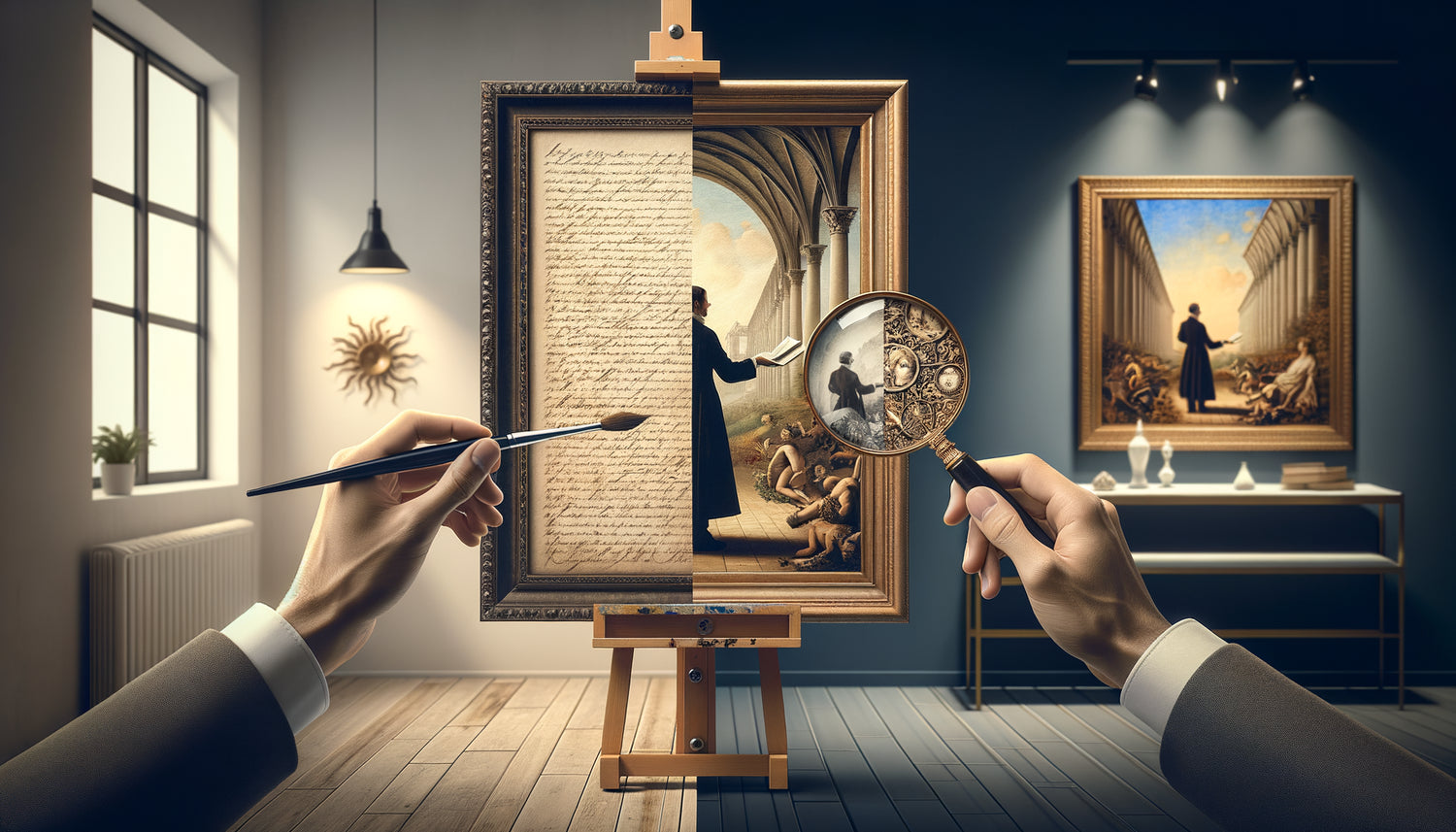
The scene repeats every week in my Brussels gallery. A collector hesitates between two works: an original painting by an emerging artist at €3,500 and a museum-grade giclée reproduction of a Monet at €850. His gaze oscillates between the two, seeking an answer that no one can give him. Because the real question is not « Which is best? » but « What am I really looking for? »
Here's what your customers are truly looking for: an authentic emotional connection, a confident cultural legitimacy, and consistency with their personal or professional identity. Three aspirations that can be fulfilled by the original as much as by the reproduction, according to radically different paths.
The art market is undergoing a fascinating transformation. On one hand, museum-quality reproductions have reached astonishing fidelity thanks to giclée technologies and fine art printing. On the other hand, original paintings by contemporary artists are becoming accessible through online galleries and open studios. Between these two universes, your customers often navigate lost, torn between the desire for authenticity and budgetary constraints.
After fifteen years of supporting private collectors and corporate decorators in their artistic choices, I have understood one essential thing: no one is simply looking for « a painting ». We are searching for a story, a presence, a message. And it is precisely this quest that determines whether the original or the reproduction emerges as the obvious choice.
The irresistible appeal of the unique: when the original becomes a necessity
There are customers for whom the reproduction, however perfect it may be, will never resonate. Not out of snobbery, but out of a visceral need for direct connection with the creative act. These collectors seek the physical trace of the artist: the thickness of the gesture in the impasto, the visible pentimenti from certain angles, the micro-decisions that make a canvas exist only once in the universe.
I have seen a financial director buy an original abstract painting for his office, categorically refusing a reproduction of a modern master who was yet more « impressive ». His reason? « When I get stuck on a complex file, I look at this painting and remember that another human being took creative risks. It gives me courage. » This existential dimension of the original work is irreplaceable.
The original also carries an investment heritage dimension that the reproduction does not have. A savvy customer who acquires today a painting by a promising emerging artist is not only beautifying his space: he is building up a collection that will potentially increase in value. This perspective transforms the artistic purchase into a strategic gesture, particularly appreciated by entrepreneurs and self-employed professionals.
Museum quality reproductions: when technical perfection meets emotion
But let's dismiss the preconceived notion that a reproduction would be a « default choice ». The museum-grade giclée reproductions we offer today achieve color fidelity and detail finesse that defy the expert eye. Printed on linen canvas with inks guaranteed for 100 years, stretched over wooden frames and sometimes hand-varnished, they offer a visual presence comparable to the original for a fraction of the price.
Some clients are specifically looking for this technical excellence. A business law firm wanted to create a refined cultural atmosphere in its meeting rooms without exposing original artworks to the risk of deterioration. We selected museum-grade reproductions by modern masters: Kandinsky, Pollock, Rothko. The result? A sophisticated ambiance that impresses international clients, with the serenity of being able to replace a damaged piece without patrimonial drama.
Quality reproduction also responds to a legitimate desire: to live daily with inaccessible masterpieces. Do your clients dream of a Turner in their living room? A Klimt in their bedroom? Fine art reproduction offers them this emotional proximity to the icons of art history, this daily inspiration drawn from the sources of recognized geniuses.
The professional context
In professional spaces, museum-quality reproduction offers decisive advantages. It allows you to deploy a visual consistency across multiple offices or floors without mobilizing a colossal budget. A large medical practice can thus create a themed artistic itinerary with coordinated reproductions, where originals would impose disparate choices according to available budgets.
Reproduction also avoids the problems of insurance, preventive conservation and rotation of works that are posed by originals in a professional environment. For a hotel, a restaurant or a coworking space, this operational flexibility weighs heavily in the decision.

The authenticity syndrome: understanding psychological blocks
Yet, some clients remain blocked by what I call the « authenticity syndrome ». They perceive reproduction as a betrayal, a confession of imposture, even when the quality is impeccable. This psychological reluctance does not concern the reproduction itself, but what it symbolizes socially.
In some circles, displaying reproductions is seen as a lack of means or discernment. This social judgment, often unconscious, leads clients to prefer a modest original rather than a masterful reproduction. A young entrepreneur confessed to me: “I would rather have a small original painting by an unknown artist than a fake Picasso, even a perfect one. It says something about my choices.”
This attitude is neither superficial nor condemnable: it reveals that art also fulfills an identity and narrative function. What we hang on our walls tells who we are, our values, our relationship to culture and contemporary creation. For these clients, supporting a living artist, building a coherent collection of originals, even modest ones, is an integral part of their life project.
When hybridization becomes strategy: mixing original and reproduction
The smartest solution? Not to choose. Many enlightened clients develop an hybrid approach that combines originals and reproductions according to spaces and uses. In their private interior: original paintings by artists they have met, whose process they know, with whom they sometimes weave a relationship. In passageways or professional spaces: museum-quality reproductions that bring a strong cultural reference without the constraints of the original.
This strategy allows for optimization of artistic investment. A budget of 5,000 euros can be transformed into a major original painting for the living room, complemented by three giclée reproductions for the bedrooms and office. Result: overall aesthetic consistency with the emotional satisfaction of the unique work where it really matters.
I also observe a fascinating trend among young collectors: they start with reproductions of their favorite artists, then switch to the original when their budget allows, keeping the reproductions as witnesses of their aesthetic journey. This evolutionary approach takes away the guilt of buying reproduction by inscribing it in a collector's trajectory.
Non-negotiable quality criteria
If your clients opt for reproduction, certain standards are absolutely essential. A museum-quality reproduction is recognized by its giclée print on cotton or linen canvas (never on photographic paper), its pigment inks guaranteed resistant to UV rays, its mounting on a wooden frame with tensioning keys, and ideally a hand-varnished finish that recreates the relief and brilliance of the original painting.
The printing resolution must reach at least 1440 dpi, and color management must be ICC calibrated to respect the subtle nuances of the original work. These technical details make all the difference between a reproduction that impresses and a copy that disappoints after a few weeks.

What Your Clients’ Artistic Choices Really Reveal
Beyond the original versus reproduction debate, I realized that each artistic choice reveals deep existential priorities. The client who favors an original often seeks singularity, affirmation of a personal taste, sometimes a form of transgression against established canons. They accept imperfection, aesthetic risk-taking, because it is precisely this part of the unknown that nourishes them.
The client who fully embraces high-quality reproductions demonstrates another form of maturity: they reject false appearances, accept their budgetary constraints, and prioritize daily aesthetic experience over patrimonial possession. They seek inspiration, not social status. This pragmatic and guilt-free approach is gaining ground, especially among intellectual and creative professionals.
Between these two profiles, a multitude of nuances. The methodical collector who mixes emerging originals and reproductions of masters. The lover of a deceased artist who compensates for the impossibility of acquiring the original with the best available reproduction. The decorator who strategically uses both to create specific atmospheres.
Your professional space deserves an artistic presence worthy of your ambitions
Discover our exclusive collection of tableaux for law firms that combine artistic excellence and professional relevance, in originals as well as museum-grade reproductions.
The Real Question Isn’t Which One, But Why
Ultimately, the tension between original painting and museum-quality reproduction reveals a more fundamental question: what do we expect from art in our lives? An inspiring presence? A patrimonial investment? A social marker? A spiritual connection with creation? A decor consistent with our identity?
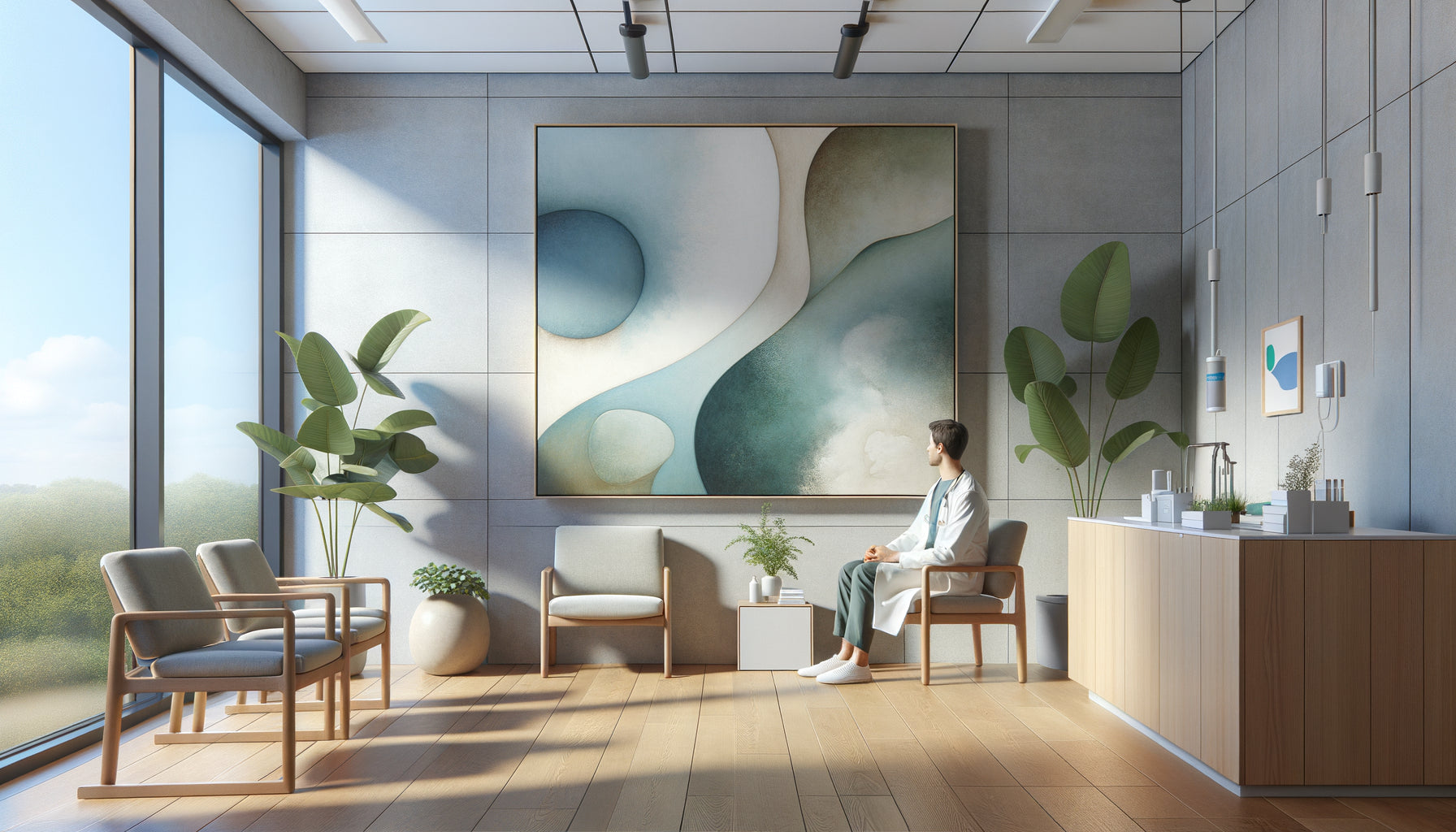
Your clients are right to ask these questions. The mistake would be to believe that a universal answer exists. A doctor setting up their waiting room, a collector patiently building their collection, a couple furnishing their first apartment: each is legitimate in their choice, provided it is conscious and assumed.
What I’ve learned after hundreds of conversations with art buyers? Regrets never come from the type of artwork chosen, but from the mismatch between the purchase and deep aspirations. The customer who buys an original out of social conformity when a reproduction would have sufficed. The one who takes a reproduction out of financial caution while secretly dreaming of the uniqueness of the original.
The only bad decision is one that isn’t aligned with your true needs. A museum-quality reproduction that inspires you every morning is worth infinitely more than a mediocre original acquired by obligation. And conversely, a modest but vibrant original brimming with authentic creative energy will always surpass a perfect but emotionally neutral reproduction.
So before advising your clients, ask them the real questions: What is your relationship with artistic creation? Are you looking for a cultural icon or a contemporary discovery? Do you prioritize visual perfection or living imperfection? Is your space a place of heritage investment or daily inspiration? The answers will naturally guide you towards the original, the reproduction, or that intelligent combination of the two that characterizes the most accomplished collections.
Frequently Asked Questions
Can a museum-quality reproduction really visually rival an original?
Yes, and that's where the technological evolution of the last fifteen years lies. Museum-level giclée reproductions use large format printers with 12 or 16 pigment ink cartridges, capable of reproducing millions of color nuances. Printed on genuine linen canvas, mounted on a professional frame and hand-varnished, they even reproduce the relief and shine of brushstrokes. At normal viewing distance (1 to 2 meters), the illusion is perfect. The difference appears upon close examination: absence of truly raised texture, microscopic uniformity of the surface. But for everyday aesthetic experience, a museum-grade reproduction offers 95% of the visual presence of the original. What’s missing is the aura of the unique, that existential and patrimonial dimension that technique cannot reproduce. For decorative and inspirational use, a quality reproduction perfectly fulfills its function.
How to justify the price of an original artwork by an emerging artist compared to a reproduction of a recognized master?
It’s a classic tension that reveals two different purchasing philosophies. Acquiring an original work by an emerging artist is betting on talent, participating in the contemporary creative ecosystem, and potentially building an investment that will increase in value if the artist becomes successful. It's also owning an absolutely unique piece, with all the emotional weight of this exclusivity. A reproduction of a master offers access to recognized genius, an immediately identifiable cultural reference, and total aesthetic security: you know that this work has stood the test of time. The choice depends on your temperament: are you a discoverer or an admirer? Risk-taker or lover of safe bets? Builder of a personal collection or passionate about art history? Both approaches are legitimate. Personally, I often advise a mix: contemporary originals in intimate spaces to assert your personal taste, reproductions of masters in social spaces to create cultural bridges with your visitors.
Are reproductions acceptable in a high-end professional space?
Absolutely, and it has even become the norm in many demanding professional sectors. Large international firms, luxury hotels, and even some museums in their administrative spaces use museum-quality reproductions for pragmatic reasons: visual homogeneity over large volumes, ease of rotation and replacement, absence of insurance and conservation constraints. The key is impeccable quality and total assumption. A museum-grade giclée reproduction, well framed, with appropriate lighting, in a refined environment, will always be more enhancing than a mediocre original poorly presented. What matters in a high-end professional space is overall coherence, the relevance of artistic choices to your brand identity, and excellence of execution. A thoughtful selection of reproductions of modern masters says: we value culture, we create inspiring environments, we make intelligent strategic choices. No sophisticated client will hold that against you, especially if you assume it with transparency.