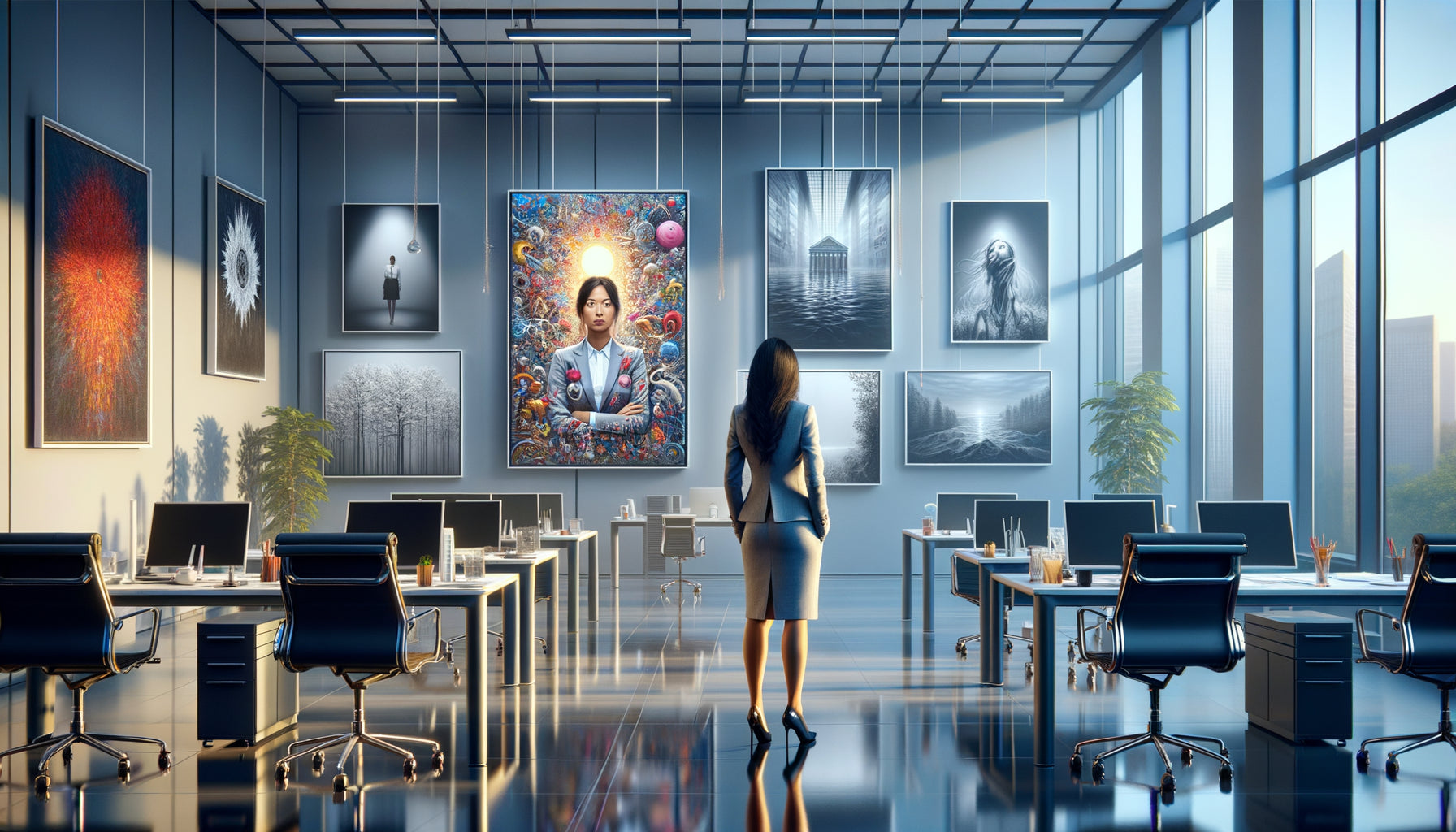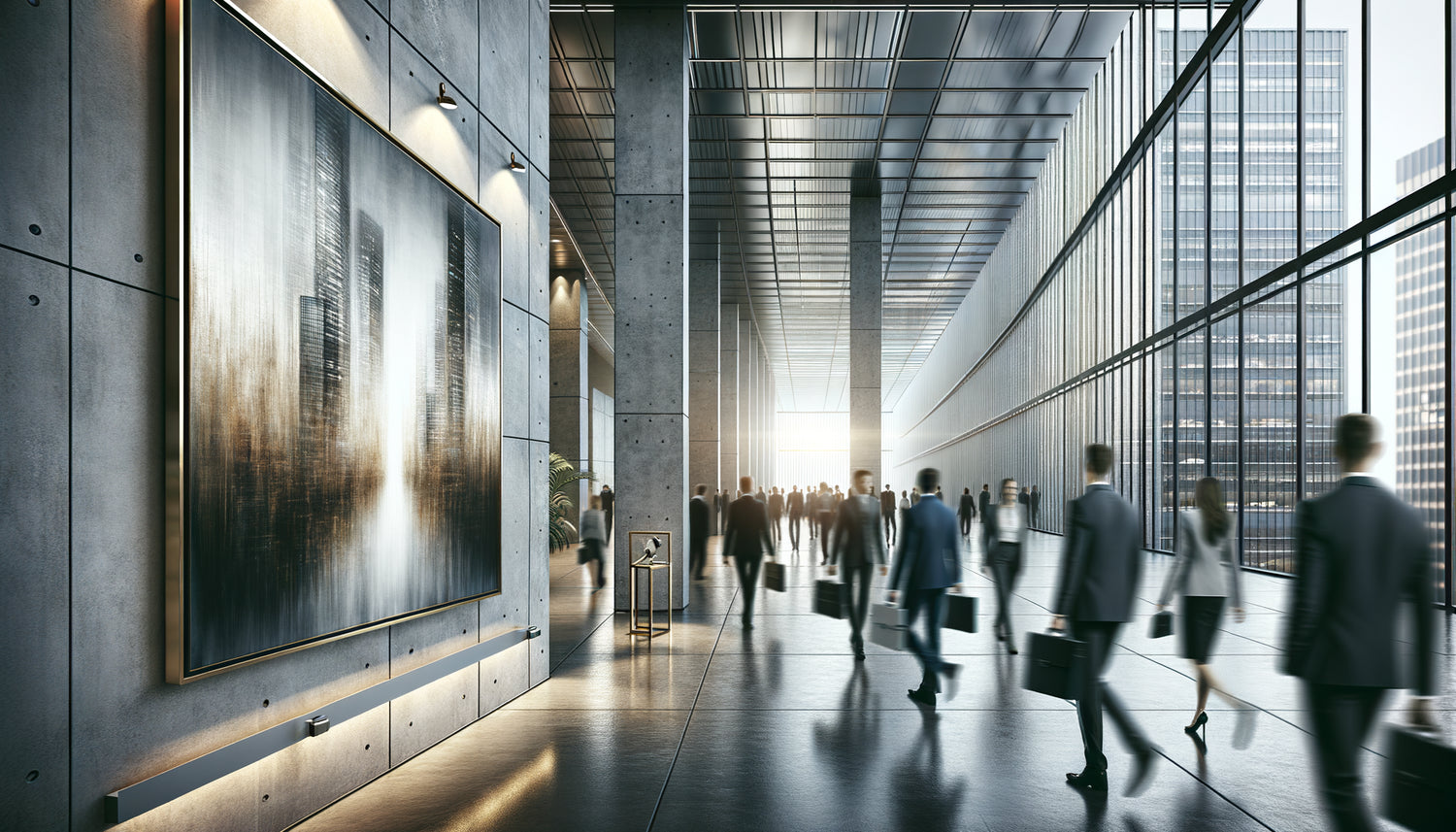
I still remember this contemporary screen print, a pristine white frame, perfect minimalist lines. It was magnificent when installed in the reception hall of a Parisian startup. Three years later, during a maintenance visit: the frame had hairline cracks, the colors had faded, and the artwork seemed to have aged twenty years. The problem? No one had assessed its resistance to a daily flow of 200 people, door vibrations, and thermal variations in the glazed hall.
Here's what a durable work brings to an intensive office environment: a constant artistic presence that enhances the space for years, an investment protected against daily wear and tear, and a flawless professional image for your visitors.
You may feel this frustration: how do you distinguish a work that will stand the test of time from one that will quickly degrade under the constraints of an active office? Gallery owners tout beauty, but rarely robustness. Corporate suppliers offer standardized products, but you want authenticity.
Rest assured: assessing the longevity of a work in a demanding professional environment is less about chance than objective criteria. Some creations are literally designed to last in difficult conditions, while others require a controlled museum environment.
I'm going to reveal how I systematically evaluate each artwork before recommending it for high-traffic professional spaces.
The silent enemies that attack your artworks every day
An intensive office environment is nothing like a residential living room. I have identified five constant aggressions that artworks endure in these spaces.
Daily vibrations are the first attacker. Every door slam, every passage in a hallway generates micro-vibrations. On a lithograph under glass, I noticed that these repeated vibrations create imperceptible friction between the glass and the artwork. After 18 months of exposure in a corridor leading to a frequently used meeting room, abrasion marks were visible on the edges.
Prolonged light exposure is the second enemy. In an office, artificial lighting operates 8 to 12 hours daily. I documented an watercolor in an open space that lost 40% of its chromatic intensity in just two years. Non-archival inks are particularly vulnerable to this photochemical degradation.
Thermal variations constitute a considerable mechanical stress. Air conditioning systems create cycles of expansion and contraction. A canvas stretched on a wooden frame reacts differently from the metal frame surrounding it. I observed warping on artworks exhibited near ventilation grilles.
Particulate pollution accumulates insidiously. Even in air-conditioned offices, dust particles, printer residue, volatile organic compounds settle. On a patinated bronze sculpture installed in a coworking space, the patina deteriorated in 14 months due to this atmospheric contamination.
Finally, the accidental human contact: brushes in narrow passages, coffee spills near machines, bumps when moving furniture. A framed artwork in a corridor only 1.20m wide statistically experiences contact every 6 months.
The trilogy of materials that resist time
Not all supports are created equal when facing the constraints of an intensive office environment.
Prints on aluminum dibond constitute my first recommendation for high-traffic areas. This sandwich of aluminum and polyethylene offers exceptional rigidity and resistance to vibrations. I have artworks installed for 7 years in company halls that retain perfect freshness. The surface can be cleaned without fear, and the material does not warp with hygrometric variations.
Fine art paper prints with museum framing represent the premium choice for executive offices. The critical element here is not so much the paper as the framing system: anti-reflective glass with UV filter, acid-free mat board, rigid backing. This system creates a protective micro-atmosphere. An artwork photograph thus framed that I installed in a law firm is exactly the same after 5 years.
Artwork on canvas with protective varnish are suitable for controlled spaces. The key lies in the quality of the varnish: an acrylic or polyurethane varnish forms a barrier against UV rays and pollution. I always insist on a canvas stretched over a keyed frame, allowing the artwork to be retightened if necessary after a few years.
Materials to avoid in an intensive office
Some supports are unsuitable for professional constraints. Artwork on paper without hermetic protection degrades quickly. Unvarnished canvases accumulate dust in their fibers. Sculptures made of porous materials such as untreated plaster absorb ambient moisture. Softwood frames warp with thermal cycles.

The test of the 5 questions before any investment
I systematically apply this evaluation grid before validating a work for an intensive office environment.
Question 1: What is the UV resistance of the pigments? Ask the gallery owner or artist about the permanence of the ink or paint. Pigment inks achieve a lifespan of 100+ years, against 5-10 years for dye inks. This information should be documented, especially for digital prints.
Question 2: What mounting system is planned? A heavy artwork requires secure attachment points. I’ve seen a 15kg piece fall from a drywall wall because the fixing system was undersized. For an intensive office, prioritize anti-vibration systems with dampers.
Question 3: Can the frame withstand handling? Physically test the rigidity of the frame. A quality frame should not flex when you apply slight lateral pressure. The corners must be solidly assembled, ideally mitred with metal reinforcement.
Question 4: Is there a surface protection? For areas accessible to touch, physical protection is essential. Anti-glare glass, scratch-resistant plexiglass, or varnish for canvases. This barrier multiplies the lifespan by five in a professional environment.
Question 5: Does the artwork allow for regular maintenance? An artwork intended for an intensive office should be cleanable. Smooth, non-porous surfaces facilitate this maintenance. I created a quarterly maintenance protocol for my clients: gentle dusting, tension check, fixing control.
How location multiplies or destroys longevity
Evaluating an artwork is inseparable from its future placement in your office environment.
Secondary passageways offer the ideal balance: visibility without intensive aggression. A hallway leading to meeting rooms, but away from the main entrance, has moderate and controlled traffic. I regularly install delicate works there, such as framed watercolors under museum glass.
Reception areas require robust artworks. These are high-traffic zones with significant temperature variations (opening doors) and maximum light exposure. Only rigid substrate prints with UV protection survive harmoniously. A lacquered resin contemporary sculpture that I positioned in a lobby has been resisting perfectly for 6 years.
Closed offices and executive boardrooms allow more latitude. The controlled environment, limited traffic, absence of direct sunlight (thanks to blinds) create almost museum-like conditions. This is where I dare to install original lithographs, mixed media on paper, artworks with more fragile materials.
Beware of trap locations: walls receiving direct sunlight even for a few hours a day, areas near radiators or air conditioners, spaces above coffee machines or photocopiers, hallways less than 1.5m wide. I developed a simple rule: if you can touch the artwork by stretching out your arm from your natural path, the location is too exposed.

Early signs of degradation to watch out for
Assessing whether a work will age well also involves knowing how to detect the first signs of fatigue.
The yellowing of glass or plexiglass generally appears after 3-4 years of intense UV exposure. This yellowish haze indicates that the UV protection is running out. It's time to replace the glass before the UV rays attack the artwork itself.
Changes in canvas tension manifest as ripples or sags. A canvas correctly stretched on a keyed frame can be readjusted. But persistent undulations after restretching signal structural degradation of the support.
The appearance of moisture stains on the paper or backing board reveals infiltration. In an air-conditioned office environment, this usually indicates a condensation problem related to temperature variations. The artwork should be removed immediately and reconditioned.
Frame delamination or corners coming apart are evidence of either initial poor quality or excessive vibrations. This problem worsens exponentially: a detached corner puts stress on the other three which will gradually give way.
Color variations are the most critical indicator. Take a photo of the artwork immediately after installation with a color chart nearby. Compare annually. A 10% drift is acceptable over 5 years, beyond that, degradation accelerates.
The guarantee of time: investing in documentation
A dimension often overlooked when assessing the longevity of a work in an intensive office environment: its traceability.
Require a detailed certificate of authenticity mentioning the exact materials, techniques used, and protective treatments applied. This document becomes your reference for future maintenance and to assess the evolution of the artwork.
Document the initial condition with photographs: overall view, details of corners, close-ups of the signature, photo with raking light revealing the texture. This photographic archive becomes your baseline for detecting any changes.
Keep maintenance information: what product to use for cleaning, how often, which gestures to avoid. I create a technical sheet for each artwork installed, which I pass on to the head of general services.
This documentation also allows you to retrospectively assess the quality of a supplier or artist. If after 5 years, all works by a particular creator show excellent durability, this guides your future investments.
Transform your offices with works designed to last
Discover our exclusive collection of wall art for law firms that combines artistic excellence with exceptional resistance to the constraints of intensive professional environments.
Your transformed perspective on professional art
Evaluating whether a work will age well in an intensive office environment is no longer a mystery to you. You now know how to identify robust materials, ask the essential questions, choose optimal locations, and detect early signs of degradation.
This week, observe works differently in your professional space. Look for these quality indicators: frame rigidity, UV protection presence, support type, fixing system. You will immediately see which works are durable investments and which require special attention.
Art in an office is not just about aesthetics. It's an investment that reflects your values, welcomes your visitors, inspires your teams. Choosing works designed to stand the test of time is a statement of your commitment to quality and sustainability.
Start with a single work, evaluated according to these specific criteria. Document its evolution. In five years, you will have the satisfaction of contemplating an artistic presence as vibrant as on the first day, a silent testament to your discernment.
FAQ: Your questions about the durability of works in offices
What is the average lifespan of a work in an intensive office?
The lifespan varies considerably depending on the materials and location, but a properly selected and positioned work should retain 90% of its aesthetic qualities for at least 10 to 15 years. Prints on aluminum dibond with pigment inks in protected areas regularly exceed 20 years without visible degradation. Unprotected watercolors in very busy corridors may show signs of wear after only 2-3 years. Investing in archival quality materials and museum framing multiplies longevity by a factor of 5 to 10. For a standard office environment with air conditioning and LED lighting, aim for a minimum lifespan of 10 years as an evaluation criterion when acquiring. This longevity amortizes the initial investment and guarantees a constant artistic presence that durably enhances your professional space.
How do you know if a work has sufficient UV protection?
UV protection can be at two levels: in the print itself or in the protective glass. For prints, check that inks are certified with a permanence of 75+ years according to Wilhelm Imaging Research standards. Explicitly request a pigment permanence certificate from the supplier. For glass, true museum-quality glass filters 99% of UV rays; test it by placing a banknote underneath under UV light: fluorescent elements should not react. High-quality anti-UV acrylic offers similar protection. Be wary of vague terms like 'treated glass' without specifying the UV filtration rate. Standard glass only filters 45% of UV, insufficient for an intensive office environment with prolonged lighting. Investing in true UV protection represents 15-20% of the total framing cost but guarantees color permanence. Without this protection, even the best pigment inks degrade prematurely under daily exposure from an office.
Should original artworks or reproductions be preferred for an intensive office?
This question is more about balancing artistic value and pragmatism than an absolute rule. High-quality reproductions on robust supports (aluminum, fine art print professionally framed) often offer better resistance to the constraints of an intensive office environment than fragile original works. An original lithograph on paper will require museum framing and a protected location, while a giclée reproduction on aluminum will withstand a high-traffic corridor. For high-risk areas, I systematically recommend quality reproductions, reserving originals for closed offices and controlled spaces. The key is aesthetic consistency and execution quality: a poor reproduction degrades visually even without material degradation. Always prefer limited edition reproductions, signed and numbered, which retain artistic value while offering the necessary robustness. This approach allows you to combine artistic ambition and practical durability in your intensive office environment.