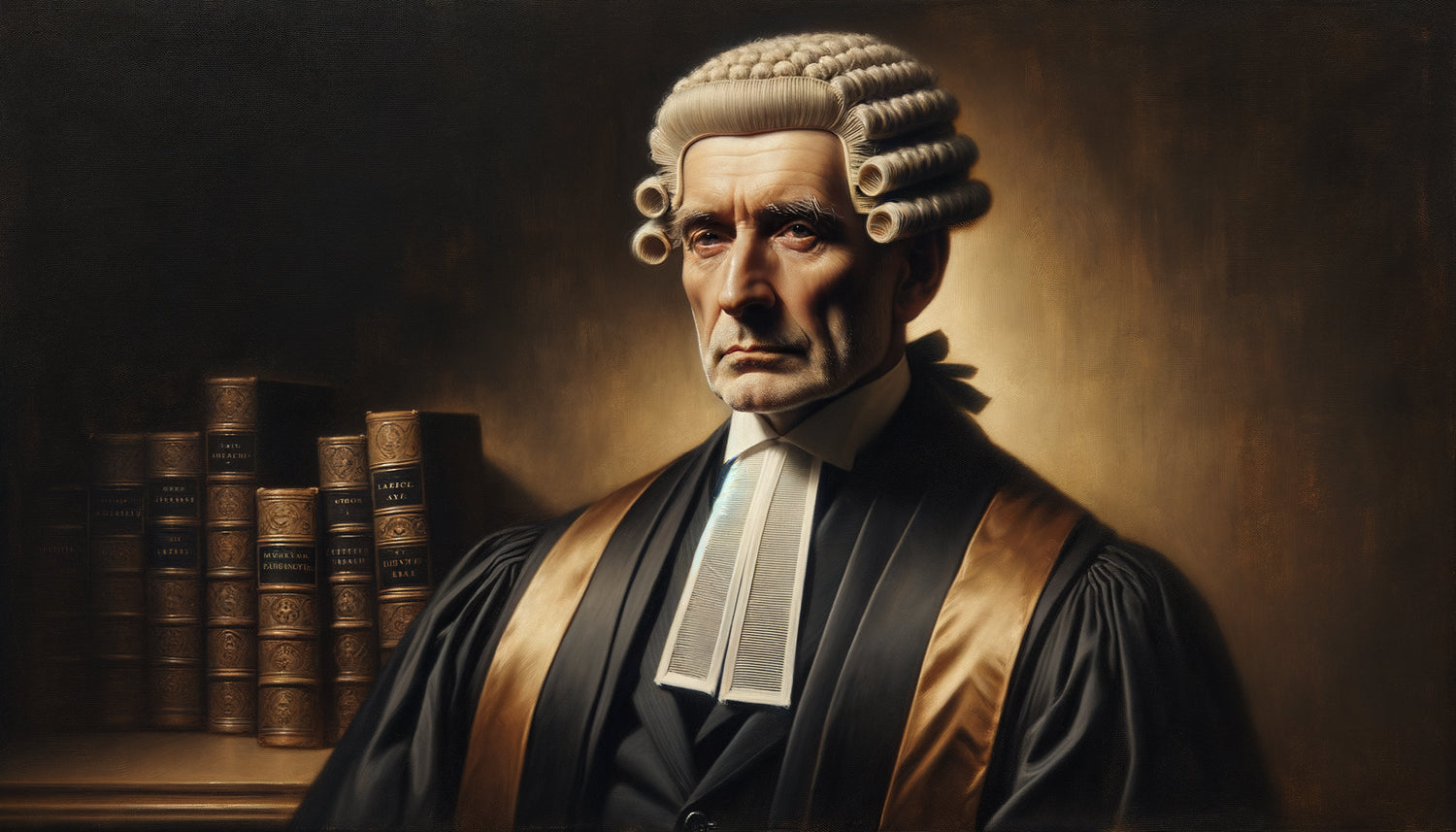
Last week, visiting the office of a young lawyer installed in a renovated industrial loft, I was struck by one detail: amidst Eames armchairs and glass partitions, there was a portrait of a man in ceremonial robes from the 18th century. Far from creating a dissonance, this antique canvas brought an unexpected depth to the contemporary space. This scene perfectly summarizes the debate that is agitating legal and design professionals today: historical legal portraits do they still have a place in a modern law firm?
Here's what these heritage works bring to your professional space: instant institutional legitimacy which reassures your clients, a narrative dimension which humanizes your practice, and a cultural anchor which radically differentiates your visual identity from aseptic firms.
Many young lawyers hesitate. They fear that these historical portraits will age them, confine them to a dusty image incompatible with their innovative approach to law. This concern is legitimate in an era where agility, transparency, and proximity to the client are valued.
Yet, the most avant-garde firms have understood it: modernity and heritage do not oppose each other, they complement each other. The art of mixing these legal portraits with contemporary architecture creates a sophisticated visual identity that particularly appeals to patrimonial and entrepreneurial clients.
I invite you to discover how these works steeped in history can radically transform the atmosphere of your firm, and above all, how to integrate them properly into a professional environment of the 21st century.
The silent power of historical portraits in the legal space
During my consultations for law firm renovations, I systematically observe the same dynamic: clients unconsciously spend more time in spaces that tell a story. A historical legal portrait is never just a decoration. It's a witness, a guardian of bar traditions, a visual reminder that law crosses centuries.
These portraits create what I call the temporal anchoring effect. In a professional world where everything accelerates, where digital tools dominate, these works offer a reassuring counterpoint. They whisper to your clients: here, we take the time. Here, we are part of a continuity. Here, the fundamental principles of law are not negotiable.
I accompanied the installation of a 17th-century magistrate in the office of a tax lawyer specializing in cryptocurrencies. The contrast was striking, but perfectly consistent: the permanence of legal principles facing financial innovation. His clients immediately perceived the message: cutting-edge expertise, but rooted in the classic rigor of law.
When the old dialogues with the contemporary: the golden rules
The successful integration of a historical legal portrait into a modern office relies on three staging principles that I have refined through my interventions.
Embrace Contrast Rather Than Faded Harmony
Do not seek to soften the age of your historical portrait. On the contrary, amplify the contrast with your contemporary furniture. A portrait in ceremonial attire from the 19th century gains power against a bleached oak minimalist desk. This visual tension creates a stimulating intellectual dynamic for your visitors.
I recently worked on an office where we placed a portrait of an imperial prosecutor on a raw concrete wall. The result? An unexpected sophistication that generated more conversation with clients than any conventional decorative element.
Lighting as a Temporal Mediator
A historical legal portrait deserves appropriate museum lighting. Forget generic ceiling lights. Opt for directional LED spotlights with a 3000K temperature that reveals the nuances of the painting without assaulting it. This targeted lighting creates a space for contemplation within your modern office.
Storytelling: Transforming the Work into a Conversation
Each historical portrait carries a story. Research the era, judicial attire, and attributes represented. Share this story with your clients. I always encourage lawyers to place a small discreet plaque or prepare an anecdote. This portrait then becomes a client relationship tool, a gateway to a casual conversation before the formal meeting.

Historical Legal Portraits as an Identity Signature
In a sector where visual differentiation is difficult, these heritage works constitute a powerful identity marker. Major international firms understand this: their Parisian, London or New York spaces systematically integrate heritage elements that distinguish them from generic corporate spaces.
For mid-sized firms or independent lawyers, a well-chosen historical legal portrait offers the same sophistication at a measured investment. It instantly communicates several messages: respect for tradition, deep legal culture, institutional stability, intellectual refinement.
I have observed that clients in the heritage and family sectors are particularly receptive to these visual codes. When they entrust us with managing their assets or resolving intergenerational conflicts, they seek professionals who embody continuity and permanence. A historical portrait sends exactly this signal.
Beyond decoration: the psychological function of the portrait
Neuroscience applied to professional spaces reveals fascinating data about our perception of faces, even painted ones. A portrait generates a presence, a form of silent witness that subtly alters the behavior of those occupying the space.
In a law firm, this presence plays a regulatory role. It recalls the solemnity of legal action, the gravity of the issues, and the importance of ethical guidelines. Without being oppressive, it maintains an elevation of standards for both the lawyer and the client.
Several colleagues have confided in me that since installing a historical legal portrait in their meeting room, exchanges have gained depth and courtesy. The gaze of a past magistrate, even fictional, seems to invite intellectual rigor and mutual respect.

Choosing the right portrait: era, style and message
Not all historical portraits are equal for a modern firm. Here are the criteria I use to guide my clients in their selection.
The era and its codes: Portraits from the 18th and 19th centuries generally offer the best balance between historical significance and contemporary readability. Judicial costumes are recognizable, compositions are often majestic but not overwhelming.
The pictorial quality: Prioritize works with real attention to material, light, and expression. A mediocre portrait, even an old one, will bring less than a high-quality reproduction of a major work. Subtlety counts more than absolute authenticity.
The subject's expression: Avoid portraits that are too austere or severe. Instead, look for benevolent dignity, a firm but accessible presence. The portrait should inspire confidence, not intimidation.
Dimensions: For an individual office, aim for 60x80 cm to 80x100 cm. For a waiting room or meeting room, you can go up to 100x150 cm. A portrait that is too small loses its impact; one that is too large overwhelms the space.
The contemporary alternative: artistic reinterpretations
If you are concerned that a true antique portrait will be too marked, consider contemporary reinterpretations of the genre. Several current artists revisit the codes of historical legal portraits with modern techniques: photographic treatment, refined palette, unusual format.
These works offer an interesting compromise: they retain the reference to legal tradition while asserting a contemporary sensibility. They dialogue perfectly with clean architecture and design furniture.
I particularly appreciated a project where a young firm had commissioned a series of three legal portraits in black and white treated as fashion studio portraits. The result? Classic elegance met modern graphic aesthetics, creating a unique and memorable visual identity.
Your firm deserves a visual identity that tells your vision of law
Discover our exclusive collection of tableaux for law firms that combine legal tradition and contemporary aesthetics to create distinguished professional spaces.
Towards a new visual culture of law
The question is not whether historical legal portraits are still relevant, but rather how they become differently relevant in our modern firms.
We are witnessing a rehabilitation of traditional visual codes, not out of nostalgia, but out of a search for authenticity. In an increasingly digitalized legal world, these tangible works, steeped in history, create valuable emotional anchors.
Firms that succeed in this integration do not copy the past: they invoke it with discernment to enrich their present. They create layered spaces where multiple temporalities coexist harmoniously. This intellectual sophistication in design reflects the sophistication of their legal practice.
Imagine your next client stepping into your firm's office. Their gaze rests on this historical portrait, then slides towards your touchscreen, your library blending ancient codes and digital journals. They instantly understand: here, we respect the fundamentals while embracing innovation. That is exactly the lawyer they were looking for.
The relevance of historical legal portraits in a modern law firm is not decreed, it is built. It requires a look, a staging, a story. But once these elements are gathered, these works become much more than decoration: they become the visible soul of your professional practice.
Frequently Asked Questions
Could a historical legal portrait risk giving my young firm an outdated image?
This is the most common concern, and it is unfounded if the integration is well thought out. A historical portrait placed in a resolutely contemporary environment actually creates the opposite effect: it brings a cultural depth that is often lacking in younger structures. The key lies in assumed contrast rather than accumulation of old elements. A single quality portrait on a clean wall, accompanied by modern furniture, communicates legal sophistication and culture, not obsolescence. I have seen firms created by people in their thirties gain credibility with senior clients precisely thanks to this well-dosed heritage touch. The outdated image comes from the accumulation of aged elements, not from a historical piece highlighted with a contemporary look.
Where can I find quality historical legal portraits without breaking the bank?
Several options are available to you depending on your budget. Regional antique shops and auctions regularly offer period portraits at affordable prices, between 200 and 800 euros for decent pieces. Galleries specializing in old masters offer a guarantee of superior quality, with expert support, for investments from 1000 to 5000 euros. But the most accessible solution remains very high-quality art reproductions: printed on canvas with pigment inks and mounted on frames, they offer a museum-like rendering for 150 to 400 euros. Several cultural institutions now offer their collections in print-on-demand. Finally, platforms like Walensky offer collections specifically designed for law firms, with curatorial work that guarantees aesthetic consistency. The important thing is not so much the authenticity of the work as the quality of its presentation and its thoughtful integration into your space.
How to properly maintain and preserve an old portrait in a modern office?
The conditions for a modern office are generally favorable to the preservation of a portrait, provided that a few simple principles are respected. Absolutely avoid direct exposure to sunlight, which irreversibly degrades pigments and support. Prefer a wall perpendicular to the windows rather than facing them. Maintain a stable temperature between 18 and 22°C and humidity between 45 and 55% - conditions comfortable for humans are also for artworks. Avoid placing the portrait above a radiator or air conditioning vent. A delicate dusting twice a year with a soft brush is sufficient for routine maintenance. If your portrait has significant heritage value, consultation with a restorer every five years allows you to monitor its condition. For quality reproductions, maintenance is even simpler: occasional cleaning with a slightly damp microfiber cloth is enough. In all cases, these works are much more robust than one might think and perfectly adapt to the daily life of a law firm.