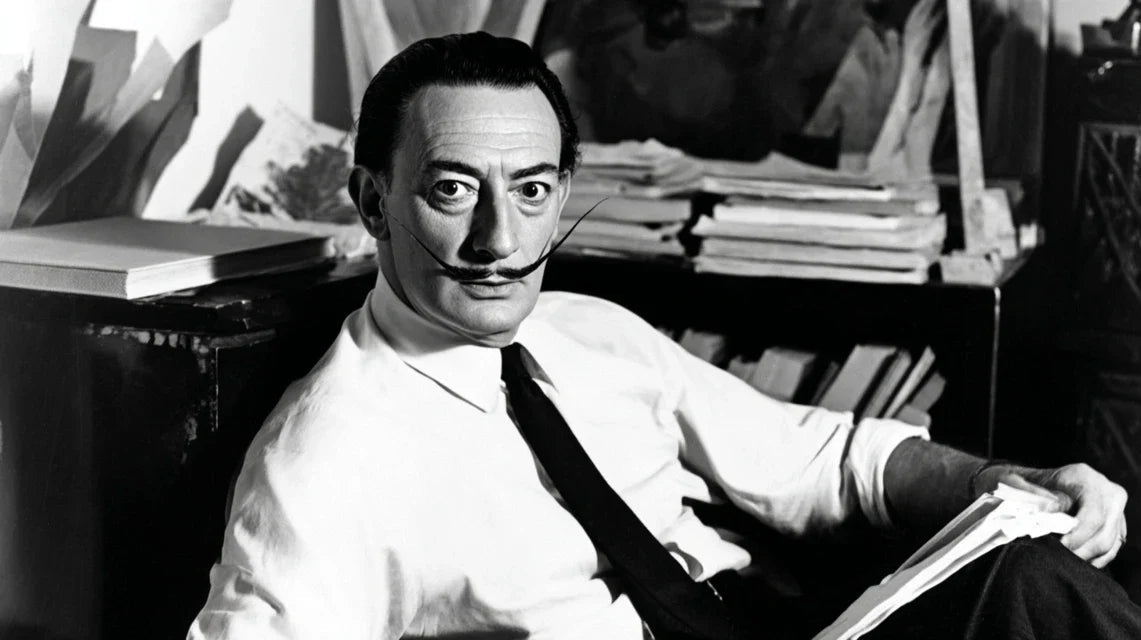
🎨 Imagine a man with waxed mustaches defying the laws of gravity, painting melting clocks under the scorching sun of Catalonia. Salvador Dalí transforms each canvas into a theater of the impossible, where dreams take shape and reality wavers.
In the workshop of Port Lligat, facing the Mediterranean, this surrealism orchestra leader revolutionizes 20th-century art. His brushes capture the Freudian unconscious with surgical precision, creating a universe where ants and spiders-legged elephants coexist in perfect dream logic.
Why does Salvador Dalí still fascinate today? How did this self-proclaimed genius manage to impose his delirious vision on the world? Behind the media eccentricity lies an artist of impeccable technique and limitless creativity.
Discover the man behind the myth, his secret obsessions, and the creation secrets that make each Dalinian work a journey into the collective unconscious.
Salvador Dalí: The Catalan Master of Surrealism and the Paranoiac-Critical Method
Knowing the true story of Salvador Dalí helps understand how a young man from Figueres became the most recognizable artist of the surrealist movement. Beyond legends and provocations, a creator with exceptional technical mastery is revealed.
| Biographical Highlights | Artistic Legacy |
|---|---|
|
Full name: Salvador Domingo Felipe Jacinto Dalí i Domènech Born: May 11, 1904, Figueres (Catalonia) Died: January 23, 1989, Figueres Nationality: Spanish (Catalan) |
Movement: Surrealism, academic realism Style: Dreamlike hyperrealism, paranoiac-critical method Flagship work: The Persistence of Memory (1931) Innovation: Technique of melting clocks, double image |
To grasp the essence of Dalí, one must delve into the universe of a man who made his theatrical personality an artwork in its own right, revolutionizing both creation and its promotion.
Salvador Dalí as a child: Between family trauma and early artistic revelation
Born into a bourgeois family in Figueres, Salvador grew up under the shadow of an older brother who died before his birth and bore the same name. This original identity confusion deeply marks his creative psyche and nourishes his future artistic obsessions.
The awakening of genius at six years old: In 1910, little Salvador discovers French Impressionists in an art book belonging to his notary father. Fascinated by the colors of Monet, he proclaims that he wants to become a "cook" then, correcting himself, a "painter". This anecdote already reveals his taste for calculated provocation.
The fundamental Dalinian principle: "One must learn to paint like the old masters in order to be able to paint like no one has ever painted." This philosophy guides his quest for absolute technical perfection serving revolutionary dreamlike visions.
Dalí and the Roaring Twenties: European art in perpetual revolution
The 1920s saw the birth of the Surrealist movement under the impetus of André Breton in Paris. In this creative ferment, Freud revolutionized the understanding of the unconscious while artistic avant-gardes exploded traditional aesthetic conventions.
The Europe between two wars experienced an unprecedented cultural effervescence. Picasso explored Cubism, Miró developed his abstract language, Max Ernst invented his dreamlike collages. This creative emulation offers Dalí an ideal testing ground.
Unlike his Parisian contemporaries, Dalí retains his Catalan roots and develops a unique approach blending classical technique and unbridled imagination. Where Magritte cultivates bourgeois sobriety and Delvaux silent dreamlike visions, Dalí chooses explosive theatricality.
The Francoist Spain and the European political tensions influence his artistic production. His works reflect the anxieties of his time: war, psychoanalysis, scientific progress and questioning of reality.
Dalí's unique alchemy: Dalí transforms Freudian discoveries into an accessible pictorial language, making visible the invisible of the unconscious. He democratizes Surrealism by creating images that are immediately recognizable and universally disturbing.
This ability to synthesize the revolutions of his time while maintaining a unique artistic identity explains why Dalí transcends trends to become a timeless cultural icon.
The years of Parisian training: When Dalí conquers the city of art
Arriving in Paris in 1927, the young Salvador discovered a scene dominated by established surrealists. Despite his obvious talent, he had to prove his legitimacy in an intellectual Parisian environment that sometimes scorned provincial artists.
His first Parisian exhibition at Pierre Colle in 1929 met with mixed success. Critics, accustomed to abstract experimentations, struggled to classify this young man who painted dreams with the precision of a photographer. Some saw it as a conservative return, others as a revolution.
The meeting with Gala Éluard in 1929 radically transformed his personal and artistic life. This revolutionary muse, wife of the poet Paul Éluard, became his creative obsession and astute manager. Their relationship scandalized the Parisian art scene.
These early difficulties forged his legendary determination and his ability to turn every obstacle into a creative opportunity. Dalí developed his self-promotional genius, understanding that a modern artist must be as much a creator as a communicator of their universe.
This period of Parisian learning allowed him to refine his paranoid-critical method and develop this unique blend of technical rigor and overflowing imagination that characterizes his future masterpieces.
Dalí provocateur: The scandals that revolutionize surrealist art
From his early days in Paris, Dalí cultivated calculated controversy. His shocking statements and spectacular performances divided the artistic community. He turned every exhibition into a media event, revolutionizing the promotion of contemporary art.
In 1934, his London conference in a diving suit nearly suffocated him. This performance, intended to illustrate his ability to "dive into the human unconscious," caused an international scandal and definitively established his reputation as a brilliant eccentric.
His artistic philosophy fully embraces this spectacular dimension: "The difference between me and the surrealists is that I am a surrealist." This apparent arrogance hides a profound reflection on the role of the artist in modern society.
The split with André Breton: In 1939, Breton excluded Dalí from the official surrealist movement, accusing him of complacency towards Franco and excessive commercialization of his art. Dalí responded with his usual humor: "Surrealism is me!"
These controversies reveal his artistic strategy: to use media provocation to disseminate his aesthetic innovations to the general public. Dalí democratizes avant-garde art by making it accessible and memorable.
Far from being simple whims, these controversies are part of a revolutionary vision: to transform the artist into a living work of art, abolish the boundary between creation and communication, and make each public appearance a total creative act.
The Dali Art: When Classical Technique Meets Surrealist Imagination
The 1930s mark the peak of Dalí's creative period. He develops his paranoiac-critical method, a revolutionary technique for accessing images from the unconscious while maintaining total creative lucidity.
The creation of "The Persistence of Memory" in 1931 perfectly illustrates this unique alchemy. Inspired by a melting camembert in the sun, Dalí transposed this vision into a landscape of Port Lligat, creating the most famous image of Surrealism worldwide.
The Persistence of Memory: An Absolute Masterpiece by Salvador Dalí
This canvas measuring 24 × 33 cm revolutionizes the representation of time. The soft watches symbolize temporal relativity discovered by Einstein, while the Catalan landscape anchors this cosmic vision in the artist's geographical intimacy. Every detail bears witness to a microscopic observation of reality.
His pictorial technique mixes photographic hyperrealism and pure dreaminess. Dalí paints his controlled hallucinations with the precision of a Flemish master, creating that unsettling effect of "dream photographs" which characterizes his mature style.
Revolutionary Techniques: Dalian Innovation at the Service of Art
Dali develops the technique of double image: a single pictorial element reveals several visual interpretations simultaneously. This optical innovation revolutionizes traditional artistic perception and influences contemporary research in visual neuroscience.
Dalí facing Picasso, Miró and the masters of his time
Unlike Picasso who deconstructs reality, Dalí rebuilds it according to his dream logic. Faced with Miró’s abstraction, he chooses hallucinatory hyperrealism. This unique approach distinguishes him radically from his Surrealist contemporaries.
A revealing anecdote: during a visit of Freud to London in 1938, Dalí paints the portrait of the father of psychoanalysis in real time. Freud, initially skeptical of Surrealism, declared: "This young Spaniard, with his candid and fanatical eyes, and his undeniable technical mastery, made me change my mind."
OUR RECOMMENDED PRODUCTS
This recognition by Freud himself establishes Dalí as the official painter of the unconscious, capable of translating into images the most revolutionary discoveries of his time.
Salvador and Gala: The mad love that transforms art into a creative obsession
The meeting with Gala Éluard in 1929 radically transforms Dalí's creative universe. This revolutionary muse, ten years his senior, becomes simultaneously his artistic inspiration, his business manager and his sublimated erotic obsession.
Their installation at the castle of Púbol in 1970 perfectly illustrates their fused relationship. Dalí transforms this residence into a temple dedicated to Gala, creating total works of art blending architecture, painting and a permanent theatrical staging.
Dalí's personality mixes deep shyness and calculated exhibitionism. His phobias (physical contact, grasshoppers, eggs) nourish his creative imagery while his obsessive daily rituals rhythm his artistic production with a methodical regularity.
This duality between private fragility and public confidence explains the psychological richness of his works, veritable disguised self-portraits revealing the secret mechanisms of contemporary art creation.
Dalí international star: From cursed artist to global icon
The international recognition arrives in the 1930s with his New York exhibitions. The Museum of Modern Art acquires his major works, establishing Dalí as an essential figure of modern art.
His exile in the United States during the Second World War marks his entry into global popular culture. His collaborations with Disney, Hitchcock and haute couture revolutionize the boundaries between elite art and mass culture.
Dalí and value: Spectacular evolution on the art market
The Dalí quote knows a dazzling progression, reflecting his growing popularity among international collectors. His works combine visual accessibility and technical sophistication, seducing both enthusiasts and savvy investors.
| Period | Average value | Record sale |
|---|---|---|
| 1930-1989 (living) | $50,000 - $500,000 | $1.5 million (1989) |
| 1990-2010 (posthumous) | $500,000 - $2 million | $11.8 million (2010) |
| 2010-2025 (current market) | $1 - $5 million | $22.4 million (2022) |
This spectacular evolution is explained by the growing recognition of Dalí as a precursor to contemporary art and by the universality of his imagery, now integrated into global visual culture.
Dalí's death in 1989: End of an era, birth of an eternal myth
The last years of Dalí in Figueres saw the creation of the Dalí Theater-Museum, the ultimate artistic testament. This revolutionary space mixes a traditional museum and a giant surrealist installation, foreshadowing today's contemporary art museums.
His disappearance on January 23, 1989 marks the end of an artistic era while opening the age of the Dalinian legacy. His posthumous influence proves to be even more powerful than his impact during his lifetime, touching all areas of contemporary creation.
Dalí and contemporary art: A permanent creative influence
Contemporary artists constantly draw on the Dalinian universe. Jeff Koons borrows his theatricality, Damien Hirst his calculated provocation, street-artists divert his visual icons. This creative lineage testifies to the persistent modernity of his artistic approach.
New technologies reveal new aspects of his genius: virtual reality, artificial intelligence and digital art explore the territories he intuitively pioneered. His research on visual perception inspires current developments in cognitive neuroscience.
Recognizing the Dalinian legacy today: Observe contemporary advertisements, music videos and video games. The Dalinian aesthetic permeates our daily visual environment, proof of its definitive integration into global culture.
Dalí in world collections: Where to discover the Catalan genius
The Dalí Theater-Museum in Figueres remains an essential pilgrimage, complemented by the House-Museum of Port Lligat and the Castle of Púbol. Internationally, the Dalí Museum of Saint Petersburg (Florida) and the collections of the MoMA in New York offer exceptional views of his creative evolution.
These places allow us to grasp the extraordinary coherence of a work that transcends traditional supports to create a total aesthetic universe, definitively revolutionizing our conception of modern art.
🎁 Special readers offer
Because you took the time to learn, enjoy a 10% discount on your first order:
⏰ Valid for 72h after reading • Applicable to all our products
Frequently Asked Questions about Salvador Dalí: Everything you need to know about the surrealist master
Born in 1904 in Figueres into a bourgeois Catalan family, Salvador Dalí grew up marked by the death of an elder brother with the same name. This identity confusion shapes his complex personality, blending deep shyness and calculated exhibitionism. A child prodigy, he shows exceptional artistic abilities from six years old, encouraged by his cultured family.
Trained at the 'Figueres School' and then at the 'Royal Academy of Madrid', Dalí obsessively studies the classical masters, particularly Velázquez and Vermeer. He develops an absolute technical mastery before exploring surrealism, stating that one must "learn to paint like the old masters to paint like no one". This rigorous training explains the photographic precision of his dreamlike visions.
This revolutionary technique allows access to images from the unconscious while maintaining total creative control. Dalí deliberately provokes controlled hallucinations which he transposes with absolute technical precision. This method produces his famous double images and explains the unsettling effect of "dream photographs" characteristic of his mature style.
Dalí revolutionizes artistic communication by transforming his personality into a living work of art. His spectacular performances, his shocking statements and his collaborations with Disney, Hitchcock and fashion democratize surrealist art. He creates images universally recognizable like the melting clocks, definitively integrating his universe into global popular culture.
Dalinian canvases are traded between $1 and $5 million for medium-sized works, with records at $22.4 million for masterpieces. This exceptional valuation is explained by the growing critical recognition and worldwide popularity of his imagery. Collectors appreciate the unique combination of visual accessibility and technical sophistication.
The Dalinian legacy permeates contemporary creation: Jeff Koons borrows his theatricality, street artists divert his icons, new technologies explore his intuitions about visual perception. His research foreshadows developments in virtual reality and cognitive neuroscience, confirming his persistent modernity and visionary pioneer status.
Salvador Dalí today: The eternal legacy of the Catalan surrealist genius
More than thirty years after his disappearance, Salvador Dalí continues to fascinate with his unique ability to make visible the invisible from the human unconscious. His genius lies in this extraordinary alchemy between absolute technical mastery and unbridled imagination, creating an artistic language universally understandable.
His artistic message retains a striking modernity: in our image-dominated age and virtual realities, Dalinian intuitions about perception and manipulation of reality resonate with prophetic acuity. He anticipated our world saturated with images by creating immediately memorable visions.
Discovering Salvador Dalí is allowing yourself to look at the world differently, to free your imagination while developing your aesthetic sense. His work reminds us that authentic art transforms our perception of reality and enriches our inner life sustainably.
Dalinian permanent invitation: Every contemplation of a Dalí artwork opens new creative territories in our mind. His legacy encourages us to cultivate our personal originality and to transform our dreams into concrete achievements, as he himself knew how to materialize his most daring visions.