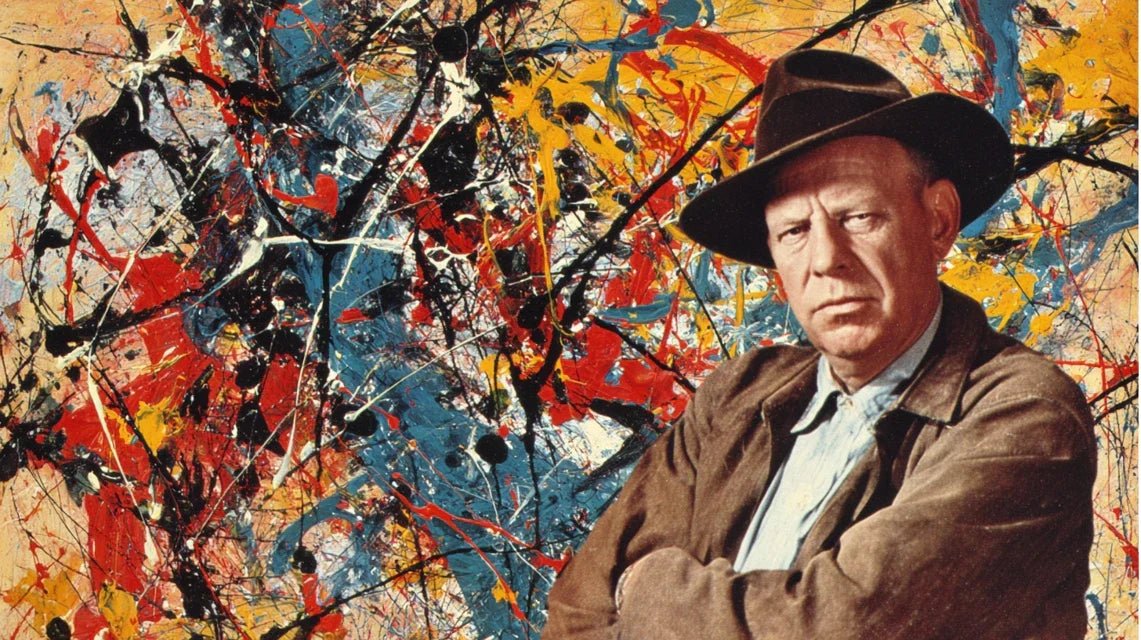
Imagine a man dancing frantically around a huge canvas laid on the floor, projecting paint using sticks and brushes in a hypnotic ballet that forever revolutionizes modern art.
In the small workshop in East Hampton in 1950, Jackson Pollock created his revolutionary masterpieces, transforming a simple hangar into a laboratory of abstract expressionism. His quick and precise gestures, guided by extraordinary artistic intuition, gave birth to compositions of dizzying complexity.
This biography reveals the fascinating story of the painter who liberated artistic creation from its traditional constraints, imposing American art on the international scene for the first time. Discover how this son of a farmer from Wyoming became the icon of pictorial modernity.
A captivating dive into the universe of the master of dripping, from his difficult beginnings to his worldwide consecration - American art finally liberated
Jackson Pollock : Portrait of a revolutionary of American abstract art
Understanding Jackson Pollock means grasping how one man reinvented the millennial codes of Western painting. His story goes far beyond that of a simple artist to become the symbol of American cultural emancipation in the 20th century.
| Biographical highlights | Artistic legacy |
|---|---|
|
Full name : Paul Jackson Pollock Birth date : January 28, 1912, Cody, Wyoming Death date : August 11, 1956, East Hampton, New York Nationality : American |
Movement : Abstract Expressionism Style : Action painting and dripping technique Key work : Autumn Rhythm (Number 30) Innovation : Total liberation of the pictorial gesture |
This revolutionary approach will definitively transform our conception of what painting can be.
Paul Jackson Pollock : Nomadic childhood and artistic revelation in the American West
Born in the vast expanses of Wyoming, Jackson Pollock grew up in an Irish-Scottish family marked by geographical instability. His father LeRoy Pollock, farmer and then government surveyor, imposed constant moves on the family through Arizona and California.
The foundational discovery of Native American cultures : During surveying missions with his father, young Jackson discovered the ritual art of the Navajo Indians and their sand paintings. This encounter with ancestral pictorial techniques, where the artist moves around the work on the floor, will profoundly mark his future creative approach.
In Los Angeles, he attended Manual Arts High School where he met Philip Guston, a future renowned painter. However, his rebellious temperament and questioning of authority led to two successive expulsions. These academic difficulties already revealed a personality seeking alternative forms of expression.
The creative principle revealed in adolescence: Pollock intuitively understood that authentic art is born from the transgression of established rules and the exploration of unknown creative territories.
In 1930, at 18, he joined his brother Charles in New York to study at the Art Students League.
Jackson Pollock and the artistic effervescence of America in the 1930s-1950s
Pollock's arrival in New York coincided with a period of intense cultural ferment. The 1930s saw European artists fleeing Nazism flocking to New York, bringing with them the innovations of Surrealism and modern art.
The artistic climate in New York at that time was characterized by a desire for independence from European cultural hegemony. Government programs like the New Deal, such as the Works Progress Administration, offered American artists their first opportunities of significant scale.
His contemporaries - Willem de Kooning, Mark Rothko, Barnett Newman - were all seeking to create a specifically American pictorial language. But Pollock distinguished himself by his technical radicalism and complete rejection of European conventions.
The Second World War and the emergence of the United States as a global superpower created a favorable context for the affirmation of an autonomous American art. Abstract expressionism became the cultural weapon of democracy against Soviet socialist realism.
Art as an expression of freedom: Pollock perfectly embodies the spirit of innovation and individualism that characterizes triumphant post-war America, offering the world a new aesthetic model.
This unique historical context would allow his work to radiate far beyond artistic circles.
Jackson Pollock facing adversity: Alcoholism and quest for identity in the New York of the 1930s
Pollock's early professional years in New York were marked by precariousness and personal demons. Working as an assistant for WPA murals, he mingled with masters such as David Alfaro Siqueiros and José Clemente Orozco, discovering large-scale mural painting techniques.
In 1937, his already problematic alcoholism led him to begin Jungian psychoanalysis. This therapy introduced him to the concepts of collective unconscious and archetypes, nourishing his future artistic explorations. The sessions revealed a man tormented by profound existential anxieties.
The decisive encounter occurs in 1941 with Lee Krasner, an accomplished painter and erudite intellectual. Impressed by the canvases she discovers in Pollock's studio, she quickly becomes his companion and will be the architect of his artistic recognition.
These years of trials forge his conviction that authentic art is born from confrontation with one’s inner demons. Adversity becomes fuel for his future creativity.
The pre-war period ends on a note of hope with the growing support of Peggy Guggenheim.
Jackson Pollock scandalizes America: When abstract art divides public opinion
Pollock's art provokes passionate reactions from its first exhibitions. His radical rejection of figuration and his unconventional methods disconcert a public accustomed to traditional art. Conservative critics see it as an imposture, a "child’s scribbling".
On August 8, 1949, the magazine LIFE dedicates a resounding article to Pollock with this provocative title: "Is he America's greatest living painter?" This media coverage transforms the artist into a social phenomenon but also fuels controversy.
Faced with attacks, Pollock develops an assumed artistic philosophy. He claims the right of art to explore new expressive territories, refusing to be limited by the reassuring conventions of the past.
His revolutionary statement: "I paint on the floor because I feel closer to the painting, more involved. I can go around it, work on all four sides and literally be in the painting."
These public debates reveal the tensions of post-war America between tradition and modernity. Pollock becomes, despite himself, a symbol of this cultural shift.
His persistence in pursuing his research despite criticism demonstrates remarkable artistic integrity.
Jackson Pollock revolutionizes painting: Birth of dripping and action painting
The year 1947 marks Pollock's definitive artistic transformation. Settled in his East Hampton farm with Lee Krasner, he converts a barn into a studio and develops his revolutionary dripping technique.
The creation of Autumn Rhythm (Number 30) in October 1950 perfectly illustrates his accomplished mastery. This monumental work, 525 cm wide, is the result of a completely unprecedented creative process in Western painting history.
Autumn Rhythm Number 30: Masterpiece of American Abstract Expressionism
This iconic canvas reveals the perfect synthesis between technical control and creative spontaneity. Pollock deploys a complex network of intertwined lines, creating a composition without center or hierarchy, where each visual area has equal importance.
The black enamel paint on raw canvas creates an unparalleled richness of texture. The absence of primer allows the paint to penetrate directly into the fibers, fusing support and pigment in an organic unity.
The dripping technique: Jackson Pollock's revolutionary innovation
Pollock definitively abandons easel and traditional brushes. He lays his canvases on the floor and pours paint using sticks, spatulas or directly from the pots. His entire body participates in the creative act in a calculated choreography.
Jackson Pollock facing his contemporaries: Picasso, Miró and European avant-garde
While Picasso still decomposes visible reality and Miró stylizes his organic forms, Pollock makes the radical choice of pure abstraction. He surpasses Surrealist innovations by eliminating any reference to the external world.
His bodily approach to painting, where gesture takes precedence over image, distinguishes him radically from European intellectualism. He creates a visceral, immediate art, deeply American in its pragmatism and extravagance.
OUR RECOMMENDED PRODUCTS
This technical revolution opens the way to all subsequent artistic experiments.
Jackson Pollock: Portrait of a tormented man between creative genius and self-destruction
Pollock's personality reveals a complex being, oscillating between moments of transcendent creation and phases of alcoholic self-destruction. His introverted temperament contrasts with the expressive violence of his works.
His marriage to Lee Krasner in October 1945 constitutes the essential emotional anchor for his artistic development. Krasner, partially sacrificing her own career, becomes the vigilant guardian of his work and mental health.
Life in Springs, Long Island, away from the bustle of New York, offers him the serene environment necessary for his creation. In this rural setting, he rediscovers harmony with nature from his Western childhood, a source of inspiration for his pictorial rhythms.
This human dimension illuminates the profound emotional sincerity that permeates each canvas.
Jackson Pollock achieves fame: Critical consecration and commercial success of the 1950s
The institutional recognition arrives gradually from 1943 with the decisive support of Peggy Guggenheim. Her "Art of This Century" gallery offers Pollock his first solo exhibition, revealing his talent to the New York art world.
The turning point occurs with the article in magazine LIFE in 1949, which propels Pollock to the rank of national celebrity. This media coverage transforms the confidential artist into a popular icon of American modern art.
Jackson Pollock and the Spectacular Evolution of His Artistic Value
The evolution of the market value of his works perfectly reflects his growing recognition and impact on the history of contemporary art.
| Period | Average Value | Record Sale |
|---|---|---|
| Living (1940-1956) | $1,000 - $8,000 | $8,000 (Blue Poles, 1952) |
| Immediate Posthumous (1960-1980) | $50,000 - $500,000 | $2 million (1973) |
| Contemporary Market (2000-2024) | $5 - $50 million | $200 million (Number 17A, private sale 2016) |
This exceptional valuation confirms his status as a major artist of the 20th century.
Jackson Pollock Dies in 1956: Tragic Death and Artistic Immortality
The last years of Pollock were darkened by the resurgence of his alcoholic demons. Despite his international fame, he experienced a profound creative crisis, questioning the validity of his innovations. His later works, such as The Deep (1953), testify to a search for artistic renewal.
On August 11, 1956, at the age of 44, Jackson Pollock died in a car accident near his home in East Hampton. This sudden disappearance instantly transformed the artist into a legend, crystallizing the myth of the American cursed artist.
Jackson Pollock Inspires Contemporary Art: A Lasting Influence on Future Generations
His legacy is evident in the development of conceptual art, performance and installation. Artists such as Yves Klein, Robert Rauschenberg or Cy Twombly draw directly from his gestural innovations.
More recently, Damien Hirst with his "Spin Paintings" or Anselm Kiefer with his unconventional materials perpetuate the Pollockian spirit of transgression. Contemporary street art also owes much to his liberation of pictorial gesture.
Recognizing Pollock's legacy today: Observe in current art the persistence of the bodily approach to creation, the importance of process over result, and the sacralization of the studio as a performative space.
Jackson Pollock in World Collections: Where to Discover His Masterpieces Today
His major works are held at the Museum of Modern Art in New York, the Metropolitan Museum, the National Gallery of Art in Washington and the Guggenheim Museum. The Pollock-Krasner House and Study Center in East Hampton offers a unique immersive experience into his creative universe.
These institutions perpetuate the memory of the master and continue to enrich our understanding of his genius.
🎁 Special offer for readers
Because you took the time to inform yourself, enjoy 10% discount on your first order :
⏰ Valid 72h after reading • Applicable to all our products
Frequently asked questions about the life and work of Jackson Pollock
Paul Jackson Pollock was the youngest of five brothers, born into a family of Presbyterian farmers of Irish-Scottish origin. His nomadic childhood in the American West, marked by his father's frequent absence and the family’s economic difficulties, forged a rebellious temperament that manifested from adolescence through successive school expulsions.
Pollock developed his technique by combining several influences: his work with Mexican muralist David Siqueiros in 1936, his fascination for the sand paintings of Navajo Indians discovered in his youth, and his study of Surrealist automatism. He perfected this approach in his East Hampton studio between 1947 and 1950.
Pollock revolutionized painting by abandoning easel and brushes for a total bodily approach. He lays his canvases on the floor and pours paint while moving around, creating "all-over" compositions without center or hierarchy. This technique transforms the act of painting into a physical performance and frees Western art from its traditional constraints.
His recognition is the result of several factors: Peggy Guggenheim’s early support, the emergence of New York as a new global art center, and above all the resounding article in LIFE magazine in 1949 which presented him as possibly “the greatest living painter in the United States”. This media coverage transforms a confidential artist into a national cultural phenomenon.
Pollock's works now reach peaks: "Number 17A" sold for $200 million in 2016, setting a record. His major canvases generally sell for between $20 and $100 million, reflecting his status as an essential artist of the 20th century. Even his minor works far exceed one million dollars.
Pollock’s legacy manifests in conceptual art, performance, installation, and even street art. His conception of the studio as a performative space, the importance placed on the creative process over the final result, and the liberation of artistic gesture continue to inspire generations of contemporary artists such as Damien Hirst, Anselm Kiefer, or street artists.
Jackson Pollock: The Eternal Legacy of America’s Abstraction Cowboy
Nearly seventy years after his disappearance, Jackson Pollock continues to fascinate with the radical nature of his approach and the authenticity of his expression. His work transcends artistic categories to become a universal symbol of creative freedom and innovative boldness.
His modernity lies in this unique ability to have transformed the very act of painting into an existential event. Each Pollock canvas bears within it the imprint of this absolute quest for authenticity that characterizes the most demanding art.
Discovering Pollock today means understanding how art can constantly push its own limits and open up new territories of expression. His message resonates particularly in our era of accelerated technological and cultural changes.
The Pollockian inspiration for our time: His work reminds us that true creation is born from the courage to break with conventions and explore the unknown. A lesson in boldness and authenticity more necessary than ever.