🎨 Imagine a three-year-old child watching his father cleaning the public toilets of a village of 200 people in the Xinjiang desert, condemned to this daily humiliation for his poetic writings deemed subversive by Mao's regime.
This little boy grows up in exile, deprivation and surveillance, but also in the shadow of a giant of Chinese poetry who teaches him the art of transforming suffering into beauty. Forty years later, this same child becomes Ai Weiwei, China's most famous and controversial artist.
In a world where contemporary Chinese art fascinates as much as it questions, understanding Ai Weiwei means deciphering a century of political upheaval, stifled creativity and cultural resistance. His journey reveals how an artist can become the living symbol of freedom of expression facing one of the most monitored regimes in the world.
This biography unveils the man behind the myth, his revolutionary works that defy conventions, and why his art resonates more than ever today in our era of geopolitical tensions - an essential read to understand contemporary Chinese art.
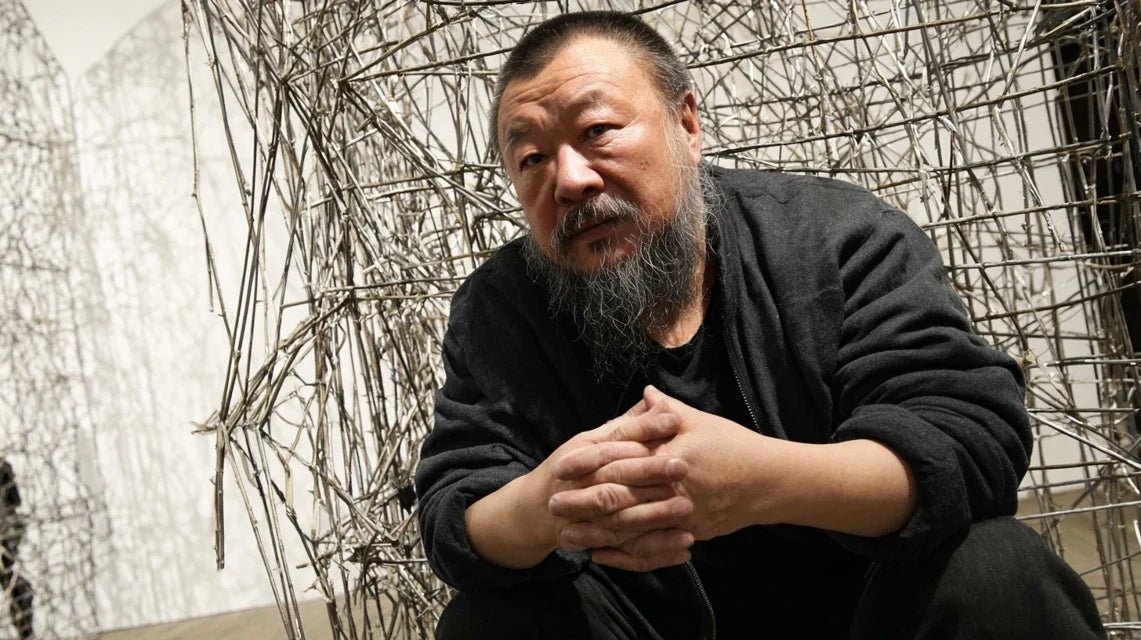
Ai Weiwei : the conceptual artist who revolutionized dissident Chinese art
Discovering Ai Weiwei means understanding how a man can transform his personal traumas into universal works of art, becoming the voice of millions of silenced Chinese people. His story is not only that of a talented artist, but also that of a cultural resister who paid a high price for his creative freedom.
| Biographical highlights | Artistic legacy |
|---|---|
|
Full name : Ai Weiwei (艾未未) Born : August 28, 1957, Beijing, China Status : Living, exiled in Portugal Nationality : Chinese |
Movement : Contemporary conceptual art Style : Monumental installations, political provocations Key work : Sunflower Seeds (2010) Innovation : Fusion of traditional Chinese art and social critique |
This biography traces the extraordinary journey of a man who transformed contemporary Chinese art by imbuing it with an unprecedented political dimension, opening the way for a new generation of committed artists.
The poetic roots of Ai Weiwei : between paternal heritage and artistic training
Understanding Ai Weiwei requires delving into the universe of his father, Ai Qing (1910-1996), one of the greatest poets of the 20th century Chinese. This artistic lineage largely explains the poetic and symbolic dimension of his most famous creations.
The exile that forges character : When Ai Weiwei is one year old, his family is deported to the Beidahuang labor camp in Heilongjiang, then exiled to Shihezi in Xinjiang in 1961. For sixteen years, the little boy grew up under extremely harsh conditions, watching his father clean public toilets daily - a humiliation imposed by the regime to break the spirit of this poet turned "rightist".
The clandestine artistic transmission : Despite surveillance, Ai Qing secretly passes on his passion for art and literature to his son. This underground artistic education nurtures in young Ai Weiwei a vision of art as an act of resistance and ultimate space of freedom.
Ai Weiwei and the artistic effervescence of post-Mao China
The year 1978 marks a pivotal turning point in Chinese history and in the life of Ai Weiwei. The country timidly opens to external influences under the impetus of Deng Xiaoping, creating an unprecedented cultural effervescence since the founding of the People's Republic.
This period sees the birth of the famous "Wall of Democracy" in Beijing, where young intellectuals post their political and artistic demands. The Chinese art moves out of its straitjacket of socialist realism to explore new creative territories, often inspired by Western avant-gardes.
It is in this context that Ai Weiwei joins the Beijing Film Academy to study animation, while co-founding the avant-garde group "The Stars" with artists such as Wang Keping, Ma Desheng and Huang Rui. This hundred of young creators revolutionizes Chinese art by rejecting the aesthetic codes imposed by the Party.
Unlike his contemporaries who seek to reform the system from within, Ai Weiwei already develops a more radical approach. He anticipates that true artistic freedom can only flourish by completely freeing itself from Chinese ideological constraints.
Art as a laboratory of democracy : For Ai Weiwei, the experience of the "Stars" demonstrates that art can become a space for democratic experimentation, foreshadowing the social transformations necessary for contemporary China.
Ai Weiwei's American odyssey: survival and discoveries in New York
In 1981, at the age of 24, Ai Weiwei flew to the United States with a few dollars in his pocket and the hope of discovering the secrets of Western art. This courageous decision propels him into a twelve-year adventure that radically transforms his artistic vision.
His first months in Philadelphia then San Francisco are marked by extreme precariousness. He survives by stringing together odd jobs: baggage carrier, museum guard, housekeeper, street portraitist in Washington Square Park. This period of wandering teaches him humility and resourcefulness.
The permanent installation in New York in 1983 marks the beginning of his true artistic training. He joins the Art Students League where he studies with Bruce Dorfman and Richard Pousette-Dart, while discovering the revolutionary works of Marcel Duchamp, Andy Warhol and Jasper Johns.
A chance encounter changes his life: during a poetry reading, he meets Allen Ginsberg, the beat poet who had met his father Ai Qing during a trip to China. This friendship opens the doors for him to New York's underground art scene and provides valuable moral support.
In parallel with his studies, Ai Weiwei develops an unexpected passion for blackjack, frequenting the casinos of Atlantic City assiduously. This activity provides him with extra income while honing his sense of calculated risk - a quality that would later characterize his artistic provocations.
Ai Weiwei's resounding return: provocations and challenges to the Chinese authorities
The return of Ai Weiwei to China in 1993, motivated by his father's illness, marks the beginning of a deliberately provocative artistic career. Drawing on his Western experience, he develops a conceptual art that challenges the taboos of contemporary Chinese society.
From 1994, he caused a scandal with the photograph "June 1994" showing his wife Lu Qing lifting her skirt on Tiananmen Square, a symbolic place of the 1989 student repression. This sexual provocation in the most monitored space in China foreshadows the color of his artistic commitment.
His "Study of Perspective" (1995-2017) series systematizes this iconoclastic approach: Ai Weiwei photographs himself brandishing a middle finger in front of global power monuments, from the White House to the Eiffel Tower, and Tiananmen Square. This simple but radical gesture summarizes his philosophy: art must question all forms of authority.
The manifesto of creative destruction: In 1995, Ai Weiwei created his most controversial performance, "Dropping a Han Dynasty Urn." Facing the camera, he drops and breaks a precious urn two thousand years old. This voluntary destruction of Chinese heritage caused outrage but affirmed his belief: art must sometimes destroy to create new meaning.
These provocations established Ai Weiwei as the leader of a new generation of Chinese artists who refuse to compromise with political power, preparing for the more direct confrontations that would mark the 2000s.
Ai Weiwei's monumental art: when Chinese tradition meets contemporary art
The 2000s consecrate Ai Weiwei as one of the most influential artists of his generation. His participation as an artistic consultant to the Beijing Olympic Stadium (2008), nicknamed the "Bird's Nest", brought him international recognition while revealing his contradictions with the Chinese regime.
At the same time, he developed his most famous work: "Sunflower Seeds" (2010), a monumental installation presented at the Tate Modern in London. This revolutionary work transforms the Turbine Hall into an ocean of one hundred million porcelain sunflower seeds, each painted by hand by artisans from Jingdezhen.
Sunflower Seeds: Ai Weiwei's iconic work that shook up contemporary art
"Sunflower Seeds" perfectly illustrates the genius of Ai Weiwei: transforming a symbol of Maoist propaganda into a meditation on individuality. Under Mao Zedong, the Chinese people were compared to sunflowers turning towards their sun, the "Great Helmsman". Here, the released seeds accumulate in indifference, questioning notions of mass and individual.
This installation required the collaboration of 1600 artisans for two years, revealing another dimension of his art: valuing traditional Chinese craftsmanship in a globalized contemporary art context. Each seed, unique despite its apparent uniformity, questions our relationship to authenticity and mass reproduction.
Revolutionary Techniques of Ai Weiwei: Fusion of Ancestral Craftsmanship and Modern Concept
Ai Weiwei revolutionizes contemporary art by rehabilitating ancient Chinese artisanal techniques. His works in porcelain, his sculptures in wood from ancient temples, and his installations in bamboo demonstrate that there is no opposition between tradition and modernity, but rather a fertile complementarity.
Ai Weiwei Compared to His Contemporaries: Anselm Kiefer and Jeff Koons
Unlike Anselm Kiefer who explores the traumas of German history through raw materials, Ai Weiwei favors formal beauty to convey his political messages. In contrast to Jeff Koons and his commercial art, he maintains a critical and committed dimension, refusing the political neutrality of contemporary Western art.
One revealing anecdote: during the exhibition "Dropping a Han Dynasty Urn", a Western collector offers to buy the urn before its destruction. Ai Weiwei categorically refuses, explaining that the work lies in the act of destruction, not in the object itself - a radically different conception of the Western art market.
OUR RECOMMENDED PRODUCTS
This period of artistic flourishing paradoxically prepares for a direct confrontation with the Chinese authorities, who no longer tolerate his increasingly explicit criticisms of the communist regime.
The Man Behind the Artist: Ai Weiwei Between Family Intimacy and Public Engagement
Behind the image of the provocative artist lies a man deeply marked by family ties and the responsibility of perpetuating the intellectual heritage of his father Ai Qing. This intimate dimension sheds new light on the radicality of his public positions.
His marriage to Lu Qing in 1996 marks a turning point in his personal life. An artist herself, she becomes his closest collaborator, notably participating in the performance "June 1994" on Tiananmen Square. This artistic and romantic complicity nourishes his creativity while strengthening his political determination.
The birth of his son Ai Lao in 2009 transforms his perspective on commitment. Ai Weiwei often speaks of his desire to leave his child a freer China, thus justifying the radicalization of his positions despite the increasing personal risks.
His complex personality mixes apparent joviality and inflexible determination: smiling and accessible in private, he becomes implacable when it comes to defending his artistic and political convictions.
Ai Weiwei and International Recognition: From Dissident Art to the Global Market
Ai Weiwei’s international recognition accelerates in the 2000s, paradoxically at a time when his situation in China deteriorates. This tension between Western success and Chinese repression characterizes the most productive phase of his career.
The exhibition "Sunflower Seeds" at the Tate Modern in 2010 marks his definitive entry into the pantheon of international contemporary art. More than 5 million visitors discover his universe, making this installation one of the most visited in the history of the London museum.
Ai Weiwei’s market value: record sales and valuation of the Chinese art market
The art market quickly recognizes the exceptional value of Ai Weiwei's works. His creations experience a spectacular progression, reflecting the growing appetite of collectors for Chinese contemporary art and politically charged works.
| Period | Average value | Record sale |
|---|---|---|
| 1995-2005 (emergence) | $50,000 - $200,000 USD | $380,000 USD (first concepts) |
| 2006-2015 (consecration) | $500,000 - $2 million USD | $5,427,136 USD (Circle of Animals, 2015) |
| 2016-2025 (current market) | $20,000 - $500,000 USD | Record maintained at $5.4 million USD |
His absolute record remains held by "Circle of Animals/Zodiac Heads" (2010), sold for $5,427 million USD at Phillips London in 2015, testifying to the appeal of works combining Chinese heritage and contemporary critique.
Ai Weiwei’s arrest in 2011: political repression and global artistic mobilization
The 3rd of April 2011 marks a dramatic turning point in Ai Weiwei's life. Arrested at Beijing airport for alleged "economic crimes", he disappears for 81 days in Chinese prisons, triggering an unprecedented international mobilization within the art world.
This detention, linked to his investigations into corruption during the Sichuan earthquake (2008), reveals the extent of his political influence. The Chinese regime understands that his works of art go beyond the aesthetic framework to become true tools for democratic awareness.
Ai Weiwei’s influence on global contemporary art and new generations
His release in June 2011 confirms Ai Weiwei as a global symbol of artistic resistance to authoritarianism. Artists around the world are inspired by his method: using social networks as an extension of the studio, transforming art into "social sculpture" according to Hans Ulrich Obrist.
In China, despite censorship, a new generation of artists is developing a coded political art, drawing inspiration from its techniques of symbolic subversion. In the West, it redefines the relationship between art and activism, influencing creators such as Banksy or JR in their approach to engaged urban art.
Recognizing Ai Weiwei's legacy today: His influence is manifested in the massive use of social networks by contemporary artists, the integration of traditional craftsmanship into conceptual art, and the emergence of a "documentary art" that reveals social injustices through aesthetics.
Discover Ai Weiwei in world collections: essential museums and institutions
To admire the works of Ai Weiwei, several reference institutions are a must: the Tate Modern (London) keeps elements of "Sunflower Seeds", the Museum of Modern Art (New York) exhibits his conceptual photographs, while the Musée Guimet (Paris) presents his porcelain creations. The Albertina Museum (Vienna) organized its most important recent European retrospective in 2022.
His forced exile since 2015 has paradoxically amplified his international museum presence, making his works irreplaceable testimonies of contemporary China and the challenges of artistic creation under an authoritarian regime.
🎁 Special offer for readers
Because you took the time to inform yourself, enjoy 10% discount on your first order:
⏰ Valid 72h after reading • Applicable to all our products
Frequently asked questions about Ai Weiwei's biography and work
Ai Weiwei (born in 1957) is a Chinese conceptual artist who has become one of the most influential creators of the 21st century. Son of poet Ai Qing, he grew up in exile during the Cultural Revolution before revolutionizing contemporary art with his monumental installations and political provocations. His fame stems from his unique ability to fuse Chinese tradition and social critique, particularly with works such as "Sunflower Seeds" or "Dropping a Han Dynasty Urn".
His artistic training unfolded in three stages: the early influence of his poet father Ai Qing, his studies at the Beijing Film Academy, and his participation in the avant-garde group "The Stars," followed by a formative twelve-year stay in the United States (1981-1993) where he discovered Marcel Duchamp, Andy Warhol, and Western conceptual art. This East-West synthesis forged his unique style, blending traditional Chinese craftsmanship with contemporary provocations.
Ai Weiwei masters the art of "creative détournement": he uses objects or traditional Chinese techniques (porcelain, wood from ancient temples, bamboo) that he reinterprets in a contemporary critical context. His method combines millennial artisanal know-how and modern political concept, creating monumental works that question authority while celebrating Chinese cultural heritage.
His arrest in April 2011 (81 days of detention) resulted from his investigations into government corruption during the Sichuan earthquake in 2008 and his repeated criticisms of the Chinese regime. Paradoxically, this repression accelerated his global recognition: institutions such as the Tate Modern, MoMA, and numerous European museums organized supporting exhibitions, establishing his reputation as an emblematic artist-activist.
Ai Weiwei’s works trade between 20,000 and 500,000 USD on average, with a historical record of 5,427 million USD for "Circle of Animals/Zodiac Heads" sold at Phillips London in 2015. His recent sculptures reach around 21,000 USD, while his design creations are negotiated around 11,500 USD. This high valuation reflects his unique position as an internationally recognized and politically engaged Chinese artist.
Ai Weiwei revolutionized contemporary art by demonstrating that artistic creation can be an effective tool of political resistance without losing its aesthetic dimension. He now influences a generation of artists who use social networks as an extension of the studio, integrate traditional craftsmanship into conceptual art, and develop a "documentary art" revealing social injustices. His approach inspires creators from Banksy to JR, redefining the relationships between art and activism.
Ai Weiwei today: the exiled artist who continues to transform contemporary art
In 2025, Ai Weiwei remains one of the most fascinating figures in contemporary global art. Exiled to Portugal since 2015, he continues to create works that question our troubled era, from migration crises to new forms of digital authoritarianism. His journey illustrates how an artist can transform personal traumas into universal works.
His legacy extends far beyond the artistic realm: he has redefined the relationship between creation and political commitment, demonstrating that an artist can be both a refined aesthete and a determined resister. In a world where freedom of expression is receding in many countries, his example inspires a new generation of creators concerned with combining beauty and social awareness.
Discovering Ai Weiwei today means understanding the crucial issues of our time: how to preserve cultural identity in the face of globalization, how to resist authoritarian excesses through art, how to transform collective suffering into shared beauty. His work resonates with a striking relevance in our era of increasing geopolitical tensions.
Art as a window on humanity: More than just an artist, Ai Weiwei reminds us that artistic creation remains one of the last spaces of absolute freedom in an increasingly controlled world. His works invite us to look at our time differently and to rediscover the transformative power of authentic art.