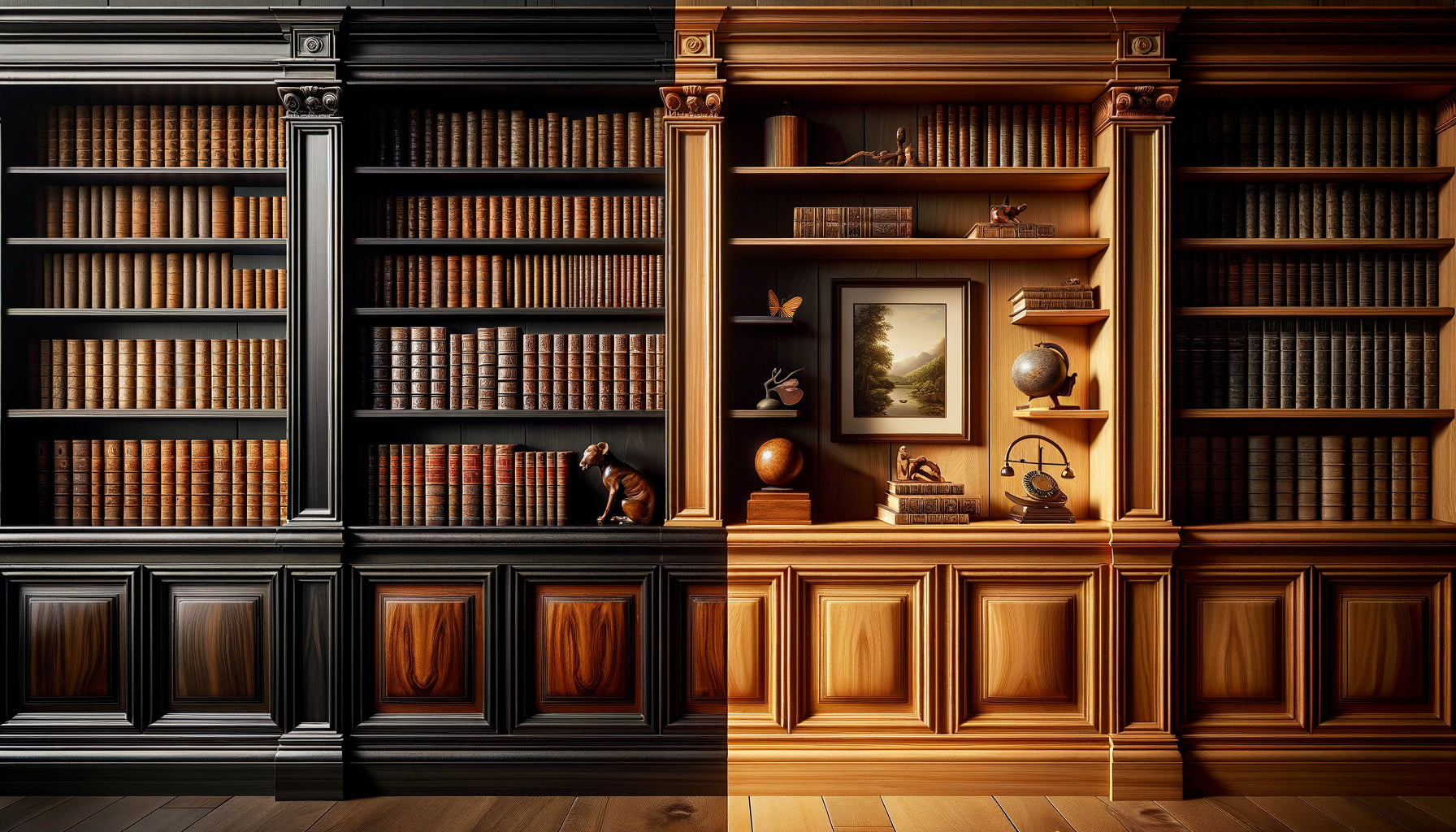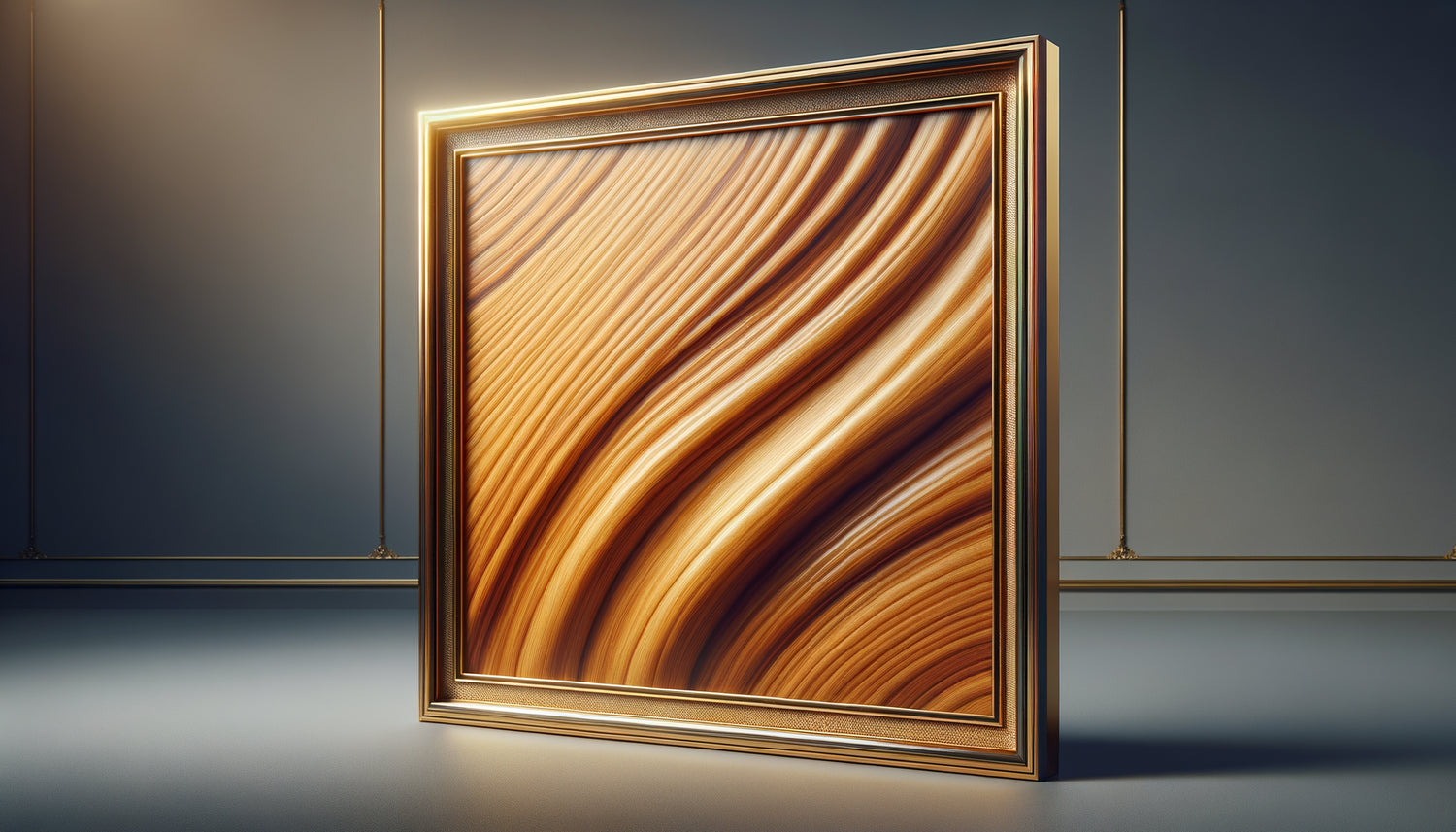
I still remember a collector client, standing in his Parisian living room, contemplating with dismay his collection of antique engravings hung on a wall that seemed perfect. Three months after the installation of his walnut veneer, cracks appeared, the wood slightly deformed, creating waves that visually unbalanced his most valuable works. That day, I realized that choosing a wood veneer to accommodate artwork was not just about selecting an essence pleasing to the eye.
Here's what a quality wood veneer brings to your precious artworks: dimensional stability that preserves the perfect alignment of your hangings, a uniform surface that highlights every detail of your pieces without creating visual distraction, and durability that guarantees your aesthetic investment will last through the decades without alteration.
You may have already felt this frustration: investing in beautiful works, imagining their ideal staging, then discovering that the chosen wall support betrayed your expectations. A veneer that warps with humidity, reveals irregularities over the seasons, or whose tone evolves unpredictably. These disappointments are common, but totally avoidable.
The good news? Evaluating the quality of a wood veneer does not require a cabinetmaker's training. A few specific criteria, observable even by an untrained eye, will allow you to distinguish a veneer worthy of your works from a mediocre product that will compromise your decorative project. Let me share with you the secrets I have learned over my fifteen years of designing cases for private collections.
The revealing thickness: first indicator of nobility
When I examine a wood veneer intended to receive precious works, my first attention is on its thickness. This measurement, often neglected, conditions the overall performance of the material. A quality veneer generally displays between 0.6 and 3 millimeters thick, depending on its use and essence.
Ultramince veneers, less than 0.5 millimeter, have obvious structural limitations. They reveal imperfections in the support, tear easily during installation, and offer almost no resistance to sanding. For a surface intended to accommodate valuable paintings, this fragility becomes problematic when installing hanging systems.
Conversely, a thick veneer — between 1.5 and 2 millimeters — allows absorption of slight irregularities in the support, authorizes careful finishing with possibility of light sanding, and guarantees a visual presence that harmoniously dialogues with the depth of frames. This substantial thickness also creates better acoustic insulation, a detail appreciated in spaces where silence reigns.
The regularity of the cutting: signature of craftsmanship
The method of cutting the wood veneer directly influences its final quality. In my workshop, I systematically prefer cut veneers to unrolled veneers. This technical distinction deserves your attention.
Sliced veneer is obtained by cutting the trunk into thin lamellae, as if slicing a sausage longitudinally. This technique respects the natural orientation of the fibers and produces aesthetic patterns: figured, mesh, flamed depending on the wood species and part of the tree used. For precious works, this visual rendering brings depth and texture that enriches the whole without ever competing with the work itself.
Rolled veneer, obtained by "peeling" the trunk like unrolling a roll of paper, has a repetitive and less noble grain. While this method is suitable for industrial applications, it lacks character to serve as a setting for an artistic collection. Observe the grain carefully: excessive regularity generally betrays a rolling process, while a natural alternation of patterns signals quality slicing.
Critical defects to spot immediately
During your inspection, some defects should trigger an immediate alert. Checks — these microfissures that run through the veneer — permanently weaken the material and will worsen with variations in humidity. Unstabilized knots risk detaching over time, creating unsightly cavities. Resin pockets, although sometimes sought after for their authentic appearance, can bleed under the effect of heat in certain rooms exposed to sunlight.
A veneer intended to receive precious works should have a surface free from major defects, with at most a few small singularities that attest to the natural origin of the material without compromising its function as a neutral and elegant support.

Dimensional stability: a guarantee of durability
Few criteria are as decisive as the dimensional stability of a wood veneer. This property determines its ability to retain its dimensions despite variations in humidity and temperature. For your precious works, it is a question of long-term preservation.
An unstable veneer deforms progressively: warping, cupping, cracking. These movements, even minimal, create stresses on the mounting systems and can disrupt the perfect alignment of your wall compositions. I have seen entire galleries require complete readjustment after two years, simply because the initial veneer had not been properly stabilized.
Stability depends on several factors. The essence itself plays a role: European walnut, fine-grained oak, or maple naturally exhibit better stability than some more lively exotic woods. Drying the veneer is the other critical variable. A properly dried veneer displays a moisture content between 8 and 12%, ideal for our heated interiors.
Always request this information from your supplier. A serious professional has precise data on the moisture content of their veneers. The absence of this information should raise your suspicion.
The application support: the decisive alliance
Excellent wood veneer applied to an inadequate substrate will lose all its qualities. This truth, which I learned at my expense during my first projects, deserves your particular attention.
To receive valuable works, the ideal support combines rigidity and stability. High-density MDF panels, marine-grade plywoods, or high-performance chipboard are excellent bases. These manufactured supports have the advantage of superior stability to solid wood, which remains subject to seasonal movements.
The adhesive used to marry the veneer to its support also influences the final quality. Urea-formaldehyde adhesives or D3/D4 class PVA adhesives guarantee a durable bond resistant to moisture. Application in a hot press, under controlled pressure, eliminates air bubbles and ensures perfect contact over the entire surface.
When examining a veneered panel, run your hand flat across the surface. You should perceive no undulation, no hollow area. Tap lightly: a full, even sound indicates perfect adhesion, while a hollow sound reveals separations that will inevitably worsen.

The protective finish: beauty and functionality
The finish applied to your wood veneer is not just an aesthetic matter. It constitutes the first line of defense against daily aggressions: scratches during handling of artworks, accidental splashes, dust accumulation, exposure to UV rays.
For a wall intended to receive valuable paintings, I recommend a matte or satin finish rather than glossy. Gloss creates parasitic reflections that divert attention from the works themselves. A matte finish, on the contrary, gently absorbs light and creates a neutral backdrop that enhances your pieces.
Natural oils penetrate the wood fibers and reveal the depth of the grain with remarkable authenticity. However, they require regular maintenance. Polyurethane or acrylic varnishes offer superior protection and facilitate cleaning while preserving the natural appearance of the veneer if you choose a suitable formulation.
UV Resistance: Silent Protection
A frequently overlooked aspect is the finish's UV resistance. Ultraviolet rays gradually alter the color of the wood, creating uneven discolorations particularly visible around frames that you will move over time. A UV filter finish preserves the original color of your veneer for decades.
This protection is especially crucial for light woods—maple, ash, birch—which exhibit increased sensitivity to photodegradation. Darker woods like walnut generally age with more grace, their tone enriched with a warm patina.
Chromatic Harmony with Your Works
Beyond technical criteria, the quality of a wood veneer is also measured by its ability to harmonize with your precious works. This aesthetic dimension requires careful consideration before any commitment.
Neutral tones—bleached oak, natural ash, light walnut—create a versatile base that elegantly welcomes various artistic styles. These discreet shades never tire the eye and allow for rotation of your collection without creating dissonances. For a personal gallery intended to evolve, this neutrality is a major asset.
More characterful woods—dark walnut, mahogany, rosewood—assert a strong presence that can enhance some works while overshadowing others. These bold choices are suitable for homogeneous collections where the entire wall forms a thoughtful composition in which the support fully participates in the desired effect.
Observe how the grain texture interacts with the lines of your works. A heavily grained veneer creates dynamism that can compete with complex graphic compositions, while it will enhance minimalist photographs or abstract canvases with color blocks.
Transform Your Walls into True Art Galleries
Discover our exclusive collection of Library Wall Art that harmonizes perfectly with noble wood veneers and creates timeless wall compositions.
Towards an Informed and Sustainable Selection
Choosing a high-quality wood veneer to showcase your precious artworks is an investment that goes beyond simple decoration. It's creating a permanent setting that will enhance your collection for decades, which will develop a noble patina, and which will bear witness to your aesthetic sensibility.
The criteria I have shared with you—substantial thickness, careful cutting, dimensional stability, appropriate support, protective finish—form an accessible grid that will allow you to objectively evaluate suppliers' proposals. Don't hesitate to ask specific questions, request samples, and demand guarantees on the origin and treatment of the veneers.
Your next visit to a showroom or with a cabinetmaker will be transformed. You will no longer simply see wood, but a living material whose intrinsic quality you will understand. Run your hand over the surfaces, observe the light dancing on the grain, imagine your works dialoguing with these natural textures. Quality reveals itself to those who know how to seek it, and now you have the keys to this reading.
Frequently asked questions about choosing wood veneer
What type of wood should I choose for a wall to display artworks?
For a wall intended to receive precious works, prioritize fine-grained woods with neutral tones such as European oak, light American walnut, or ash. These woods offer excellent dimensional stability and create an elegant background without competing with your paintings. European walnut remains my first choice for its warm patina that enriches over time. If your collection includes black and white photographs or minimalist contemporary works, bleached maple or whitened oak will provide perfect neutrality. Avoid excessively veined woods or those with pronounced colors that risk creating a visual distraction. The golden rule: your veneer should enhance your artworks, never dominate them.
How can I check that a veneer will not warp over time?
The stability of a wood veneer primarily depends on three factors that you can verify before purchase. First, ask for the moisture content of the veneer: it should be between 8 and 12% for interior use. A serious supplier has this precise data. Secondly, examine the support to which the veneer will be applied: a high-density MDF panel or plywood guarantees better stability than a low-end support. Thirdly, inquire about the gluing method: hot press application with PVA glue class D3 or D4 ensures a durable bond. If possible, ask to see previous installations of the same veneer that have been in place for several years. A quality veneer, properly installed and maintained, lasts through the decades without noticeable warping.
Should you prefer a natural or tinted veneer to enhance paintings?
This question comes up frequently, and my nuanced answer depends on your collection. A natural veneer preserves the authenticity of the wood with its variations in tone and unique grain, creating a warm and timeless atmosphere that harmonizes with most artistic styles. It's my default choice for 80% of projects. A tinted veneer offers the advantage of perfect chromatic homogeneity, particularly appreciated in contemporary galleries where visual rigor is paramount. It also allows you to precisely adjust the shade to your existing palette. However, staining partially masks the natural depth of the wood. If you opt for a tinted veneer, demand high-quality water-based stains resistant to UV rays, applied in a workshop under controlled conditions. In all cases, a matte or satin finish remains preferable to gloss to avoid parasitic reflections on your works.