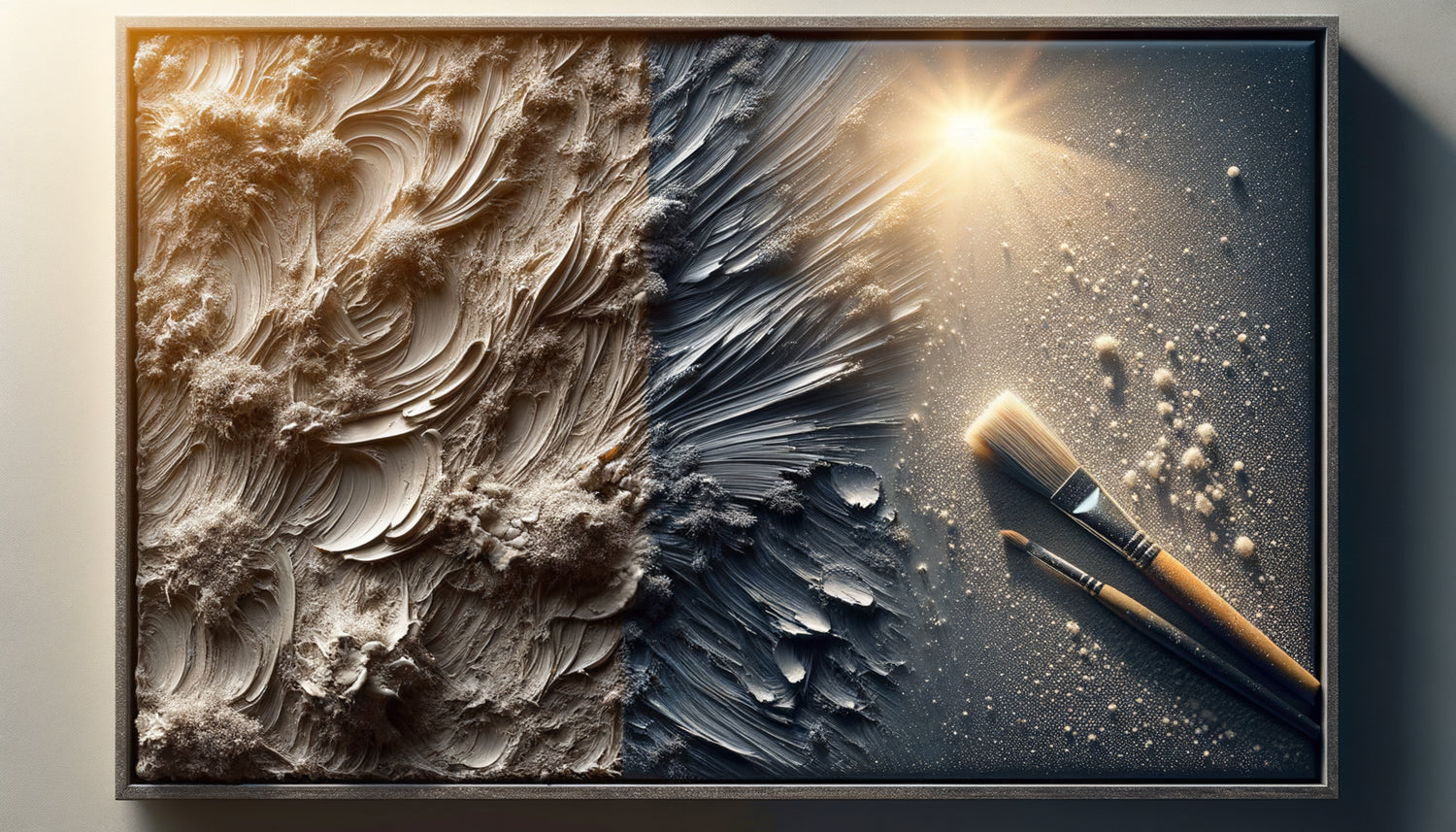
Morning light sometimes reveals unsettling truths about our walls. This grayish film that accumulates insidiously on your beloved textured canvas, this dust that seems to cling to the reliefs of the material as if it had taken up residence there. Meanwhile, your prints under glass shine with an almost insolent cleanliness. Coincidence? Absolutely not.
Here's the reality: textured paintings actually capture more dust than prints under glass, but this truth hides a much more nuanced story that will transform your relationship to wall art. Textured surfaces offer more areas for particle adhesion, multiply nooks where dust settles, and create micro-reliefs that retain atmospheric residues. But this characteristic is neither a fatality nor a reason to give up the tactile richness of textured art.
You may have just invested in this magnificent abstract canvas with generous reliefs, or you are still hesitating between the authenticity of a matte painting and the practicality of a glazed print. This maintenance question torments you, imagining yourself already climbing a ladder every week, feather duster in hand. I understand this apprehension: no one dreams of turning their art collection into a domestic chore.
Rest assured: understanding the mechanisms of dust capture will allow you to make informed choices and adopt cleaning strategies that are as simple as they are effective. Because yes, textured paintings require different attention, but this difference is not synonymous with insurmountable constraint.
In the lines that follow, you will discover why texture attracts dust, how prints under glass naturally protect themselves from it, and above all, how to combine a love of artistic materials with an impeccable interior. You will learn to choose your works with knowledge of the facts and to maintain them without disproportionate effort.
The invisible physics: why texture becomes a dust magnet
Every relief, every roughness of a textured painting changes the behavior of the air around the work. Airborne dust particles – a mixture of textile fibers, dead cells, pollens and atmospheric residues – follow airflow patterns. When these particles encounter a smooth surface like glass, they slide, bounce, continue their trajectory. But facing a texture, the scenario changes radically.
Paint reliefs create microscopic turbulence zones where air slows down. In these pockets of relative calm, particles lose momentum and settle. The more pronounced the texture – generous impastos, knife strokes, granulations – the more these capture zones multiply. This is particularly visible with impasto techniques, where pictorial material forms veritable miniature mountains.
The recesses and protrusions also act as physical traps. A particle that falls vertically can slide on a flat surface, but it gets stuck in the recess of a texture. The angle of the reliefs also plays a role: a smooth vertical surface lets dust fall by gravity, while a horizontal or overhanging texture mechanically retains residues.
Static electricity: the invisible ally of dust
Some textured paintings, especially those containing acrylic binders or synthetic mediums, develop electrostatic charges. This phenomenon, amplified by air friction and humidity, literally attracts charged particles. You may have noticed that some canvases seem to get dirty faster than others in the same room: static electricity often explains this difference. Synthetic textiles, air conditioning and heating increase this phenomenon, turning your work into a veritable dust magnet.
The glass shield: why prints remain impeccable
A print under glass benefits from decisive physical protection: a perfectly smooth, non-porous surface, and often treated. Glass has no roughness where dust could permanently adhere. Particles do settle, but they remain on the surface, without penetrating or adhering.
This smooth surface greatly facilitates maintenance. A simple pass of a microfiber cloth is usually enough to restore the original clarity. Dust literally slides under the action of the fabric, with no resistance. Where a texture requires meticulousness and patience to dislodge particles lodged in recesses, glass offers cleaning in seconds.
Glass also has a higher density which limits electrostatic accumulation, especially if it is anti-reflective treated. Modern prints often benefit from surface treatments – UV varnishes, protective films – which further reduce particle adhesion. That's why your framed prints retain that crystalline shine even after several weeks without maintenance.
The airtight frame: an extra barrier
Quality prints are usually mounted in closed frames, creating an airtight space between the image and the glass. This configuration not only protects against UV rays and humidity, but also from deep dust. Only the external surface of the glass needs cleaning, while the artwork itself remains preserved indefinitely in its protective setting.

Texture vs. glass: an aesthetic choice above all
Acknowledging that textured paintings collect more dust doesn't mean they are inferior. It would be like rejecting a Persian rug in favor of a marble floor solely for maintenance purposes. Each support serves different aesthetic intentions, and your choice should reflect your artistic sensibility as much as your practical constraints.
A textured canvas brings an irreplaceable tactile presence. It captures light differently depending on the angle, creates shadow games that evolve throughout the day, offers a physical depth that no print can reproduce. This materiality speaks to our ancestral need to touch, to feel the artist's hand in the material. It is the raw authenticity of creation.
Glass impressions, on the other hand, excel in sharpness and color accuracy. They faithfully reproduce every nuance, are perfectly suited for art photography, graphic illustrations, works requiring maximum definition. Their minimal maintenance makes them ideal for high-traffic areas or dusty environments.
Mixing supports: the strategy of savvy collectors
The most harmonious interiors often combine both approaches. Glass impressions in hallways, kitchens or offices – areas where practicality is paramount. Textured paintings in the living room, bedroom or contemplation spaces – where artistic emotion takes over. This hybrid strategy allows you to enjoy sensory richness without turning your daily life into a cleaning marathon.
The maintenance secrets galleries never share
Keeping your textured paintings impeccable doesn't require superhuman skills, just the right techniques. The first rule: prevention is better than intensive cleaning. Position your textured artworks away from direct sources of dust – air vents, frequent passages, proximity to open windows. This simple precaution reduces dust accumulation by 40 to 60%.
For regular maintenance, forget the classic duster that only moves dust around. Invest in a soft-bristled brush made of natural hair, ideally goat's hair, used by restorers. Gently pass it over the reliefs, following the direction of the texture. The hairs penetrate into the recesses without damaging the paint, capturing particles instead of repelling them.
A vacuum cleaner with low power and a soft brush attachment is your best ally for very pronounced textures. Keep the nozzle 2-3 centimeters from the surface, without direct contact. The vacuum captures dust dislodged by the brush, preventing it from falling or dispersing. This method, used in museums, removes up to 90% of dust in minutes.
Optimal maintenance schedule according to your environment
In an urban apartment or near a road: weekly light cleaning, more thorough intervention monthly. In a suburban house or in a low-dust environment: bi-monthly maintenance is sufficient. Adapt the frequency to your reality, without guilt. A thin layer of dust does not damage your work; it is prolonged accumulation and humidity combined that pose a problem.

Choosing wisely: your lifestyle dictates your walls
If you are prone to dust allergies or asthmatic, prints under glass objectively represent a more sensible choice. They do not retain allergens, clean quickly, and maintain superior indoor air quality. This is not giving up art; it's adapting your collection to your health.
If you have young children or pets, textured paintings are likely to accumulate not only dust but also various splashes. Glass offers valuable resilience here. Reserve your textured acquisitions for out-of-reach spaces, or wait until your family situation evolves.
For authenticity enthusiasts willing to dedicate 15 minutes weekly to maintenance, textured paintings remain an incomparable emotional investment. This regular attention becomes a ritual of connection with your works, a moment of contemplation during care. Many collectors transform this maintenance into active meditation.
Want to combine aesthetics and practicality without compromise?
Discover our exclusive collection of Library Wall Art that combines the visual depth of textures with surfaces designed for simplified maintenance – the best of both worlds for demanding enthusiasts.
When dust becomes patina: embracing imperfection
The greatest collectors will tell you: a work of art is not a smartphone screen. It lives, evolves, bears the subtle traces of time. This thin film that settles in the recesses of an old texture can sometimes be part of the history of the work. Purists may find this perspective scandalous, but there is wisdom in accepting a certain imperfection.
This does not mean letting your works deteriorate, but recognizing that a slightly dusty textured painting retains all its beauty and integrity. Obsessive cleaning can also cause more damage than dust itself – repeated friction, unsuitable products, excessive handling.
Find your personal balance between preservation and perfectionism. Your works are there to be admired daily, not to become a source of domestic anxiety. If a few particles lodged in the reliefs bother you less than the idea of weekly cleaning, embrace this choice with serenity.
Your informed decision: texture or glass?
You are now armed with the complete truth: yes, textured paintings objectively collect more dust than under-glass prints. This physical reality stems from the very structure of surfaces, the laws of aerodynamics and static electricity. But this knowledge should not mechanically dictate your aesthetic choices.
Imagine your interior in six months. Visualize yourself spending a few minutes each week maintaining your textured canvases, appreciating this regular contact with your works? Or do you prefer the peace of mind of frosted prints, freeing your time for other passions? There is no wrong answer, only the one that resonates with your lifestyle.
Perhaps start with a test piece: a textured painting in your favorite space, to assess the necessary maintenance in your specific environment. After a few weeks, you will know if this tactile presence justifies the attention it requires, or if the practicality of glass better suits your daily life.
Wall art transforms our spaces into reflections of our soul. Whether you choose the sensory depth of texture or the preserved sharpness of glass, the essential remains that emotion that seizes you each time your gaze meets the artwork. Dust is just a practical detail in this much larger equation: building an environment that resembles you, inspires you, soothes you. So, what story will your walls tell?
FAQ: Your questions about dust and wall artworks
Can a textured painting be cleaned with a damp cloth?
Absolutely not, unless explicitly indicated by the manufacturer or artist. Moisture can penetrate the pores of the paint, dissolve some binders, cause halos, or alter pigments. Acrylic paints are certainly resistant once dry, but they are not designed for repeated wet cleaning. Always prefer dry methods: soft brush, low-power vacuum cleaner, or compressed air blower for delicate textures. If a stain persists, consult a restorer rather than experimenting with homemade solutions. Your artwork deserves this precaution, especially since damage caused by improper cleaning is often irreversible. For prints under glass, however, a microfiber cloth slightly moistened with demineralized water or a non-ammonia window cleaner works perfectly, provided you avoid contact with the frame if it is made of untreated wood.
Do protective varnishes reduce dust accumulation on textures?
Partially, yes. A quality varnish creates a protective barrier that slightly smooths out micro-roughness without flattening the main reliefs. This layer reduces surface porosity, decreases static electricity, and considerably facilitates dusting. Satin or gloss varnishes offer the best performance in this area, while matte varnishes retain more of the texture's original captivating properties. However, be careful: the varnish must be compatible with the technique used (acrylic, oil, mixed) and applied correctly. A poorly chosen or applied varnish can yellow, crack, or create a whitish veil. If you buy an unvarnished artwork, ask the artist about the possibility and timing of varnishing – some paintings require prolonged drying time before this step. For your own creations, consider varnish as a double investment: protection against UV rays and humidity, facilitation of daily maintenance. Professional ranges now offer varnishes with antistatic agents specifically formulated to minimize dust attraction.
In which rooms is it absolutely essential to prioritize prints under glass?
The kitchen tops the list, without a doubt. Suspended grease mixes with dust to form a sticky film that is almost impossible to remove from a textured surface without damage. Glass cleans completely with a mild degreaser. The bathroom follows closely: constant humidity, steam, and water splashes create an environment hostile to unprotected textured paints, promoting mold and alterations. Home offices with laser printers also deserve this attention – toner generates fine particles that become deeply embedded in textures. Hallways and entrances, areas of intense traffic where external dust constantly penetrates, greatly benefit from the easy maintenance of glass. Finally, if you smoke indoors (even occasionally), combustion residues adhere terribly to porous surfaces: glass remains your only reasonable option. Conversely, bedrooms, living rooms without open kitchens, libraries, and meditation spaces offer ideal conditions for textured paints, with moderate and controllable dust accumulation. Honestly analyze the use of each room before investing in an expensive textured artwork – this preventative clarity will spare you frustrations and regrets.