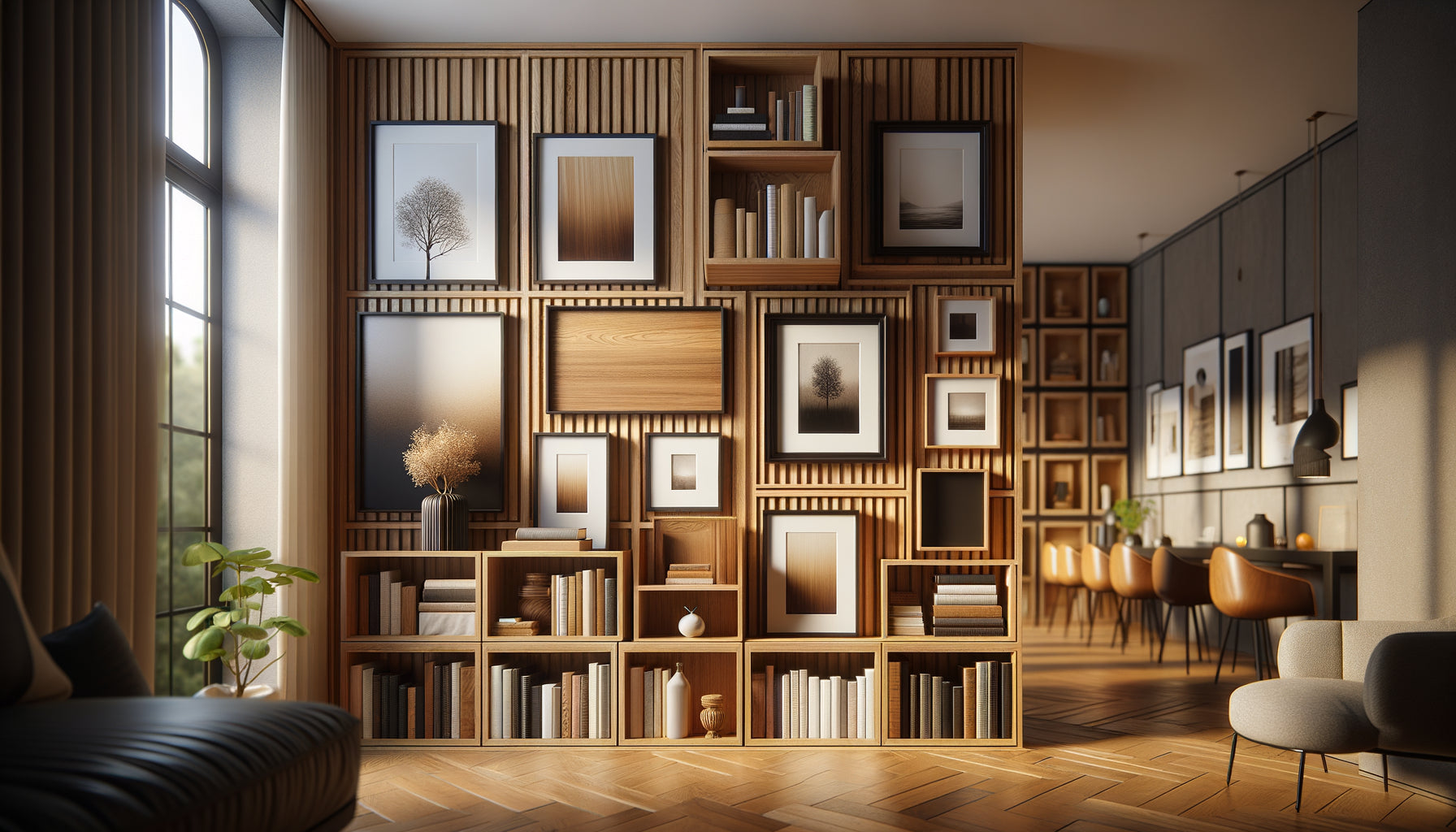
I recently transformed the living room of an apartment where the bookcase formed a majestic angle, occupying two entire walls like a showcase of knowledge. A monumental canvas stood at the center, seeming to float in space, creating a fascinating dialogue between books and art. This configuration, far from being a puzzle, represents an exceptional opportunity to create a spectacular focal point.
Positioning a large painting in a corner bookcase offers three major advantages: creating visual breathing room between volumes of books, structuring the space by defining distinct zones, and simultaneously enhancing your artistic and literary collection. Many shy away from hanging an imposing painting for fear of cluttering the space or creating a cacophony of visuals. Yet, with the right positioning techniques, you transform this configuration into a true aesthetic signature of your interior.
The perpendicular wall: your unsuspected ally
When your bookcase occupies two perpendicular walls, the third wall naturally becomes the ideal candidate for your large painting. This arrangement creates what I call a "visual triangle": the gaze circulates from the bookshelves to the work of art, then returns to explore the colorful slices of books. The effect is striking.
Imagine your living room seen from the doorway. Your corner bookcase naturally frames the wall in front. It is precisely there that your large painting should take place, at a height where its center is between 145 and 155 cm from the floor – the museum rule which guarantees optimal visual comfort. This position allows you to admire both your books and your canvas without abrupt head movements.
Distance also plays a crucial role. Position your sofa or reading chair at least 2 meters from the painting to allow for a global appreciation of the composition. This configuration transforms your space into a kind of private gallery where literary and artistic culture dialogue harmoniously.
Above the bookcase: the art of daring suspension
For low or mid-height bookcases (less than 120 cm), the wall space above offers a spectacular surface for expression. I applied this solution in an office where a perpendicular bookcase left a top panel of wall nearly 150 cm high.
Proportions to respect
Your painting should never exceed the width of the bookcase below – a golden rule to maintain visual balance. Leave at least 20 cm between the top of the books and the bottom of the frame to avoid an oppressive effect. This breathing space is essential: it allows each element to retain its identity while participating in a harmonious composition.
For a library measuring 180 cm wide, opt for a painting no larger than 140 to 160 cm. A slight asymmetry adds a touch of modern dynamism, whereas perfect alignment would create formal rigidity. I particularly like this approach for corner libraries: the large artwork becomes the visual keystone that unifies the two perpendicular sides.

Integration in the corner: when boldness pays off
Here's a solution that few dare to try, but which produces spectacular results: positioning the artwork directly in the angle formed by the perpendicular library. This technique requires precision and confidence, but it transforms a dead space into a magnetic focal point.
Specifically, install your canvas on the wall adjacent to one of the two sides of the library, approximately 30-40 cm from the corner. This position creates a sense of continuity while marking a transition between the storage area and the contemplation space. The painting then plays a role as a visual pivot, inviting the eye to explore the entire configuration.
This approach works particularly well with abstract works whose colors echo some of the shades of book spines. I recently used a large format in ochre and navy blue tones that echoed an antique binding collection – the result created an enchanting chromatic harmony.
The calculated offset technique for imposing libraries
When your library occupies two walls over their entire height, the challenge becomes exciting. Rather than looking for a traditional wall space, consider the library itself as a potential support.
The cantilevered panel method
Install a 15 mm plywood panel in a cantilevered position in front of a section of the library, creating an independent mounting surface. This base allows you to position your large artwork without drilling into the shelves or moving your books. The panel, painted in a contrasting shade or identical to the wall, creates a fascinating architectural depth.
I applied this technique in a living room where the perpendicular library formed a complete L. The cantilevered panel, positioned on the shortest segment, accommodated a large format of 140 x 100 cm. The three-dimensional effect gave the impression that the artwork was floating in front of the books, creating a physical dialogue between cultural supports.
This solution offers a considerable practical advantage: you can change your book arrangement without touching the painting, and vice versa. Flexibility meets aesthetics.

Color palettes that unify painting and bookcase
Beyond physical placement, color consistency determines the success of your composition. A large artwork should never be chosen independently of its immediate environment – especially when that environment is as present as a double bookcase.
Observe the dominant tones in your book spines. A collection rich in classic literature will offer bordeaux, bottle green and gold hues. Contemporary works will tend towards white, black and bright colors. Your painting should contain at least two shades present in your bookcase to create visual echoes that unify the whole.
I particularly like artworks featuring horizontal or vertical lines that recall the rhythm of the shelves. This graphic repetition creates a formal continuity that soothes the eye while maintaining visual interest. Conversely, a very organic or curved composition will bring a dynamic contrast appreciated in interiors filled with books.
Lighting: Revealing Your Composition
An artwork positioned precisely but poorly lit remains invisible. Light transforms your arrangement into an everyday scenography. For a perpendicular bookcase, lighting must serve a double function: to enhance the books and reveal the work of art.
Install adjustable spotlights on a ceiling rail, positioned to create a 30-degree angle with the painting. This inclination avoids reflections on glass or varnish while sculpting the reliefs of the canvas. For the bookcases themselves, LED strips integrated into the shelves create a warm atmosphere that highlights the colored spines.
The trick I apply systematically: create two distinct lighting circuits. The first illuminates the bookcase for your reading sessions, the second stages the painting for moments of relaxation. This modularity allows you to adapt the atmosphere according to the use of the room, transforming a living room into a studious library or an intimate gallery.
Your bookcase deserves a work of art to match
Discover our exclusive collection of Bookcase paintings that perfectly dialogue with your walls of books and transform your perpendicular angle into a decorative masterpiece.
Visualize your transformation
Imagine yourself tomorrow morning, a steaming cup in hand, contemplating your transformed living room. Your perpendicular library structures the space with authority, while your large artwork captures the morning light and silently dialogues with the thousands of words aligned on the shelves. The balance is perfect: neither too cluttered nor too austere.
Your guests consistently stop in the doorway, captivated by this composition that combines culture and aesthetics. They don't know where to look – and that's precisely the desired effect. This visual hesitation translates the richness of your arrangement.
Start by accurately measuring your walls and library. Draw a simple sketch with dimensions. Identify the three possible locations mentioned in this article. Test them with kraft paper cut to the size of your artwork before permanently hanging it. This preview eliminates regrets and guarantees a result that meets your expectations.
Your library and your artwork do not oppose each other – they form an alliance that tells your personal story, that of a person who attaches as much importance to words as to images, to narratives as to colors.