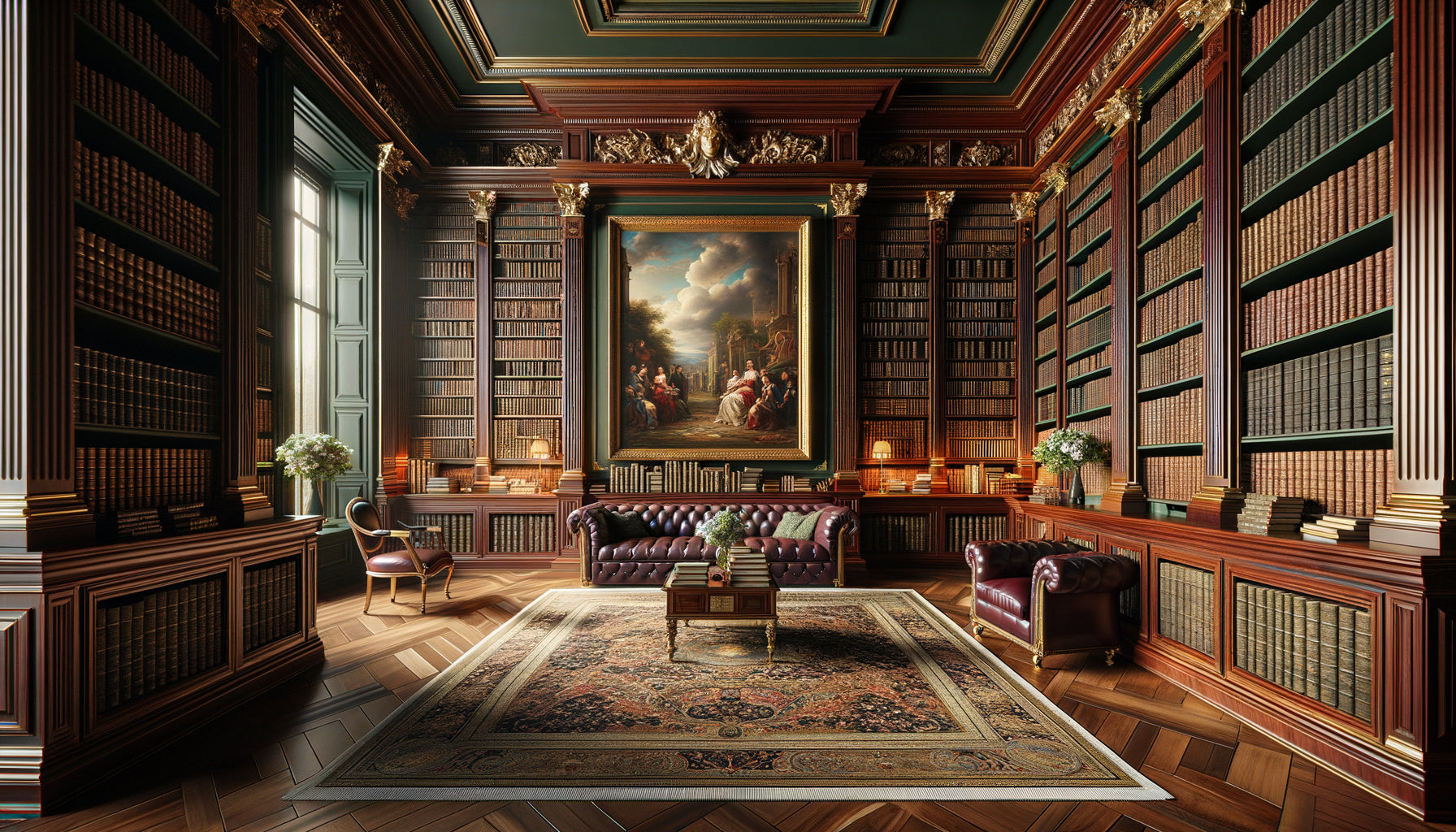
I still remember the day when, at the home of a Bordeaux book lover whose collection I was staging, we spent three hours contemplating an entire wall of antique bindings. She was desperately searching for a work to complement this section of her library, but every proposal seemed either too literal - a still life with books, a calligraphic quote - or completely disconnected from the intimate universe she had patiently built.
Here's what a work in authentic dialogue with your books brings you: it creates a visual breath in your library without duplicating its message, it reveals the emotions carried by your readings rather than illustrating them, and it transforms a collection space into a place of contemplation where each element nourishes the other.
The trap we all fall into? Looking for a work on books when you should be looking for a work with books. That nuance changes absolutely everything. You may have come across those reproductions of antique libraries, those typographed quotes, those illustrations of feathers and inkwells that, rather than enriching your space, end up creating visual redundancy.
The good news? There is a much more subtle and personal approach to create this dialogue. An approach that I have refined over dozens of artistic installations in private and public libraries, and that I am going to share with you today.
Listening to the soul of your library before choosing
Even before thinking about the work itself, ask yourself this essential question: what emotional universe do your books inhabit? A library of Nordic crime novels does not carry the same atmosphere as a collection of surrealist poetry or a set of illustrated botanical treatises.
When I work on a project, I always spend a long time simply feeling the space. The fauve leather bindings of a collection of French classics create warmth, a historical density. The colorful covers of contemporary essays generate a more dynamic, fragmented visual rhythm. Your books already have a voice - the artwork must harmonize with it, not cover it.
I remember one collector whose shelves were overflowing with travel stories and anthropology. Rather than choosing a photograph of an exotic landscape - too obvious - we opted for an organic abstraction in ochres and deep blues that evoked the watercolor notebooks of 19th-century explorers without ever representing them directly.
The rule of complementary contrast
Here's a principle I consistently apply: if your books are dense in text and meaning, your artwork should offer visual breathing room. Contrast is not contradiction, it is complementarity.
Libraries are visually charged spaces. The aligned edges create repetitive horizontal lines, the text of the titles generates fragmentation. A work that truly dialogues with this environment brings what is missing: emptiness, breath, continuous forms.
Three types of contrast that work
Contrast of density: Faced with a multitude of volumes, prioritize a refined, minimalist artwork. A solid color, a simple geometric composition, a contemplative photograph. Your eye then finds a point of rest in your library.
Contrast of temporality: If your collection leans towards old and patrimonial editions, a contemporary work creates a fascinating dialogue between eras. Conversely, an ultra-modern library benefits from welcoming an antique engraving or a classic painting.
Contrast of materiality: Books are paper, ink, flat. Introducing a textured artwork - thick canvas, relief, mixed media - adds a tactile dimension that enriches the sensory experience of your space.

Seeking invisible thematic echoes
The most subtle dialogue takes place in secret correspondences. It's not about illustrating the content of your books, but about revealing the underlying essence.
One of my most successful installations concerned a library specializing in existentialist philosophy. Rather than choosing a portrait of Sartre or a quote from Camus - which would have been terribly reductive - we hung an abstract work with contrasting black and white tones, with a single red line traversing the composition. This line evoked the quest for meaning in the void, a central theme of these readings, without ever naming it.
Ask yourself: what are the transversal emotional themes of your collection? Escape? Melancholy? Scientific curiosity? Wonder? Once this essence is identified, look for an artwork that embodies it visually rather than one that represents it literally.
Color as a silent connecting thread
If you are still unsure about the conceptual approach, color offers a universal language to create connections. But be careful: linking by color does not mean mechanically matching.
Observe the chromatic dominants of your bindings. Many personal libraries reveal unconscious preferences - greens and blues for nature writing enthusiasts, reds and golds for collectors of classics, grays and blacks for readers of crime novels.
The artwork can either echo these tones to create an enveloping harmony or introduce a complementary color that energizes the whole. In a library with warm, woody hues, I recently placed an abstraction in deep blues. The contrast literally made the space breathe while remaining perfectly integrated.
The power of monochrome
Never underestimate the strength of a monochromatic or near-monochromatic artwork in a library. Black and white, shades of gray, tonal series create a sophisticated dialogue that allows books to take center stage with vibrant colors while asserting a strong artistic presence.

Scale and spatial breathing
An often overlooked aspect: the size of the artwork completely transforms the nature of the dialogue. A small, delicate piece nestled between two shelves creates intimacy, a secret to discover. A large work that occupies an entire wall between two libraries asserts a powerful counterpoint.
I've learned to prioritize medium to large formats for dense libraries. An artwork that is too small risks getting lost, swallowed by the multiplication of volumes. Conversely, a piece that assumes its presence creates a real focal point, a moment of contemplation that interrupts potential reading flow.
Also consider vertical breathing. If your shelves run the full height, placing a horizontal artwork pleasantly breaks this rhythm. On the contrary, if your library is low, a vertical composition elongates the space.
Dare the unexpected that makes sense
The most memorable dialogues sometimes arise from bold choices. An industrial landscape photograph in a romantic poetry library. A rigorous geometric abstraction facing fantasy novels. An enigmatic portrait silently observing your psychoanalysis essays.
These apparent counterpoints work when they create creative tension rather than dissonance. The test? Imagine yourself in your library: does the artwork spark an interesting question or discomfort? The former enriches your space, the latter unbalances it.
With that science fiction collector I was talking about earlier, we ultimately chose a reproduction of an antique celestial map. The link wasn't immediate but deep: the same fascination for the unknown, the same ambition to chart the impossible, dialogue between imagined space exploration and the historical exploration of navigators.
Ready to transform your library into a visual dialogue space?
Discover our exclusive collection of Library Wall Art that creates subtle connections with the universe of your books without ever imitating them.
Trust Your Reader's Instinct
After all these technical considerations, here is the most important advice: you know your books better than anyone. You have spent hours with them, they carry your emotions, your discoveries, your questions.
When you consider a potential artwork, don’t ask yourself if it represents your books. Ask yourself: Does this work extend the conversation I have with my library? Does it invite me to look at my books differently? Does it create a moment of pause that makes me want to dive back into reading afterwards?
Authentic dialogue between a work and your books cannot be calculated - it is felt. That particular vibration when elements come together just right, when the space finds its balance. Trust this intuition.
Your library does not need an illustration of what it already is. It awaits a work that reveals what it could become - a place where art and literature nourish each other, where each element enriches the presence of the other, where the silence of an image dialogues with the noise of words.
Frequently Asked Questions
Do I necessarily have to choose an abstract work to avoid repeating the subject of my books?
Absolutely not! While abstraction does indeed offer a great freedom of interpretation and facilitates dialogue without redundancy, a figurative work can function wonderfully. The essential thing is that the subject represented is not a direct illustration of your readings. For example, an enigmatic portrait can wonderfully converse with a library of psychological novels without illustrating a specific character. A contemporary still life can talk to cookbooks without showing recipes. What counts is that the work brings a complementary dimension - emotional, visual, conceptual - rather than it duplicates what the books already express by themselves.
How do I know if a work really dialogues with my books or if I am simply letting myself be seduced by it?
Excellent question that gets to the heart of the matter. Here's a simple test I use consistently: imagine the artwork hanging elsewhere in your interior, away from your bookcase. Does it still please you as much? If so, that's a good sign - you truly love the work. Then, mentally place it back near your books: does it create something more in that specific location? Does it transform your perception of space? Does it make you want to take a new look at your books? If the answer is yes, then you have found a true dialogue. The ideal artwork is one that works both independently AND in conversation with your bookcase, creating added value specific to that location.
My library mixes a lot of different genres, how to find a coherent artwork?
Eclectic libraries are actually the most interesting to decorate! Rather than looking for an artwork that responds to each genre present - an impossible mission - focus on the dominant emotion or intention that governs your collection. Why are all these different books gathered in your home? Often, the answer reveals a common thread: curiosity, the need for escape, the quest for knowledge, love of beautiful stories... It is this essence that your artwork should capture. A heterogeneous library also benefits from welcoming a structuring work - geometric, balanced, soothing - which visually unifies the diversity without flattening it. Think of the artwork as the conductor who harmonizes different instruments rather than as an additional musician who should play all the scores at the same time.