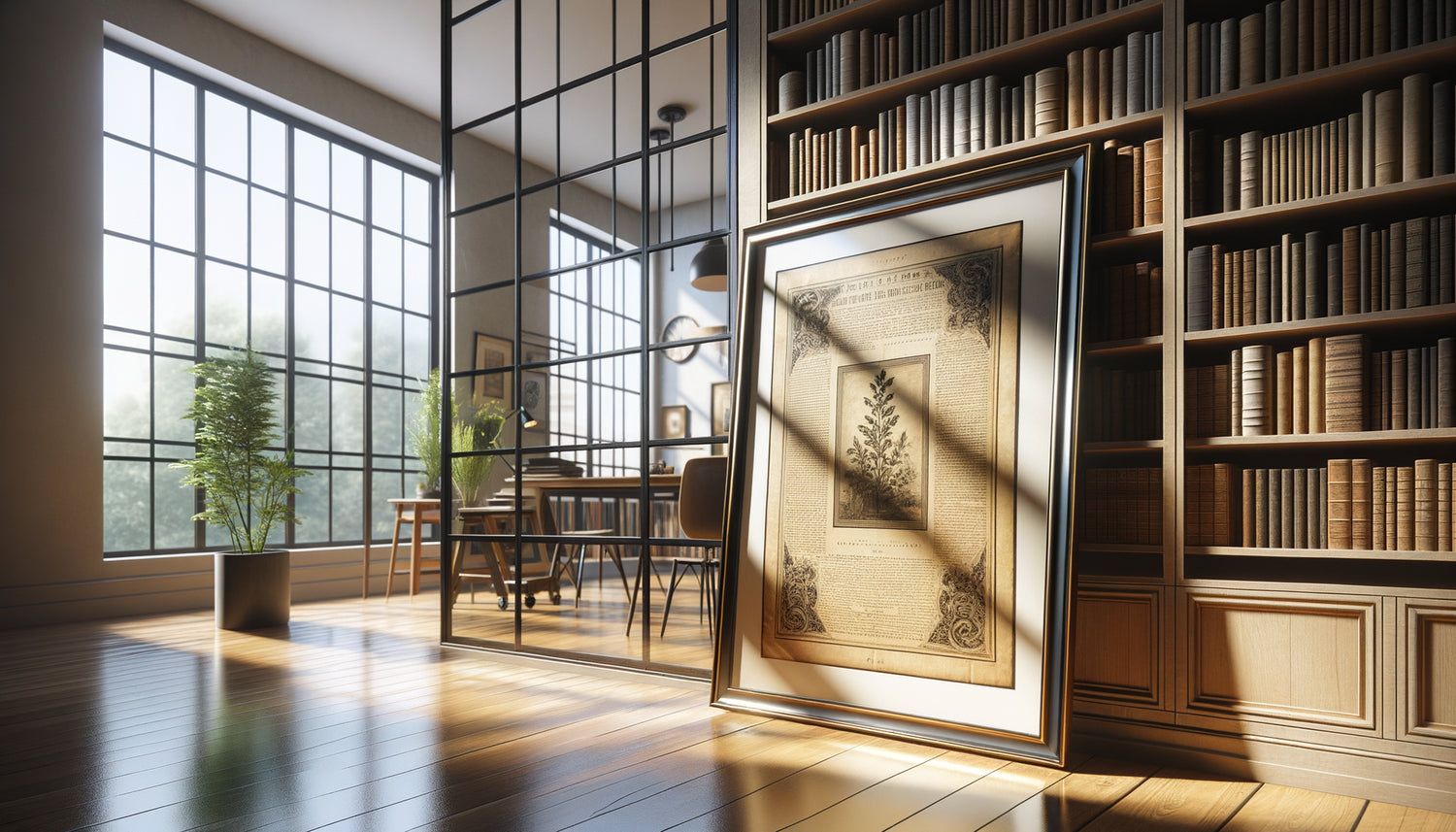
I spent fifteen years designing museum lighting for institutions like the Musée Carnavalet and private foundations. My obsession? Protecting artworks while enhancing them. How many times have I seen collectors proudly install a valuable lithograph in their office, only to discover it months later faded, drowned in a window reflection that made it invisible? This question of anti-reflective glass for works on paper in a library-office isn't just aesthetic: it’s a matter of preservation and daily experience.
Here's what anti-reflective glass brings to your works on paper: perfect visibility even facing windows, UV protection that extends the life of the artwork by decades, and a contemplative experience without those annoying reflections that turn your print into a mirror. In a library-office where natural and artificial lighting mix, where the computer screen generates its own brightness, standard glass quickly becomes your enemy.
You've probably invested in a beautiful engraving, an original drawing or a watercolor. But every time you look up from your work, instead of the artwork, you see the reflection of the window, your own silhouette, or the desk lamp. Frustrating, isn’t it? What if I told you there was a solution that radically changes your daily relationship with art?
Why your library-office is a hostile environment for works on paper
A library-office accumulates all the dangers for works on paper. First, multiple light sources: window, desk lamp, skylight, computer screen. Each creates its own reflection on standard glass. Then, the orientation of the room: if your office benefits from beautiful natural light (essential for working), your framed artworks are bombarded with UV rays that progressively decompose pigments.
I accompanied a collector who had hung a magnificent 19th-century Japanese print facing her south window. In two years, Prussian blues had turned beige-grey. The paper itself had yellowed irreversibly. Anti-reflective glass with UV filter would have divided this damage by ten. In a workspace where you spend 6 to 8 hours a day, this protection becomes vital.
Standard glass reflects 8 to 10% of the light that hits it. That doesn't seem like much? In an office with three simultaneous light sources, these reflections overlap and create a veil that completely masks the artwork at certain times of the day. Anti-reflective glass, on the other hand, only reflects 1 to 2% of the light.
The invisible threat of UV rays: what really happens behind the glass
Ultraviolet rays are the silent enemies of works on paper. Even behind a window pane, 50 to 70% of UV rays still pass through and attack the cellulose fibers of the paper, inks, watercolors, pigments. A single sheet of paper exposed to natural light can lose 30% of its whiteness in one year.
I have restored entire collections where drawings from the 18th century had lost their subtlety due to unsuitable framing. Delicate washes had evaporated, sanguines had faded. This was irreversible. The anti-reflective glass with UV protection (99% filtration) stops this photochemical degradation. It's like sunscreen with SPF 50 for your art.
In a library-office where antique books coexist with framed works, this consistency of protection becomes essential. You protect your rare editions from direct light? Your prints deserve the same attention. Especially since works on paper are among the most fragile: no protective varnish like in oil painting, just the bare vulnerability of the fiber and pigment.

Anti-reflective glass or museum glass: decoding the technologies
There are three levels of framing protection: standard glass (to be absolutely avoided), standard anti-reflective glass (a good compromise), and museum glass (absolute excellence). The latter combines high-performance antireflection and maximum UV filtration. This is the one I use for all works of heritage or sentimental value.
Standard anti-reflective glass
Chemical or physical treatment on one or two sides. Reduces reflections by 80 to 90%. Variable UV protection (often 70-90%). Perfect for an office with controlled light. Accessible price: between 30 and 80 euros depending on the format. Suitable for reproductions, recent lithographs, art photographs.
Museum glass
Multilayer treatment on both sides. Quasi-invisibility: 99% light transmission. 99% UV protection. The work seems suspended without a barrier. Higher price (100 to 250 euros), but proportional investment for an original print worth 500 euros or more. Essential for: antique drawings, watercolors, rare engravings, collector's works.
In my practice, I have seen that collectors who choose museum glass literally rediscover their works. Subtle nuances, paper details, blacks depth become visible again. One client told me: 'It's like I bought a new artwork'.
The light-distance-orientation equation in your office
The location of your artwork in the library-office determines the level of protection needed. I always apply this rule of thumb: <strong>less than 2 meters from a window = museum glass mandatory</strong>. Between 2 and 4 meters = standard anti-reflective coating is sufficient. Beyond that, if lighting is solely artificial with LEDs, anti-reflective glass remains recommended for visual comfort.
Orientation also plays a role: a north-facing window provides soft but constant light (8 hours a day all year round). A south or west exposure concentrates violent UV intensity peaks. In my old Paris office facing southwest, even my own prints required <strong>anti-reflective glass with UV protection</strong>. Since moving to a northeast space, I can allow myself standard anti-reflective coating for some less fragile pieces.
Don't forget <strong>artificial sources</strong>: a halogen or incandescent desk lamp also emits UV rays (less than the sun, but over a significant cumulative duration). Modern LEDs are safer, but create parasitic reflections on standard glass that hinder visual reading of the artwork.

The evening test: when your lighting reveals the problem
Here's my favorite test to convince skeptics: observe your <strong>framed artworks</strong> in late afternoon, when outdoor lighting decreases and you turn on your desk lamp. With standard glass, the artwork disappears under the reflection of the lamp. You have to move your head, move around, to find the angle where the image becomes visible again. Exhausting.
With <strong>anti-reflective glass</strong>, the artwork remains present, stable, viewable regardless of your position. This visual constancy transforms your relationship with art on a daily basis. The artwork is no longer a decorative object that you notice distractedly: it becomes a meditative presence that accompanies your working hours.
I equipped an attorney's office with six 18th-century botanical prints, all in museum glass. He confided to me that these images had become his mental refuge between stressful cases. Impossible with reflections that would constantly bring him back to his own image or the window.
Investment and durability: the 20-year calculation
The extra cost of <strong>anti-reflective glass</strong> is mathematically justified. Let's take an original print at €400. Standard framing with basic glass: €80. With UV anti-reflective glass: €150. Difference: €70. Over 20 years of exposure in an office, standard glass will allow the artwork to degrade by 40 to 60% (loss of value: at least €200). Anti-reflective glass will limit degradation to 5-10%.
Not to mention the daily visual pleasure: 20 years × 250 working days × 6 hours = 30,000 hours spent in this office. If each hour is slightly more pleasant thanks to the accessible beauty of your artworks, the calculation becomes obvious. You are not buying a piece of glass, you are buying three decades of preserved contemplation.
For lower-value works (reproductions, art posters), standard anti-reflection remains relevant for comfort, even if UV protection becomes less critical. The key is to adapt the level of protection to the patrimonial, sentimental and financial importance of each piece.
Your library deserves artworks that remain visible and vibrant
Discover our exclusive collection of Library paintings that transform your workspace into a contemplative gallery.
Visualize your office-library in 10 years
Imagine: a decade has passed. Your paper artworks, protected by their anti-reflection glass, have retained their freshness. The blues remained deep, the whites bright, the details intact. Every morning, when you sit at your desk, these images greet you with the same silent presence. They have accompanied hundreds of projects, decisions, moments of doubt and victory.
You receive a visitor. He approaches your favorite print and exclaims about its beauty. No annoying reflection, no white veil masking the image. Just the artwork, pure, accessible, generous. That's the magic of good framing: it disappears to let art exist fully.
My final advice? Start with your favorite piece, the one that really counts. Invest in professional framing with museum glass. Observe the difference for a month. Then decide for the others. Art is not meant to be stored in boxes for fear of damaging it. With the right protections, it can live alongside you, day after day, without losing its splendor.
FAQ
Can anti-reflection glass yellow over time?
Excellent question that comes up often. High-quality anti-reflective glasses (brands like Tru Vue Museum Glass or Artglass AR70) do not yellow. Their treatment is stable over time. However, some low-end anti-reflective acrylics can indeed yellow after 10-15 years of UV exposure. That's why I always recommend mineral glass for valuable works. It is certainly heavier and more fragile, but its chemical stability is guaranteed for generations. If your framer offers you acrylic, check that it is a conservation grade (type Plexiglas Museum) with anti-yellowing guarantee. For an office-library where the artwork remains in place for decades, this durability is essential.
Can an anti-reflective film be added to existing glass?
Technically yes, but I strongly advise against it. Anti-UV or anti-reflective adhesive films applied afterwards never give the optical quality of a factory-treated glass. They often create bubbles, areas of peeling, and their lifespan rarely exceeds 5 years. Furthermore, application on an already framed artwork requires dismantling the frame, risking damage to the mounting. If your paper artwork is currently under standard glass and deserves better protection, invest in a complete reframing. Take this opportunity to check the backing board as well (must be acid-free), the mat (conservation quality), and the rear seal. A good frame is a global system where every element counts. The glass is only one part of the protection, albeit the most visible.
How to clean anti-reflective glass without damaging it?
The anti-reflective treatment is a microscopic layer that requires precautions. Never use ammonia-based products (like Windex) which can attack the treatment. My professional method: a microfiber cloth slightly moistened with distilled water (or tap water if it's not too hard), gentle wiping in circular motions, then immediate drying with a second dry microfiber cloth. For stubborn marks (greasy fingerprints), a drop of pH neutral dish soap diluted in water. No paper towels which can scratch. Once or twice a year is more than enough for an office-library. Dust can be removed with an anti-static duster or a dry cloth. Avoid touching the glass directly: fingerprints are the main aesthetic enemy of anti-reflective glass, precisely because it is so transparent that they become very visible.