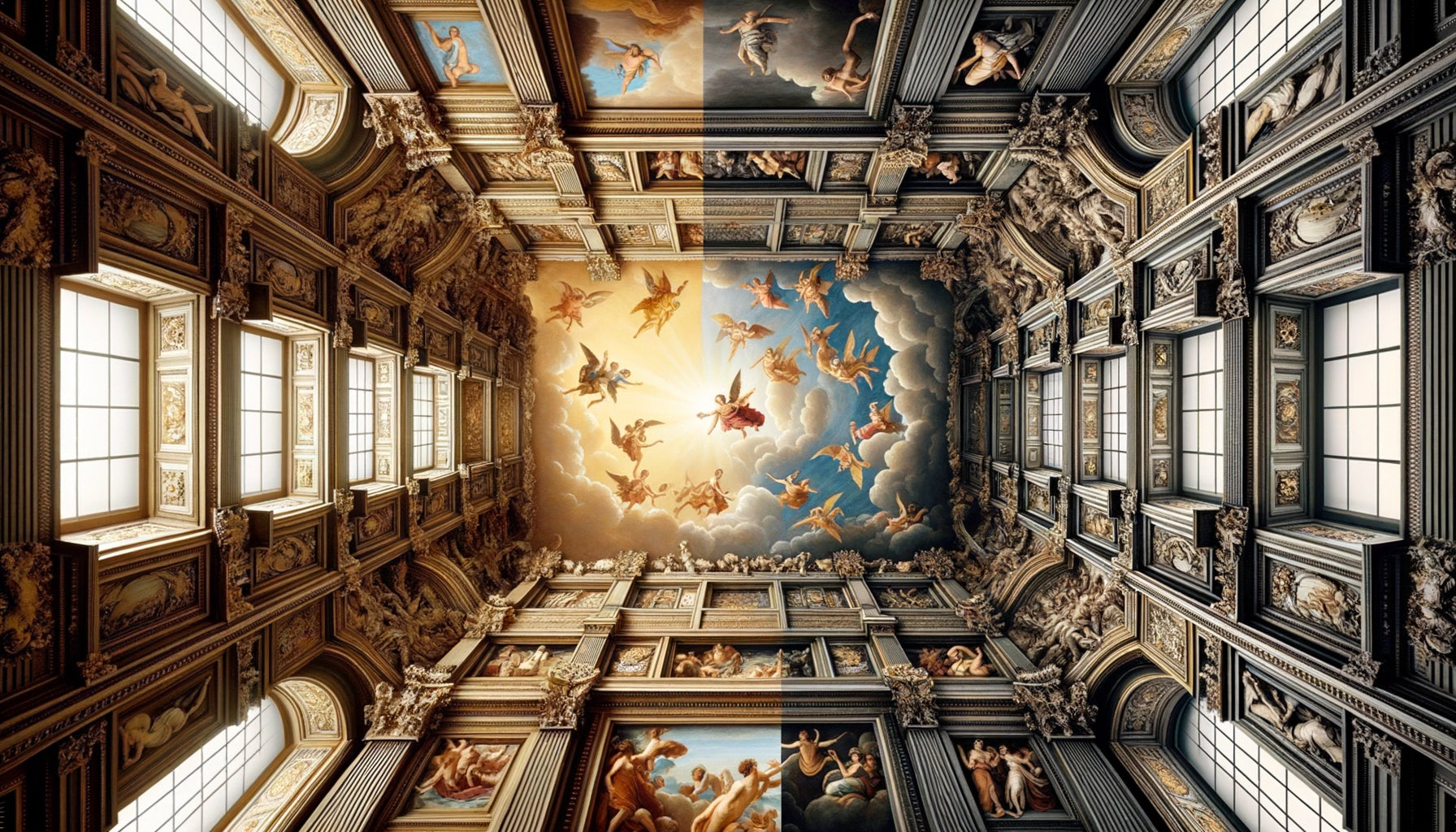
I felt that particular vertigo when I looked up at the ceiling of the library in the Santo Domingo convent in Oaxaca. Above the shelves of religious manuscripts from the 17th century, a painted wooden sky displayed its geometric interlacing: eight-pointed stars, golden arabesques, stylized floral motifs of hypnotic complexity. How could these Islamic patterns adorn a Christian sanctuary, thousands of kilometers from Granada or Cordoba?
Here's what these Mudejar ceilings reveal: an exceptional cultural dialogue between three civilizations, a brilliant technical solution to the tropical climate, and a timeless aesthetic that still inspires our interiors today.
Faced with these colonial convent libraries, many wonder about this unlikely encounter. Why did Catholic religious orders choose decoration techniques from Muslim Andalusia? How can we explain this artistic continuity across the Atlantic? And above all, what do these hybrid spaces teach us about the art of creating inspiring places of knowledge?
Rest assured: this apparent contradiction hides a fascinating story where pragmatism, artisan availability, and the quest for beauty have perfectly combined. Join me in the aisles of these extraordinary libraries to understand how the Mudéjar style crossed the oceans and continues to influence our conception of cultural spaces.
The Andalusian heritage carried to the New World
When the first mendicant orders – Franciscans, Dominicans, Augustinians – settled in New Spain as early as 1524, they brought in their immaterial baggage an architectural know-how still alive in the Iberian Peninsula. The Mudéjar style, born of the coexistence between Christians and Muslim artisans in medieval Spain, still dominated religious construction in 16th century Spain.
These religious knew intimately the Mudejar ceilings of churches in Toledo, Seville or Teruel. They had prayed under these artesonados – these richly decorated coffered ceilings – and understood their double function: structural and symbolic. When it came time to build convent libraries in colonial territory, this aesthetic language naturally imposed itself.
But the implantation of painted Mudejar ceilings in the colonies was not a simple nostalgic mimicry. It responded to very concrete constraints. Colonial libraries had to protect precious manuscripts in a climate that was often humid and hot. Mudéjar techniques, proven for centuries in Andalusia, offered perfectly adapted solutions: natural ventilation thanks to the coffers, resistance of local cedar wood, protection against humidity by mineral pigment based paints.
When know-how meets necessity
The presence of Mudéjar ceilings in colonial convent libraries can also be explained by a pragmatic reality: the availability of artisans. The conquistadors did not arrive with battalions of Gothic carpenters. On site, they found indigenous populations possessing an extraordinary mastery of woodworking and decorative traditions strikingly close to Islamic aesthetics.
Zapotec, Mixtec or Purépecha artisans quickly learned the formal codes of Mudéjar style. Their own decorative traditions – Greek key motifs, geometric cosmological representations – naturally dialogued with Muslim interlacing. This encounter produced unique painted Mudéjar ceilings, veritable mixed creations where one can guess, in certain floral details or proportions, the hand and sensitivity of the indigenous people.
In the convent library of Yuriria in Michoacán, octagonal coffers alternate with rosettes that evoke both pre-Hispanic mandalas and the stars of the Alhambra. This hybridization was not a deviation but a richness: it allowed new converts to recognize within the Christian space a continuity with their own cosmology.

The library as cosmos: a dizzying symbolism
Why particularly in convent libraries? Because these spaces carried a specific symbolic charge. The library was not only a storage place, but the intellectual heart of the convent, the place where human and divine knowledge concentrated.
The painted Mudéjar ceilings transformed this space into a representation of the cosmos. Their complex geometric motifs embodied divine order, the underlying mathematical rationality of Creation. By looking up from the manuscripts, the reader contemplated an ordered sky where each element found its place in a harmonious whole – a perfect metaphor for the universal knowledge that the library claimed to contain.
This symbolic dimension explains why religious orders invested considerable sums in these ceilings. At the Tepotzotlán convent, near Mexico City, the Jesuits had an extraordinary Mudéjar ceiling made for their library: more than two hundred different coffers, each painted with pigments imported from Europe. The result justified the investment: a space where study became contemplation, where reading naturally rose to meditation.
Pictorial techniques in service of durability
The painting of Mudéjar ceilings adhered to strict protocols passed down from master to apprentice. On cedar or cypress wood, a primer layer of gesso was first applied, a mixture of fine plaster and animal glue. This preparation ensured the adhesion and longevity of the pigments.
The colors of painted Mudéjar ceilings were never arbitrary. Ultramarine blue, obtained from lapis lazuli or azurite, symbolized the divine and cost a fortune – it was reserved for central motifs. Vermilion red, derived from cinnabar or local cochineal, evoked Christ's passion. Gold, applied in thin sheets, represented divine light and created those plays of reflections that animated the ceilings according to the time of day.
This codified color palette transformed each colonial convent library into an open book. Educated monks deciphered in these combinations of colors and shapes a theological discourse parallel to the texts preserved below. An intense blue surrounded by gold signified the Virgin Mary; eight-pointed stars evoked the Resurrection; endless intertwines represented divine eternity.

Circulation of models and local adaptation
How did the same motifs appear in convent libraries thousands of kilometers apart? Religious orders functioned as networks for cultural diffusion. Master builders circulated from one construction site to another, carrying sketchbooks and geometric layouts.
Certain architectural treatises circulated between convents, such as the famous Tratado de arquitectura by Diego de Sagredo, published in 1526, which codified the proportions of Mudéjar ceilings. But local adaptation remained the rule. In Quito, now Ecuador, artisans incorporated tropical woods with naturally warm hues that modified the color palette. In Puebla, Mexico, the influence of Talavera ceramics inspired rosettes with brighter colors.
This ability to adapt explains why the painted Mudéjar ceilings of colonial convent libraries are never simple copies. Each bears the mark of its territory, its materials, and the sensitivity of the artisans who created it. It is this diversity within stylistic unity that makes their study so fascinating and their contemplation always renewed.
Mudéjar inspiration for our contemporary interiors
What do these conventional libraries teach us for our current living spaces? First, that structural beauty is not a luxury but a necessity. These Mudéjar ceilings were not mere decorations: they improved acoustics, regulated temperature, protected collections. Function and aesthetics never opposed each other.
Next, they remind us of the power of geometric patterns to structure a space. In an office, a personal library or a living room, introducing elements inspired by Mudéjar style – a frieze, a decorative panel, even a photographic reproduction of a painted Mudéjar ceiling – instantly creates verticality, invites the gaze upwards, expands the space.
Several contemporary designers reinterpret these codes: acoustic panels made of carved wood according to Mudéjar geometric patterns, wallpapers reproducing coffers at scale, luminaires whose projected shadows recreate these hypnotic interlacing. The legacy of colonial convent libraries continues to irrigate our decorative imagination.
Transform your reading space into a cultural sanctuary
Discover our exclusive collection of Library wall art that captures the contemplative spirit of great historical libraries and elevates your walls to new horizons.
Preserving a fragile heritage, inspiring the future
Today, many painted Mudéjar ceilings in colonial convent libraries require urgent restoration. Humidity, earthquakes, and sometimes abandonment threaten these masterpieces. Fortunately, rescue initiatives are emerging, led by cultural institutions and enthusiasts.
Some of these libraries can be visited and offer an unforgettable experience. In Oaxaca, Puebla, Querétaro, Quito or Cuzco, stepping through the doors of these spaces is crossing five centuries of history in an instant. It is understanding viscerally how architecture shapes thought, how a ceiling can elevate the spirit as surely as a text.
And perhaps that's the most valuable lesson from these colonial convent libraries: they remind us that our reading and reflection spaces deserve special attention. Whether it's a reading corner in an apartment or an entire library, the visual environment influences our relationship with books, our ability to concentrate, our intellectual pleasure.
The Mudéjar ceilings invite us to think of our interiors as total spaces, where the gaze circulates freely from book to wall, from wall to ceiling, creating a complete cultural experience. This lesson remains surprisingly relevant at a time when we are rediscovering, after months of lockdown, the importance of truly inhabiting our spaces.
Your library can tell a story
Imagine yourself in your reading space transformed. Books, of course, but also a gaze that rises, finding above the shelves a source of visual inspiration. Not necessarily a complete Mudéjar ceiling – few of us have the height or budget –, but a nod to this tradition: a framed photograph, a decorative panel, a background color that evokes those deep lapis lazuli blues.
Colonial convent libraries teach us that a space dedicated to knowledge does not have to be austere. On the contrary, visual beauty prepares the mind, disposes it to receptivity, puts it in a state of curiosity. That's exactly what you can create at home, on your scale.
Start simply: observe your current library. What does your gaze see when it detaches from the book? A white, anonymous ceiling? Purely functional lighting? Introduce a vertical element – an artistic reproduction, a geometric pattern, even a richer wall color – and watch how the space transforms. How your reading experience is enriched by this contemplative dimension.
The monks who commissioned these painted Mudéjar ceilings knew one essential thing: you don't just read with your eyes on the page. You read with your whole being, in an environment that supports or hinders concentration. They created optimal conditions for study and meditation. You can do the same, with today's means but guided by the same deep intuition.
Frequently Asked Questions about Mudéjar Ceilings in Colonial Libraries
Are Mudéjar ceilings only found in religious libraries?
No, even though colonial convent libraries offer the most spectacular examples. The Mudéjar style also adorned government palaces, aristocratic residences and even some civic buildings in Latin America. However, religious orders had the resources and cultural will to commission the most ambitious achievements. Their mission of evangelization through beauty justified considerable investments. In libraries in particular, these ceilings served a pedagogical project: impress local elites, demonstrate European cultural superiority, but also create spaces conducive to prolonged study. Today, some heritage hotels and restored cultural centers in former colonial residences also feature magnificent Mudéjar ceilings, accessible to the public.
How have the colors of Mudéjar ceilings lasted for centuries?
The exceptional longevity of the pigments used on painted Mudéjar ceilings can be explained by several factors. First, artisans exclusively employed mineral pigments – lapis lazuli, natural ochres, cinnabar, malachite – infinitely more stable than organic dyes. These finely ground minerals, mixed with binders based on egg or animal glue, created a paint that slightly penetrated the wood prepared with gesso. Secondly, these ceilings benefited from environmental protection: height which kept them away from human contact, absence of direct sunlight in convent libraries with reduced windows, relatively stable temperature. Finally, some pigments like ultramarine even gain intensity over time, through a slow crystallization process. Current restorations strive to exactly reproduce these ancestral techniques.
Can we visit convent libraries with Mudéjar ceilings today?
Absolutely, and it's an unforgettable experience! Several colonial convent libraries are open to the public, often transformed into museums or cultural centers. In Mexico, don't miss the library of the Tepotzotlán monastery (now National Museum of the Viceroyalty), that of Santo Domingo monastery in Oaxaca, or the Palafoxiana Library in Puebla – the oldest in America, a UNESCO World Heritage Site, with its extraordinary painted Mudéjar ceilings. In South America, Quito and Cuzco house several visitable colonial monasteries. Check opening hours as some spaces retain a religious function with restricted access. The ideal? Plan a guided tour with a local art historian who will decode the symbolism of the motifs for you. Photography is generally allowed without flash – and believe me, you will leave with hundreds of photos of these hypnotic ceilings.