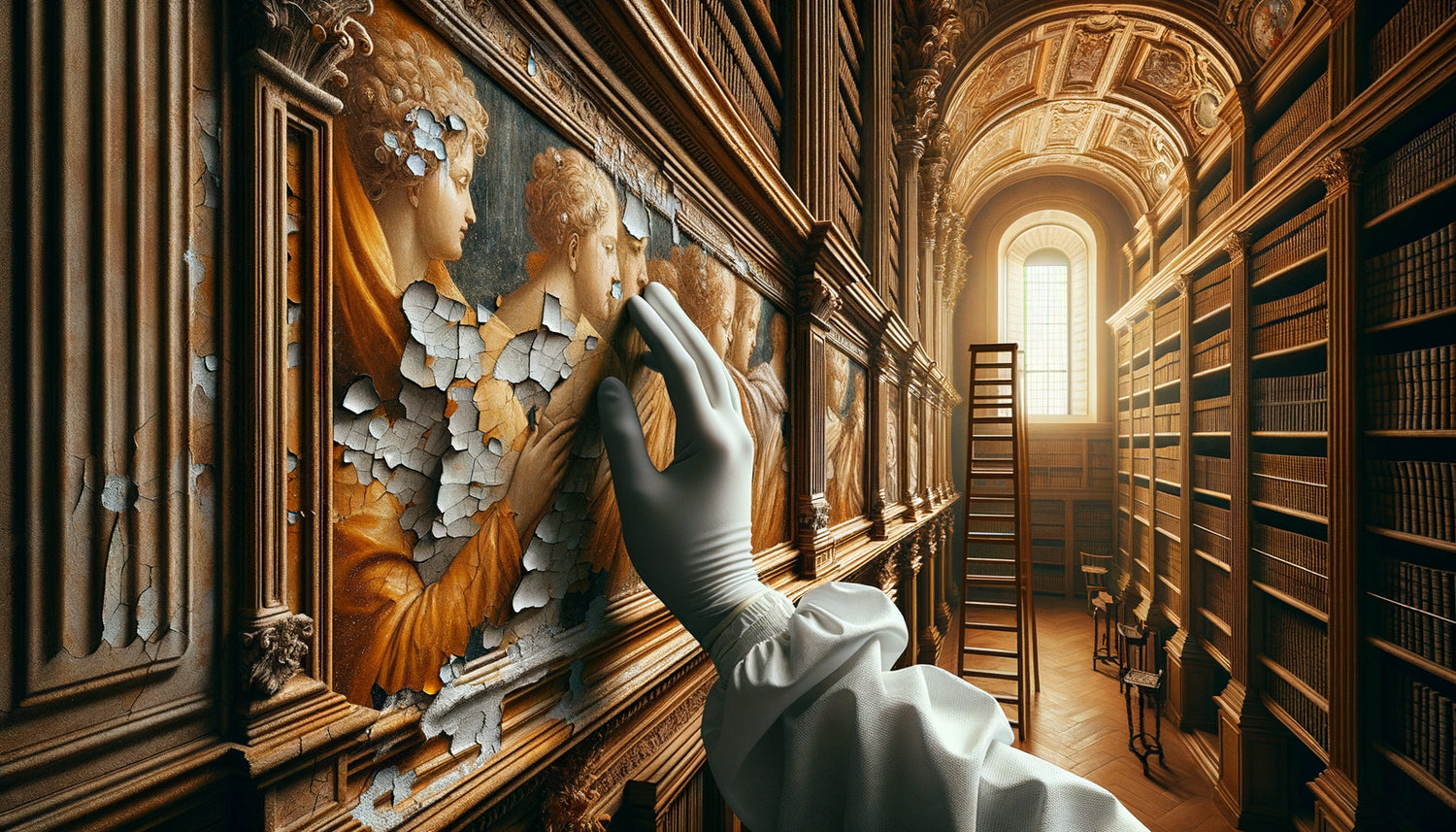
In the hushed dimness of an 18th-century library, I once placed my hand on a wall that everyone believed to be commonplace. Beneath my fingers, a slight irregularity. Passing a raking lamp revealed unsuspected shadows, revealing the contours of a forgotten fresco, concealed beneath three layers of repaint. This moment of pure revelation remains etched as one of the most moving in my career as a heritage restorer. For twenty-three years, I have been traveling through Europe's historic libraries, tracking down these hidden wall treasures that time and clumsy renovations have veiled.
Here is what recognizing an original fresco brings: the possibility of preserving authentic artistic heritage, the historical and financial valuation of a place, and the incomparable emotion of reconnecting with the original intention of artisans from days gone by.
You may be facing these weathered walls, inhabited by the intuition that they hide something. This diffuse feeling that a modern repaint masks the original splendor. But how can you be sure without risking damage to what could be precious? How to distinguish the authentic from the restoration, the gesture of the master from that of hasty whitewashing?
Rest assured: recognizing an original fresco does not require a doctorate in art history. With the right visual and tactile clues, some accessible technical knowledge, and above all an attentive gaze, you can conduct your own investigation. I am going to pass on to you the methods that I use daily, these discreet but decisive gestures that separate the discerning eye from the distracted one.
In the lines that follow, you will discover how to identify the revealing signs of an ancient fresco, decode the clues left by modern repaints, and understand when to call in an expert. Prepare to see your walls differently.
The visual clues that don't deceive: when the surface tells its story
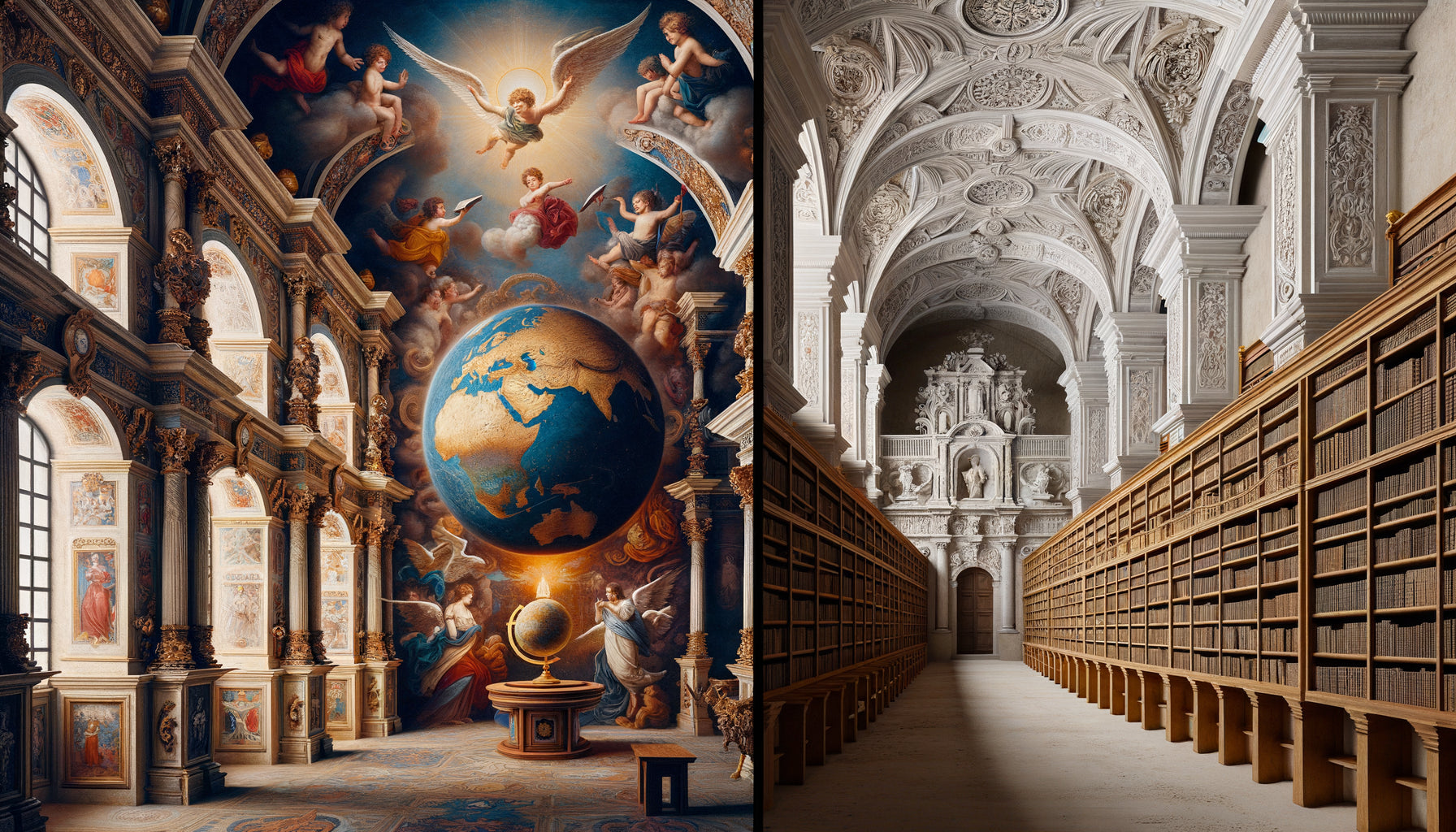
An original fresco in a historic library possesses an invisible signature for the hurried eye, but eloquent for those who know how to look. The first thing I always examine is the stylistic consistency with the era of the building. Frescoes from the 18th century, for example, present allegorical motifs – open books, cherubs holding feathers, intertwined cartouches – in palettes dominated by ochres, Sienna earths, and cobalt blues faded by time.
The repaint, on the other hand, often betrays a palette that is too vivid, too homogeneous. Modern pigments have this glaring intensity that clashes with the natural patina. I have seen libraries where restorations from the 1970s had applied acrylic colors of an electric blue to Renaissance vaults – an obvious visual heresy once you know it.
Carefully observe the cracks. An ancient fresco develops a characteristic network of micro-fissures, called craquelé, which follows the very structure of the plaster. These cracks are fine, irregular, sometimes resembling spiderwebs. A recent repaint on an old surface will either have no cracks (the paint is too fresh) or cracks that stop abruptly – they only cross the superficial layer without penetrating into the depth of the wall.
Sidelight remains your best ally. In the evening, with a simple flashlight held parallel to the wall, you will reveal imperceptible reliefs. An original fresco perfectly follows the irregularities of the support, because it was applied as a true fresco, on fresh plaster. A repaint, applied dry decades or centuries later, will often create slight overthicknesses, accumulations in the hollows, a less organic texture.
The technique of authentic frescoes: understand to better identify
To recognize an original fresco, you must understand how it is born. The true fresco – the buon fresco of the Italians – is a chemical marriage between pigments and lime. The artisan applied his colors on still-damp lime plaster. As it dries, the lime crystallizes and literally traps the pigments in its mineral matrix. This process creates a total integration between the pictorial layer and the support.
This fusion explains why an authentic fresco has a matte surface, slightly porous, almost chalky to the delicate touch (with gloves, always!). The pigments seem to be part of the wall itself. Conversely, a repaint with tempera or oil remains on the surface, forming a film. You can sometimes perceive a barely perceptible difference in temperature to the touch – the original fresco, mineral, remains cooler.
Historical historical libraries often featured trompe-l'oeil decorations: false architectures, painted columns, illusionistic niches where precious volumes seemed to rest. These perspective effects required perfect mastery of gradation and modeling. Examine the sophistication of these effects: a repaint almost always simplifies, loses subtlety. Shadows become uniform, volumes flatten.
I learned to look for giornate – these work joints visible to the trained eye. Each day, the fresco artist prepared a surface of plaster corresponding to what he could paint before drying. These limits create very slight demarcations. Their presence almost certainly authenticates an original fresco. A repaint, applied in one or a few sessions with modern techniques, will never present these characteristic subdivisions.

The pitfalls of repainting: when restoration obscures the authentic
Not all repaints are acts of vandalism. Some, carried out with respect in the 19th century, now possess their own historical value. But others, alas, have brutally covered original frescoes for practical reasons – simplifying maintenance, modernizing aesthetics, or simply due to ignorance of what lay beneath.
In a monastery library near Bruges, we discovered that what appeared to be a uniform beige repainting from the 1950s actually concealed a set of 16th-century frescoes depicting the liberal arts. The repainting had been applied in three thick layers, probably because the monks wanted a more austere decor, in accordance with post-conciliar guidelines. Only stratigraphic sampling – a small sample analyzed in the laboratory – revealed this treasure.
The signs of a repaint are sometimes discreet. Look for areas where the paint flakes off differently from the rest. A poorly adhered repainting detaches in relatively regular patches, revealing an underlying layer of a completely different color. I have seen cases where, in the corners of vaults or near window frames, modern paint had shrunk back, exposing square centimeters of the original fresco – like an unexpected temporal window.
Beware of stylistic anachronisms. A 17th-century library adorned with Art Nouveau motifs? Certainly a later repainting. A pastel palette typical of the 1980s in a Louis XV townhouse? Same here. These temporal inconsistencies are obvious red flags, even for an untrained eye. Trust your intuition – if something doesn't seem to match the age of the building, investigate that impression.
The technical examination: non-destructive investigation methods
When visual clues suggest the presence of an original fresco beneath a repainting, several investigative techniques can confirm the hypothesis without damaging the surface. Ultraviolet light photography reveals differences in chemical composition between layers. Old varnishes, certain organic pigments react differently under UV, creating contrasts invisible in normal light.
The digital rakelight photography, processed with contrast enhancement software, can reveal millimeter-scale reliefs – traces of a preparatory drawing (sinopia), variations in texture between layers. I systematically use this method before any intervention: it documents the existing condition and suggests where potential probes should be performed.
Stratigraphic stratigraphic surveys remain the reference method. A qualified restorer, with your authorization and that of the heritage authorities if necessary, takes a microscopic fragment of material – a few square millimeters across the entire thickness of the pictorial layers. In the laboratory, this sample reveals the complete stacking: number of layers, nature of pigments, composition of binders. This is the identity card of your wall.
Infrared infrared reflectography, a technique borrowed from the analysis of easel paintings, can sometimes penetrate the superficial layers of repaint to reveal the underlying drawing of an original fresco. The carbon in preparatory sketches absorbs infrared differently than colored pigments, creating a ghostly image of the hidden composition. This non-invasive method offers spectacular results on certain types of repaint.

When and how to contact a conservation expert
You have identified converging clues suggesting an original fresco under a repaint? The time has come to consult a professional. But be careful: not all restorers are equal. Look for a specialist in ancient mural paintings, preferably accredited by Historic Monuments or a member of a recognized professional association (FFCR in France, ECCO in Europe).
A good expert will always start with a non-invasive preliminary study. They will photographically document, analyze the building's archives (old plans, correspondence, invoices for work), establish hypotheses before any intervention. Be wary of those who immediately propose to 'clean to see' – reckless stripping has destroyed more frescoes than wars.
The financial question arises legitimately. An initial assessment generally costs between 500 and 2000 euros depending on the surface area and complexity. If it reveals a significant original fresco, the complete restoration will be estimated at tens of thousands of euros. But several schemes exist: heritage subsidies, tax deductions for historic monuments, patronage. A library with authentically restored frescoes sees its cultural and even commercial value considerably increased.
Document the entire process. Before-during-after photographs constitute an extraordinary valuation file. I have seen owners organize guided tours of their restored library, create editorial content, even host film shoots. An original fresco revealed and enhanced becomes the narrative heart of the place, its visible soul.
Your library deserves a second artistic life
While waiting to reveal the hidden wall treasures, discover our exclusive collection of Library paintings that celebrate the world of books and knowledge with elegance and refinement.
Preserve to transmit: your responsibility as a temporary guardian
If you are lucky enough to identify an original fresco in your historic library, you become a link in a multi-century transmission chain. These works have survived wars, revolutions, changes of ownership. They have survived not by miracle, but because successive guardians chose to preserve them rather than destroy them out of convenience.
Even if a complete restoration remains beyond immediate reach, simple conservation measures will prolong the life of your fresco. Stabilize ambient humidity (ideally 45-55%), avoid direct exposure to sunlight, never apply cleaning products directly to the surface, monitor the appearance of new disorders (flaking, saline efflorescence). A simple annual photographic notebook allows you to detect worrying developments.
Pass on the story. If your investigation has revealed the existence of a fresco hidden under paint, document your discoveries, create a file for future owners. I have so often cried in front of frescoes destroyed by ignorance, simply because no one had left a trace of their existence in the archives of the place. A simple registered letter to the Departmental Archives can save a heritage.
Recognizing an original fresco is not just a technical exercise – it is an act of cultural resistance against collective amnesia. It is affirming that ancient beauty deserves our attention, our respect, our investment. In a world obsessed with novelty, you choose to keep alive the memory of artisanal gestures, the intelligence of compositions, the nobility of mineral pigments applied by hands lost centuries ago.
Imagine your library revealed
Imagine the moment when, after weeks of meticulous work, the restorer removes the last layer of paint. The original fresco reappears, with its colors preserved, its forgotten details, its message transcending time. The faces of the allegories regain their expression, the shadows of the trompe-l'œil recreate their illusion of depth, the gold leaf captures light again as it did on the first day.
Your guests stop, captivated. This is no longer simply a library – it is a place inhabited by history, where every corner tells an artistic intention, where walls converse with books in a rediscovered aesthetic dialogue. You no longer own a space; you are its amazed guardian.
This transformation begins with an attentive look, a curiosity that refuses to accept the deceptive evidence of surfaces. Now that you know the signs revealing an authentic fresco, that you know how to decode the clues of the paint, you will never see your walls the same way again. And perhaps, in a few months, you will contact me to say: 'You were right. There was something under this uniform beige. And it's magnificent.'
Your investigation begins now. Observe, document, question. Forgotten frescoes are waiting for your gaze to be reborn.