


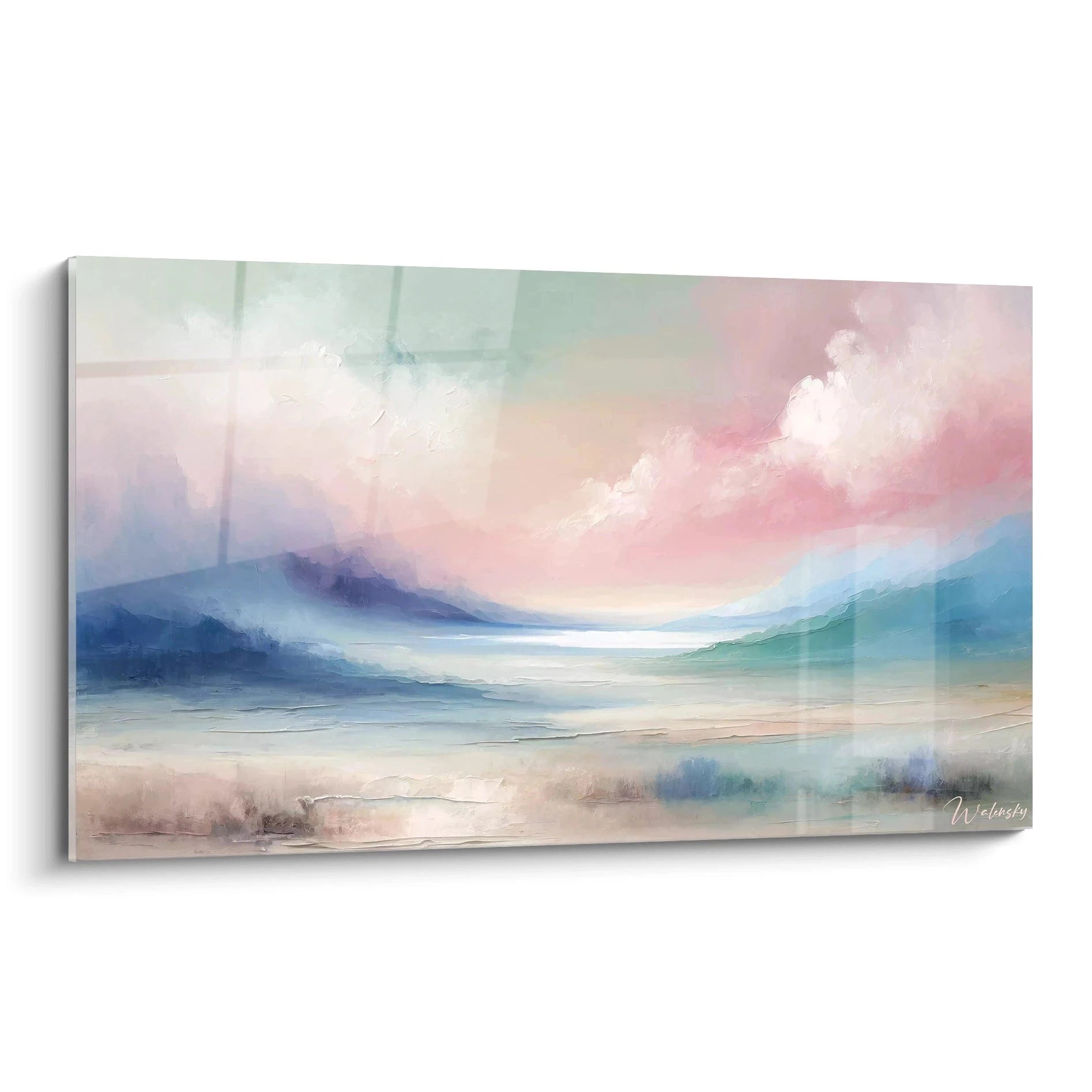

Create a gallery effect at home with modern and contrasting paintings
October 11, 2025 · 18 min read · by Walensky
You look at your living room and feel that familiar frustration: despite your beautiful furniture and careful decoration, your walls seem dull, impersonal, almost empty. You may have hung a few paintings here and there, but the overall effect lacks character and visual impact.
Perhaps you have even tried to buy works that you like, but once hung, they get lost in the space, do not create any dialogue between them and give the disappointing impression of a disparate composition rather than a harmonious one.
You have probably tried to follow the classic advice: "match the colors", "respect the proportions", "space regularly"... But the result remains disappointing, far from those sophisticated gallery effects that you admire in decoration magazines.
Rest assured, it's neither a lack of taste on your part nor a question of budget. The real difficulty lies in the lack of knowledge of professional wall composition codes that transform simple paintings into a true immersive visual experience.
By the end of this article, you will master the expert techniques to create a striking gallery wall at home, which will captivate the eye and reflect your artistic personality with sophistication.
Why does the gallery effect instantly transform your interior?
Creating a gallery wall decor effect at home is not just a decorative trend: it is a real layout strategy that instantly transforms the atmosphere of your home. Imagine the impact on your guests when they discover a wall that tells a story, where each painting dialogues with the others in a controlled visual symphony. Without this approach, your walls remain passive surfaces that waste the emotional potential of your space.
🎨 Real transformation: Sarah, a Parisian interior architect, had an elegant but cold living room. In one afternoon, she transformed her main wall with five contrasting modern paintings. Result: her 30m² space now looks twice as large and every visitor spontaneously compliments this "professional private gallery ".
Conversation with a decor expert
The golden rule of modern galleries: A successful gallery wall creates a controlled visual tension, like a musical chord where each note enriches the overall harmony. You will observe this transformation from the first glance, and the effect improves over time.
Why haven't your previous attempts worked?
Do you recognize yourself in these situations? You hang a painting, step back, find that "something is wrong". You move it three times without being satisfied. Or worse: you hesitate for weeks before daring to drill your wall, paralyzed by the fear of making an irreversible mistake.
The problem isn't your artistic sense, but a too fragmented and intuitive approach. Unlike professional galleries that follow precise rules of composition, you try to create an overall effect by thinking about each artwork individually, as if you were composing a melody note by note without knowing the scale.
It's like cooking a gourmet dish by improvising each ingredient: even with excellent products, the result will be disappointing without a global composition method.
The myth of "instinctive hanging"
Contrary to what some magazines suggest, creating a professional gallery effect is not a matter of spontaneous inspiration. The most beautiful wall compositions obey precise mathematical principles: proportions, visual rhythms, anchor points, lines of force.
Imagine an orchestra conductor who would direct "by feel" without a score: even with excellent musicians, the result would be cacophonous. Your paintings are these talented musicians waiting for a coherent direction to reveal their harmonic potential.
This revelation changes everything in your approach: you move from a haphazard attempt to mastered composition, from the accumulation of objects to the creation of an immersive visual experience.
🔍 Immediate test: Take a photo of your current wall with your paintings. Look at it in black and white on your phone. If the whole thing doesn't create a visible "movement" even without color, the structural composition needs to be reworked.
The error of uniform spacing
Many think that spacing works regularly creates harmony. In reality, this approach produces the opposite effect: a monotonous rhythm that lulls the eye instead of stimulating it. Modern galleries use variable spacing that creates movement and breathing room.
It's like the difference between a mechanical metronome and a jazz rhythm: perfect regularity quickly becomes boring, while subtle variations maintain attention and create emotion.
This awareness frees your creativity: you are no longer constrained by perfect symmetry, but guided by the search for dynamic balance that characterizes the most captivating gallery walls.
The illusion of the "dominant color"
You've probably heard that you need to choose a dominant color and decline around it. This approach works for classic decoration, but considerably limits the visual impact of a modern gallery wall. The most striking compositions play on controlled chromatic contrasts.
Observe your favorite wardrobe: you don't necessarily wear blue from head to toe, but you know how to combine colors that enhance each other. A gallery wall works on the same principle of sophisticated complementarity.
Result: instead of looking for "matching" paintings, you will learn to create chromatic dialogues that reveal the richness of each work while building a strong visual identity for your space.
3 signs that your composition needs to be reworked:
- The eye doesn't know where to settle: No element naturally guides the eye, like text without punctuation that fatigues reading
- Some paintings "disappear": Despite their quality, they don't catch the eye, a sign of a visual hierarchy problem
- The whole thing seems to "float": The works appear disconnected from the furniture and architecture, creating a feeling of instability
The trigger: the masterpiece
Here's what makes all the difference: every successful gallery wall has a pivotal artwork that structures the whole, like a soloist in a concert who sets the tone for all the other musicians. Without this centerpiece clearly identified, even the most beautiful paintings struggle to create a collective impact. The secret lies in the choice and strategic positioning of this central work that will serve as the visual anchor for your entire composition.
Gallery professionals' rule: Always start by identifying your "star" painting, place it strategically, then orchestrate the other works around it. You check it by mentally covering this piece: if the whole collapses visually, it's successful!
| ❌ Amateur approach | ✅ Gallery method | 💡 Why this changes everything | 🎯 Visible result |
|---|---|---|---|
| I hang randomly according to my desires | I compose according to an overall plan | Coherence comes from the global vision | Immediate "signature wall" effect |
| I space everything uniformly | I create varied visual rhythms | Movement captures and guides attention | Dynamism and sophistication |
| I look for matching colors | I orchestrate controlled contrasts | Controlled tension generates emotion | Memorable visual impact |
| I accumulate my favorites | I prioritize around a centerpiece | Structure guides perception | Readability and artistic depth |

Our selection
Reflet painting in black and gold - Abstract Face Edition
233.90€
Discover this paintingThe 3-step method to create your gallery effect
Creating a sophisticated gallery wall follows a logical progression, like building a house: solid foundations, supporting structure, then refined finishes. This methodical approach avoids costly trial and error and guarantees a result that lives up to your aesthetic ambitions. Ultimately, you will obtain a space that breathes artistic expertise and reflects your personality with elegance.
🗺️ Overview of your project: Step 1: Define your artistic universe and choose your masterpiece (immediate satisfaction). Step 2: Compose the ensemble according to the rules of proportion and contrast (visible gallery effect). Step 3: Fine-tune the hanging and lighting for a professional finish (maximum impact).
Step 1: Define your artistic signature
Starting with this step avoids the pitfall of impulsive purchases and costly regrets. Like an architect who draws before building, you will first clarify your aesthetic vision to guide all your future choices. This phase of reflection will give you immediate satisfaction: finally a clear direction for your decor project!
The key elements to gather
- Your favorite artwork: This masterpiece should instantly move you and reflect your personality. Choose a work that generates a strong reaction, not something "pretty" or "practical". Avoid mass reproductions: prioritize originality that will give character to your composition. This work will dictate the tone of your entire gallery.
- A guiding theme or style: Modern abstract, contemporary figurative, art photography... Your guiding thread unifies diversity without falling into monotony. It's not rigid: a theme can be a color, an emotion, or even an artistic technique. This invisible coherence creates the professional effect you are looking for.
- Your defined space constraints: Accurately measure your wall surface and identify fixed elements (sockets, switches, furniture). This practical mapping will avoid disappointments and optimize your composition. A precise plan frees your creativity instead of limiting it.
Now, let's move on to the concrete
How to proceed without making mistakes
Create your visual moodboard: Gather 10-15 images of gallery walls that inspire you (Pinterest, magazines, visited galleries). The goal is to identify common points: do you prefer strong contrasts or subtle nuances? Varied or homogeneous formats? This analysis reveals your deep tastes beyond trends.
⏱️ Time: 45 minutes | ✅ Success when: You can explain in 2 sentences what attracts you to these compositions | ⚠️ Attention: Don't copy an existing composition, be inspired by the general spirit
Select your pivot artwork: Among your current artworks or your purchase desires, identify the one that will be the "conductor" of your composition. It must be visually strong enough to structure the whole, but not so dominant that it overwhelms the others. Think "first violin" rather than "absolute soloist".
⏱️ Time: 30 minutes | ✅ Success when: This work still moves you after 5 minutes of contemplation | ⚠️ Attention: Resist the temptation of the "biggest" or "most expensive" = more important
Define your creative constraints: Set yourself a maximum of 3 rules (e.g., "only works with black", "rectangular formats only", "urban theme"). These apparent limitations actually stimulate your creativity by channeling your choices. It's the principle of haikus: constraint generates beauty.
⏱️ Time: 20 minutes | ✅ Success when: Your rules naturally eliminate 50% of the options | ⚠️ Attention: Too many constraints kill spontaneity, too few create anarchy
✓ Validation of step 1: You have a clear vision of your style, a pivot artwork that excites you, and precise selection criteria for your next choices. If you are still hesitating, that's normal: gradually refine rather than starting over. The next step will concretize this vision!
Step 2: Orchestrating the overall composition
You are now moving to the next level: creating your visual symphony. This step transforms your collection of individual paintings into a true work of art installation. The effect is spectacular: your wall instantly acquires a professional dimension that impresses and inspires. This is where the magic really happens.
Professional composition tools
- Kraft paper or newspaper: Cut out shapes the exact dimensions of your paintings to test compositions directly on the wall. This gallery-style technique avoids costly mistakes and allows for free experimentation. Temporarily secure with tape: you instantly see the final effect without damaging the wall. Minimal investment, guaranteed professional result.
- Level and measuring tape: Millimetric precision distinguishes an amateur hanging from a gallery presentation. A deviation of 2° is enough to ruin the overall effect, even with beautiful works. Technical rigor enhances your artistic creativity rather than constraining it.
- Plumb bob or smartphone app: To check vertical alignments invisible to the naked eye but subconsciously perceptible. These details make the difference between "pretty" and "professional". Your brain detects these micro-imbalances and translates them into a general feeling of instability.
Composition according to the rules of three
Apply the rule of thirds: Mentally divide your wall into 9 equal areas (3x3). Place your pivot work on an intersection of these lines, never at the exact geometric center. This photographic technique naturally creates dynamism and guides the eye harmoniously. The perfect center produces a static effect that puts the gaze to sleep.
⏱️ Time: 20 minutes | ✅ Successful when: The main work immediately "catches" the eye when entering the room | ⚠️ Attention: Do not confuse "rule of thirds" with "random decentering"
Create visual triangles: Arrange your paintings according to imaginary triangles that structure the whole. This invisible geometry creates a reassuring stability while maintaining dynamism. Alternate triangles pointing up (momentum) and down (anchoring) for a sophisticated balance that the eye perceives without analyzing.
⏱️ Time: 40 minutes | ✅ Successful when: You can trace at least 3 triangles connecting your main works | ⚠️ Attention: Triangles guide but should not imprison the composition
Respect the wall breathing space: Maintain 5-15cm between works depending on their format and intensity. Intense works (bright colors, strong subjects) require more space to "breathe". It's like conversation: the silence between words gives meaning to sentences. This breathing avoids visual cacophony.
⏱️ Time: 30 minutes | ✅ Successful when: Each work retains its individual impact while participating in the whole | ⚠️ Attention: Too much space disperses, not enough stifles
Step 3: Finalize the professional hanging
Excellence lies in the details: this final step transforms your beautiful composition into a gallery-level wall installation. Every millimeter adjustment, every lighting choice contributes to creating this particular "presence" that distinguishes exceptional interiors. Your guests will immediately feel this quality without necessarily being able to explain it: it is the signature of expert work.
Finishing equipment
- Suitable hanging system: Hooks X, suspension rail, or wall fixings depending on the weight and value of your works. A 2kg painting poorly secured can fall and break: saving money on the fixing is expensive to repair. Rails offer maximum flexibility to readjust without re-drilling.
- Directional lighting: Adjustable LED spotlights or track lighting to reveal textures and colors without glare. Lighting transforms a decorative wall into a true artistic staging. Cool light reveals details, warm light creates ambiance: alternate according to the desired effect.
- Wall material detector: Essential for locating studs and avoiding pipes. A missed drill hole can cost hundreds of euros in repairs and compromise your entire installation. Safety is paramount to aesthetics: a falling picture instantly destroys the gallery effect.
Expert progression rules: Master each step before moving on to the next. Objective criteria: step 1 is mastered when you can explain your choice in 30 seconds, step 2 when the composition works even in black and white photography, step 3 when the lighting reveals each work without dazzling. Patience and ambition feed each other.
You now master the fundamentals of gallery composition. Here are the subtleties of an expert that distinguish the passionate amateur from the true connoisseur. These refinements give your installation that particular sophistication that marks exceptional interiors and elicits the admiration of the most demanding visitors.
💎 Professional gallery secret: Create "controlled accidents": a slightly offset painting, a format that breaks the series, a color that contrasts... These calculated "imperfections" generate a captivating visual tension and avoid the too-perfect "catalog" effect. Art lives on these mastered surprises that maintain attention.
What if I get tired of my composition in 6 months?
"I'm afraid to start because I'm afraid of quickly getting tired of the arrangement..."
This concern reveals excellent decorative intuition! Contrary to popular belief, a well-designed gallery wall evolves with you rather than becoming fixed. The trick is to plan from the start for "modular zones" where you can easily substitute 20-30% of the works according to your seasonal desires. Like a well-organized dressing room allows you to renew your outfits with a few key pieces, your gallery reinvents itself in subtle touches without starting over.
🔄 Anti-fatigue strategy: When composing initially, identify 2-3 "satellite" locations around your pivot work. These areas will receive paintings that are more easily replaceable (standard formats, simple fixings). Result: you keep the strong structure while varying the details.
— Also to discover


— Other selected pieces


The 5 mistakes that ruin a gallery effect (and how to avoid them)
Even with the best method, some pitfalls await enthusiastic beginners. These mistakes are so common that I prefer to warn you about them now: they ruin months of effort and significant budgets. Good news: they are all easily avoidable when you know them!
- 🔴 Buying impulsively without a global plan: Enthusiasm leads to cracking for a "beautiful" painting that proves impossible to integrate harmoniously. Result: frustration and wasted budget. Solution: always visualize the work in your existing composition before buying. This discipline avoids 80% of decorative regrets!
- ⚡ Neglecting lighting until the end: Poorly thought-out lighting can turn your most beautiful paintings into dull or dazzling surfaces. The mistake costs dearly in electricians and may require revising the entire layout. Integrate lighting from the design stage: it is part of the final work.
- 📐 Hanging too high relative to furniture: The standard height "150cm from the floor" only applies in a void space ! With a sofa, a console, a table, everything changes. Golden rule: a maximum of 15-20cm between the furniture and the bottom of the nearest painting. This proximity creates the essential furniture-art dialogue.
- 🎨 Avoiding contrasts for fear of "doing too much": Chromatic timidity produces bland compositions that go unnoticed. A gallery wall must have character! Dare to marry a colorful abstract with a black and white photograph: the opposition reveals the beauty of each work. "Too much" only begins when harmony disappears.
- 🔧 Underestimating the importance of fastening: A cheap hook for a valuable painting is like fragile foundations for a luxury house. Safety determines the serenity of your project. Invest in quality fixings: your peace of mind and the protection of your works are worth it.
🛡️ Anti-error verification system: Before permanently drilling, photograph your test composition with your paper templates. Wait 24 hours then look again: defects become obvious with hindsight. Check that you can trace consistent guidelines, that each work "breathes", and that the whole works even in peripheral vision. Warning sign: if you have to "explain" why it's beautiful, it's not beautiful enough.
— In the same spirit


Answers to the questions you ask yourself
Allow for €300-800 for a gallery wall of 5 artworks depending on your level of requirement. Optimize by mixing 1-2 master pieces (€100-200 each) with more accessible complementary artworks (€30-80). Hanging and lighting represent 15-20% of the total budget but account for 80% of the final effect. Concrete example: Marie created her living room gallery for €450 by investing in 2 modern paintings at €150 and 3 art photographs at €50, plus €75 for LED lighting.
3 weeks to assimilate the method, 1 weekend to compose and hang. The real difficulty is not technical but decisional: choosing and daring! Once your style is defined (step 1), the rest follows naturally. Tip: start with a test wall in a bedroom or office before tackling the main living room.
No particular skills required! With a level, a meter and suitable fixings, it is within everyone's reach. The trickiest part: drilling straight and at the right depth (3 minutes of learning). If you know how to assemble an Ikea piece of furniture, you know how to hang professionally. For concrete walls or very heavy artworks, a craftsman costs €80-120 and completely secures the installation.
Even better! Small spaces concentrate the visual impact and allow for more daring compositions. Specific rule: prioritize 3-4 medium-sized artworks rather than 6-8 small ones that scatter attention. In a 25m² studio, a well-composed gallery wall visually doubles the feeling of space by creating depth and character. The effect is spectacular because unexpected in a small volume.
The secret: an invisible common thread (recurring color, theme, era, technique...). Successful example: black and white urban photography + geometric abstract + modern illustration = coherence through contemporary spirit. Avoid mixing more than 3 different artistic universes: richness becomes cacophony. Infallible test: if you can explain the link in a simple sentence, it is harmonious!
Your artistic transformation begins now
In 3 weeks, you will look at your living room with a new pride. This wall that frustrated you so much will have become your personal decorative signature, that magnetic zone that immediately attracts attention and elicits admiring compliments from your guests. You will have joined the circle of people who master the art of living at home, those whose interior is remembered long after the visit.
But this transformation goes far beyond decoration: you will have developed an refined artistic eye that will serve you in all your future aesthetic choices. This newfound confidence in your tastes and your ability to create beauty will transform your relationship with your living space and strengthen your personal expression on a daily basis.
Understanding was the main obstacle: now that you know the method, action becomes natural. Start today by identifying your pivot artwork in your current possessions or your desires. This first concrete step launches a creative dynamic that will surprise you with its transformative power!
🚀 Your artistic adventure starts here: You now have all the codes to create at home that sophisticated gallery atmosphere you dreamed of. The expertise you have just acquired is worth years of haphazard experimentation: it is your shortcut to decorative excellence!
Also read: 🎨 Explore artistic styles for wall art


