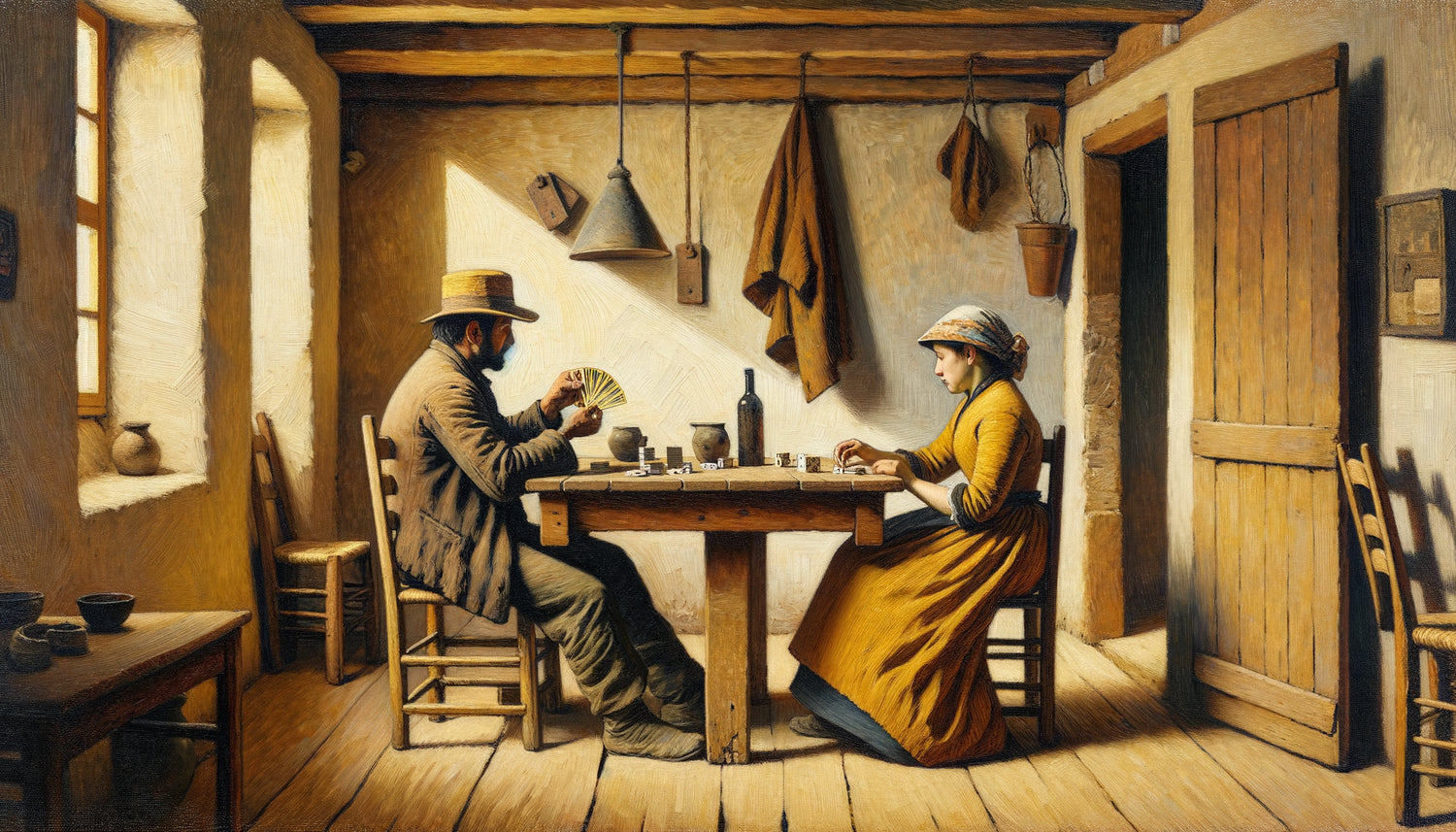
In the hushed silence of a New York auction in 2011, a painting depicting two Provençal peasants playing cards was sold for the staggering sum of $250 million. Yet, this scene was not unique. Four other versions, almost identical, already existed in the world's leading museums. How can the same motif be reproduced in five distinct works? This multiplication is neither chance nor repetition: it embodies the obsessive quest of an artist who revolutionized our view of painting.
Here's what the five versions of The Card Players reveal: a revolutionary working method based on progressive experimentation, a vision of art as process rather than final result, and a timeless lesson in the value of creative perseverance. Three lessons that transform our understanding of artistic creation and resonate with our contemporary interiors.
You may have already wondered why some reproductions of The Card Players show five characters when others only count two. This confusion is legitimate. Faced with the multiple versions circulating, it's difficult to understand which one is the « true » one. This apparent inconsistency actually hides a deeply modern artistic approach, that of a painter who never ceased refining his vision.
Rest assured: these five versions are neither copies, nor forgeries, nor even minor variants. Each represents an essential step in Paul Cézanne's creative evolution. Together, they tell the fascinating story of a man who devoted nearly five years to exploring a single subject, transforming a mundane scene into a pictorial manifesto.
This article plunges you behind the scenes of this legendary series. You will discover why Cézanne painted and repainted these card players, how each version subtly differs from the others, and what this obsession teaches us about the very nature of artistic excellence. An exploration that will illuminate your aesthetic choices and nourish your view of art.
The Aix studio: birth of a Provençal obsession
Between 1890 and 1895, in the golden light of his native Provence, Paul Cézanne began a series that would mark the history of art. The subject? Local peasants, playing cards in the anonymity of Aix cafés. Nothing romantic or exotic: just ordinary men, focused on their game, in an atmosphere of silence and contemplation.
This first version, now held at the Musée d'Orsay, features five characters. The composition is still narrative, almost anecdotal. One can guess the influence of 17th-century Dutch masters, those painters of genre scenes who immortalized daily life. But already, something differs: Cézanne purges superfluous details. No picturesque decor, no theatrical expression. Only the essentials: bodies, cards, the silent tension of the game.
This stripped-down approach is no accident. Cézanne seeks to extract the underlying structure of things, what he calls « the cylinder, the sphere, the cone » in nature. The card players become volumes in space, geometric shapes inhabited by a human presence. A quiet revolution that foreshadows cubism.
The method of reduction : when less becomes more
Dissatisfied with his first attempt, Cézanne revisits his subject. A second version is born, then a third, still with five characters. But gradually, something changes. The painter tightens his framing, eliminates peripheral elements. The background simplifies. Clothing loses its details to become structured color planes.
Then comes the radical turning point : Cézanne reduces the number of players. A fourth version shows only three, creating a different dynamic. The viewer can now observe the game from a privileged position. The composition gains balance, silent monumentality.
But the artist doesn't stop there. The two final versions, those that will definitively mark history, present only two players facing each other. This drastic reduction paradoxically amplifies the intensity of the scene. One of these versions is at the Musée d'Orsay, another at the Courtauld Institute in London, while the version sold in 2011 now belongs to a Qatari private collection.
This progression towards the essential illustrates a revolutionary artistic philosophy : repetition as a method of exploration. Far from being redundant, each version deepens the understanding of the subject. Cézanne does not copy, he distills, he concentrates, he reveals.

The silent dialogue : anatomy of a pictorial confrontation
In the two-player versions, the composition reaches an almost abstract purity. Facing each other, separated by an invisible table, the two men form an architecture of verticals and horizontals. Their massive bodies, treated as sculptures, create a perfect balance on either side of a central axis.
The genius lies in what Cézanne omits. No window to locate the scene, no decorative object to tell a story. Even the cards become secondary. What matters is the presence, that indefinable quality that makes a painting transcend simple representation to touch the universal.
The colors contribute to this concentration: ochres, browns, muted greens. An earthy palette that anchors the figures in a robust materiality. The visible and constructive touches of paint reject illusion to affirm the reality of the canvas. Each brushstroke is a decision, a gesture that builds space rather than concealing it.
This approach finds a unique echo in our contemporary interiors. At a time when minimalism and authenticity dominate decor trends, Cézanne's lesson on concentration and essence resonates with a troubling actuality. Choosing the essential, eliminating the superfluous: isn't that precisely what we seek in our living spaces?
Five versions, five laboratories of chromatic experimentation
Beyond the composition, each version of The Card Players explores distinct color nuances. Cézanne does not use the same ratio between light and shadow, nor dose his blues and ochres identically. Each painting becomes a coloristic experimentation ground.
In the Musée d'Orsay version with two players, the tones are colder, almost crepuscular. A muted melancholy pervades the scene. Conversely, the version held in a private collection exudes an earthy warmth, as if Provençal light penetrated more deeply into the enclosed space of the cafe.
These variations are not gratuitous. They testify to research on emotion through color, a subject that will preoccupy the Fauves and then the Expressionists. Cézanne demonstrates that the same subject can generate radically different atmospheres depending on the chromatic treatment. A valuable lesson for anyone interested in the emotional impact of colors in an interior.
This sensitivity to color nuances partly explains why these works continue to fascinate. They do not merely represent card players: they create atmospheres, psychological climates that vary subtly from one version to another. The same motif, five distinct emotional presences.

The modern legacy: how Cézanne invented the contemporary creative process
Cézanne's approach with The Card Players has profoundly influenced the modern conception of artistic creation. Before him, a painter would make preparatory studies, then the “real” painting, considered as a definitive culmination. Cézanne reverses this hierarchy: each version possesses its own legitimacy.
The idea that art is an endless process rather than a fixed result resonates today in all creative disciplines. Interior designers know this: a space is not conceived in one go, but built through successive iterations, each version refining the previous one. Cézanne's philosophy of exploratory repetition has become our standard working method.
Artists who follow will remember it. Picasso painted more than fifty variations of Velázquez's Las Meninas. Monet multiplied views of Rouen Cathedral and his water lilies. Warhol turned repetition into a signature. They all inherit this Cézannian intuition: repeating is not dwelling on the past, but deepening.
For our interiors, this lesson is essential. It invites us to consider decoration not as a unique and definitive choice, but as an evolving dialogue with space. Like Cézanne with his card players, we can revisit our spaces, purify them, reinterpret them, until we find the balance that truly resembles us.
250 million dollars for an obsession: the value of perseverance
In 2011, when one of the two-player versions was acquired for a record amount, the art world was stunned. How to justify such a price for a painting depicting such a modest scene? The answer lies precisely in this series of five versions.
What makes this work invaluable is not only its technical execution, but the entire journey taken to get there. Each previous version retrospectively enriches the value of the following ones. The final work carries within it the memory of previous attempts, the accumulation of experiences, the weight of obstinate research.
This valuation of the creative process transforms our relationship with excellence. In a culture of instant gratification and immediate results, Cézanne reminds us that greatness is born of patience and tenacity. Five versions for the same subject: five proofs that genius is not sudden enlightenment, but enlightened labor.
For anyone seeking to create an interior that truly resembles them, this lesson is liberating. It allows us to experiment, to make mistakes, to start over. Your first color choice wasn't right? That's not a failure, it's a preparatory study. Like Cézanne, you have the right to revisit, refine, and perfect until you find your definitive version.
Transform your interior with the spirit of the masters
Discover our exclusive collection of famous artist inspired paintings that bring the depth and timelessness of great masterpieces into your daily life.
Your gaze transformed: seeing the invisible in everyday life
The story of the five versions of The Card Players doesn't end in museums. It continues every time a gaze lingers on an ordinary scene and discovers unexpected beauty. Cézanne taught us that the extraordinary is hidden in the mundane, provided we dedicate enough attention to it.
Now imagine your relationship with art and decoration enriched by this understanding. You will no longer seek the perfect work at first glance, but you will allow for evolution, gradual adjustment. You will understand that a wall composition can be rethought, that a color palette can be refined, that your interior is a work in progress rather than a completed project.
This Cézannian philosophy of patient research and progressive refinement is an antidote to contemporary decorative anxiety. It frees you from the dictate of immediate results and invites you to savor the creative process. Your home then becomes a miniature Aix workshop, a space for experimentation where each change is a new version that brings you closer to the essence of your identity.
The five versions of The Card Players finally remind us of this: perfection does not exist in absolute terms, but in the sincere and repeated quest for what resonates within us. Start today by observing your space with fresh eyes. What element could you simplify, what color could you adjust, what composition could you refine? Like Cézanne, allow yourself the time and permission to explore.
Frequently Asked Questions
Are the five versions of The Card Players really all by Cézanne?
Absolutely, and that's precisely what makes them so precious. Unlike copies or reproductions made by assistants or forgers, each version of The Card Players is entirely painted by the hand of Paul Cézanne himself, between 1890 and 1895. Art historians have authenticated these five paintings through analysis of painting technique, documented provenance, and characteristic touches of the Aix master. These are not minor variations, but complete and autonomous works, each representing a distinct stage in his artistic research. This approach to creative repetition was unusual at the time, but it testifies to Cézanne's radical modernity, foreshadowing the working methods of 20th-century artists.
What is the main difference between the five versions?
The most striking difference lies in the number of characters depicted, which evolves from one version to another according to a process of progressive refinement. The first three versions show five card players in a more narrative and detailed composition. The fourth reduces this number to three characters, creating a different balance and a new visual tension. Finally, the last two versions, considered the most accomplished, feature only two players facing each other, in a composition of almost abstract purity. Beyond the number of characters, each version also explores subtle chromatic variations, different framing and distinct levels of formal simplification. This progression is testament to Cézanne's desire to reach the very essence of his subject by gradually eliminating all superfluous elements, like a sculptor slowly revealing the pure form from a block of marble.
Can I see all the versions of The Card Players in one place?
Unfortunately not, and that is precisely what makes this series so fascinating and inaccessible in its entirety. The five versions are scattered across the four corners of the world, held in prestigious institutions or private collections. Two versions are at the Musée d'Orsay in Paris, one at the Metropolitan Museum of Art in New York, one at the Courtauld Institute in London, and the fifth, sold in 2011 for $250 million, now belongs to the royal family of Qatar and is not accessible to the public. This geographical dispersion makes it almost impossible to have an exhibition bringing together the five works simultaneously, which has only happened very rarely in history. However, museum-quality reproductions now allow us to appreciate the nuances between these versions, and many art books offer detailed comparative analyses that reveal the subtleties of this legendary series.