Imagine a work of art capable of traversing five centuries without its colors fading, without its luminosity dimming. A painting that defies time with a quiet arrogance, as if it had captured eternity itself. This is exactly what Sebastiano del Piombo achieved in the 16th century, daring to do what no one had attempted before: painting in oil directly onto stone.
Here's what this revolutionary innovation brings: exceptional preservation that lasts through the centuries without major restoration, unparalleled chromatic depth and luminosity, and a technique that sublimates the material by transforming stone into a living support.
If you have already contemplated an ancient painting in a museum, you have probably noticed these cracks, these areas where the color flakes off, where the yellowed varnish alters the original brilliance. This is the silent tragedy of paintings on wood or canvas: time always ends up taking its toll. Sebastiano del Piombo understood that the true enemy of art was not a lack of talent, but the fragility of the support itself.
Yet, this innovation did not fall from the sky. It was born of deep frustration, meticulous observations, and a boldness that only true pioneers possess. Let's discover together how this technique transformed the history of art, and why it continues to inspire contemporary creators seeking authenticity and durability.
The genesis of a revolution: when Michelangelo whispers in Sebastiano's ear
In the Roman workshops of the early 16th century, a fierce rivalry opposed two giants: Michelangelo and Raphael. Sebastiano del Piombo, a Venetian painter established in Rome since 1511, found himself within the orbit of the former. Michelangelo, a sculptor at heart, observed with some frustration the fragility of mural paintings and wooden or canvas paintings. Why, he wondered, not paint on stone as one sculpts marble?
It is in this context of creative emulation that the revolutionary idea was born. Michelangelo suggests to Sebastiano that he experiment with oil painting on stone, a technique never exploited before. The innovation is bold: traditionally, paintings were done in fresco on walls, in tempera or in oil on wood and canvas. Stone was reserved for sculpture. But Sebastiano, with his Venetian expertise in color and glazes, immediately perceived the extraordinary potential of this approach.
Between 1516 and 1520, he carried out his first experiments on lavagna, that dark slate with a fine grain which would become his signature. The result is stunning: the pigments adhere perfectly, the colors burst forth with an intensity never seen before, and above all, the smooth and impermeable surface of the stone naturally protects the painting from humidity and deformations.
The technical secrets of a masterful innovation
The technique developed by Sebastiano del Piombo is based on an intimate understanding of materials. Unlike wood, which expands and contracts with humidity, or canvas, which sags, stone offers absolute dimensional stability. This fundamental characteristic eliminates the main factor in the degradation of ancient paintings: movement of the support that causes cracks and flaking.
The meticulous choice of support
Sebastiano favors lavagna, a slate with a deep gray hue and bluish reflections. This sedimentary rock has a fine grain that receives layers of paint without excessively absorbing oil. Its slightly porous surface nevertheless allows for optimal adhesion, creating a durable chemical bond between the pigments and the mineral matter. He also uses white marble for some works, whose natural luminosity enhances skin tones and draperies.
The application of pigments: a precise alchemy
Oil painting on stone requires considerable technical adaptation. Sebastiano works with successive glazes, these translucent layers that allow light to penetrate the pictorial matter before reflecting off the support. With stone, this interaction of light reaches exceptional depth. The color seems to emanate from within, creating that mysterious luminosity which characterizes his most famous works.
The painter also adjusts the viscosity of his binders. On stone, oil does not penetrate in the same way as on wood. It is necessary to find the perfect balance so that the layers adhere without slipping, while preserving the fluidity necessary for subtle transitions and refined modeling.

Masterpieces that defy time
Sebastiano del Piombo's innovation is not just a technical feat: it radically transforms the aesthetic experience. His paintings on stone possess a unique physical presence, a materiality that dialogues with the subject represented.
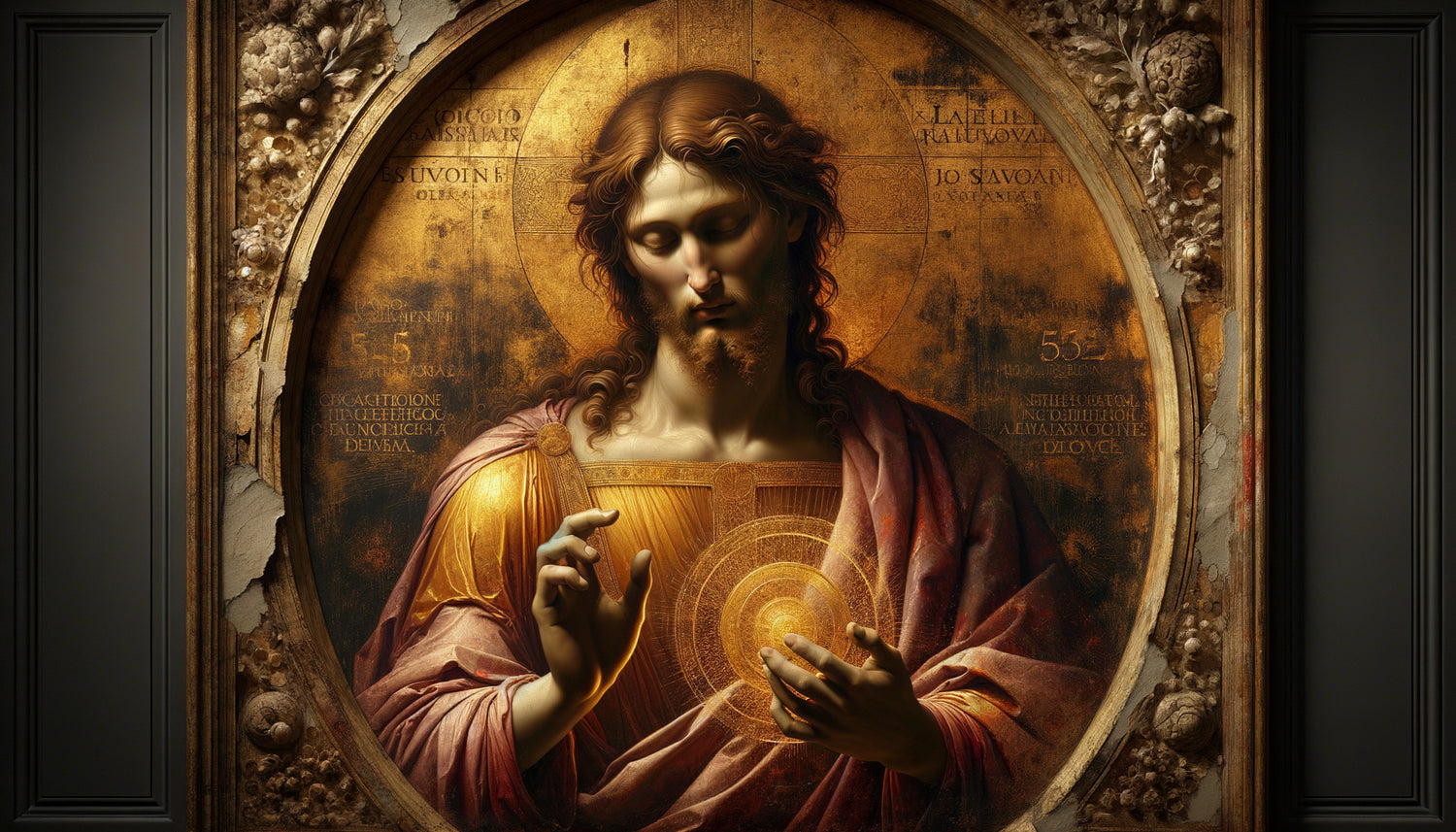
His most iconic work on this medium is undoubtedly the Pietà held at the Museo Civico de Viterbe, painted on lavagna around 1516-1517. The depth of the blacks, the dramatic intensity of the shadows, the spectral luminosity of Christ's flesh: all contribute to creating a raw, visceral emotion. The choice of stone is not decorative; it is constitutive of the very meaning of the work. The mineral matter, cold and eternal, evokes death and the tomb, while painting infuses life and pathos.
Another remarkable masterpiece is the Portrait of Clement VII, where the technique on stone allows to capture with astonishing precision the textures of fabrics, metallic reflections, subtle variations in skin tone. Five centuries later, these works retain a freshness that surprises restorers. Where other paintings from the same period have required countless interventions, those by Sebastiano on stone cross time with a disconcerting serenity.
Contemporary legacy: when innovation is reborn
If the technique of painting on stone did not experience immediate posterity after Sebastiano del Piombo – perhaps because of its complexity and the considerable weight of the works –, it fascinates today artists and curators seeking authentic durability.
In our era obsessed with the ephemeral and disposable, this approach resonates with a new relevance. Some contemporary artists rediscover stone as a pictorial support, not out of nostalgia, but out of ecological awareness and desire to create truly lasting works. Local stone, untransformed, has an infinitely lower carbon footprint than industrial canvases or synthetic supports.
Museums, for their part, are rediscovering Sebastiano's works with a renewed perspective. They embody a philosophy of creation diametrically opposed to planned obsolescence: art as commitment in the long term, as dialogue with future generations.

Why this innovation still speaks to us today
Beyond the technical feat, Sebastiano del Piombo's innovation raises questions about our relationship with creation and duration. In a world saturated with volatile digital images, where aesthetic trends are constantly changing at a dizzying speed, the idea of a painting capable of crossing five centuries without major alteration has an extraordinary symbolic power.
This technique reminds us that authentic innovation doesn't always involve inventing something radically new, but sometimes combining existing elements in a bold way. Sebastiano didn't create oil painting or discover stone. He had the brilliant intuition to marry them, understanding that their union would transcend the limits of each taken individually.
For art and contemporary decor enthusiasts, this story offers a valuable lesson: true quality is measured by the test of time. Rather than succumbing to fleeting trends, why not seek out works and objects designed to last, carrying a material authenticity that gains beauty with age?
Be inspired by the masters of the Renaissance
Discover our exclusive collection of wall art inspired by famous artists that captures the timelessness and depth of classic masterpieces to sublimate your interior.
Stone as a metaphor for artistic commitment
By choosing to paint on stone, Sebastiano del Piombo accomplished a gesture that was both technical and philosophical. Stone imposes its constraints: its weight, its rigidity, the impossibility of correcting it easily. It demands from the artist an absolute mastery from the first gesture, a clear vision of the completed work before even starting.
This requirement strangely resonates with our era of permanent undo, Instagram filters and endless retouching. Sebastiano's innovation reminds us that there is a form of freedom in accepted constraint, a depth in irrevocable commitment. Every brushstroke on the stone counts, every chromatic choice is definitive.
Perhaps it is this existential dimension that explains the magnetic presence of his works on stone. One perceives the intensity of a creation where the artist has neither right to approximation nor to repentance. This creative tension crosses the centuries and still touches us, we who live in the illusion of perpetual temporality.
Your gaze transformed
Now that you know the story of this revolutionary innovation, each visit to a museum will take on a new dimension. In front of an old painting, you will ask yourself: what is its support? How has it crossed time? What technical choices made its preservation possible?
Sebastiano del Piombo bequeathed us much more than a pictorial technique. He offers us a philosophy of creation centered on durability, material authenticity and dialogue with time. In your own aesthetic quest, whether for your interior or your collections, let yourself be guided by this requirement: to prioritize what is made to last, what carries within it a material truth, what will gain beauty with age rather than degrade.
The innovation of painting on stone whispers this essential truth to us: true art does not fear time, it feeds on it.