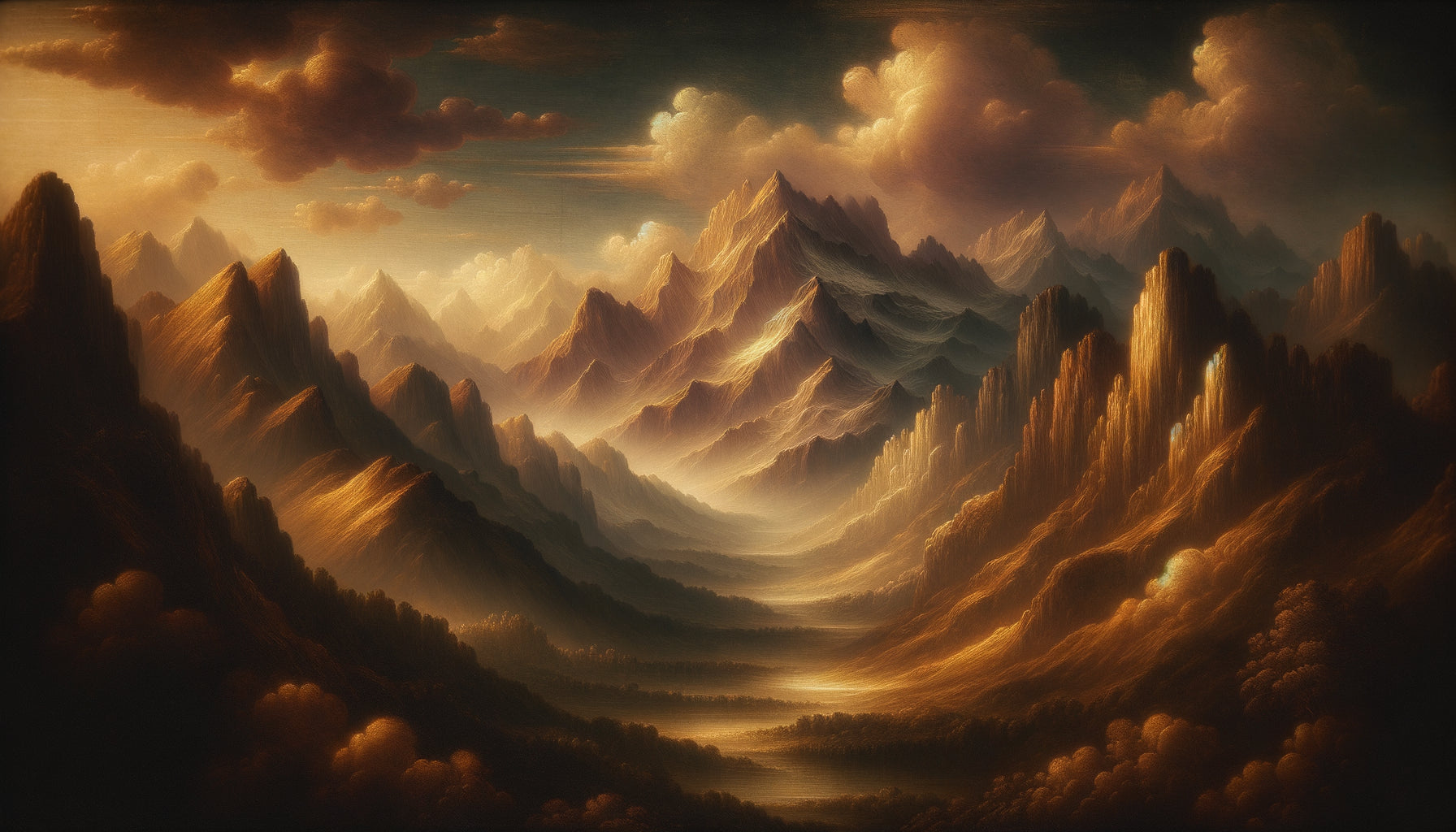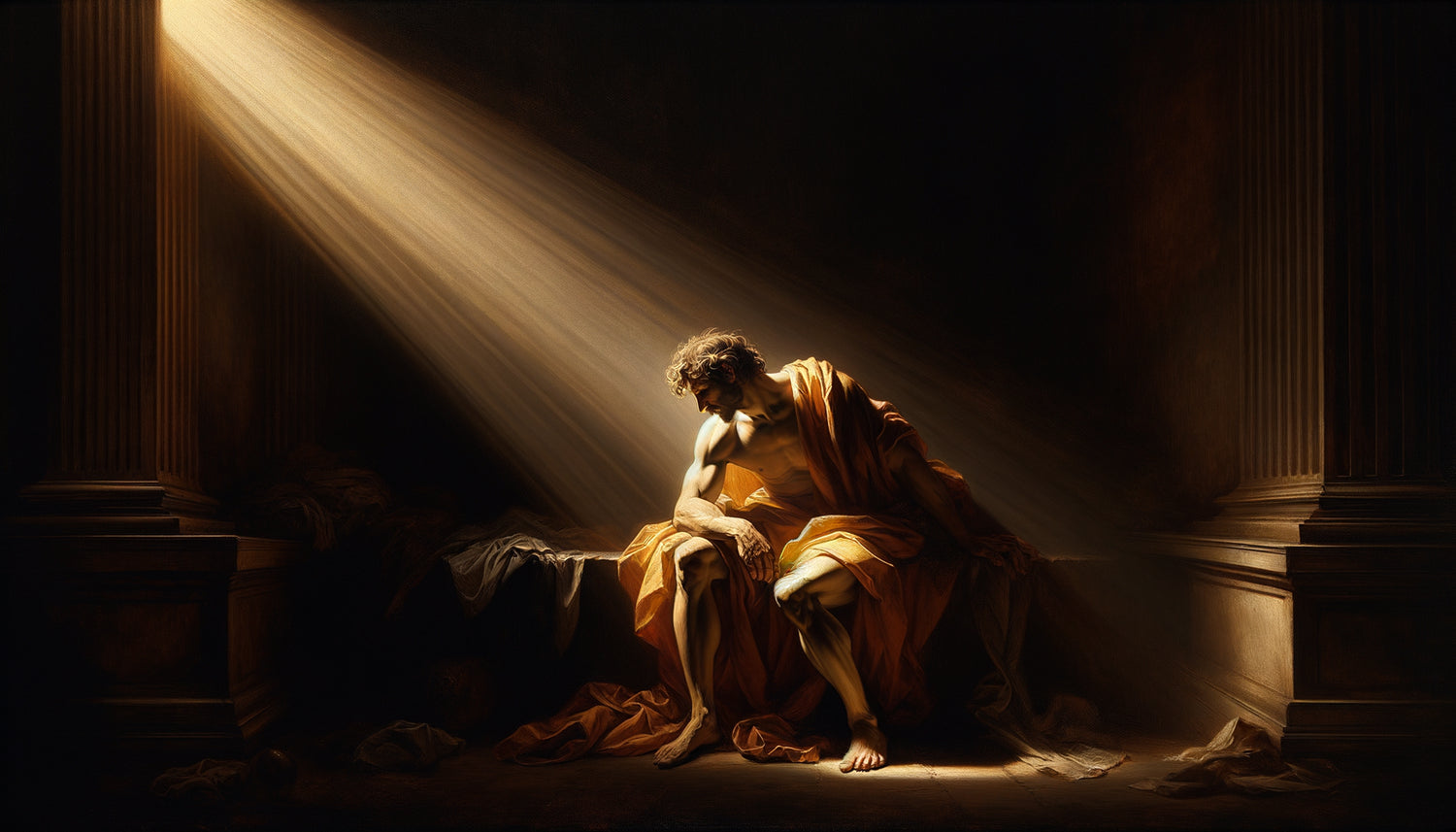
Imagine entering a 17th-century Roman church. Darkness first envelops you, then suddenly, a ray of divine light strikes the face of an ecstatic saint. This striking theatricality, this ability to sculpt volumes by the magic of shadow and light alone, is the very essence of Baroque chiaroscuro. A revolutionary technique that transformed painting into a mystical, dramatic, almost cinematic experience before its time.
Here's what the origin of Baroque chiaroscuro reveals to us: a radical break with Renaissance harmony, a technical mastery that brings canvases to life, and the emergence of a new way of telling human emotions through the violent contrast between darkness and light.
You may be fascinated by these paintings where the light seems to emerge from nowhere, creating dramatic atmospheres that give flesh to biblical narratives. But where does this technique actually come from? Who invented it? How did it become the visual signature of an entire era? These questions deserve consideration, because understanding the roots of chiaroscuro means penetrating the secret workshop of Baroque masters and discovering how art can manipulate our deepest emotions. I will tell you this fascinating story, from the first gropings to its flamboyant peak.
Early Italian developments: when the Renaissance prepares the ground
Baroque chiaroscuro does not emerge from nothingness. Its roots lie in the Italian Renaissance, a period when painters begin to question the representation of light. Leonardo da Vinci experiments with sfumato, this technique of soft transitions between shadow and light that gives faces their mystery. The Correggio, in his frescoes in Parma, plays with more marked contrasts, already foreshadowing the boldness to come.
But it is truly in Venetian workshops that something new is fermenting. Titian, in his later period, considerably darkens his backgrounds, making his figures spring from a deep black. Tintoretto pushes this luminous dramaturgy even further, creating compositions where darkness becomes a character in its own right. These Venetian masters of the second half of the 16th century are the true precursors: they understand that shadow is not simply the absence of light, but a powerful narrative tool.
The technique evolves gradually. Painters abandon medieval gold backgrounds, then the bright landscapes of the High Renaissance. They discover that a dark background concentrates attention, that it creates a disturbing spatial depth. This evolution is also ideological: the Catholic Counter-Reformation seeks new ways to move the faithful, to make faith more visceral, more embodied.
Caravaggio: the inventor of revolutionary tenebrism
And then comes Michelangelo Merisi da Caravaggio, known as Caravaggio, and everything shifts. In the 1590s, this painter with a volcanic temperament literally revolutionizes European art by inventing tenebrism, the most radical form of Baroque chiaroscuro. His innovation? To plunge his scenes into almost total darkness, from which emerges a harsh, almost violent light that sculpts bodies and faces with unparalleled intensity.
Take The Calling of Saint Matthew (1599-1600). The scene takes place in a dark tavern. A ray of light, entering from the right, crosses the room and points to the future apostle. This light is not naturalistic: it comes from nowhere, it is pure divine manifestation. Caravaggio uses chiaroscuro as theological language. The areas of shadow represent ignorance, sin, the human condition before grace. Light embodies revelation, the divine call, spiritual transformation.
Technically, Caravaggio works in a revolutionary way. He paints on brown or black backgrounds prepared, building his figures by progressively adding light rather than traditional modeling. He practically doesn't use preparatory drawings, working directly from live models that he dramatically illuminates in his studio. This method creates a striking realism: his saints have dirty feet, his virgins look like peasant women, his biblical scenes take place in poor contemporary settings.

The European contagion: how chiaroscuro conquers the continent
Caravaggesque style spreads like wildfire across Europe. Artists of all nationalities flock to Rome to study the master's works. They then bring this technique of chiaroscuro back to their countries, creating distinct national Baroque schools but all marked by this luminous dramaturgy.
In Spain, Ribera and Zurbarán adopt tenebrism to express Iberian Catholic mysticism. In the Netherlands, Utrecht caravaggists like Hendrick ter Brugghen import the technique into a Protestant context. In France, Georges de La Tour develops a purified, almost geometric variant of chiaroscuro, often lit by a single candle. Each region adapts the technique to its own sensibility.
The influence extends even to masters who are not strictly caravaggesque. Rembrandt, in the Netherlands, creates his own version of chiaroscuro, more subtle, more atmospheric, bathed in a golden light that evokes as much psychological introspection as transcendence. Rubens, while retaining a brighter palette, integrates dramatic contrasts of light into his large Baroque compositions.
The reasons for a resounding success
Why does this technique appeal so much? First of all, it perfectly meets the needs of the Counter-Reformation. The Catholic Church, facing the Protestant Reformation, seeks to win back the faithful through emotion. Baroque chiaroscuro, with its theatricality, its ability to create memorable and overwhelming images, becomes the ideal tool for this spiritual reconquest.
Secondly, the technique has a fascinating psychological dimension. The areas of shadow invite the eye to explore, create mystery, suggest what is not shown. They activate our imagination. The violent contrast with the illuminated areas creates a visual tension that maintains attention, which dramatizes every gesture, every expression.
The technical secrets of chiaroscuro masters
But how did these painters actually create these striking effects? The technique of Baroque chiaroscuro is based on several fundamental principles that any art lover should know to better appreciate these masterpieces.
Firstly, the choice of light source. In Caravaggesque paintings, the light almost always comes from a single point, often off-screen, creating sharp cast shadows and abrupt transitions. This directional light, which could be compared to a theater spotlight, sculpts volumes with surgical precision.
Secondly, the limited color palette. Masters of chiaroscuro often work with restricted ranges: browns, ochres, deep reds, creamy whites. This economy of colors reinforces the visual unity and focuses attention on the play of light and shadow rather than chromatic variations.
Thirdly, the centralized composition. The main figures occupy the center or foreground, directly illuminated, while secondary elements merge into the peripheral darkness. This visual hierarchy guides the eye in a very directive, almost cinematic way.
Finally, the use of live models directly illuminated in the studio. Caravaggio is famous for this practice: he arranged his models in precise poses, illuminated them with lanterns or by letting in light through a controlled opening, then painted what he saw. This direct observation of natural light on bodies gives his figures their extraordinary physical presence.

The legacy of chiaroscuro: from painting to cinema
Baroque chiaroscuro does not end with the end of the 17th century. Its influence crosses centuries and permeates all visual arts. In the 19th century, the Romantics rediscovered Caravaggio and reintegrated his dramatic contrasts. Pioneer photographers, such as Julia Margaret Cameron, were directly inspired by Baroque lighting for their portraits.
But it is especially cinema that becomes the natural heir of chiaroscuro. The Hollywood film noir of the 1940s, with its menacing shadows and expressionistic lighting, descends directly from Caravaggio's tenebrism. Filmmakers like Orson Welles in Citizen Kane or Gordon Willis in The Godfather create images that could have come from a 17th-century painting.
Even today, photographers and videographers study Baroque masters to understand how to sculpt a face with light, how to create depth with shadows, how to direct the viewer's attention. Modern technical vocabulary - Rembrandt lighting, Caravaggio light - testifies to this continuous lineage.
Why chiaroscuro still fascinates today
What makes Baroque chiaroscuro still so captivating four centuries after its invention? I believe that this technique touches something fundamental in our relationship with the visible and the invisible. It materializes our existential condition: we are beings of light and shadow, divided between knowledge and ignorance, between what is revealed and what remains hidden.
Chiaroscuro also creates a particular intimacy. By concentrating light on a face, on joined hands, it brings us closer to these figures, it invites us to penetrate their interiority. The darkness that surrounds them eliminates distractions, creating a mental space where only the moment of grace or pain captured by the brush counts.
For lovers of decoration and interior design, understanding chiaroscuro also illuminates our contemporary aesthetic choices. The resurgence of dark walls, the use of indirect or targeted lighting, the emphasis on contrasts rather than uniform brightness: all these current trends unconsciously draw from this Baroque heritage.
Be captivated by the play of light and shadow
Discover our exclusive collection of artwork inspired by famous artists that capture the baroque dramaturgy and transform your walls into a timeless art gallery.
The shadow that reveals the light
Baroque chiaroscuro is more than just a pictorial technique: it's a philosophy of representation, a way of thinking about the visible and giving form to the invisible. Born from burgeoning experiments, revolutionized by Caravaggio’s tormented genius, spread throughout Europe by generations of fascinated artists, it has shaped our Western visual imagination.
This technique reminds us that the most powerful art often arises from contrast, from the tension between opposites. That light truly exists only because there is shadow. That what is hidden makes what is revealed more precious. The next time you stop in front of a baroque painting, take the time to observe how light sculpts forms, how it guides your gaze, how it transforms an ordinary scene into a moment of eternity. You will never see art the same way again.
Frequently asked questions about the origin of baroque chiaroscuro
What is the difference between chiaroscuro and tenebrism?
Chiaroscuro is the general term for the use of contrasts between light and dark areas in a painting. It's a technique that has existed since the Renaissance. Tenebrism, on the other hand, is an extreme and radical form of chiaroscuro, invented by Caravaggio around 1600. In tenebrism, backgrounds are plunged into almost total darkness, and light bursts forth violently and dramatically, creating much more abrupt contrasts. While classic chiaroscuro uses gradual transitions between shadow and light, baroque tenebrism favors sharp, almost theatrical breaks. That's the difference between Leonardo da Vinci’s soft sfumato and Caravaggio’s spotlight lighting. Both techniques share the same principle - playing with light and shadow - but with very different intensities.
Why did Caravaggio develop this dark technique?
Several reasons explain the invention of tenebrism by Caravaggio. Firstly, there is a religious context: the Catholic Counter-Reformation was seeking ways to emotionally touch believers, and this luminous dramaturgy perfectly served that purpose by creating memorable and shocking images. Secondly, Caravaggio had a realistic and almost revolutionary vision of art: he wanted to show the sacred in everyday life, with characters who looked like real people. The intense chiaroscuro allowed him to focus attention on the essentials - faces, hands, gestures - while erasing background details that could distract. Thirdly, there is probably also a psychological dimension: Caravaggio's violent and tormented temperament found its natural expression in these extreme contrasts between darkness and light. Finally, practically speaking, this technique allowed him to work faster, without having to paint complex backgrounds, while creating maximum visual impact.
How to integrate the spirit of Baroque chiaroscuro into your interior decoration?
The aesthetics of Baroque chiaroscuro can transform a modern interior into a sophisticated and theatrical space. Start by daring dark walls - navy blue, deep emerald green, anthracite gray - in at least one room, ideally a living room or bedroom. These shades create the dark setting necessary to highlight the elements you want to emphasize. Then, work your lighting in a targeted way: abandon ceiling-mounted uniform lighting in favor of directional lamps, spotlights on rails, wall sconces that create areas of light and shadow. Specifically illuminate works of art, precious objects, reading areas. Choose Baroque paintings reproductions or black and white photographs with strong contrasts to dress your walls. Finally, prioritize materials that play with the light: deep velvet, antique mirrors, patinated metals, dark woods. The goal is to create depth and drama, while maintaining a refined elegance. Your interior will become a scene where each element is highlighted as in a masterpiece.