In the dusty workshops of antique restorers, there is a pigment that makes the heart beat faster: Indian yellow. This golden hue, warm like a ray of sunshine filtered through foliage, has a history as fascinating as it is strange. Behind its incomparable luminosity lies a secret few know: this precious pigment came from the urine of cows fed exclusively on mango leaves. A mysterious, almost alchemical practice that persisted for centuries before disappearing, leaving contemporary artists orphans of this unique color.
This is what this fascinating story reveals: the extreme ingenuity of Indian artisans who discovered this extraordinary method, the obsessive quest of European painters to obtain this rare pigment, and the ethical reasons that led to its prohibition. You might think that the colors in your interior or the paintings you admire have banal origins? That pigments come simply from modern factories without a history? Rest assured, every shade has its own epic. And that of Indian yellow is one of the most extraordinary in the history of art. I promise you that after this reading, you will never look at golden yellows the same way again.
Liquid gold: the birth of a legendary pigment
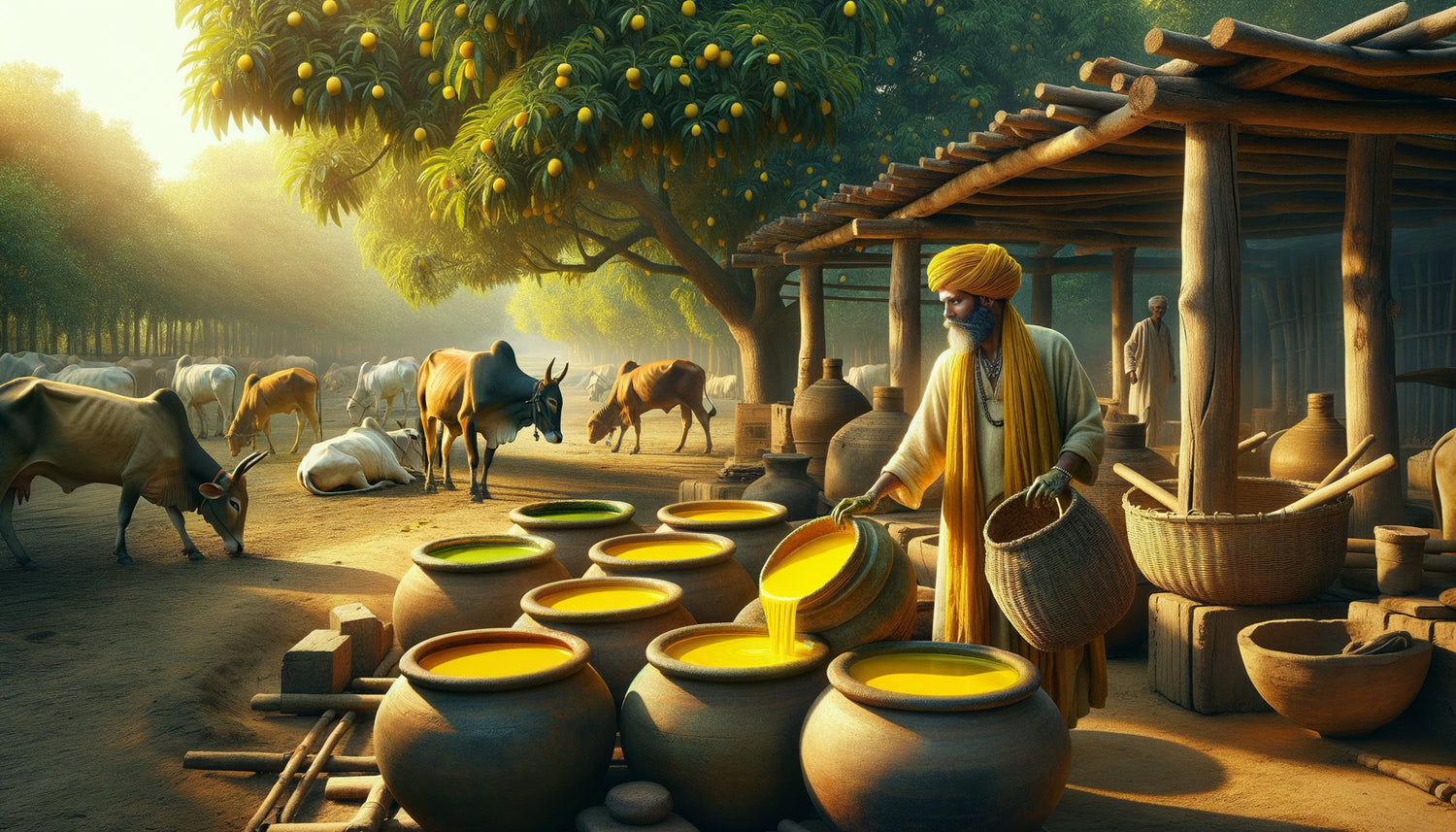
In the heart of Bengal, India, in the Monghyr region, a centuries-old tradition developed around a process as ingenious as it was unlikely. Entire families dedicated themselves to producing Indian yellow, this pigment of incomparable luminosity that European painters clamored for at high prices. The process was meticulous: breeders fed their cows exclusively on mango leaves and water, creating a strictly controlled diet.
The urine of these cows thus fed took on an intense yellow hue, charged with a chemical compound called euxanthine. This substance, the result of a particular metabolism caused by mango leaves, was the key to this exceptional color. Artisans carefully collected this urine, heated it until partially evaporated, then filtered it to obtain a thick paste. This material was then shaped into small balls or patties, dried in the sun for several days. The result? A pigment with an unparalleled golden luminosity, slightly translucent, which captured light in an almost magical way.
A color that crossed the oceans
European merchants discovered this extraordinary pigment in the early 18th century. Flemish, then French and English painters were immediately seduced by its luminous transparency and its ability to create glazes of incredible depth. Unlike other yellows available at the time - such as ochre or Naples yellow - Indian yellow possessed a almost supernatural quality: it seemed to radiate from within, as if the canvas itself emitted light.
The chemical mystery behind the magic
For a long time, Europeans completely ignored the exact origin of this fascinating pigment. Indian merchants maintained the mystery, vaguely speaking of plant substances and secret processes. It was only in 1883 that T.N. Mukharji, at the Calcutta Colonial and Indian Exhibition, finally revealed the true source of Indian yellow : cow urine from cows fed on mango leaves.
The revelation was like a bombshell in European artistic circles. How could such a noble substance have such a... prosaic origin? Yet, from a chemical point of view, the process was relentlessly logical. Mango leaves contain large amounts of euxanthic acid. When cows ingested these leaves exclusively, their bodies metabolized this substance and concentrated it in their urine as magnesium and calcium euxanthate. It was this unique chemical combination that created this unparalleled golden hue.
A pigment with exceptional technical properties
Beyond its beauty, Indian yellow possessed remarkable technical qualities. Its transparency allowed for the creation of superimposed luminous glazes, a technique prized by old masters. Its permanence was good, although not absolute - some works today show slight browning of the pigment. Mixed with other colors, it produced vibrant greens and vibrant oranges. Indian and Persian miniature painters used it to create these sumptuous gold tones that characterize their works.

When beauty meets ethics: the end of a tradition
But this extraordinary story hides a dark side. The diet imposed on the cows was deeply harmful to their health. Fed exclusively on mango leaves, these animals sacred in Hindu culture suffered from severe nutritional deficiencies. Mango leaves, although non-toxic in small quantities, did not provide the nutrients necessary for a cow. The animals thinned, became weak, and their milk production collapsed.
As details of this practice spread, indignation grew. How could animals, moreover sacred ones, be mistreated to produce a simple pigment? British colonial authorities, under pressure from animal protection societies and certain Hindu religious groups, eventually banned this practice at the beginning of the 20th century. The production of authentic Indian yellow gradually ceased, with the last reliable mention dating back to the 1920s.
The legacy of a lost pigment
Today, true Indian yellow no longer exists. The few tubes or cakes that survive in museum collections or with rare collectors are invaluable treasures. Restorers of old works who have the chance to possess a few milligrams handle it with almost religious care. Modern color manufacturers offer synthetic substitutes bearing the name of Indian yellow, but these imitations, however well formulated, never quite possess the original’s unique luminous quality.
Chemists have attempted to synthetically reproduce euxanthine, with varying degrees of success. Some modern formulations approach the original hue, but the pigment's behavior in glazes, its particular way of interacting with light, remains impossible to perfectly duplicate. It is as if this pigment had taken its secret with it.
These masterpieces illuminated by Indian gold
In museums around the world, thousands of works still bear the mark of this extraordinary pigment. 17th-century Mughal miniatures, with their golden skies and sumptuous costumes, used Indian yellow abundantly. 19th-century British painters, such as William Turner, employed it to create those luminous atmospheres characteristic of their landscapes. In portraits from the Dutch school, this warm, golden hue is found in the draperies and backgrounds.
Each time a visitor marvels at the luminosity of an old painting, there is a chance they are admiring, unknowingly, this pigment derived from a millennia-old practice that has now disappeared. These works are the last visual witnesses to a tradition that combined empirical knowledge of natural chemistry, artisanal know-how passed down from generation to generation, and a certain form of bold creativity - even if it raised serious ethical questions.

Contemporary Lessons from an Ancient Color
The history of Indian yellow resonates strangely with our contemporary concerns. It reminds us that beauty sometimes has a hidden cost, that our aesthetic choices carry ethical implications. In a world where we question the origin of our products, the sustainability of our consumption choices, this ancient pigment becomes a modern parable.
Designers and decorators today who seek this particular golden hue for their projects must contend with synthetic alternatives. Some see this as a loss, the end of an authenticity. Others recognize it as progress: proof that we can create beauty without sacrificing animal welfare. Contemporary paint manufacturers have also developed modern organic pigments which offer remarkable qualities, sometimes even superior to historical pigments in terms of permanence and stability.
Reinventing Golden Yellows in Our Interiors
For those seeking to capture the characteristic luminous warmth of Indian yellow in their interior decoration, the options are numerous. Wall paints in saffron or pale gold tones can evoke this particular quality. Natural silk textiles dyed with modern plant-based dyes reproduce these warm nuances. And above all, reproductions of ancient works that used this pigment allow us to introduce this golden light into our living spaces.
Let the history of art illuminate your walls
Discover our exclusive collection of paintings inspired by famous artists who used these legendary pigments to create timeless works, and bring this historical luminosity into your interior.
A Color That Continues to Fascinate
Indian yellow teaches us that every color tells a story, sometimes extraordinary, sometimes disturbing, always human. This golden hue born from the ingenuity of Indian artisans, sought after by the greatest European masters, then abandoned for ethical reasons, symbolizes our complex relationship with beauty and artistic creation.
Today, when you admire an old painting in a museum, take a moment to observe these bright yellows, these gildings that seem to radiate. Ask yourself what story lies behind these pigments. Indian yellow is no longer produced, but its legacy persists in the thousands of works it helped create, in the collective memory of artists, and in our continued fascination with these warm and luminous shades that transform a simple space into a place inhabited by light.
The saga of this pigment also reminds us that human creativity knows no bounds - even if it must sometimes accept ethical constraints. Contemporary artists who use modern substitutes for Indian yellow perpetuate this luminous tradition, while adapting it to our current values. Perhaps this is the most beautiful lesson of this story: beauty evolves, adapts, reinvents itself, but never truly disappears.
FAQ : Everything you need to know about Indian Yellow
Can we still find real Indian yellow today?
No, the real Indian yellow has not been produced since the beginning of the 20th century, following a ban for ethical reasons. The few existing remains are found in museum collections or with rare art restorers. What you will find today in stores under the name of Indian yellow are synthetic substitutes that imitate the original shade. These modern versions are generally composed of organic pigments or mixtures of metal oxides which approximately reproduce the color, but not exactly the unique optical properties of the original pigment. For your decoration or painting projects, these substitutes nevertheless offer excellent qualities of permanence and brightness, without the ethical problems of the original.
Why were cows specifically fed with mango leaves?
Indian artisans had empirically discovered that mango leaves caused an intense yellow coloration of bovine urine. This knowledge, likely the result of accidental observations followed by progressive refinements, was based on a chemical reality: mango leaves contain high concentrations of euxanthic acid. When cows metabolized this acid exclusively, their urine became charged with euxanthin, the compound responsible for this sought-after golden hue. It wasn't simply a dye, but a true chemical transformation carried out by the animal organism. This artisanal method, passed down from generation to generation, represented a remarkable form of intuitive biochemistry. However, this exclusive diet deprived animals of essential nutrients, causing their progressive weakening, which eventually led to the prohibition of this practice.
How to incorporate this golden hue into my current decor?
To capture the spirit of Indian yellow in your interior, prioritize warm yellows with golden and slightly orange nuances. In wall painting, look for tones like saffron yellow, pale gold, or mild curry - these colors evoke that characteristic warm luminosity. Textiles also play an essential role: silk cushions, naturally dyed linen curtains, or rugs in these shades create a enveloping atmosphere. For a more subtle effect, opt for decorative objects - vases, ceramics, works of art - which concentrate this color in focal points. Lighting is crucial: warm light will sublimate these golden tones, especially at the end of the day. Finally, reproductions of old paintings that used this pigment bring a historical and artistic dimension while diffusing this unique luminous quality throughout your space. The goal is to create an atmosphere that is both warm and refined, where the light seems to emanate from the surfaces themselves.