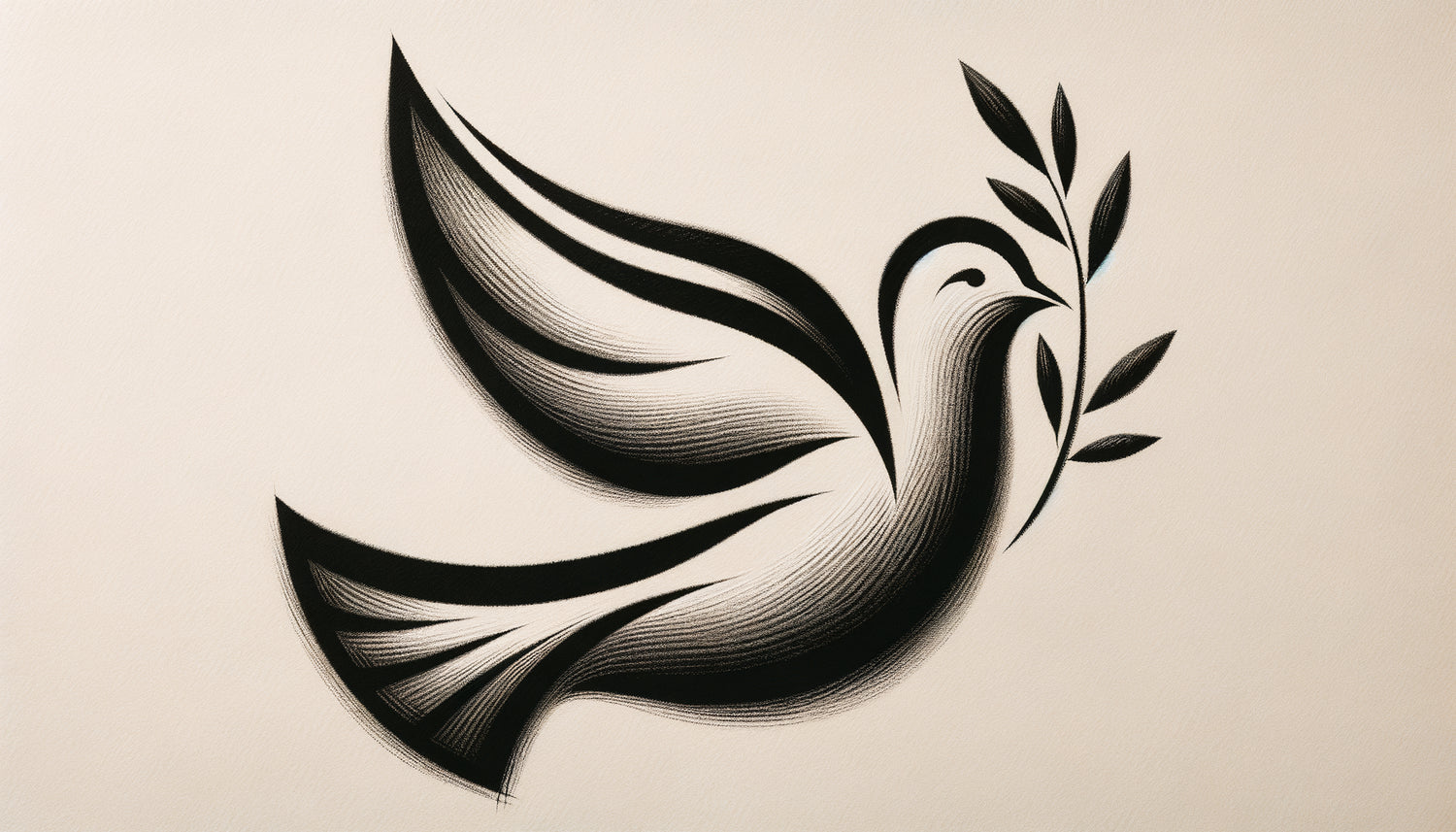
In 1949, Pablo Picasso drew a few lines in charcoal. A dove, almost childlike in its simplicity. This drawing became the poster for the World Congress of Peace in Paris. Overnight, this silhouette crossed continents, appearing on the bombed walls of Berlin, the squares of Prague, and the universities of Tokyo. Even today, this dove soars over our collective imaginations. But why do some symbols transcend their time to become universal? How does art transform abstract concepts into visual icons capable of mobilizing millions of people?
Here's what pacifist symbols in art bring: they crystallize collective aspirations into memorable images, they create a universal visual language beyond linguistic barriers, and they transform our interiors into spaces for reflection and personal commitment.
You may admire these works in museums without really understanding their genesis. You wonder how a simple drawing can carry such emotional weight. You hesitate to integrate these symbols into your home, fearing they will be too militant, too dated, or simply misunderstood.
Rest assured: peace symbols in art possess a historical and aesthetic depth that far exceeds their political dimension. They tell human stories, moments of upheaval, shared hopes. Understanding their origin restores all their power.
In this article, I'll take you behind the scenes of these visual icons. You will discover how Picasso created his dove, what other pacifist symbols have marked the history of art, and above all, how these works can enrich your daily life with meaning and beauty.
Picasso's Dove: When a Bird Becomes a Manifesto
1949. Europe heals its wounds. Pablo Picasso, already world-renowned for Guernica, his cry against barbarity, receives a commission from the French Communist Party. He is asked to create a poster for the World Congress of Peace. Picasso chose radical simplicity: a white dove, in profile, holding an olive branch in its beak.
This dove was not born by chance. Picasso owned pigeons in his Parisian studio. He observed them, fascinated by their grace and fragility. The poet Louis Aragon, seeing these sketches, is said to have suggested: 'Here's the bird we need.' The decision was made. This dove would become the most reproduced symbol of peace in the 20th century.
The impact was immediate and global. The poster was multiplied by millions of copies. Picasso's dove transcended divisions: believers and atheists, capitalists and communists, all could recognize themselves in it. The symbol even escaped its creator. Picasso declined it in lithographs, ceramics, paintings. Each version brought a nuance: sometimes the bird flies away, sometimes it perches, sometimes it carries a flowering branch.
What strikes you about these representations is their simplicity. A few lines are enough to evoke peace, hope, reconciliation. This formal simplicity explains its infinite reproduction: on T-shirts, protest posters, murals. Picasso's dove becomes a universal visual language, instantly understood from Tokyo to Lima.
The olive tree and the dove: a millennial duo reinvented
But why a dove? And why this olive branch in its beak? These symbols have their roots in the Mediterranean Antiquity. In the biblical Genesis, it is a dove that brings Noah a branch of olive, sign that the waters of the Flood are receding. This episode anchors in the Judeo-Christian imagination the association dove = peace, olive tree = appeased land.
The ancient Greeks crowned their victorious athletes with branches of olive trees. The Romans sent emissaries of peace carrying olive branches. This symbolism crosses the centuries, immutable. Picasso does not invent it, he reactivates it with the graphic language of the 20th century.
Other artists had explored these motifs before him. In medieval illuminated manuscripts, white doves symbolize the Holy Spirit, bearer of divine peace. Renaissance painters, such as Piero della Francesca, integrate doves into their religious scenes. But it is Picasso who secularizes and democratizes this symbol, freeing it from its strictly religious context to make it a universal emblem.
When artists subvert codes
Over the decades, other creators have appropriated the dove. Banksy, the British street artist, paints a peace dove wearing a bulletproof vest. The pacifist symbol becomes ironic, almost cynical, pointing to the hypocrisy of speeches about peace in a militarized world. This critical reinterpretation proves the vitality of the symbol: it resists reinterpretations, is enriched by new contexts.
Keith Haring, a major figure in American pop art, integrates stylized doves into his New York murals. His birds dance, intertwine, celebrate brotherhood. Haring multiplies the symbol, creating graphic flights where peace becomes movement, collective energy.

Other pacifist symbols that have marked art
Picasso's dove is not alone. Other pacifist symbols have marked the history of art, each carrying its own historical and emotional weight.
The peace symbol, this circle crossed by three lines, was born in 1958. Gerald Holtom, a British graphic designer, designed it for the Campaign for Nuclear Disarmament. This drawing combines the semaphore signals of the letters N and D (Nuclear Disarmament). Simple, memorable, it becomes the emblem of the hippie movements in the 1960s, then of all global pacifist demonstrations.
Pop artists seize upon it. Andy Warhol silkscreens it in psychedelic colors. Peter Max integrates it into his flamboyant posters. The peace symbol becomes a decorative motif as much as an engagement. It adorns clothing, jewelry, everyday objects. This omnipresence is a testament to a deep aspiration: to transform the visual environment into a permanent manifesto for peace.
The white flag: neutrality or surrender?
Another millennial pacifist symbol: the white flag. Waved during truces, it signals a willingness to negotiate, to suspend hostilities. But its artistic representation is ambiguous. Is it an act of courage or cowardice? Artists explore this tension.
Anselm Kiefer, a contemporary German painter, integrates torn white flags into his monumental canvases. These soiled, burned fabrics tell the impossibility of peace in a world traumatized by war. The pacifist symbol becomes melancholic, charged with disillusionment.
Conversely, Yoko Ono plants white flags in her participatory installations. She invites the public to write their wishes for peace on these immaculate banners. The symbol once again becomes a bearer of hope, a space for collective projection.
How to integrate these pacifist symbols into your interior
You may be wondering how these works steeped in history can find their place in your home, without turning your living room into a militant meeting room. The key lies in the balance between aesthetics and message.
A lithograph of Picasso's dove, simply framed, stands as a focal point in a clean space. Its minimalist graphic design perfectly dialogues with a contemporary interior. Black and white brings timeless elegance. You are not displaying a slogan, you are welcoming a major 20th-century work of art.
Colorful reinterpretations of the peace symbol, in the pop art spirit, energize a youthful space. In an adolescent's bedroom, a creative office, they inject optimism without heaviness. Bright colors stimulate energy, while the pacifist message anchors positive values.
Create dialogues between artworks
Pacifist art gains depth when confronted with other universes. Pair a Picasso dove with a classic still life. The contrast between symbolic weight and the serenity of a bouquet of flowers creates a fertile tension. Your decor becomes narrative, inviting reflection.
In a hallway, align several pacifist symbols from different eras: a medieval engraving of a dove, a 1960s poster, a contemporary street art photograph. This visual chronology tells the story of a universal human aspiration. Your wall becomes a historical frieze of hope.
Don't be afraid of the message. A well-chosen pacifist symbol does not impose a political opinion; it expresses a fundamental value: the rejection of violence, the desire for harmony. These principles transcend divisions. They resonate with the search for serenity that many of us seek in our interiors.

Contemporary artists reinventing symbols of peace
Pacifist symbols do not belong to the past. Many contemporary creators reactivate them, divert them, question them.
Ai Weiwei, a Chinese dissident artist, creates monumental installations where thousands of white doves, made of porcelain, are suspended in space. Each bird carries fragility, a threat of breakage. Peace becomes precarious, requiring constant vigilance. The work questions: how long will these doves last before they shatter?
Shepard Fairey, famous for his Hope poster for Obama, regularly incorporates doves into his militant screen prints. His birds hybridize with urban elements, mechanical gears. The pacifist symbol confronts the complexity of the industrial world, rejecting the naivety of an angelic pacifism.
JR, a French photographer known for his monumental collages, projected images of doves onto the Israeli-Palestinian separation wall. The symbol of peace literally appears on the structure of division. Art becomes direct political intervention, refusing resignation.
The digital age reinvents symbols
Digital art opens new territories for pacifist symbols. Artists are creating animated doves, evolving in augmented reality. Point your smartphone at a poster, and digital birds take flight, carrying personalized messages of peace. The symbol becomes interactive, participatory.
This technological dimension does not dilute the message. It multiplies it, making it accessible to new generations. A teenager who interacts with a dove in virtual reality connects to the long history of pacifist symbols, while using the language of their time.
Transform your walls into a manifesto of hope and beauty
Discover our exclusive collection of wall art inspired by famous artists that bring meaning and elegance to your interior. Each artwork tells a story, carries values, nourishes daily reflection.
Living with pacifist symbols: an aesthetic and ethical choice
Welcoming works bearing pacifist symbols into your home is making a choice that goes beyond simple decoration. It affirms that our living spaces reflect our deepest aspirations.
These images accompany us daily. A Picasso dove seen every morning while having coffee becomes a subtle reminder: peace is not a natural state, it is a fragile construction, a permanent choice. This visual presence anchors values without proselytism. It provides a reference point in today's informational chaos.
For families, these works become tools for transmission. A child growing up with a dove on the wall unconsciously integrates this symbolic language. Questions arise naturally: ‘Why this bird?’ ‘Who drew it?’ These conversations weave links between generations, between collective history and family narrative.
Pacifist symbols in art also have a meditative dimension. In a world saturated with aggressive stimuli, these simple images - a dove, a circle and lines, an olive branch - offer visual breaths. Their contemplation soothes, refocuses. They create what the Japanese call ma, this empty space necessary for serenity.
Imagine your interior transformed: works chosen with intention dialogue with each other, creating an atmosphere where beauty and meaning meet. You have not sacrificed aesthetics to the message; you have found that rare balance where art elevates everyday life. Your guests do not initially see militant symbols but captivating artworks that gradually reveal their layers of meaning.
Start simply. Choose a quality reproduction that really speaks to you. Place it in a place where you will regularly encounter it. Let it live with you. You will discover that these symbols are not frozen in the past, but continue to nourish our present, illuminate our choices, and draw the horizon of a possible world.
Frequently Asked Questions about Peace Symbols in Art
Why did Picasso choose a dove rather than another symbol to represent peace?
Picasso owned pigeons in his Parisian studio and regularly observed them, fascinated by their natural grace. When he received the commission for the poster of the World Peace Congress in 1949, he naturally drew on his immediate surroundings. But beyond this personal anecdote, the dove already carried a millennial symbolic charge, particularly in biblical tradition where it brings Noah the olive branch announcing the end of the Flood. Picasso did not invent the symbol; he updated it with modern graphic language, creating a refined, memorable, infinitely reproducible version. Its formal simplicity - just a few charcoal strokes - allowed for its global dissemination. Picasso's genius was to understand that the power of a symbol lies in its economy of means: fewer details, more universality.
How to integrate a work with pacifist symbols without my interior seeming too militant?
The balance lies in the aesthetic treatment and context of presentation. An original lithograph of Picasso's dove, framed simply, first imposes itself as a major 20th-century artwork before being a political symbol. Favor museum-quality reproductions, with neutral and elegant frames. Integration into a varied ensemble also attenuates the militant dimension: associate your pacifist symbol with abstract works, nature photographs, portraits. This diversity creates a visual dialogue where the pacifist message becomes one note among others, enriching the whole without dominating it. Avoid accumulation: a single strong symbol, well highlighted, has more impact than three posters crammed together. Finally, consider contemporary reinterpretations by current artists, which bring a graphic freshness far from traditional militant codes.
Are peace symbols in art reserved for certain styles of decoration?
Absolutely not. The beauty of large peace symbols lies precisely in their stylistic adaptability. A Picasso dove, with its clean black and white graphic design, blends perfectly into a minimalist Scandinavian interior. Pop art color versions of the peace symbol energize an industrial or urban loft space. Contemporary reinterpretations, such as those by street artists, bring an edgy touch to modern decor. Even in classic or Haussmannian interiors, these symbols create a fascinating temporal contrast: the old and the new dialogue, creating narrative depth. The trick is to choose the graphic and chromatic treatment that suits your existing universe. A peace symbol does not impose a style; it adapts, blends, enriches. It is this flexibility that explains their longevity and continued presence in our interiors for decades.