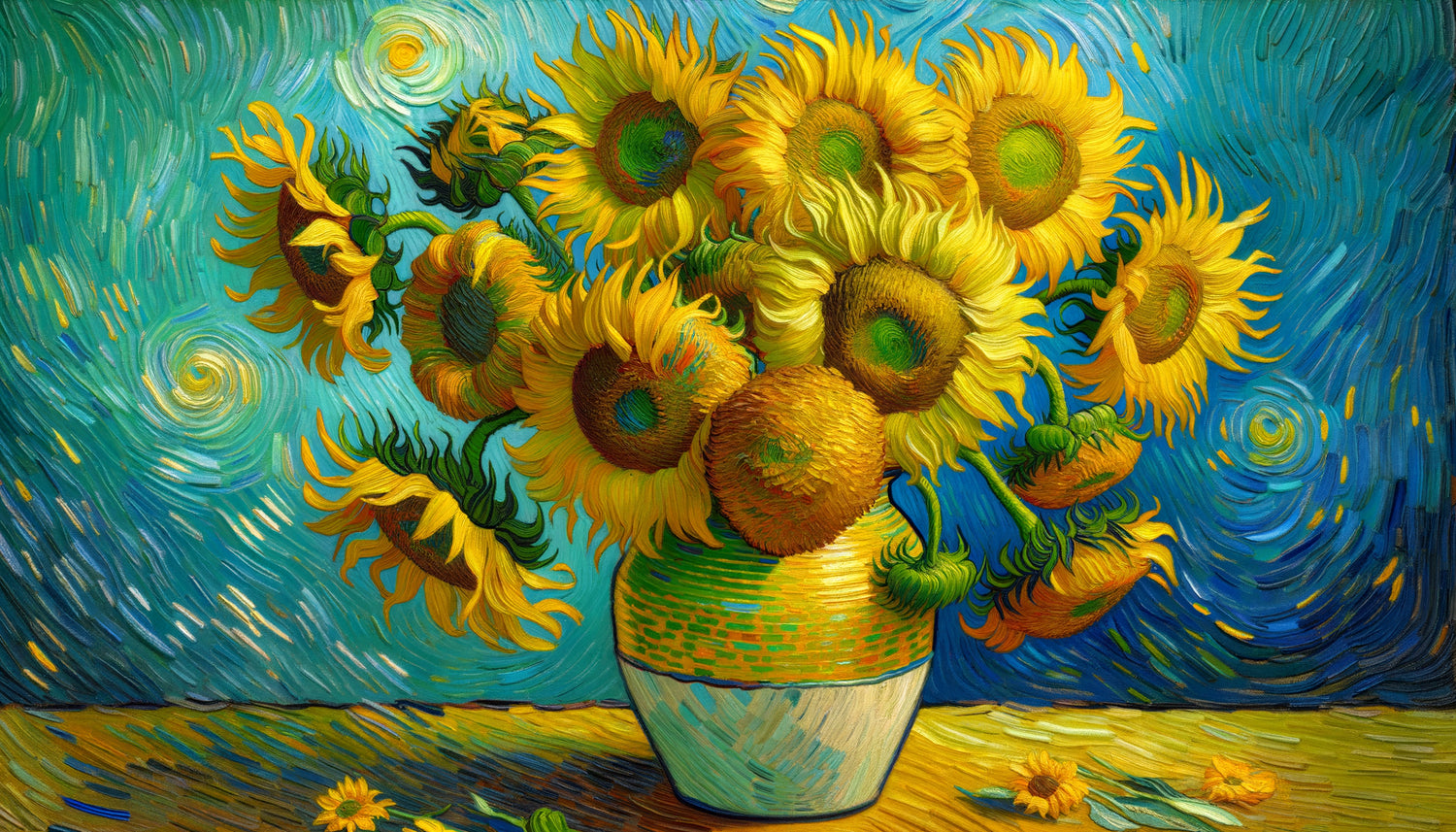
A few weeks ago, during a consultation with a Parisian couple of collectors, I noticed a striking detail: in their sleek, contemporary living room, there was a reproduction of Van Gogh's Sunflowers. Not an original, obviously, but a modern interpretation that dialogued beautifully with their Scandinavian furniture. When I asked them why this choice, their answer was immediate: “Because these flowers bring an energy that nothing else can replace.”
Here’s what Van Gogh's Sunflowers bring to your decor: a universal emotional power that transcends eras, a color palette capable of illuminating any space, and an eternal symbolism that resonates with our contemporary quest for authenticity. Are you perhaps looking to infuse warmth into your interior without falling into cliché? Are you hesitating between classic art and modern aesthetics? This tension is legitimate. But understanding why this work crosses decades without aging will give you the keys to integrate it properly. I'm going to reveal the secrets of this decorative domination that fascinates both designers and individuals.
The alchemy of yellows: when Van Gogh reinvents the color spectrum
Vincent van Gogh didn't simply paint sunflowers. He orchestrated a symphony of yellows that no one before him had dared to compose with such boldness. Between 1888 and 1889, in Arles, he created his legendary series exploring all possible nuances: from bright lemon yellow to deep ochre yellow, from luminous gold to amber brown.
This revolutionary color exploration explains why Sunflowers work in practically every modern interior. Yellow has this unique ability to act as a natural light amplifier. In a north-facing living room lacking brightness, a reproduction of Sunflowers instantly creates a warm focal point. In a contemporary kitchen with neutral tones, it brings that touch of optimism without being overwhelming.
I've observed that the tonal variations present in the original work allow for endless decorative combinations. Warm shades dialogue with natural wood, brushed brass, mustard velvet. Darker touches anchor the composition and avoid the “too sweet” effect that some fear with yellow.
The science behind emotion
Neuroscience confirms what Van Gogh intuitively sensed: yellow stimulates the production of serotonin, the hormone of well-being. Placing Sunflowers in a living space is literally injecting a daily dose of positive energy. This psychological dimension explains their recurring presence in creative workspaces, therapeutic offices, and high-end hotels seeking to create a welcoming atmosphere.
The impasto texture: when painting becomes sculpture
What fundamentally distinguishes Van Gogh’s Sunflowers from a simple floral still life is their brutal materiality. Van Gogh applied paint in thick layers, sometimes directly from the tube, creating an almost sculptural relief. This impasto technique gives the sunflowers a fascinating three-dimensional presence.
In contemporary decor obsessed with textures and material games, this characteristic makes perfect sense. Quality reproductions, especially canvas prints with texture gel or reinterpretations in oil paint, recreate this tactile dimension. I’ve noticed that in a minimalist interior with smooth and clean surfaces, this texture provides a valuable sensory contrast.
The shadow cast by the reliefs changes depending on the ambient lighting. In the morning light, the sunflowers reveal their generous volumes. In the evening, with indirect lighting, they become more mysterious, almost melancholic. This ability to evolve with the light transforms the work into a living element of your decor.

Why these faded flowers move us more than the fresh ones
Here's a fascinating paradox: Van Gogh doesn’t paint sunflowers in their radiant splendor, but often at different stages of wilting. Some petals fall, stems droop, hearts become heavy. And yet, it is precisely this imperfection that seduces our era.
We live in an age saturated with retouched images and artificial perfection. The Sunflowers offer a refreshing counterpoint: beauty in vulnerability, nobility in decline. This philosophy resonates deeply with current trends of wabi-sabi and the acceptance of imperfection as an aesthetic value.
In a raw-material industrial loft, this melancholic dimension of sunflowers creates an emotional harmony. In a cocooning bedroom, it invites peaceful contemplation. The work doesn't shout its presence; it whispers it intensely.
The cycle of life as a decorative motif
Van Gogh’s Sunflowers tell the passage of time, a universal theme that crosses all cultures. This silent narrative transforms a simple decorative element into a visual meditation. That's why I often recommend this work for spaces dedicated to reflection: personal libraries, reading corners, creative workshops.
Stylistic versatility: from industrial lofts to bohemian interiors
One of the main reasons for the dominance of Sunflowers in modern decoration is their stylistic chameleon. I have placed reproductions of this work in radically different contexts, and each time, it has adapted with disconcerting ease.
In an industrial interior with exposed brick walls and metal structures, Sunflowers bring the essential organic touch. The contrast between architectural harshness and pictorial sensitivity creates a captivating visual tension. The warm palette compensates for the potential coldness of concrete and steel.
In a minimalist Scandinavian decor, the work becomes the colorful focal point that breaks neutrality without betraying it. The yellows harmonize naturally with blond wood, while the green touches dialogue with the omnipresent indoor plants in this style.
For a maximalist bohemian interior, Sunflowers integrate into an eclectic wall composition. Their iconic status allows them to coexist with other works without losing their presence. They visually anchor bolder arrangements.
Even in ultra-contemporary spaces with strict geometric lines, sunflowers work. Their composition, despite its spontaneous appearance, rests on a balanced structure that Van Gogh mastered perfectly. This underlying rigor resonates with modern aesthetics.

The Vincent effect: how a personal story amplifies the decorative impact
It’s impossible to look at Sunflowers without summoning, consciously or not, the tragic figure of Vincent van Gogh. This narrative dimension transforms the work into an incomparable conversation starter. In a living room, it generates discussions that go far beyond simple aesthetic appreciation.
Van Gogh painted these sunflowers to decorate the room of his friend Paul Gauguin in Arles, hoping to create an idealized artists' studio. This quest for friendship and creative community, tragically aborted, adds a powerful emotional layer. Your guests don’t just see flowers: they perceive hope, solitude, creative passion.
This symbolic charge allows the Sunflowers to transcend their decorative function to become a true identity marker. Choosing this work is asserting a particular sensitivity: an appreciation for authentic beauty, the valuing of emotion over technical perfection, adherence to a form of lucid romanticism.
The myth at the service of interior design
I’ve noticed that owners of Sunflowers reproductions often develop an almost affectionate relationship with the work. It becomes a daily companion whose presence reassures and inspires. This psychological dimension, rare with other decorative motifs, justifies investing in a quality reproduction rather than a simple poster.
How to integrate Sunflowers without falling into museum cliché
The popularity of Van Gogh’s Sunflowers also represents a challenge: how to adopt them without your interior resembling a museum shop? Here are the strategies I have developed over the years.
Play with scale. Instead of a standard format reproduction, opt for a monumental format that asserts its presence, or conversely, for an intimate version in a small antique gilded frame. This change of scale desacralizes the work while respecting its integrity.
Dare to enlarge the detail. Some publishers offer zooms on sections of Sunflowers: an isolated floral button, a portion of vase, a few petals. This fragmentary approach creates a modern dialogue with the original while asserting an assumed decorative approach.
Mix eras. Place the Sunflowers in a decidedly contemporary frame: plexiglass, brushed metal, deep American box. This temporal contrast between the 19th-century work and its 21st-century setting creates a stimulating visual tension.
Create a chromatic dialogue. Don’t leave the sunflowers alone. Build around them a coherent decorative palette: cushions in the same yellows, earthenware in ocher tones, textiles echoing the greens. The work then becomes the starting point of a broader color narrative.
Embrace the confrontation. Pair Sunflowers with decidedly contemporary elements: neon lights, iconic designer furniture, urban art. This bold coexistence affirms that Van Gogh belongs as much to our time as he did to his.
Transform your space with the timeless power of the great masters
Discover our exclusive collection of tableaux inspirés d'artistes célèbres that bring emotion and character to your modern decor.
Beyond fashion: lasting inscription
Van Gogh’s Sunflowers do not dominate modern decoration by accident or simple trend. Their persistent presence for over a century testifies to a deep resonance with something essential in the human experience.
In our era of visual over-information and permanent renewal of trends, these sunflowers offer a reassuring anchor. They represent the permanence of authentic beauty facing the ephemeral. Choosing this work is refusing the tyranny of the latest trend to affirm a lasting value.
Imagine your living room in ten years. The textiles will have changed, perhaps the sofa too. But the Sunflowers will still be there, as relevant, as moving. This timelessness represents, paradoxically, the ultimate luxury in a society obsessed with novelty.
Start by defining the space that would most benefit from this solar energy. Observe natural light at different times of the day. Then choose your version of Sunflowers: faithful reproduction or contemporary interpretation. The essential thing is that you feel, every day, this particular connection that Van Gogh infused into each brushstroke. The Sunflowers are not waiting in a museum. They await to transform your daily life.
FAQ: Your questions about Van Gogh’s Sunflowers in decoration
Are Van Gogh’s Sunflowers not too seen to be original in my decoration?
This is a legitimate concern, but let's look at it differently. The popularity of Sunflowers doesn't stem from a fleeting trend, but from an aesthetic and emotional relevance that transcends generations. Their recurring presence testifies to their ability to touch something universal. Originality isn't about the obscurity of the chosen motif, but about how you integrate it into your personal world. By playing with format, framing, association with other elements, or choosing a contemporary interpretation rather than a classic reproduction, you create a unique version of Sunflowers that reflects your sensitivity. Many « original » decorations quickly become tiresome, while Sunflowers continue to reveal new nuances over time. It is this depth that justifies their iconic status.
Does the yellow of Sunflowers risk aging badly or becoming tiresome quickly?
Yellow suffers from an unfair reputation in decoration, often perceived as a difficult or ephemeral color. But the yellow of Van Gogh's Sunflowers isn't a loud or one-dimensional yellow. It’s a symphony of nuances ranging from deep gold to bright lemon, with touches of ochre, brown and even green. This tonal complexity allows for remarkable visual longevity. Unlike trendy colors that quickly date, the yellow of Sunflowers possesses a timelessness proven by over a century of enthusiastic reception. Moreover, this color has beneficial psychological properties: it stimulates creativity, promotes optimism and amplifies natural brightness. Even in periods of your life when you might be tempted by darker palettes, the warm presence of Sunflowers will act as a welcome counterpoint. If you still have doubts, test a reproduction in the intended space for a few weeks before making a final purchase.
How to choose between a faithful reproduction and a modern interpretation of Sunflowers?
This question reveals your sensitivity to respecting the original artwork, which is excellent. The choice depends on your decorative intention and your relationship with art. A faithful reproduction is perfect if you want to celebrate Van Gogh's work in its integrity, create an immediately recognizable focal point, and benefit from all the emotional weight associated with the original. Opt for high-quality canvas prints with UV treatment and, if possible, impasto texture reproduction. A modern interpretation (cropping, modified palette, contemporary graphic style) is essential if your interior is resolutely modern and you want to create a dialogue between eras rather than a direct tribute. This approach also helps avoid the « museum reproduction » effect. In both cases, quality of execution is paramount. A poor faithful reproduction will always be less satisfying than a beautiful modern interpretation. If possible, visit the works in person, observe the details, then choose the format that resonates most with your personal vision. Sunflowers are rich enough to support multiple readings.