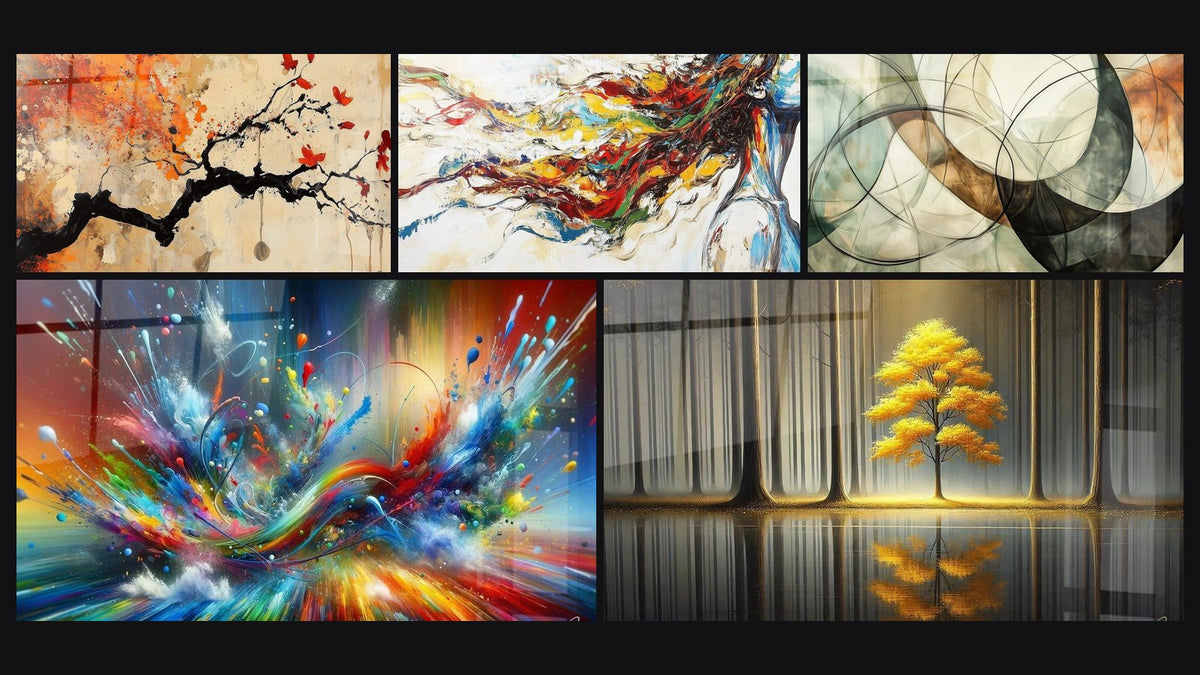
Create a visual sanctuary in a bedroom or office
October 11, 2025 · 18 min read · by Walensky
Coming home after a long day, you push open the door to your bedroom or office... and instead of feeling that longed-for sense of calm, you feel even more tense. The space feels cold, impersonal, almost hostile.
Bare walls reflect this sense of emptiness back at you, harsh lighting assaults you, and even your favorite furniture seems to have lost its charm. You may have invested in beautiful furniture, carefully chosen your colors... something is wrong, and you don't know what.
You may have tried adding a few decorative objects here and there, changed the lighting, rearranged the space. But nothing works: the protective atmosphere you are looking for remains elusive, as if your interior rejects you instead of welcoming you.
Rest assured, this is not a matter of taste or budget. The real reason? You have decorated your space, but you haven't created a visual cocoon - that sensory bubble which transforms any room into an emotional refuge.
By the end of this article, you will know exactly how to transform your bedroom or office into a true visual sanctuary, where every glance at the walls will bring you an immediate feeling of well-being and security.
Why does your space exhaust you instead of replenishing you?
Our brain processes over 11 million visual information pieces per second. In a poorly designed environment, this overload becomes exhausting. It's like trying to rest in a train station: impossible to disconnect when everything around us stimulates our nervous system chaotically.
🏠 Customer testimonial : "I had transformed my office into the perfect Pinterest showroom. Everything was matching, tidy, impeccable. Yet I spent as little time there as possible. One day, my sister said to me: 'Your office is beautiful, but it doesn't look like it belongs to you.' She hit the nail on the head: I had created a decor, not a cocoon."
Conversation with a decorating expert
The rule of the protective cocoon: A space only becomes restorative when it tells your personal story through visual elements that resonate with your emotions. Observable result: you feel an immediate sense of calm upon entering the room, from the first week.

What's really stopping you from creating your visual sanctuary
Do you recognize yourself in these situations? Do you avoid your office on weekends, have difficulty falling asleep in your bedroom, or do you feel a strange melancholy when you look at your walls. These signals reveal that your environment is working against you instead of supporting you.
What's really happening? Your brain is constantly looking for emotional anchors in your environment. Without them, it remains in a permanent "alert" mode. The problem isn't your sensitivity; it's the lack of emotional connection in your decor.
It’s like trying to feel at home in a hotel room: technically, everything is there for comfort, but that personal dimension is missing that transforms a space into a sanctuary.
First hidden cause: The dictatorship of "neutral"
You were probably advised to choose neutral tones so as "not to get tired". Result? Your space looks like an Ikea catalog: functional but soulless. The truth is: neutral colors don't create a cocoon, they create indifference.
Imagine your relationship with your space as a friendship. Neutral tones are like a polite but distant friend: reassuring at first, but never emotionally nourishing you. Your cocoon needs personality to recharge you.
The impact? You feel a dull fatigue in your own space, a constant desire to "change something" without knowing what. Understanding this will revolutionize your approach: your cocoon should move you, not just please you.
🎨 Quick test: Look at your room and ask yourself: "If I had to describe the dominant emotion of this space to a friend, what would I say?" If you struggle to answer or the answer is "nothing special", your cocoon still needs to be created.
Many create spaces that are “Instagram-ready” by following trends rather than their instincts. They choose artworks because they are “of the moment” or “tasteful”, not because they touch them personally.
It’s like wearing beautiful clothes that don't suit you: the effect is pretty in photos, but you never feel truly yourself in them. Your visual sanctuary follows the same principle.
Consequence? You have a beautiful space that you proudly show to your guests, but in which you never find that deep feeling of "home" that you are looking for. The solution starts by listening to your true tastes, not trends.
The trap of immediate perfection
You probably want to create your perfect cozy space in one go, like in magazines. Mistake! A true cozy space is built gradually; it evolves with you and your artistic discoveries. Wanting to buy everything at once creates a "frozen" decoration.
Imagine your cozy space as a collection of visual memories: each addition should have its own story, its moment of revelation. When you accumulate these authentic "favorites," the magic will happen naturally.
The effect? Your space retains a living and personal dimension that grows with you, instead of becoming a museum of your old tastes. This patient approach transforms decoration into constant pleasure rather than an occasional chore.
3 signs that your space lacks coziness:
- The "something is missing" syndrome: You constantly add elements without ever reaching satisfaction - a sign that the basic emotion is not defined
- Unconscious avoidance: You prefer common areas to your own bedroom/office - your brain is fleeing an environment that doesn't nourish it
- Photogenicity without well-being: Your space is pretty in photos but does not provide you with any particular sensation on a daily basis - the sensory dimension of coziness is missing
The trigger element: Emotional coherence
What really makes the difference is the emotional coherence of your artistic choices. Like a perfume that reveals its notes throughout the day, your cozy space should tell an emotional story that unfolds with every glance. Look for this "emotional signature" in each work you choose: soothing, creative energy, gentle nostalgia...
The instant feeling rule: A work belongs to your cozy space if it provokes a positive emotional reaction within the first 3 seconds of contemplation. Always test this "visual crush" before any aesthetic criterion.
| ❌ Classic decoration | ✅ Visual cozy space | 💡 Explanation | 🎯 Practical benefit |
|---|---|---|---|
| "This color goes with my furniture" | "This work makes me feel serenity" | Emotion takes precedence over technical harmony | Immediate soothing upon entering the room |
| "It's trendy and modern" | "It reminds me of a happy moment" | Personal connection creates lasting attachment | Renewed pleasure with every glance |
| "All the paintings are matching" | "Each work tells a facet of me" | Unified diversity enriches the experience | Positive stimulation without saturation |
| "You have to stay restrained" | "You have to create an atmosphere" | Well-dosed emotional intensity restores | Creative energy and rest according to zones |

The 3-step method to create your protective cozy space
Rassurez-vous : creating a visual sanctuary doesn't require an astronomical budget or interior design expertise. It’s like learning to cook: a few basic principles, quality ingredients, and lots of passion. Here's your progression: first identify your "emotional signature," then create your initial visual anchors, finally develop the overall atmosphere that reflects you.
🗺️ Overview of your transformation : Step 1 - Discovering your visual identity (immediate feeling of “home”), Step 2 - Structuring your emotional zones (each corner has its soothing function), Step 3 - Refining your personal sanctuary (perfect harmony with your lifestyle).
Step 1: Revealing Your Emotional Signature
Starting with this step avoids months of costly trial and error. It’s like taking an imprint of your personality before building: everything that follows will be naturally in harmony with who you are. Once this foundation is laid, you'll already feel a difference in your relationship with space.
What You Need for This Exploration
- A notebook and colored sticky notes: To capture your "emotional moments" when viewing visuals - keep them close at hand for a week and note each time an image touches you (magazine, internet, street). Avoid mobile apps that scatter attention: handwriting anchors emotion better.
- A camera (even smartphone): To immortalize your spontaneous "decor crushes" - photograph everything that makes you say “I’d love to have that at home”. The accumulation of these images will reveal your unconscious emotional patterns.
- 30 minutes of calm per day for 5 days: To analyze your emotions without judgment - this time of introspection is your most valuable investment in creating a sanctuary that truly reflects you.
Now, let's get practical:
Concrete Actions to Discover Your Signature
Create your "visual emotion journal": For 5 days, note each image that evokes a positive emotion in you - even 2 seconds is enough. Describe the emotion felt in 3 words maximum ("calm-nostalgic-soft" or “energetic-joyful-free”). This collection reveals your deep emotional needs.
⏱️ Time: 5 minutes/day for 5 days | ✅ Success when: You have 15-20 emotions noted and see patterns repeating | ⚠️ Attention: Don't censor anything, even tastes that seem "strange" to you - they often reveal your true personality
Identify Your 3 Dominant Emotions: Analyze your journal to spot the emotions that come up most often. Group similar words ("calm/serenity/peace" = family "soothing”). These 3 families of emotions form your personal signature and will guide all your future decor choices.
⏱️ Time: 20 minutes of analysis | ✅ Successful when: You can say "I am primarily looking for X, Y and Z in my environment" | ⚠️ Attention: Avoid choosing what "looks good" - your signature must genuinely move you
Test your signature in your current space: Observe your bedroom/office and identify which elements already correspond to your 3 dominant emotions. Also note what contradicts them. This "emotional mapping" of the existing shows you exactly what to keep, move or replace.
⏱️ Time: 15 minutes of careful observation | ✅ Successful when: You have a "yes/no/to see" list for each object in the room | ⚠️ Attention: Don't rush to change everything - this step is about understanding, not acting
✨ Validation of Step 1: You must be able to complete this sentence: "My ideal cocoon makes me feel [emotion 1], [emotion 2] and [emotion 3], and I now know why my current space does not satisfy me." If it's blurry, reread your journal more carefully - your signature is necessarily hidden there.
— Our selection


OUR RECOMMENDED PRODUCTS
Step 2: Structuring your resource zones
Now that you know your emotional signature, we are going to create "well-being islands" in your space. Each zone will have its specific function: relaxation, creativity, introspection... It's more powerful than a global decorative effect because your brain will associate each corner with a precise emotion, creating tailor-made refuges according to your needs at the moment.
Your tools for this structuring
- 3 to 5 different wall artworks: Choose varied formats and styles that correspond to each of your dominant emotions - avoid "matching series" which create monotony. Prioritize diversity unified by your feeling rather than visual uniformity.
- A modular hanging system: Rails, repositionable hooks or magnetic system to test several configurations - your cocoon will evolve with you, so plan for flexibility from the start. Adaptability is the key to a living cocoon.
- An additional lighting: Ambient lamps, garlands or spotlights to create different atmospheres depending on the moment - lighting reveals or hides your artworks according to your emotional needs of the day.
Creation of your emotional zones
Define your well-being territories: Identify 3 zones in your room according to your main activities (rest, work, reflection...). Associate each zone with one of your dominant emotions discovered in step 1. Materialize these zones mentally by standing in each and imagining the desired emotion.
⏱️ Time : 30 minutes of reflection in the space | ✅ Successful when : You can say "This area is for X emotion, this one for Y" | ⚠️ Attention : An area can be small (an armchair + wall) - the important thing is emotional delimitation, not geographical
Select the anchor artwork of each zone : Choose a masterpiece for each of your emotional zones. This work must perfectly embody the desired emotion and serve as a "trigger" to the desired state. Test it by looking at it: do you immediately feel the desired emotion?
⏱️ Time : 1 hour of careful selection | ✅ Successful when : Each artwork evokes a clear feeling within 5 seconds | ⚠️ Attention : Prefer authentic emotion to aesthetics - your cocoon is nourished by feelings, not conceptual beauty
Install and test your first anchors : Hang your main artworks and live with them for a minimum of 48 hours. Observe whether you naturally gravitate towards these zones at the corresponding times (fatigue → rest zone, need to create → energy zone...). Your spontaneous behavior will validate or not the placement.
⏱️ Time : 2 days of natural observation | ✅ Successful when : You instinctively use each zone according to its intention | ⚠️ Attention : If a zone doesn't "work", it's the location or the artwork that needs to be adjusted, not your feelings
Step 3 : Refine your personal ecosystemYou now master the art of the functional cocoon. This final step transforms your space into a true personal sanctuary where every detail works for your well-being. Here, we create nuances, subtle connections between zones, and this overall harmony that makes you feel "at home" as soon as you cross the threshold.
Your tools for improvement
- Smaller complementary artworks : To create "visual bridges" between your main zones - A5 to A4 formats, which dialogue with your masterpieces without competing with them. These details create the narrative fluidity of your cocoon. Varied textural elements : Canvases, prints on wood, metal, or paper to enrich the sensory experience - your eye needs tactile diversity even in visual contemplation. This richness nourishes attention without tiring it. An ambiance tracking notebook : To note the evolution of your feelings over the weeks - your perfect cocoon emerges through successive adjustments, and this notebook captures the important nuances that memory would forget.
Refinement of your overall harmony
Create transitions between zones : Add visual elements that link your different emotional zones - a recurring color, a common artistic style, or a theme that runs from one zone to another. These "connecting threads" unify your cocoon without making it uniform.
⏱️ Time: 45 minutes analyzing possible connections | ✅ Successful when: The eye naturally travels from one area to another without disruption | ⚠️ Attention: Transitions must be subtle - too obvious, they create redundancy
Adjust emotional intensity: Observe your energy in each zone at different times: morning, afternoon, evening. Adjust the impact of your artworks according to these natural variations (lighting, addition/removal of secondary elements). Your cocoon must adapt to your biological rhythms.
⏱️ Time: 1 week of conscious observation | ✅ Successful when: Each zone naturally supports you depending on the time of day | ⚠️ Attention: Adjustments should remain simple - complicating breaks the spontaneity of the cocoon
Create your reconnection ritual: Establish a daily visual path in your cocoon - 30 seconds to 2 minutes where you "greet" consciously each zone and its emotion. This ritual anchors the protective dimension of your space and makes it a true psychological refuge.
⏱️ Time: Maximum 2 minutes per day, at a fixed time | ✅ Successful when: This moment becomes an automatic pleasure, not a constraint | ⚠️ Attention: The ritual should remain light - too much solemnity kills spontaneity
The rule of gentle evolution: Your perfect cocoon must not be frozen. Change one secondary element every 2-3 months to maintain positive stimulation, but keep your main emotional anchors. The balance between stability and renewal nourishes your long-term attachment.
Congratulations! You now master the subtle art of the visual cocoon. But a few secrets from professionals can transform your success into true expertise. These details make the difference between a pleasant space and an extraordinary refuge.
🎨 Expert secret - The "peripheral gaze" technique: Place small, intriguing visual elements slightly outside your direct field of vision in each zone. Your brain picks them up unconsciously and constantly enriches your experience without ever saturating it. Example: a small artwork on the side of your desk, visible only when you turn your head slightly.
Frequent question from our readers
"I find my tastes too eclectic... How can I create a coherent cocoon when I like everything and its opposite?"
Your eclecticism is an asset, not a problem! Many creative people feel this "dispersion" of tastes. The solution? Don't seek coherence in style, but in emotion. Your eclectic favorites certainly have a common emotional point - perhaps you are always looking for "authenticity" or "originality" in different forms? Identify this common emotion and it will naturally unify your most varied choices.
💡 Quick action: Gather 10 images of your most disparate favorites and look for the common emotion they evoke in you. This "hidden emotional signature" will be the guiding thread of your eclectic cocoon.
— You may also like


The 5 mistakes that sabotage your cocoon (and how to avoid them)
Warning! Some mistakes can undo weeks of effort and make you doubt your abilities. I prefer to tell you about them now to avoid these common but perfectly avoidable frustrations.
- 🚫 Trying to reproduce a cocoon seen elsewhere: It's tempting to copy an atmosphere that has seduced us from someone else or on Instagram. Problem: you are creating the cocoon of someone else, not yours. Result: a pretty decor in which you never really feel at home. Solution: be inspired by the emotion of this cocoon, not its visual form. 🚫 Changing everything at once out of impatience: Enthusiasm often leads to revolutionizing everything in a weekend. Mistake! Your brain needs time to get used to new elements. A sudden change can create a feeling of strangeness. Proceed zone by zone, allowing 2-3 weeks of adaptation between each transformation. 🚫 Underestimating the importance of lighting: Many focus on artworks forgetting that it is the light that reveals their emotions. An appeasing artwork under an aggressive neon loses all its power. Test your atmospheres at different times of the day and adjust the lighting accordingly. 🚫 Ignoring hanging height: Hanging too high breaks the intimate connection with the artwork, hanging too low oppresses the space. The rule: the center of the artwork at eye level standing (1m60-1m65 for most people). Adjust according to your usual point of view in each zone. 🚫 Neglecting the evolution of tastes: Your perfect cocoon today can tire you in 6 months if you do not plan its evolution. Keep 20% of your cocoon "modular" - elements that you can easily change according to your new discoveries or seasonal moods.
🛡️ Quick verification system: Each week, do this check: "Am I looking forward to entering this room? Does my gaze naturally settle on my artworks? Do I feel more relaxed than before?" If an answer is no, it's time for an adjustment. Warning signs: avoiding the room, compulsive urge to "change something", or impression that the space belongs to someone else.
Special readers offer
Because you took the time to inform yourself, enjoy 10% discount on your first order:
⏰ Valid 72h after reading • Applicable to all our products— In the same vein


Essential questions to succeed your cocoon
Allow for 150-400€ for an effective cocoon depending on the size of your room. The trick: start with 2-3 impactful artworks (80-150€ each) rather than 10 small decorations. A successful cocoon always prioritizes emotional quality over the number of elements. Concrete example: it's better to have a beautiful 60x80cm canvas that moves you than a gallery of 8 neutral small images.
The soothing begins with the first well-placed artwork (2-3 days of adaptation), but the complete cocoon effect develops in 3-4 weeks. Your brain needs this time to create new emotional automatisms. Be patient! Note your sensations each week: the progress is often more visible retrospectively than daily.
Absolutely! In 15m², a single well-chosen artwork can delineate 2-3 atmospheres depending on the viewing angle. Use the "micro-zone" technique: your desk (focus zone), your bed (rest zone), your armchair (relaxation zone). Even in a studio, these emotional territories work perfectly with the right wall art.
Test the "30 looks rule": look at the artwork for 30 seconds each day for a week. If it continues to move you or intrigue your gaze, that's a good sign. Works that bore us quickly show their limits. Another clue: do you spontaneously think of the artwork when you are not at home? It is part of your emotional universe.
Perfectly! Use non-drilling fixing systems: 3M adhesive rails, magnetic hooks on radiators, or supports to be placed on furniture. The cocoon effect does not depend on the permanence of the installation but on the emotional coherence of your choices. Some tenants create more successful cocoons than landlords!
Your new life in your personal cocoon
Imagine yourself in a month: you open the door to your bedroom or office, and instantly your shoulders relax. Your eyes naturally settle on your artworks, and each of them sends you that familiar feeling of "home". Your daily stress gradually evaporates, replaced by the deep tranquility that a true personal refuge provides.
More than just a decorative change, you have developed a new skill: creating atmospheres that nourish you emotionally. This ability will transform your relationship with all your living spaces and give you unprecedented confidence in your aesthetic choices. Your loved ones will notice this new serenity emanating from you.
The most beautiful? Now that you understand the mechanism of the visual cocoon, creating yours becomes a pleasure of exploration rather than a chore of decoration. Your first artwork awaits you - it will transform your space into a refuge. Start today by identifying your dominant emotion : this is the first step towards your new home.
✨ Your cocoon awaits you: You have all the tools to create a space that truly resembles you. Trust your emotions, they know better than any decorating rules what will do you good. In a few weeks, you won't be able to imagine living without your protective cocoon.
Also read: 🌿 Read more articles on domestic art therapy
</div
Explore our collections