

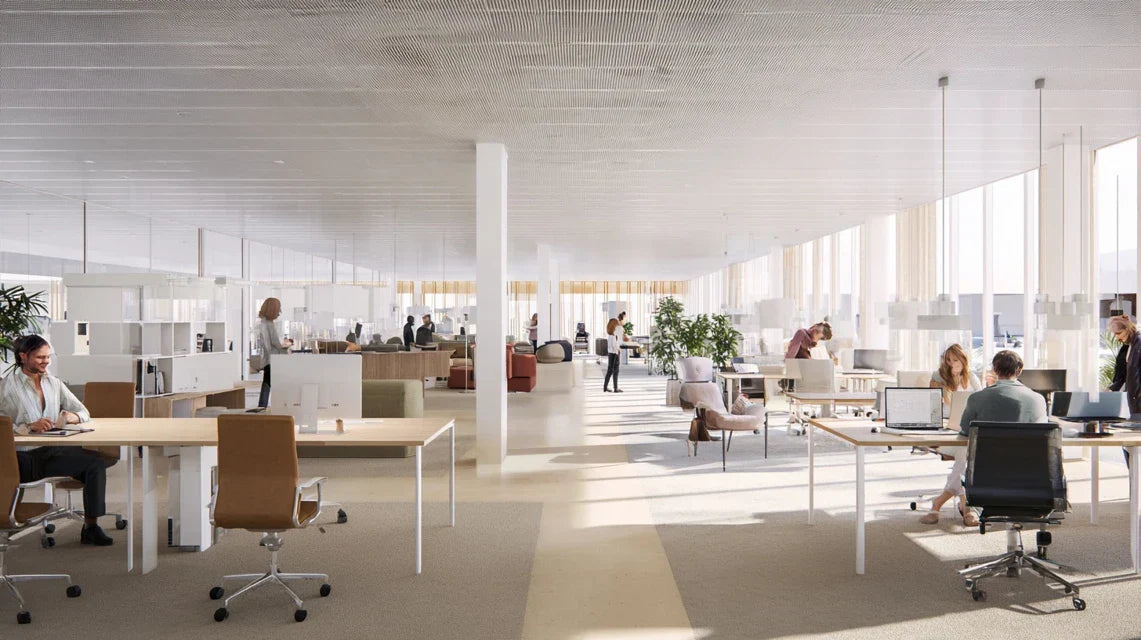
The neon lights crackle above your heads, the gray partitions seem to absorb all traces of creativity, and you feel an unpleasant impression of evolving in an environment that stifles your energy rather than nourishes it.
You may have already tried to brighten up the space with a few plants or personal photos, but the result remains disappointing. Every decoration proposal sparks endless debates between colleagues, and you end up giving up, resigned to enduring this gloomy atmosphere.
This is perfectly normal: decorating a collective space without creating controversy is a real diplomatic challenge. The problem isn't your lack of taste, but the absence of a methodical approach to choosing works that everyone likes.
By the end of this article, you will know exactly how to select artwork for open spaces that will transform your work environment into an inspiring place, without generating the slightest aesthetic conflict.
Why is wall art in open-space so crucial today?
In a context where well-being at work directly influences productivity, ignoring the visual impact of your environment would be like neglecting a major performance lever. Imagine a restaurant with bare walls: even with the best cuisine in the world, the experience would remain incomplete and you would leave with a feeling of emptiness. Every day spent in a collective workspace lacking soul represents a missed opportunity to stimulate creativity and engagement for your teams.
🏢 Revealing case study: The Pixel & Co communication agency transformed its 200m² open space by installing five abstract paintings in soothing tones. Result: 23% improvement in well-being felt by employees according to their internal survey, and a noticeable decrease in stress-related sick leave.
💬 Conversation with a decor expert
The golden rule of visual harmony: An open space ambiance artwork acts like a silent conductor that unifies the space without imposing its presence. You will observe an improvement in the atmosphere from the first week of installation.
Understanding what lies behind taste conflicts
Do you recognize yourself in these situations? Your right-hand colleague loves colorful contemporary art, the one on the left only swears by soothing landscapes, and the HR manager prefers motivational quotes in typography. Result: each artistic proposal triggers an endless debate that ends up tiring everyone.
This aesthetic chaos is not a matter of chance or a lack of collective taste. It simply reveals the absence of a common framework for evaluating what works in a collective workspace.
Like a puzzle where each person would try to place their piece without seeing the final picture.
Understanding these psychological mechanisms will allow you to move beyond personal preferences to create a consensus around artworks that speak to collective intelligence rather than individual tastes.
First hidden cause: confusion between personal taste and collective harmony
Contrary to popular belief, an open space artwork does not have to please everyone, but simply not bother anyone.
The nuance is fundamental and completely changes your selection approach.
It's like choosing the background music for an elevator: the goal isn't to make passengers dance, but to create a neutral and pleasant atmosphere that facilitates interactions.
This revelation will transform your view of collective workspace wall art: instead of looking for unanimous favorites (impossible), you will aim for silent acceptance that allows everyone to project their own positive emotions.
🧪 Immediate verification test: Look at the current artworks in your space. If someone can precisely describe its style ("it's street art", "it's very zen"), it is probably too marked for an open-space. The ideal? "It’s beautiful, it makes me feel good."
Motivating quotes and images directly related to business ("Success", skyscrapers, handshakes) create a subconscious pressure that hinders the mental relaxation necessary for creativity. A tired salesperson doesn't need a painting reminding them of their goals.
Spot this phenomenon by observing whether people avoid certain areas of the open-space: often, they subconsciously flee spaces overloaded with "corporate" messages.
This over-motivation visually generates cognitive fatigue which translates into a decrease in concentration and increased irritability at the end of the day.
🎯 The 3 alarm signals to watch out for:
- Spatial avoidance: Some areas remain deserted despite their functionality - a sign of unconscious visual discomfort
- Recurring comments: Visitors consistently make remarks about the decor - proof that it attracts too much attention
- Visual fatigue: Feeling of exhaustion faster than elsewhere - symptom of excessive stimulation
The trigger factor: emotional balance
What really makes the difference is the ability of a work to generate what psychologists call "flow state" - that feeling of harmony where the mind can focus effortlessly. It's the domino effect of successful decoration: a single well-chosen element soothes the entire space. You will recognize this balance when people spontaneously stop mentioning the decor to focus on their exchanges and their work.
The 7-second rule: A successful office wall art ambiance must produce a positive first impression in less than 7 seconds, then fade away to make room for human activity. Test by timing your own reactions.
| ❌ Personal approach | ✅ Collective approach | 💡 Explanation | 🎯 Practical benefit |
|---|---|---|---|
| "I love this modern style!" | "It creates a soothing atmosphere" | Emotion is prioritized over style | Natural adhesion of all |
| "There needs to be color everywhere" | "A few touches are enough" | The brain needs visual rest | Better concentration |
| "A motivational message will do good" | "Abstract art releases the imagination" | Avoids psychological pressure | Creativity stimulated naturally |
| "Everyone should recognize their tastes" | "No one should be embarrassed" | Consensus through benevolent neutrality | Team harmony preserved |
The 3-step method to create the perfect visual harmony
Rest assured: transforming your open space into an inspiring place doesn’t require a pharaonic budget or pointed artistic expertise. This progressive method is like building a house: solid foundations, then the layout, and finally the finishing touches that make all the difference. At each stage, you will notice a tangible improvement in the atmosphere, until you achieve that perfect balance where productivity and well-being reinforce each other.
🎯 Overview of the transformation: Step 1 - Audit and preparation (solid foundations), Step 2 - Strategic selection (harmonious structure), Step 3 - Installation and optimization (perfect finishing touches). At each level, your space gains personality while preserving its professional functionality.
Step 1: Assessment of existing conditions and site preparation
Starting with this analysis avoids costly mistakes and allows you to build on solid foundations. Like an architect who studies the terrain before drawing up plans, this diagnostic phase reveals the specific constraints and opportunities for your space. Once this step is complete, you will already feel a new clarity about possible directions and the satisfaction of having a structured vision of your project.
🛠️ Necessary analysis tools
- Visual notes notebook: A simple A5 notebook with blank pages for sketching key areas and noting observations. It serves to map traffic flows and identify natural eye-catching points. Avoid lined notebooks that restrict your creativity. Quality is recognized by paper thick enough to support felt-tip pens without smudging. The digital alternative lacks spontaneity for this creative phase.
- Colorimetric measurement application: A free smartphone tool like "Color Grab" that analyzes the dominant colors of your space. The principle: point the camera at an area to obtain precise color codes. Look for an app that displays HSB (hue, saturation, brightness) values as they are more intuitive than hexadecimal codes. Impact on the final result? Professional chromatic harmony impossible to achieve "by eye".
- Professional measuring tape: A measuring tape of at least 2 meters long, rigid and precise for measuring hanging heights and wall proportions. It allows you to calculate the ideal dimensions of artworks according to the rule of thirds (the artwork should occupy 2/3 of the available width). This technical precision brings legitimacy to your aesthetic choices.
Now, let's move on to practice with a proven method.
🔍 Conducting the visual audit
Human Flow Mapping: Observe natural movement patterns within the space for a full week, noting areas of slowdown, stopping points, and avoidance. This analysis reveals strategic locations where an open plan office wall art will have maximum psychological impact. Mark stress zones (near printers, doors) with red dots and natural relaxation zones with green dots. This "human heat mapping" technique guides your future placement choices.
⏱️ Time: 15 minutes per day for 5 days | ✅ Success when: You identify 3-4 recurring strategic zones | ⚠️ Caution: Don't rely on first impressions - habits evolve depending on the time and day
Analysis of Existing Lighting: Test the quality and direction of light at different times (morning, noon, late afternoon) to understand how it interacts with wall surfaces. Wall art for an open space that is poorly lit can create annoying reflections or appear dull depending on the time of day. Photograph each candidate zone under different lighting conditions to anticipate variations in ambiance. This attention to detail distinguishes an amateur installation from a professional arrangement.
⏱️ Time: 45 minutes spread over 3 time slots | ✅ Success when: You master the light variations of each zone | ⚠️ Caution: Artificial lighting completely changes colors - be sure to test in "normal work" mode
Identification of Technical Constraints: Accurately note obstacles (electrical outlets, switches, ventilation systems) and wall specifics (materials, load capacity, regulations). This technical phase avoids disappointments due to hanging impossibilities discovered at the last moment. Also check internal regulations regarding decorative modifications - some companies require prior approvals. The meticulousness of this step conditions the feasibility of your entire project.
⏱️ Time: 30 minutes of measurements and checks | ✅ Success when: You have a precise technical plan for each zone | ⚠️ Caution: Forgetting to check the maximum load capacity can damage the wall and compromise safety
✅ Validation of Step 1: Your audit is complete when you can explain in 2 minutes why one location is better than another, with precise technical and human arguments. If you have doubts about certain zones, go back and observe during peak hours - the evidence will always emerge. You are now ready to move on to the strategic selection of artworks.
OUR RECOMMENDED PRODUCTS
Step 2: Strategic Selection of Consensus Artwork
You are now entering the most rewarding phase: transforming your analysis into concrete choices of artworks that will be universally appreciated. This step radically changes your approach because you no longer choose based on personal tastes, but according to objective criteria for collective well-being. The snowball effect begins here: each well-chosen artwork facilitates the acceptance of the following ones and creates a positive dynamic of continuous improvement of the space.
🎨 Professional Selection Criteria
- Harmonious color palette: Prioritize artworks containing 60% neutral colors (white, beige, soft gray), 30% soothing secondary colors (sky blue, sage green), and a maximum of 10% dynamic accent colors. This 60-30-10 distribution guarantees optimal visual balance for a shared workspace. Avoid pure saturated colors that quickly tire the eye. Chromatic harmony creates a feeling of serene professionalism. Balanced composition: Look for artworks with a central or slightly off-center focal point, without disturbing elements on the periphery. The principle is: the eye should be able to "enter" the image easily and exit just as naturally. Too complex or deconstructed compositions generate cognitive tension incompatible with concentration. A good composition guides the gaze without capturing it. Format adapted to viewing distance: Calculate the optimal size according to the formula: viewing distance divided by 3. At 3 meters, a 100cm wide artwork will be perfectly proportioned. This mathematical rule avoids the "postage stamp" (too small) or "advertising poster" (too large) effect that destabilizes perception of space.
🎯 Collaborative Selection Process
Preselection by objective criteria: Create a shortlist of 15-20 artworks corresponding to the defined technical criteria, varying styles while maintaining chromatic consistency. This controlled diversity offers enough choice to satisfy different sensibilities without losing overall harmony. Document each artwork with its dimensions, dominant colors and style to facilitate subsequent discussions. The rigor of this preselection demonstrates your professionalism and facilitates adherence.
⏱️ Time: 2-3 hours of research and documentation | ✅ Success when: Your selection respects the technical constraints while offering variety | ⚠️ Attention: Do not give in to the temptation to include "just one" favorite artwork that would clash
Collective reaction test: Organize an informal consultation by presenting your preselected artworks in groups of 3-4, asking for spontaneous reactions without imposing justifications. This method reveals intuitive preferences and identifies potential emotional blockages. Note facial expressions and spontaneous comments - they are more revealing than rational analyses. The goal is to identify what unites rather than what divides.
⏱️ Time: 30 minutes of presentation + 15 minutes of summary | ✅ Successful when: You identify 5-6 artworks that generate no negative reactions | ⚠️ Attention: Avoid turning this consultation into an aesthetic debate - remain factual
You are now accessing the level of mastery that distinguishes amateur decor from a professional arrangement worthy of the most beautiful workspaces.
This step reveals all the subtlety of '
📐 Optimized technical installation
Calculation of personalized hanging heights: Position the center of the artwork at 160cm from the floor (standard eye height when standing), taking into account the sitting/standing distribution of your team. For an open space predominantly in a seated position, lower to 150cm to optimize the viewing angle. This technical personalization maximizes positive psychological impact and demonstrates your attention to collective well-being. A poorly positioned artwork can create unconscious discomfort that hinders adoption.
⏱️ Time: 20 minutes of calculations and marking per artwork | ✅ Successful when: The artwork appears "naturally" placed from all angles | ⚠️ Attention: Check the height with several people of different heights before final drilling
Staging of ambient lighting: Adjust the orientation of existing spotlights or add accent lighting to reveal chromatic nuances without creating annoying reflections. Lighting radically transforms the perception of an artwork - a dull canvas can become magnetic with the right angle of light. Test different color temperatures (warm/cold) according to the desired atmosphere: warm for soothing, cold for energizing. This technical mastery distinguishes your arrangement from basic installations.
⏱️ Time: 45 minutes of testing and adjustments per zone | ✅ Successful when: The artwork reveals all its richness without dazzling | ⚠️ Attention: Lighting that is too direct turns the artwork into a visual distraction
Rule of progression: Install one artwork at a time and observe collective adaptation for 48 hours before installing the next. This patience allows for fine adjustments and guarantees progressive acceptance rather than a brutal visual shock.
Congratulations! You now master the subtleties that transform a simple hanging into a true strategy for improving the work environment. These advanced techniques give you a lead over 95% of open-space arrangements, as they integrate the psychological dimension often neglected.
🎯 Master Decorator Tip: The "breathing space" effect - always leave an unadorned space equivalent to 40% of the artwork's width on each side. This "margin of breathing room" avoids a sense of clutter and allows the work to "radiate" in the space. This is what distinguishes museum installations from amateur decorative accumulations.
🤔 Frequent question from our readers
I perfectly understand this concern because it reveals a common confusion between "cold" and "professional". In reality, the world's largest companies (Google, Apple, etc.) have understood that careful aesthetics strengthens credibility rather than weakening it. Show him examples of offices of prestigious companies that rely on art to express their excellence. Quality wall art signals attention to detail and a concern for well-being that impresses favorably clients and partners. A company that takes care of its work environment inspires confidence and modernity.
💡 Immediate action: Propose a test in a pilot area for one month, with customer/visitor satisfaction survey. Positive feedback will naturally convince the most reluctant.
The mistakes that can ruin all your efforts
After all this meticulous work, it would be a shame to compromise the result with avoidable errors that I see too often in open-spaces. These pitfalls are insidious because they seem logical at first glance, but generate subtle dysfunctions that harm collective harmony.
- ⚠️ The "uniform theme" error: Wanting to create consistency by choosing only landscapes or only abstract art ends up creating a visually exhausting monotony. As in a gastronomic menu, controlled variety stimulates interest without tiring. Mix styles and subjects while maintaining chromatic harmony - it's richer and less predictable. This error is very tempting because it seems "safe" but produces the opposite effect.
- ⚠️ The "motivational decoration" trap: Installing inspirational quotes or visuals directly related to business ("Success", "Team Work") turns the space into a permanent pressure environment. A tired accountant doesn't need a painting reminding him of his profitability targets. Favor art that frees the mind rather than one that chains it to professional concerns. Inspiration is born from mental freedom, not visual injunction.
- ⚠️ The illusion of "economical decoration": Buying several inexpensive small artworks instead of a beautiful piece creates a "decorative bazaar" effect that devalues the entire space. As in fashion, it's better to have few quality items than many mediocre pieces. A noble work well positioned brings more prestige than ten reproductions. This penny-pinching backfires on the company's image.
- ⚠️ Long-term maintenance neglect: Choosing artworks that are difficult to clean or sensitive to light without anticipating maintenance will gradually turn your investments into faded elements that degrade the atmosphere. An open space ambiance artwork must retain its brilliance over time. Prioritize resistant supports and locations protected from splashes and handling. It's an investment, not a consumption.
- ⚠️ The initial perfectionism mistake: Wanting to install all artworks at once for a spectacular "before/after" effect creates a visual shock that generates resistance. Gradual adaptation allows everyone to get used to it and appreciate the changes. Just like renovating a house, proceed in digestible steps. This initial patience guarantees the lasting acceptance of your layout project.
🔍 Weekly checkpoints: Do the artworks remain clean and well lit? Are employees making spontaneous positive comments? Does the space seem more welcoming to visitors? Has the overall atmosphere calmed down? Monitor warning signs: dust accumulation (poor maintenance), repeated negative comments (bad choice), avoidance of certain areas (inadequate positioning).
🎁 Special readers offer
Because you took the time to inform yourself, enjoy 10% discount on your first order:
⏰ Valid 72h after reading • Applicable to all our products
🤔 Answers to frequently asked questions
Allow between €800 and €1500 for complete professional quality layout (3-4 artworks + installation). This range covers original works on durable supports with secure hanging. To optimize: start with 2 strong pieces (€400 each) then gradually complement. Concrete example: Pixel & Co agency invested €1200 and noted a 23% improvement in perceived well-being - or €50 per employee for lasting benefit.
The visual impact is immediate, but complete psychological adoption takes 2-3 weeks. The first week, you observe curiosity and initial reactions. The second week reveals acceptance or resistance. From the third week onwards, art becomes an integral part of the environment and positively influences behaviors. Patience: profound changes in atmosphere settle gradually, like a familiar melody.
Technical installation is accessible with the right tools, but aesthetic success requires experience. For lightweight artworks (<5kg) on standard partitions, follow our detailed guides. Beyond that or on special walls (concrete, fragile plasterboard), professional intervention avoids costly mishaps. Smart compromise: carry out yourself the audit and selection (creative phases), then entrust the final hanging to guarantee safety and impeccable finish.
🌟 Your open-space transformed: visualize your success
In a few weeks, you will enter your workspace with a totally different feeling. Cold and impersonal walls will give way to a warm environment that naturally stimulates creativity and exchanges. Your collaborators will thank you for creating this soothing atmosphere where it is pleasant to work, and you will feel the legitimate pride of having contributed concretely to collective well-being. Visitors will immediately notice the care taken in the layout, reinforcing your company's professional image.
This transformation goes far beyond simple decoration: you will have developed expertise in the psychology of spaces that will serve you in all your future development projects. This fine understanding of the impact of visuals on human behavior enriches your palette of professional skills and strengthens your legitimacy on issues of work organization.
Understanding was indeed the most complex step - now that you master the mechanisms, action becomes fluid and natural. Start today by auditing your space (step 1), then let yourself be guided by this proven method that will transform your workspace into a place where performance and well-being reinforce each other.
🚀 Your first step towards transformation: Mastering the art of creating a harmonious professional space is now within your reach - all you have to do is take action to see your vision come to life before the admiring eyes of your teams!


