I moved into my first apartment with three boxes, a mattress on the floor, and white walls that seemed to stretch endlessly. Faced with these empty surfaces, I felt this strange sensation: the urgency of filling the space clashed with the reality of a budget built up month after month. That's when I discovered an approach that turned my constraint into a true creative process.
Here’s what a progressive wall gallery brings: it allows you to build a coherent collection without financial pressure, refine your style over time, and create an evolving wall that tells the story of your installation.
Many people think that a wall gallery requires a massive investment and an immediate overall vision. As a result: they wait for the perfect moment that never comes, leaving their walls bare for years. Or worse, they impulsively buy disparate items that create more confusion than harmony.
The good news? The most successful wall galleries I've observed have all been built progressively. This organic approach creates depth and authenticity impossible to reproduce with a bulk purchase.
I’m going to show you how to transform your empty walls into living artworks, one step at a time, without breaking the bank or making mistakes.
The anchor piece: your first artwork as foundation
Every progressive wall gallery begins with an anchor piece. This is the first artwork that defines the visual DNA of the whole and guides all your future choices. It doesn't need to be the largest or most expensive, but it must deeply resonate with you.
I’ve found that this first acquisition works best when it reflects an emotion or a memory rather than a trend. A photograph of a place that touches you, a reproduction of a work discovered on a trip, or even an illustration that captures your universe. This piece will become your aesthetic compass.
Place it first alone on your wall, slightly above eye level. Live with it for a few weeks. Observe how natural light plays with its colors, how it transforms the ambiance of the room at different times of the day. This observation period will naturally reveal what’s missing: a touch of warmth, a more marked contrast, a more graphic dimension.
The dialogue of formats: building harmony
A frequent mistake when building a wall gallery is to accumulate identical formats. The secret to a successful composition lies in the conversation between different sizes and orientations.
After your anchor piece, introduce a work with a noticeably different format. If you started with a large horizontal landscape, your second acquisition could be a medium-sized vertical portrait, or several small square formats. This variation creates a visual rhythm that naturally guides the eye.
The rule of thirds applied to your wall
Imagine your wall divided into three horizontal zones and three vertical zones. Your progressive wall gallery gains balance when points of strong visual intensity fall at the intersections of these imaginary lines. Position your major works on these strategic points, then gradually fill in the intermediate spaces with complementary pieces.
This approach allows you to add new elements without having to reorganize everything each time. You build a flexible structure that naturally welcomes each new acquisition.

Color harmony: your invisible guiding thread
In an apartment that is gradually furnished, your color palette becomes your best ally to create a coherent wall gallery. You don't need all your paintings to share the same artistic style, but a chromatic harmony weaves a subtle link between them.
Identify three to four recurring colors in your first piece. These shades will become your visual markers. When you come across a new work that you like, ask yourself if it contains at least one of these colors. This simple principle avoids impulsive purchases that break the harmony.
I discovered that a progressive wall gallery gains depth when playing with different intensities of the same color family. Blues ranging from pastel powder to deep navy, for example, create a rich variation without visual confusion. This strategy also allows you to gradually integrate pieces of very different styles while maintaining an overall unity.
Strategic spacing: planning for growth
Here's the trickiest aspect of a progressive wall gallery: leaving space for future acquisitions. Unlike a fixed composition, your wall must breathe and anticipate its evolution.
When you hang your first pieces, resist the temptation to center them perfectly on your wall. Start slightly off-center, leaving more space on the side where you plan to extend the composition. This initial asymmetry creates visual tension that naturally calls for new elements.
Maintain a consistent spacing between your works, generally between 5 and 10 centimeters. This regularity becomes the invisible grid that structures your wall gallery. Even with varied styles and formats, this uniform spacing creates an architectural coherence that reassures the eye.
The kraft paper technique
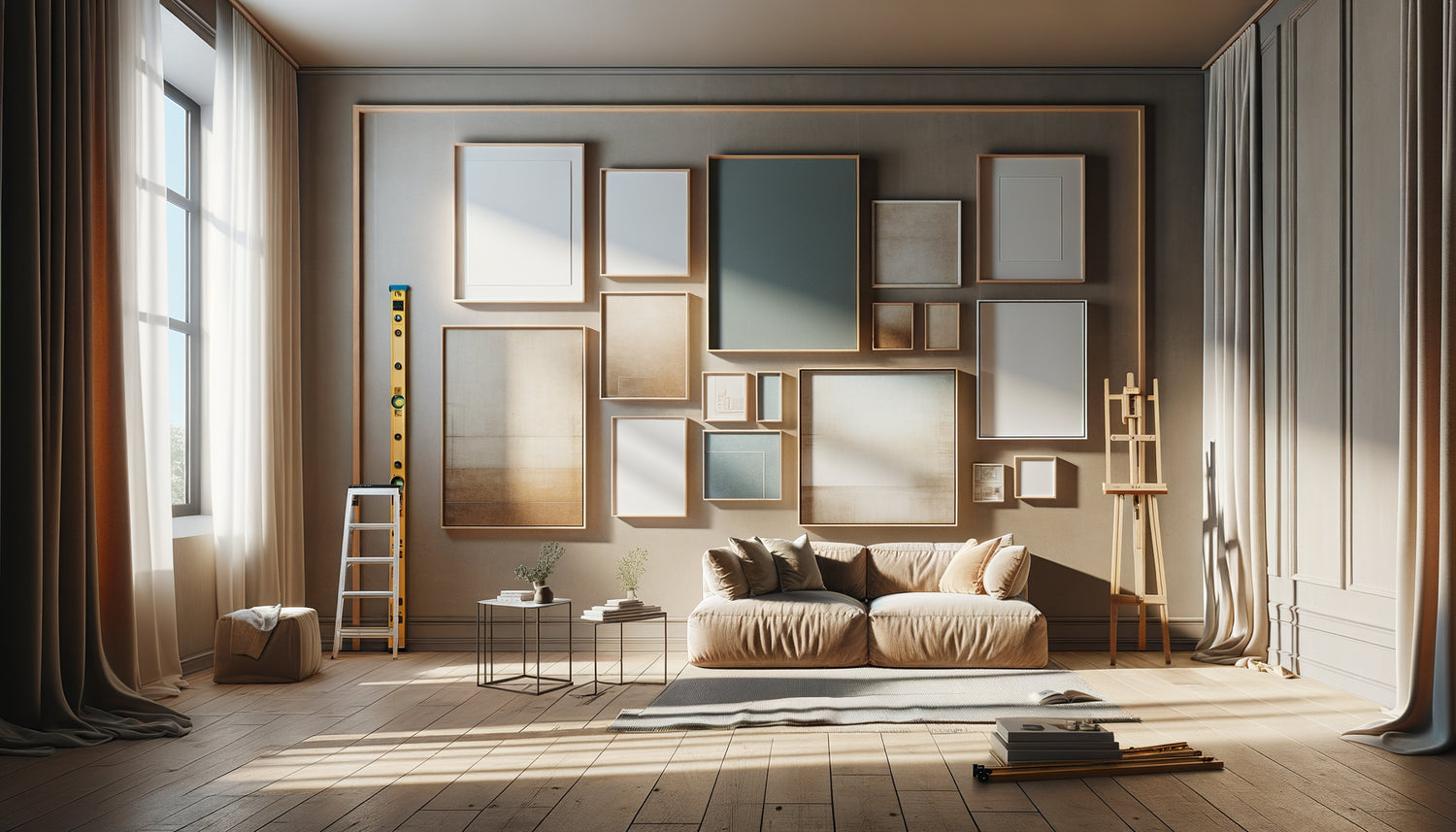
Before drilling into your wall, cut paper templates from kraft paper to the exact dimensions of your current and future artworks. Temporarily tape them in place to test different configurations. This crucial step allows you to experiment without commitment and visualize how your gallery wall will evolve with each new acquisition.
Photograph each tested composition. Return to it the next day with a fresh perspective. The right configuration often emerges after several iterations, when the balance between positive and negative space finds its natural point.

The rhythmic acquisition: when and how to add
A progressive gallery wall is characterized by a thoughtful enrichment rhythm. Rather than buying compulsively, establish an acquisition schedule that aligns with your budget and the evolution of your interior.
Some find their balance with a new piece per season, allowing each artwork to fully integrate before the arrival of the next. Others prefer to add an element after each important step in their installation: purchasing the sofa, installing the curtains, adding a bookcase. These milestones create a natural synchronization between your furniture and your gallery wall.
Between acquisitions, frequent art venues: local galleries, craft markets, ephemeral exhibitions. Keep a list of your favorites on your phone, with photos and contact details. This active scouting nourishes your eye and gradually refines your personal style. When the time comes to buy, you know exactly where to return.
Transition elements: more than just paintings
A truly captivating progressive gallery wall integrates three-dimensional elements and objects that create relief and texture. An antique mirror, a small shelf with a hanging plant, framed textile, a decorative plate: these pieces break the monotony of flat frames.
These transition elements also serve as adjustment variables when your budget doesn't yet allow for the acquisition of the missing piece. They temporarily occupy the space while enriching the composition. Some will even find their definitive place, becoming personality accents that differentiate your gallery wall from a simple accumulation of frames.
Also consider unmounted graphic elements: postcards held with decorative masking tape, vintage botanical prints, samples of artistic wallpapers. These light and flexible touches allow you to experiment without commitment, adjusting your composition as you discover new things.
Ready to lay your first stone?
Discover our exclusive collection of apartment wall art that perfectly adapts to progressive gallery walls, with formats and styles designed to evolve with you.
Living with your evolving gallery wall
The true magic of a progressive gallery wall appears after a few months of cohabitation. Each piece carries the memory of the moment you chose it, creating a visual map of your evolution in this space.
Some works that you thought were temporary will become indispensable pillars. Others, initially adored, will migrate to other walls or rooms to make way for new energies. This fluidity is not a planning failure, but the natural breath of a living interior.
Allow yourself the right to reorganize. Once a year, take everything down and replay the composition with your new acquisitions. These periodic reconfigurations refresh your perspective and reveal new dialogues between the works. Your gallery wall is never frozen; it pulsates with the rhythm of your life.
In a few years, when you receive friends and they admire your wall, you won't tell them a story of bulk purchases and instant decoration. You will share the story of a patient construction, where each piece bears witness to a stage, a discovery, an evolution. This narrative authenticity transforms simple decoration into true personal heritage.
Start today with that first piece that calls to you. Hang it with intention. Let it guide you to the next one. Your progressive gallery wall will be written day after day, a faithful reflection of your journey in this apartment that is gradually becoming your home.
Frequently asked questions about progressive gallery walls
How long does it take to create a complete gallery wall?
There is no ideal duration, and that's precisely the beauty of a progressive gallery wall. Some compositions find their balance in six months, while others continue to evolve for several years. On average, allow one to two years to reach an initial satisfactory configuration with eight to twelve pieces. The essential thing is to respect your acquisition pace and let each new work integrate before adding the next. A patiently built gallery always carries more depth than a hasty installation. Remember that your wall tells a story: it becomes richer over time.
What to do if my style evolves and my first acquisitions no longer appeal to me?
This is not only normal but revealing of a healthy aesthetic maturation. Your progressive wall gallery should be able to absorb these changes without questioning everything. Start by identifying the pieces that remain safe bets, those that continue to resonate with you. Keep them as pillars and gradually move the others to secondary rooms such as the bedroom or hallway. You can also create a second wall gallery in another space with works that no longer match your main wall. This natural rotation is part of the process: your apartment evolves with you, and your walls testify to this transformation rather than denying it.
What monthly budget to plan to gradually build a wall gallery?
A progressive wall gallery adapts to all budgets, that's precisely its advantage. With 30 to 50 euros per month, you can acquire a nice piece every two or three months by favoring young artists, quality prints or flea market finds. A budget of 100 to 150 euros per month allows you to acquire a significant work each month or invest in larger pieces quarterly. The essential thing is not the amount but the regularity and intention. It's better to make a thoughtful acquisition every quarter than an accumulation of impulsive purchases. Also keep an envelope for framing: a beautiful frame transforms a modest print into a true decorative element. Budgetary patience often creates the most authentic and personal wall galleries.