That moment of pure satisfaction when the last brushstroke dries on your freshly painted walls. The colors breathe, the light dances differently, and suddenly... that dizzying question: how to dress these immaculate walls without compromising their freshness? After twelve years transforming show apartments for high-end real estate developers, I've observed a disturbing truth: tableaux finishes can magnify or ruin the harmony of an interior in just a few hours. A poorly prepared artwork will leave traces of moisture on your new paint, while a frame that is too heavy will create unsightly cracks around the fixings.
Here's what adapted finishes bring to paintings on new walls: durable protection for your fresh paint, optimal enhancement of your works thanks to controlled reflections, and secure installation that preserves the integrity of your surfaces. You fear ruining the impeccable work of your painter? Seeing mysterious halos appear a few weeks after hanging? I understand. This anxiety haunted me during my first show apartment delivery in Neuilly. Today, I'm going to pass on exactly what I wish I had known: the tableaux finishes that respect your new walls while sublimating your decor.
Protective varnish: your first line of defense against residual moisture
Freshly painted walls release moisture for 3 to 6 weeks. This is a natural phenomenon that many ignore. This humidity migrates to any porous object nearby, particularly unprotected canvases. I learned this at my expense during a project on Quai Branly: contemporary works installed too early developed mold on the back in less than a month.
Satin varnish for paintings creates a bidirectional waterproof barrier. It protects your artwork from wall moisture while preventing volatile organic compounds (VOCs) from fresh paint from penetrating the canvas. Opt for an acrylic water-based varnish rather than solvent varnishes. Why? Solvents react chemically with some recent wall paints, sometimes creating yellowish halos that are impossible to remove.
Apply two thin coats with a flat brush, allowing 4 hours of drying time between each coat. The satin finish offers the best compromise: it effectively protects while allowing comfortable reading of the work, without the aggressive reflections of glossy varnish which create blind spots depending on the lighting. For collectors, matte varnish remains the museum option par excellence, although more fragile to fingerprints.
Framing and gilding: when weight becomes your enemy
An unsuitable frame on a freshly painted wall is like building a house on damp foundations. The paint has not yet reached its maximum hardness - it takes 21 days for acrylic paint, 30 days for glycero. During this period, the wall remains vulnerable.
Aluminum frames with anodized finish are my secret allies for the first few weeks. They weigh three times less than solid wood while offering contemporary elegance. Anodizing gives them an infinite palette: brushed gold, matte black, satin silver... I even found oxidized copper finishes that perfectly mimic antique metal.
For those who love tradition, hollow wood frames with lacquered finish are a smart alternative. Lacquering seals the wood, preventing it from absorbing or releasing moisture. Avoid raw or simply waxed wooden frames for the first 6 weeks: they act like sponges, disrupting the drying of your wall art.
The maximum weight rule
On a new wall, do not exceed 3 kg per fixing point for the first 30 days. A artwork with complete finish (varnished canvas + frame + glass) can weigh from 8 to 12 kg for a 60x80 cm format. Therefore, prefer weight distribution systems: discreet suspension rail, offset double hook, or better yet, simply wait until your paint has completely hardened.

Glass or plexiglass: this decision that changes everything
The question comes up systematically during my consultations: should the artwork be protected with glass? On new walls, this decision involves additional considerations. Glass adds weight, of course, but above all it radically alters the interaction of light with your decor.
Museum glass with anti-reflective finish remains the ultimate choice for valuable artworks. Its micro-textured surface diffuses light instead of reflecting it, creating the illusion that nothing separates the eye from the artwork. I installed this type of glass in a duplex with floor-to-ceiling windows facing south: the paintings remain perfectly readable even at 3 p.m. in July, when the light is overwhelming.
Acrylic plexiglass with UV treatment offers an alternative that is 60% lighter. Essential for large formats on new walls. Its disadvantage? Static electricity attracts dust. Prefer versions with anti-static finish, a technical detail that makes all the difference in everyday life. A microfiber cloth wipe is enough instead of having to disassemble everything every month.
For oil or acrylic paintings on canvas, I consistently advise against any glazing for the first three months. Even a perfectly dry varnish continues to release small amounts of gas. Trapping these vapors under glass creates microscopic condensation that gradually obscures the artwork. Patience always pays off in decoration.
Edge finishes: that detail no one looks at (but everyone sees)
Canvas edges are the forgotten aspect of painting finishing. Yet, in an apartment with immaculate walls, a neglected edge stands out like a false note. Three schools of thought compete, each with its own aesthetic philosophy.
The edge painted in continuity extends the artwork to the sides. Perfect for abstract or colorful compositions that gain spatial presence. This finish allows for frameless hanging, visually lightening the space – valuable in small Parisian apartments where I work regularly. Require a matte acrylic paint on the edges: gloss creates distracting reflections.
The black or white neutral edge constitutes the classic museum choice. It creates a clear break between the artwork and the wall, reinforcing the presence of the painting as an autonomous object. On freshly painted colored walls, a black edge absorbs chromatic reflections and preserves the integrity of the artwork's colors.
The raw wood edge with waxed finish brings an unexpected organic touch. I tested it in a Haussmannian apartment with restored moldings: this finish dialogues beautifully with the old woodwork while asserting a confident modernity. Caution: the wax must be completely dry (minimum 48 hours) before installation on new wall.

Hanging systems: the fixing that respects your immaculate walls
Here's where most mistakes are made. A freshly painted wall doesn't have the same mechanical strength as an old wall. Paint forms a still-flexible film that can tear when fixings are installed.
Command adhesive hooks revolutionized my installations for the first 30 days. These drill-free systems support up to 7 kg and remove without leaving traces. Their secret? A stretchable adhesive strip that detaches cleanly, even on fresh paint. I use them consistently for tableaux with light finishes during the drying period.
For heavier artworks, suspension rails with perlon cables are the professional solution. A single rail at the top of the wall supports your entire display, requiring only one fixing point to the ceiling or upper part. The transparent cables then descend, carrying the artwork to the desired height. This invisible finish preserves the purity of your new walls while offering total flexibility for rearranging.
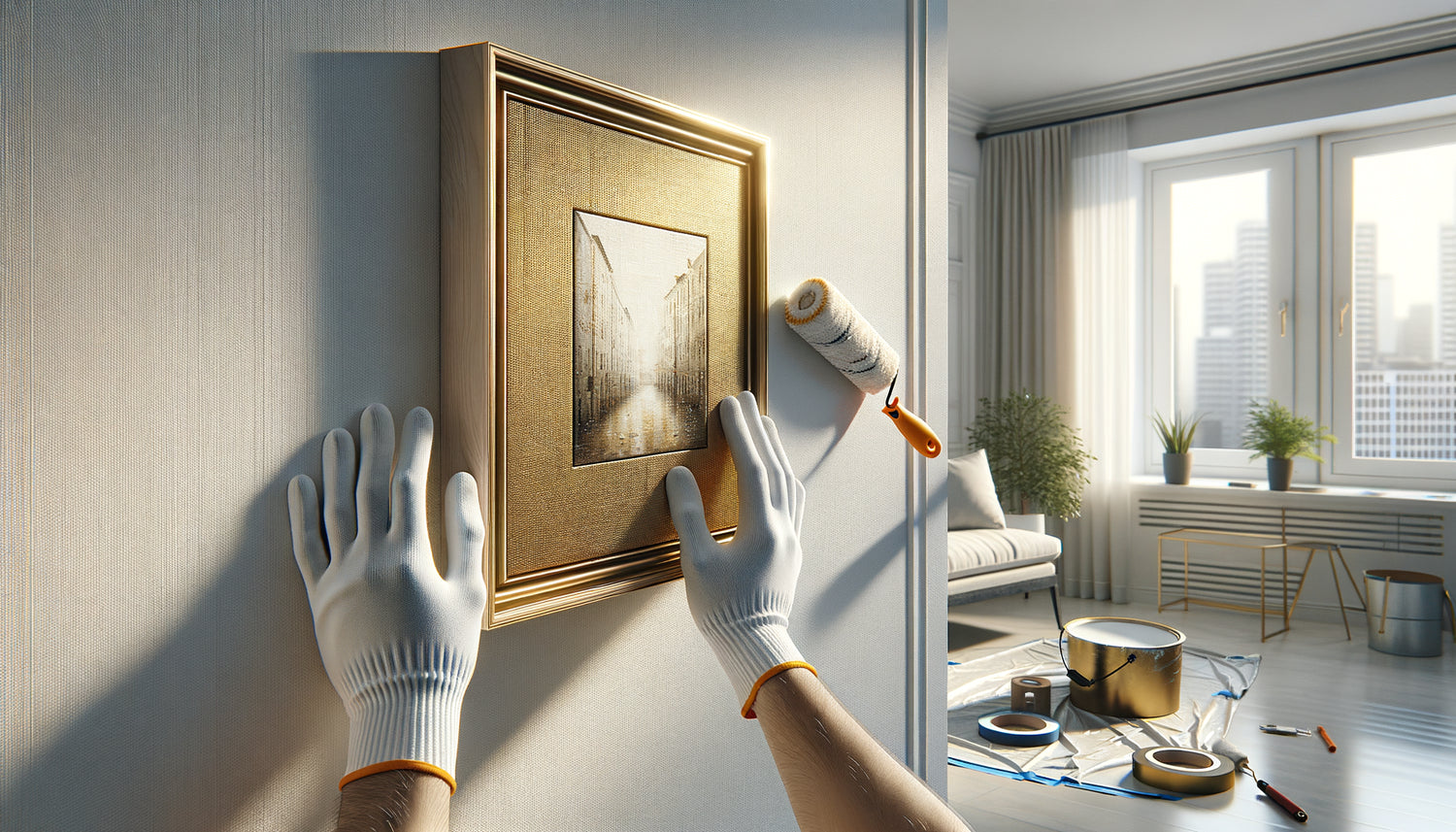
If drilling is unavoidable, be sure to use fixings suitable for the support: Molly fixings for plasterboard, nylon fixings for concrete or stone. Always drill at a low speed on fresh paint to avoid circular chipping around the hole. A piece of masking tape placed before drilling minimizes this risk.
The laser level trick
On new walls, every imperfection is visible. A artwork with impeccable finish but hung crooked instantly destroys the harmony. I invest €45 in a compact laser level that projects a perfect horizontal line. In 30 seconds, all the artworks on a wall align with surgical precision. This professional finish transforms an accumulation of works into a controlled composition.
When timing is as important as technique
The best artwork finishing is useless if the installation timing is wrong. Here's the optimal schedule that I consistently apply to my prestigious projects.
Days 1-7 after painting: Critical phase. No permanent installations. The paint still releases a significant amount of moisture and VOCs. If you absolutely must decorate, use lightweight artworks on temporary adhesive supports, without airtight finishes that would trap moisture.
Days 8-21: Intermediate period. Artworks with protective finishes (well-dried satin varnish) can be hung with light systems. Favor aluminum frames and avoid any glass trapping. Ventilate daily to accelerate complete drying.
After day 30: All clear. Your paint has reached its final hardness. All types of artwork finishes are now compatible: massive frames, museum-quality glass, permanent fixings. This is the time to install your masterpieces with their complete finishes.
I learned this patience at my own expense during a rushed delivery on Avenue Montaigne. Gilded leaf frames, placed on the 15th day on a glyceryl paint: result, halos appearing on the 45th day, requiring a complete rework. Since then, I have religiously respected these deadlines.
Your new walls deserve artwork to match their freshness
Discover our exclusive collection of apartment wall art that will transform your freshly renovated spaces into captivating personal galleries.
A visible transformation at first glance
Imagine stepping through the threshold of your apartment after a demanding day. Your immaculate walls are no longer simple neutral surfaces but living screens where your carefully finished artworks tell your story. The evening light caresses the satin varnish without creating aggressive reflections. The lightweight frames seem to float, freed from any heaviness. No trace, no halo: just the pure harmony of intelligently designed decor.
The finishes adapted for paintings are not just a technical matter – they sign your approach to living. Start by taking inventory of your current works: which deserve a protective varnish? Which frames can be lightened? Then establish your hanging schedule according to the age of your painting. This simple methodology will transform your apprehension into creative confidence.
Your freshly painted walls are a blank page offering endless possibilities. With the right finishes for your paintings, you write a decorative story that will last for years, without compromise or regrets. Lasting beauty always comes from this alliance between patience and craftsmanship.
Frequently asked questions about painting finishes for new walls
How long should I wait before hanging paintings on freshly painted walls?
Patience is your best ally. For acrylic paint, wait at least 7 days before any light installation, and ideally 21 days for paintings with complete finishes (heavy frames, glass). Glycero paints require a full 30 days. During this period, the paint releases moisture and volatile compounds that can damage your works or create halos. If you absolutely must decorate immediately, prioritize temporary adhesive systems with lightweight artworks whose finishes include a waterproof protective varnish. Ventilate the room daily to speed up drying. I have found that respecting this timing divides installation problems by ten: no traces, no peeling paint when drilling, no unexpected chemical interactions. This wait guarantees that your finishes and your decor will last through the years without alteration.
Is it better to choose a glossy or matte varnish as a finish for my paintings?
Satin varnish represents the ideal compromise for 80% of situations, particularly on freshly painted walls. Here's why: glossy varnish offers maximum protection and intensifies colors, but creates reflections that make reading the artwork difficult depending on lighting and position. In an apartment with generous windows, these reflections quickly become annoying. Matte varnish, favored by museums, offers a noble finish without any reflection, but is more fragile to traces and requires meticulous maintenance. Satin varnish combines the advantages: effective protection against residual moisture from new walls, discreet reflections that do not hinder reading, and easy maintenance. For finishes on contemporary or abstract art paintings, matte enhances textures. For photographic reproductions or detailed figurative works, satin preserves depth. Always apply two thin coats rather than one thick: the finish will be more uniform and drying more even.
Can I use solid wood frames on new walls or should I prefer other materials?
Solid wood frames are beautiful but pose two challenges on freshly painted walls: their significant weight (which stresses the paint that is not yet hardened) and their natural hygroscopicity (wood absorbs and releases moisture). If you absolutely want wood, choose finishes that completely seal the material: lacquer, thick acrylic paint, or polyurethane varnish. These finishes prevent moisture exchange between the wood and your new wall. For the first 30 days, I recommend aluminum frames with an anodized finish (perfectly imitating wood, gold or copper) or hollow wood frames which divide the weight by three. After this period, all frames become acceptable. For works of great value, invest in a custom frame with professional finishing: sealed back, anti-humidity protection, and distributed hanging system. These invisible technical details guarantee that your painting and your wall will coexist harmoniously for decades.