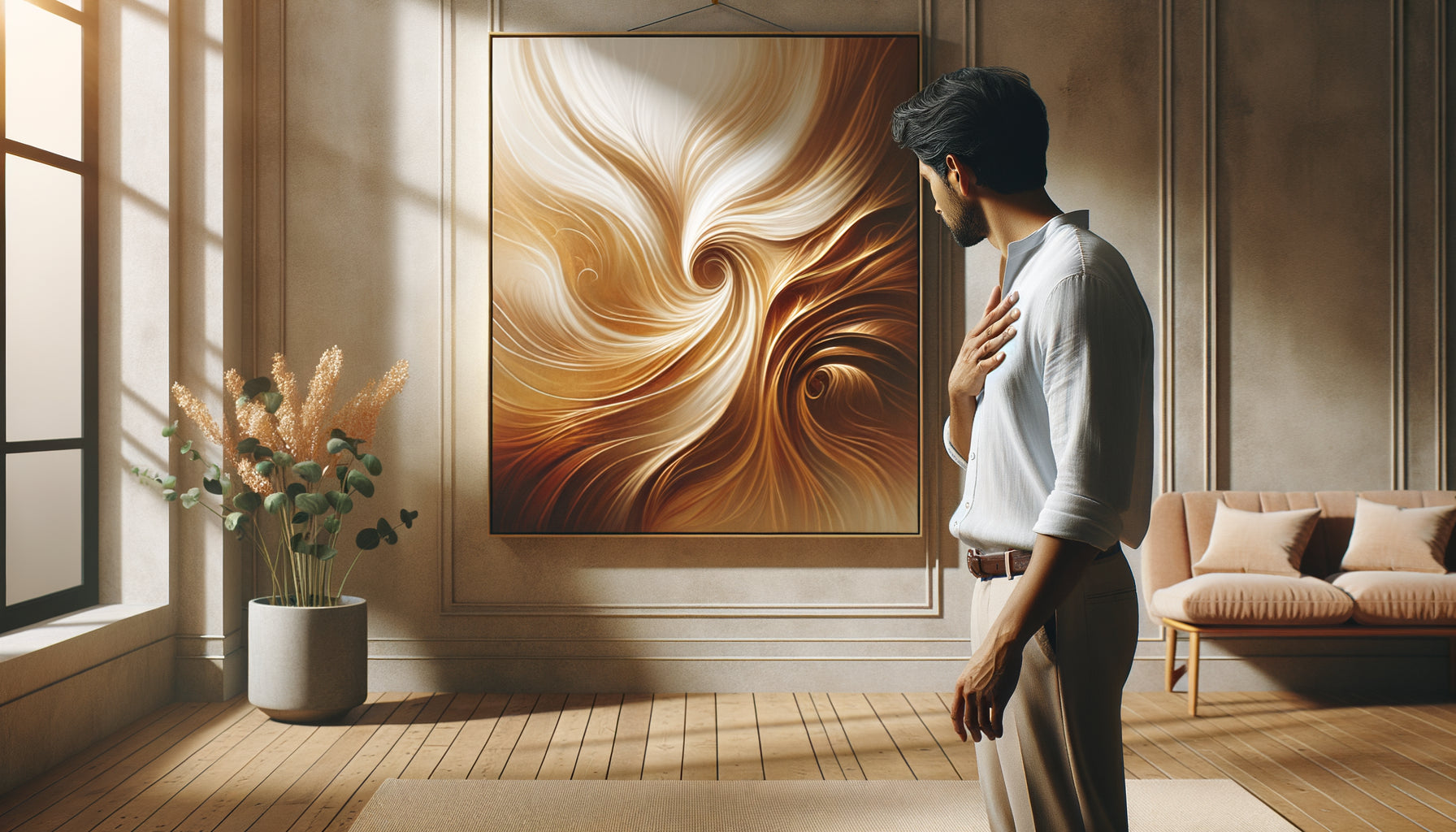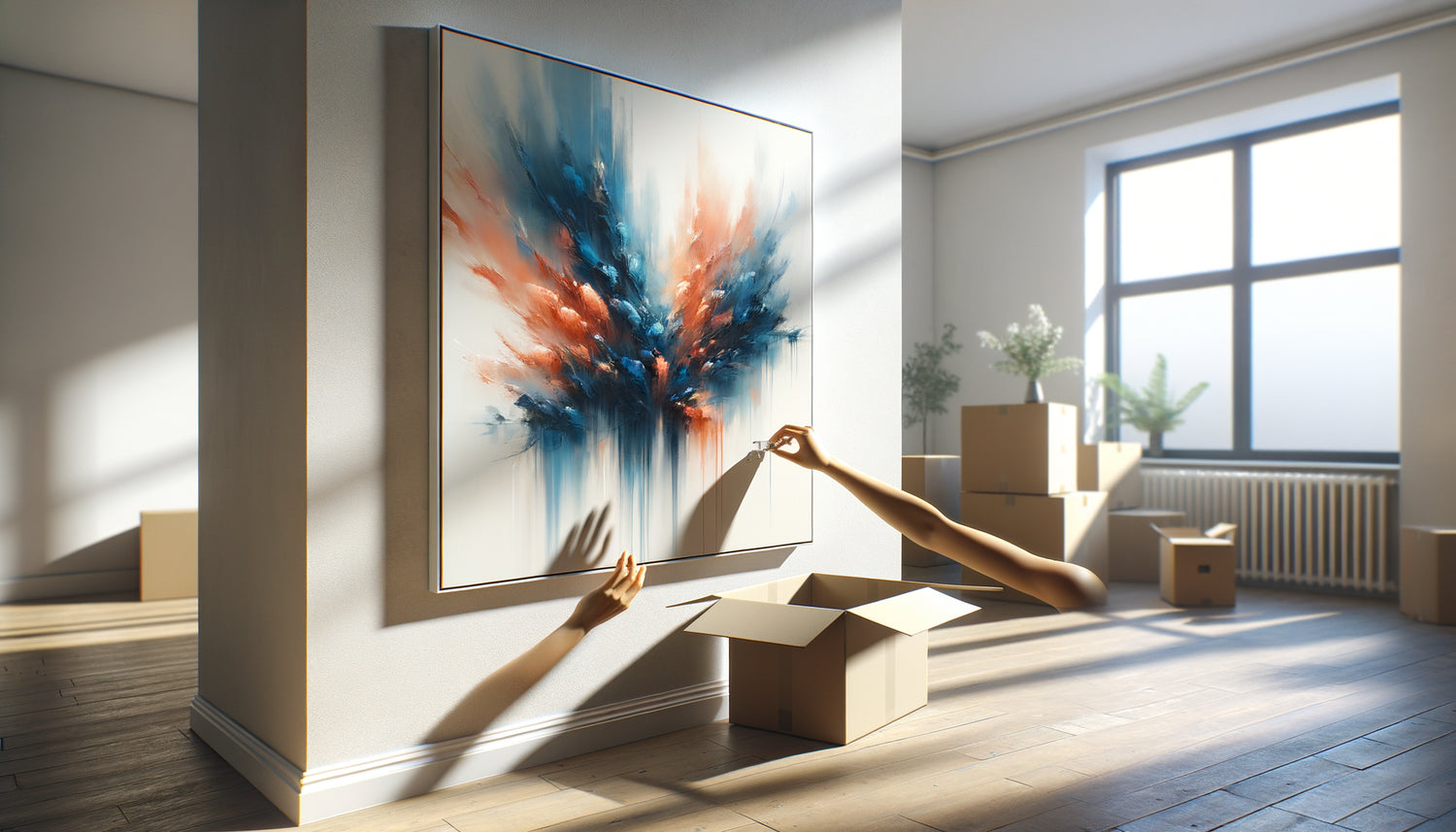
I've witnessed hundreds of moves throughout my career as a life transition coach. And each time, the same question arises: how to make this new place a true fresh start? The answer often lies in a powerful symbolic gesture – hanging a painting that is unlike anything that adorned your walls before. A painting breaking with the old accommodation becomes much more than just decoration: it's a statement of intent, an emotional marker that says "I’m turning the page.
Here's what a consciously chosen painting style brings to your new chapter: it creates a unique visual identity that erases the ghosts of the past, it stimulates your brain with new emotions and associations, and it physically anchors your intention of change in space. Many of my clients find themselves paralyzed by this choice. They fear repeating past mistakes, investing in a work that wouldn't correspond to their new life, or betraying their "true" style. I understand them – this painting is loaded with considerable symbolic stakes.
But here’s the liberating truth: there are no bad choices, only conscious or unconscious ones. The key lies in your ability to precisely identify what you're moving away from and what you're heading towards. In this article, I guide you through the most powerful archetypes of rupture – from radical minimalism to an explosion of colors – so that your painting becomes the totem of your domestic rebirth.
Contemporary abstract art: erasing figurative memories
During my training in environmental psychology, I discovered a fascinating phenomenon: people who are leaving an emotionally charged home (separation, grief, professional failure) massively turn to contemporary abstraction. Why? Because these works evoke no recognizable scene, no specific memory. They offer a blank screen for projecting new emotions.
An abstract painting with geometric shapes, bright colors in blocks or expressive textures acts as a gentle memory eraser. If your old home was decorated with bucolic landscapes, classic still lifes, or portraits, this stylistic shift is radical. The brain finds no anchor point with the past – exactly the effect sought.
I accompanied Caroline, who was coming out of a difficult divorce. Her former Parisian apartment was covered in black and white photographs of their honeymoon. For her new studio, she chose a large abstract canvas with electric colors - cobalt blue, saffron yellow, touches of vermilion red. “I don’t see anything from the past when I look at this wall,” she confided to me six months later. The painting had become her daily emotional shield.
What type of abstraction to choose ?
For a gentle break, opt for lyrical abstraction – these works with fluid, organic shapes that evoke movement without naming it. They are suitable for chosen transitions (promotion, new project). For a radical break, turn to hard geometric abstraction – sharp lines, angled edges, maximum contrast. These paintings are suitable for necessary but painful breaks, where you consciously need to “cut” with the past.
The color palette counts enormously. If your old home was bathed in neutral and soothing tones, choose saturated and energizing colors. Conversely, if you were leaving a space overloaded with patterns and colors, a minimalist monochrome painting will create this saving breath.
Radical minimalism : less to feel more
I observe a powerful trend among people who are moving after a period of material accumulation: they seek emptiness, purity, breathing space. The minimalist painting becomes their visual manifesto. A black line on white background. A golden circle on raw canvas. A patch of navy blue in an ocean of beige.
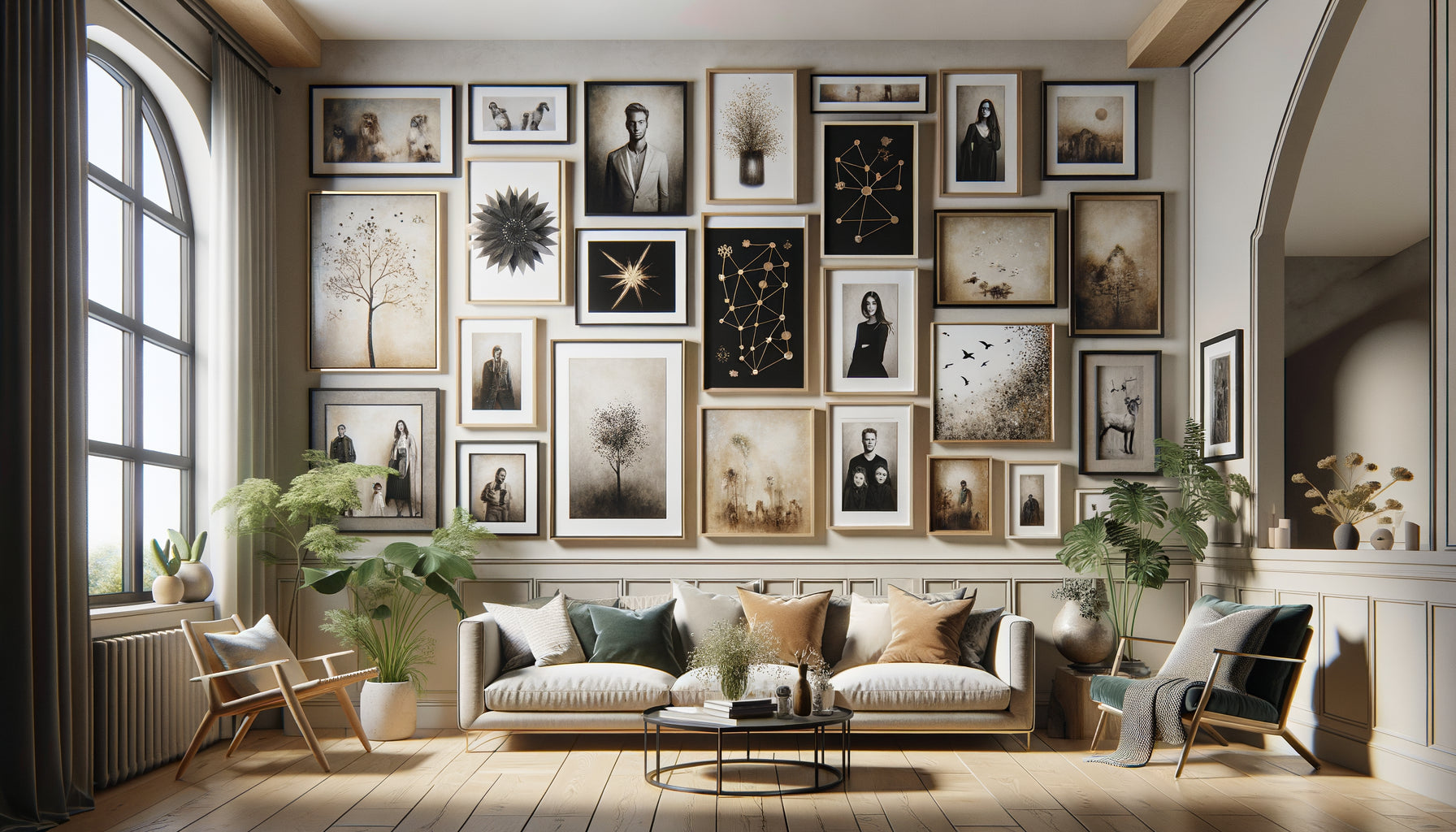
This style of painting to mark a break works by subtraction. Where your old home might have contained an overloaded gallery wall, baroque gold frames or classic reproductions, a single powerful minimalist work completely reverses the energy of the space. It's the principle of the palimpseste: scraping away the old writing to reveal the blank page.
Mathieu, an entrepreneur who was liquidating his company to reorient himself, left a loft filled with professional memories. In his new bright apartment, he hung a single canvas: three gray horizontal lines on a light beige background. “It’s almost nothing, but it's everything,” he explained to me. This work embodied his new mantra: focusing on the essentials, eliminating the superfluous.
The power of almost nothing
Minimalism takes courage. In our culture of visual abundance, choosing a quasi-empty painting can seem insufficient. But it is precisely this apparent insufficiency that frees mental space. Your gaze has nowhere to cling, no detail to analyze – just a calm presence that says “you can breathe now.”
To succeed in this minimalist break, the quality of execution becomes paramount. An approximate line or a poorly stretched canvas will ruin the effect. Look for works where apparent simplicity hides an invisible technical mastery: depth of matter, subtlety of nuances, millimeter precision of gesture. It is this discreet excellence that transforms the “almost nothing” into “everything.”

The chromatic explosion: awaken dormant senses
Opposite the spectrum, some disruptions require intense visual shock. If you were leaving a dull, conventional or depressing environment, your brain needs a colorful electroshock. I have developed what I call "saturation therapy": flooding the gaze with vibrant colors to awaken visceral joy.
A painting with explosive colors – fuchsia, turquoise, mandarin orange, anise green – acts as an emotional defibrillation. These neo-pop, street art or contemporary expressionist works brutally break with any form of decorative caution. They shout "I exist" where the old home whispered "remain discreet".
Sophie, a banker, lived for ten years in an apartment with taupe and gray tones – "professional and neutral", as she said. After her burnout and career change to yoga instructor, she chose for her new home an immense multicolored canvas inspired by chakras. "My colleagues would have found that vulgar. Now I don't care - this painting reminds me every morning that I am finally living my true life," she confided in me.
Dose the intensity without overheating
The common mistake with very colorful paintings? Choosing too small for fear of doing too much. The result: the work looks like an incoherent stain that pollutes without liberating. For a chromatic explosion to really mark the break, it must occupy a significant surface – at least 80x100 cm, ideally 120x150 cm for a main wall.
Another trap: multiplying colorful works. One vibrant large piece is quite enough. The rest of the decoration should remain subdued so that the painting retains its status as a statement piece – the piece that affirms your new identity without compromise.
Textured artworks: touch to believe in change
Here's a secret that few decorators mention: visual disruption is not always enough. Some transitions require a tactile dimension to physically anchor the change. Paintings with relief, visible material or three-dimensional elements create this sensory incarnation.
I often encourage my clients to choose mixed media artworks – thick knife painting, collage of materials, sand integrated into the paint, embossed metal elements. These rough surfaces literally invite the hand to check: "Yes, it's real. Yes, I have really changed universes." This tactile confirmation short-circuits the mind that might minimize the change.
Thomas, who was moving from a spartan student room to his first real professional apartment, chose a painting with thick layers of gold and copper paint creating valleys and ridges. "I run my hand over it every week, almost ritually," he confessed to me. This gesture physically embodied his new prosperity, his right to occupy space with substance.

Inverted figurative art: same subject, different perspective
Sometimes the most subtle shift is the most powerful. Rather than radically changing styles, you can keep a familiar subject but treat it in a radically different aesthetic. This is what I call the strategy of "same but completely different."
Typical example: did you have classic watercolor marine landscapes? Choose an abstract ocean with metallic acrylics. Black and white photographic portraits? Opt for a pop art face with Warhol colors. Dark Dutch still lifes? Hang fruits in minimalist Japanese flat designs.
This approach is particularly suitable for nuanced shifts: you are not totally denying your past, but asserting an evolution, a maturity, a new interpretation of who you are. Claire, who was moving after her children left home, replaced her framed family photos with a large abstract silhouette evoking family ties without freezing them. "I remain their mother, but I am also becoming myself again," she explained with liberating clarity.
Creating conscious bridges
This strategy works wonderfully for geographical moves. Are you leaving Marseille for Paris? A contemporary version of a Mediterranean painting maintains the emotional connection while asserting your new urbanity. Were you moving from the countryside to the city? Stylized natural elements in Scandinavian design style preserve your connection to nature without rustic kitsch.
The advantage: this gentle break avoids the brutal rejection of the past, a frequent source of regrets or toxic nostalgia. You create a conscious continuity where the artwork becomes a bridge between two chapters rather than a wall.
Ready to materialize your new beginning?
Discover our exclusive collection of wall art for Apartment that will transform your walls into statements of intent and visually mark your break with the past.
Your artwork, your totem of rebirth
After years of supporting hundreds of residential transitions, I can affirm this: the first artwork you hang in a new home is never trivial. It crystallizes your intention for change, it materializes your courage to break away, it silently testifies to your evolution.
Whether you choose radical abstraction, meditative minimalism, liberating colorful explosion or embodied texture, the essential thing lies in the awareness of the choice. This style of artwork to mark a break must resonate viscerally with your need for transformation. Not with current trends, not with the opinion of those around you, but with that inner voice that knows exactly what you need to turn the page.
My final advice: don't rush. Live for a few days in your new empty space. Observe the light, feel the energy of the rooms, identify the wall that naturally attracts the eye. Then choose this artwork with the intensity of a ritual – because it is one. You are not buying a decoration, you are installing a symbolic guardian of your new chapter. And this guardian deserves all your attention.
Frequently asked questions about choosing a break artwork
Should I choose a radically different style from my previous decor?
Not necessarily. The break can be subtle or radical depending on your emotional need. If you are leaving a toxic or painful environment, a drastic change – going from classic to abstract contemporary, from dark to bright – effectively helps the brain to “cut” with negative associations. But if your move is a positive evolution, a gentle break where you keep some codes while reinterpreting them may be quite sufficient. The important thing is that you viscerally feel the difference when you look at your new wall. Ask yourself this question: “Would this artwork have had its place in my old home?” If the answer is a clear “no”, then you’ve found your break.
What size artwork should I choose to really mark the change?
An artwork that is too small risks going unnoticed and missing its symbolic function. For a main wall in the living room or bedroom, I recommend a minimum of 80x100 cm, ideally 100x120 cm or larger. The rule of thumb: the artwork should occupy approximately 60 to 75% of the width of the furniture below (sofa, bed, console). A large format visually affirms “something has changed” as soon as you enter the room. If your budget limits the size, prefer a single large piece rather than several small ones – the impact force of a unique statement piece always surpasses a hesitant accumulation. The change must be obvious, not timidly suggested.
How do I know if my choice really reflects my new beginning or just an impulse?
Excellent question that shows a beautiful awareness. Here is my three-step test: firstly, live with the image of the artwork (photo on your phone) for a week, looking at it daily. If the positive emotion persists, that's a good sign. Secondly, ask yourself: Does this artwork represent the person I am becoming or the person I think I should become? The nuance is crucial. Thirdly, project yourself: imagine this artwork still present in five years – does it still inspire you, or do you already feel potential fatigue? A true totem artwork of change retains its emotional resonance over time because it embodies a profound transformation, not a passing trend. Trust your visceral instinct more than your analytical mind.