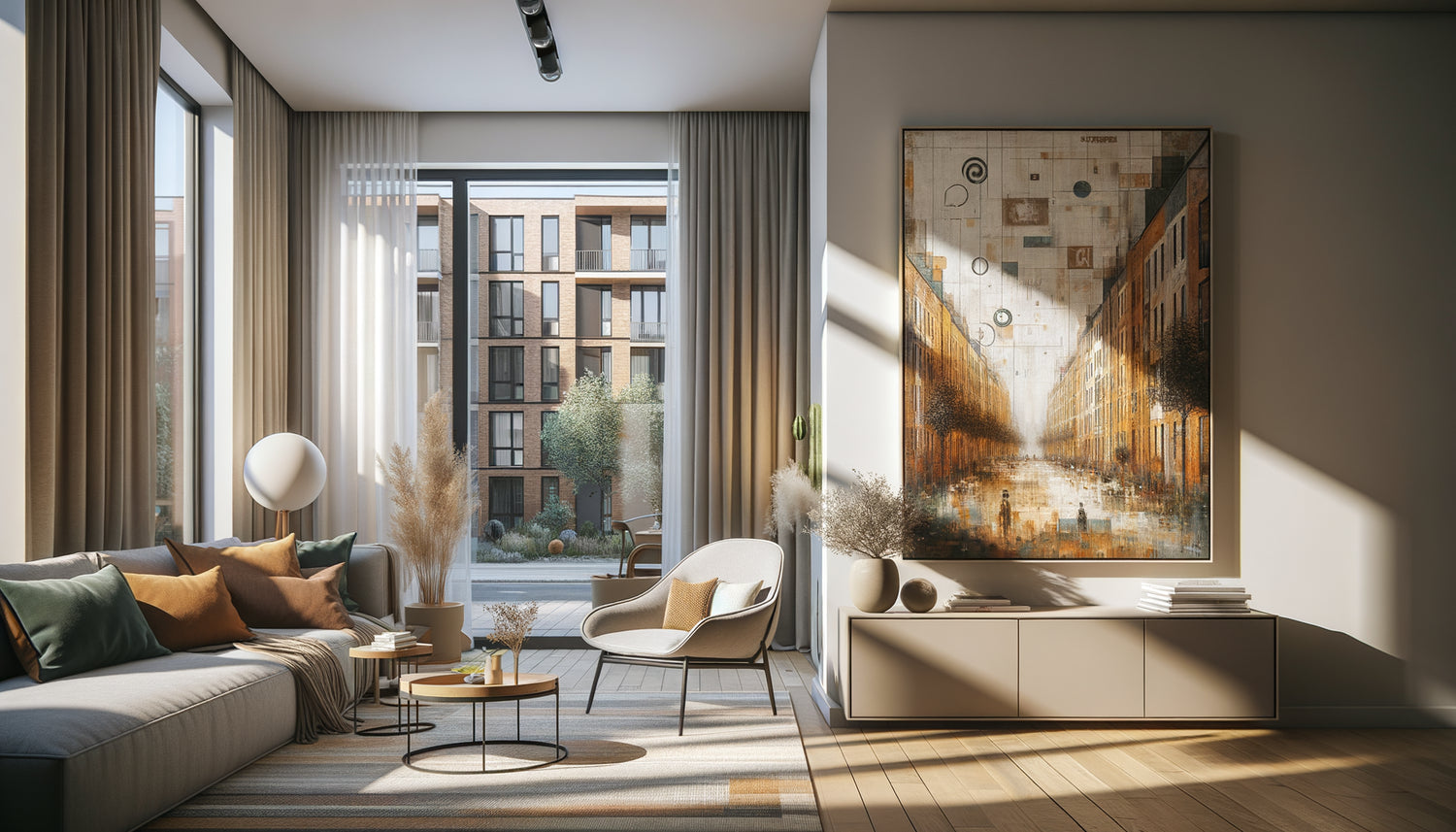
When I moved into my new apartment in La Confluence, Lyon, the white walls echoed with a heavy emptiness. This brand-new neighborhood, with its glass facades and designer walkways, felt as impersonal as an airport terminal. Until the day I discovered, in a small gallery on rue Denuzière, a series of silkscreen prints by a local artist depicting the old port cranes. This purchase changed everything. Suddenly, my living room spoke not only about me but also about where I lived, its history, and its transformation. My neighbors recognized these images during my housewarming parties. Conversations started differently.
Here's what local artwork brings to your new space: it transforms four anonymous walls into inhabited territory, creates bridges between the past and present of the neighborhood, and generates authentic conversations with your neighbors. Beyond simple decoration, they weave a deep sense of belonging to your urban environment.
The problem when you arrive in a new neighborhood? That feeling of floating in a setting that doesn't yet belong to you. You know the way to the bakery, but not the soul of the place. You cross faces without understanding the common history that connects them. Local art then becomes that invisible thread that weaves us into the social and cultural fabric of our new life.
Rest assured, creating this connection requires neither a colossal budget nor expertise in art history. It takes a sincere intention and an openness to what your neighborhood has to tell. Local artists are the sensitive chroniclers of your environment, and their works become your gateways to a real territorial connection.
When walls tell the story of the corner
Neighborhoods change, transform, sometimes at a dizzying speed. These urban transformations often erase collective memory. Local artists capture these moments of transition with a sensitivity that real estate developers do not possess. They document the former cinema transformed into a loft, the industrial wasteland turned park, the century-old bistro resisting between two glass towers.
Hanging a watercolor depicting the old fish market in your seaside neighborhood is installing a dialogue between what was and what is. Your guests systematically ask: 'Where is that?' And you tell them. You transmit. You become guardian of a memory that, without these artistic traces, would disappear into the digital oblivion of our accelerated existences.
A collector I know in Le Marais owns a series of art photographs showing the buttonholes of the neighborhood before their disappearance. These black and white images create a temporal depth in his ultra-modern apartment. The new generations who visit his space discover that their trendy territory was once the heart of an artisanal industry. This historical awareness enriches their sense of belonging immeasurably.
The visual signature of your territory
Each neighborhood possesses a distinct visual personality. The red bricks of the North, the ochre facades of the South, Parisian Haussmannian architecture, the Art Deco buildings of Boulogne-Billancourt. Local artists master this particular aesthetic grammar because they live it daily. Their color palette, their subjects, their treatment of light reflect the visual DNA of the environment they share with you.
When you choose a canvas from a painter in your neighborhood, you are not importing a generic vision. You invite inside an sensitive interpretation of your own external reality. This consistency creates a subtle harmony between your private space and public space. Your windows frame the real neighborhood, your walls welcome its sublimated version, poetized by the artistic gaze.
I recently discovered an aquarellist from Belleville who captures zinc roofs under different lights. Her works in interiors of the 20th arrondissement create a fascinating visual continuity: the eye moves from the painting to the window without aesthetic disruption, as if the apartment naturally extends the urban landscape. This fluidity generates deep psychological comfort, a feeling of being exactly where you belong.

The conversations that create neighborhood
Urban isolation has become the silent epidemic of our time. You can live for years in a building without knowing the first name of your neighbor. Local art acts as an unexpected social trigger. When you mention having bought a work from the gallery on the boulevard, eyes light up: 'Oh, you know this place? I love their selection too!'
These connection points transform anonymous cohabitants into members of the same community. You share common references, appreciated places, a curiosity for the same creators. Art becomes a pretext for authentic exchange, far beyond the usual weather small talk. It reveals shared sensitivities, common values around supporting local creation.
An architect friend organized a private vernissage at her home inviting the artist from whom she had just acquired a sculpture. She invited her neighbors out of simple curiosity. This evening created links that last three years later. Friendships were born around this work, becoming much more than a decorative object: a community catalyst. The children in the building now know 'the man who makes sculptures', some neighbors regularly buy his creations.
The short circuit of creation
We are increasingly aware of the importance of short food supply chains. Why not apply this philosophy to our cultural consumption? Buying a work by an artist who lives just three streets away creates a virtuous local creative ecosystem. Your purchase allows this creator to continue working in the neighborhood, paying their studio rent, and contributing to the local economy.
This proximity economy also generates direct encounters. You can visit the studio, understand the creative process, and order a custom piece that dialogues with your specific architecture. This direct relationship with the artist greatly enriches your experience of the work. You know their story, their intentions, the technical challenges they overcame. The object on your wall now carries a narrative charge that fascinates your visitors.
Unlike reproductions of famous works purchased online, local art possesses an territorial authenticity impossible to reproduce. It's the cultural equivalent of farm cheese versus industrial product. Both may be visually appealing, but only the former tells a story of origin, terroir, and know-how rooted in a specific place. This authenticity can be felt, even unconsciously, and nourishes your sense of belonging.

Collective identity markers
Some local works become icons shared by the residents of a neighborhood. The mural that everyone knows, the installation in the square, the photographic series exhibited at the town hall. Owning a work by the same artist enrolls you in this community of taste and values. It's a subtle but powerful marker of belonging.
When you discover that a colleague also owns a print by the same local engraver, an immediate connection is created. You share more than just an artistic taste: you share a common attachment to a territory and its creators. These coincidences reveal deep affinities and create unexpected solidarities. You inform each other about upcoming exhibitions, studio open houses, and new emerging talents in the neighborhood.
In some neighborhoods undergoing rapid gentrification, works by historical local artists become symbols of identity resistance. Owning a painting depicting the neighborhood before its transformation becomes an almost militant act, a way of saying: 'I know the history of this place, I am not just passing through.' This often unconscious political dimension of local art nevertheless helps to preserve collective memory against urban amnesia.
How to Choose the Artwork That Creates a Connection
There's no need to overcomplicate things. Start by strolling around your neighborhood with fresh eyes. Look out for galleries, open studios, exhibitions in cafes and bookstores. Talk to local shopkeepers who often know artists from the area. Check out local magazines that showcase creators from the region.
During your explorations, let yourself be guided by emotion rather than investment. The artwork that will truly create a connection is one that resonates with your personal experience of the neighborhood. Perhaps this watercolor painting of the park where you run every morning, this photograph of the Sunday market where you buy your vegetables, this abstract sculpture whose shapes evoke the architecture you pass through daily.
Don't hesitate to talk to the artist if the opportunity arises. Ask them what inspires them about the neighborhood, how they perceive its evolution, and what invisible details they are trying to reveal. These conversations enrich your own perspective on your environment. You begin to see what you didn’t notice: the repeated pattern of balconies, the particular quality of light at certain hours, the architectural contrasts that shape the place's visual identity.
Consider emerging young artists, too. Their prices are more accessible and your support can be decisive in their career path. Plus, discovering a talent before it’s recognized creates a particular satisfaction. You become a witness and actor in the local creative ecosystem, not just a passive consumer.
Transform Your Apartment into a Lived-in Space
Discover our exclusive collection of wall art for Apartment that creates bridges between your intimate space and the outside world, for an interior that truly tells your story.
Beyond Decoration, a Sense of Place
Six months after hanging this series of silkscreen prints of the old port cranes, I no longer walk through my neighborhood in the same way. My gaze has become more refined. I notice architectural details, traces of the industrial past, and the temporal layers that coexist in the urban landscape. The artwork on my wall has educated my eye and deepened my relationship with the territory.
Even more surprisingly, this acquisition has generated unexpected encounters. The artist invited me to neighborhood events I was unaware of. I met other collectors passionate about local history. I discovered an association that organizes heritage tours. My social network has been enriched by authentic connections, all linked to this initial purchase that seemed purely decorative.
Local art is not just a wall decoration. It's a remarkably effective tool for territorial integration. It transforms the newcomer into an aware resident, the passerby into a community member, and the anonymous apartment into a rooted space. This magic operates discreetly, over time with glances cast on the artwork, questions from visitors, memories that gradually cling to it.
So yes, local artworks create much more than a connection with your new neighborhood. They create belonging, shared memory, authentic conversations, and an enriched awareness of your environment. They transform four walls into inhabited territory, and that's precisely what we need in our often uprooted urban lives. Start with a single piece, the one that really speaks to you, and observe how it gradually weaves your integration into the living fabric of your neighborhood.
Frequently Asked Questions
How to find local artists in my new neighborhood?
The most effective method remains active strolling. During your first weeks, systematically explore your neighborhood on foot. Spot galleries, even small ones, concept stores that exhibit creators, cafes whose walls host rotating exhibitions. Consult municipal bulletin boards which often announce open studio events, a valuable opportunity to meet artists directly. Social networks are also useful: search for hashtags combining your neighborhood and the words 'artist' or 'creator'. Local libraries and cultural centers generally have resources on the local art scene. Don't hesitate to ask long-established merchants: they often personally know the local artists and can direct you to less visible but authentic talents.
Do I need a large budget to acquire local art?
Absolutely not, and that's excellent news. Accessible local art exists at all prices. Young artists often offer original works between 50 and 200 euros: small formats, prints, limited edition photographs. Local art markets, studio sales, and collective exhibitions are great opportunities to discover affordable creations. Prioritize the quality of emotional connection over size or technique. A small watercolor for 80 euros that represents your street will create infinitely more connection than a large generic canvas purchased online for 500 euros. Start modestly with a piece that really touches you. You can then gradually enrich your collection as you discover and your budget allows. The important thing is the authenticity of the created link, not the amount invested.
What if the style of local artists doesn't match my decor?
This concern is legitimate but often overestimated. First, the diversity of local artists is generally wider than one might imagine: contemporary, figurative, abstract, photographic, sculptural styles coexist in most neighborhoods. Take the time to explore thoroughly before concluding incompatibility. Secondly, remember that perfect decorative consistency can create cold and impersonal interiors. A slightly offbeat local artwork often brings a stimulating creative tension that makes the space more lively and personal. It becomes a conversation starter, a character element. Finally, consider that your decor style may evolve: authentic local artwork will cross these changes precisely because it carries a meaning that goes beyond aesthetic trends. Its connection to your territory gives it a permanence that purely decorative choices do not have.