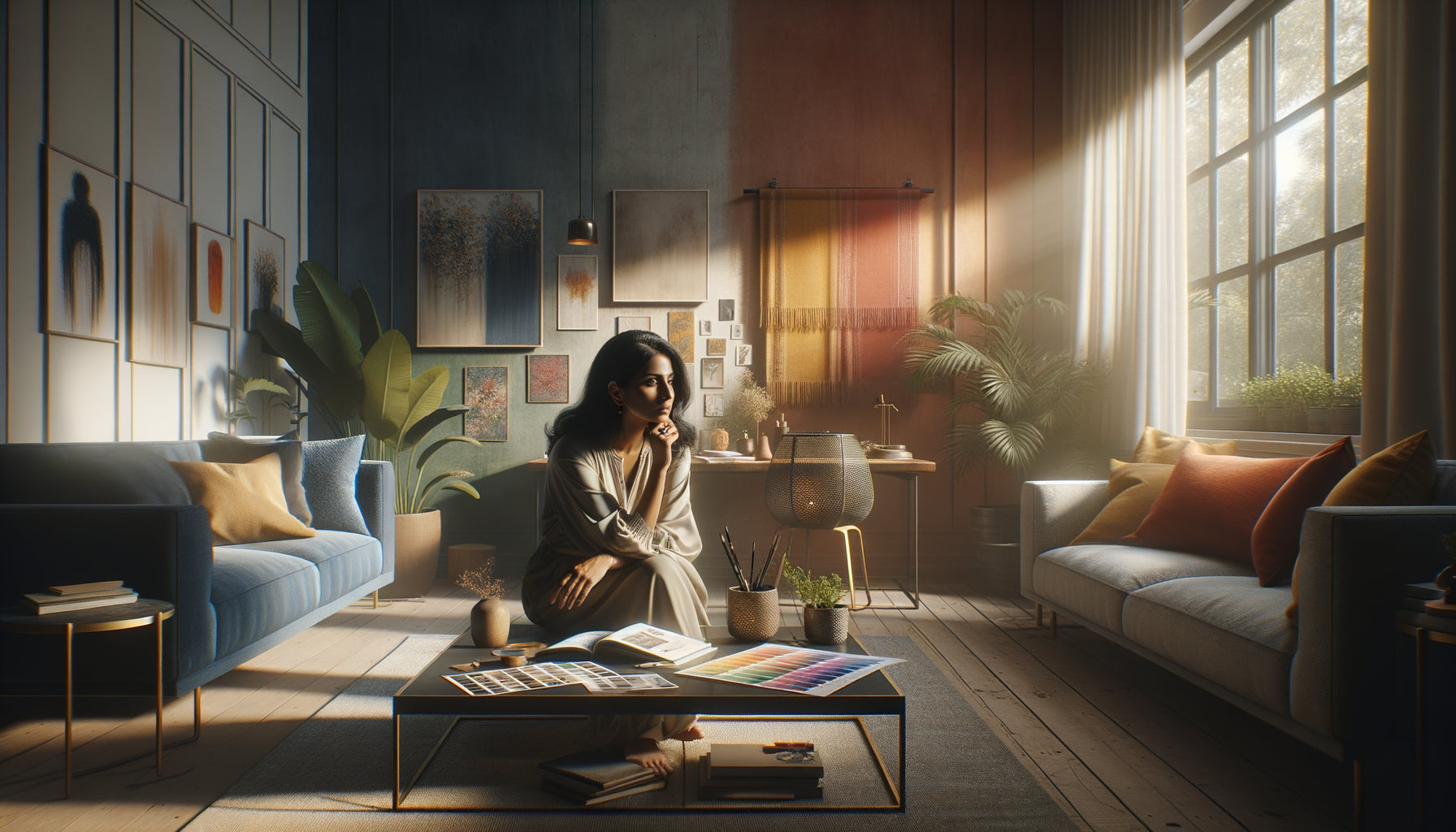
The smell of cardboard, the new keys in your palm, and that question that haunts you in front of the stacked frames in the hallway: what to do with this large Normandy landscape that grandfather cherished, this sepia portrait of great-aunt Madeleine, these still lifes with faded tones that have crossed three generations? In the euphoria of a fresh start, between the desire for modernity and family attachment, these inherited paintings confront you with an emotional as well as aesthetic dilemma.
Here's what thoughtful integration of your inherited paintings brings: a unique narrative depth that transforms an apartment into a true home, an emotional bridge between your family history and your current identity, and a visual richness impossible to reproduce with new works. These canvases steeped in memory possess what designers call “emotional patina,” that intangible quality that instantly gives soul to a space.
Many abandon these legacies in storage units or relegate them to oblivion for fear of being out of date, afraid of not honoring the contemporary style of their new apartment. You may have been told that mixing old and modern was risky, that inherited paintings belong to the past, that they will never find their place in your new chapter of life.
Rest assured: the most beautiful interiors are those that tell a personal story. It's not about blindly displaying every family canvas, but composing an intimate gallery where heritage and present dialogue harmoniously. You will discover how to transform these legacies into emotional anchors for your new apartment, how to select the pieces to keep, and above all how to showcase them without sacrificing your decorative identity.
Artistic inheritance is not an obligation, it's an opportunity
The first liberation comes from understanding that receiving an inherited painting does not automatically mean hanging it. This distinction seems obvious, yet so many people live with works they don’t really like, prisoners of family guilt. Your new apartment represents a blank page, the ideal opportunity to sort through things with lucidity and tenderness.
Ask yourself this fundamental question: does this inherited painting evoke something in you beyond the duty of memory? Some canvases hold specific memories – that landscape in front of which you had breakfast at your grandmother's house, that portrait that watched over your childhood summers. Others, inherited from distant branches of the family, resonate with no personal echo. Authentic emotional attachment should guide your first selection.
For inherited paintings that don’t find their place in your apartment but which you want to preserve, explore alternative solutions: lend them to other family members who would appreciate them more, have them digitized in high definition to keep a trace, or entrust them to a heritage association if their historical value warrants it. Honoring an inheritance does not necessarily mean living with it every day.
The rule of three looks to evaluate each inherited canvas
A pragmatic method allows you to objectively evaluate each inherited painting before deciding its fate in your new apartment. I call it the rule of three looks: the emotional look, the aesthetic look and the spatial look.
The emotional look examines your personal connection with the work. Close your eyes and recall the moments associated with this inherited painting. If memories flow back accurately and gently, if you can tell a story about it, it probably deserves its place in your apartment. Emotionally anonymous canvases, even pretty ones, can be released without remorse.
The aesthetic look evaluates the work independently of its origin. Would you choose this inherited painting in a gallery today? Does its palette, subject and style resonate with your current sensibility? Some dark 19th-century oils, beautiful in their own right, can weigh down a bright contemporary apartment. Conversely, a delicate watercolor from the 1930s often integrates wonderfully into modern interiors.
The spatial look considers the physical constraints of your new apartment. Will this large 47x59 inch (120x150 cm) portrait find an appropriate wall? Can this series of six engravings be grouped together or must they be separated? Measure your inherited paintings and available walls precisely before moving in. A family masterpiece that finds no suitable place will generate frustration rather than joy.

Three integration strategies to harmonize heritage and modernity
The contrasting staging
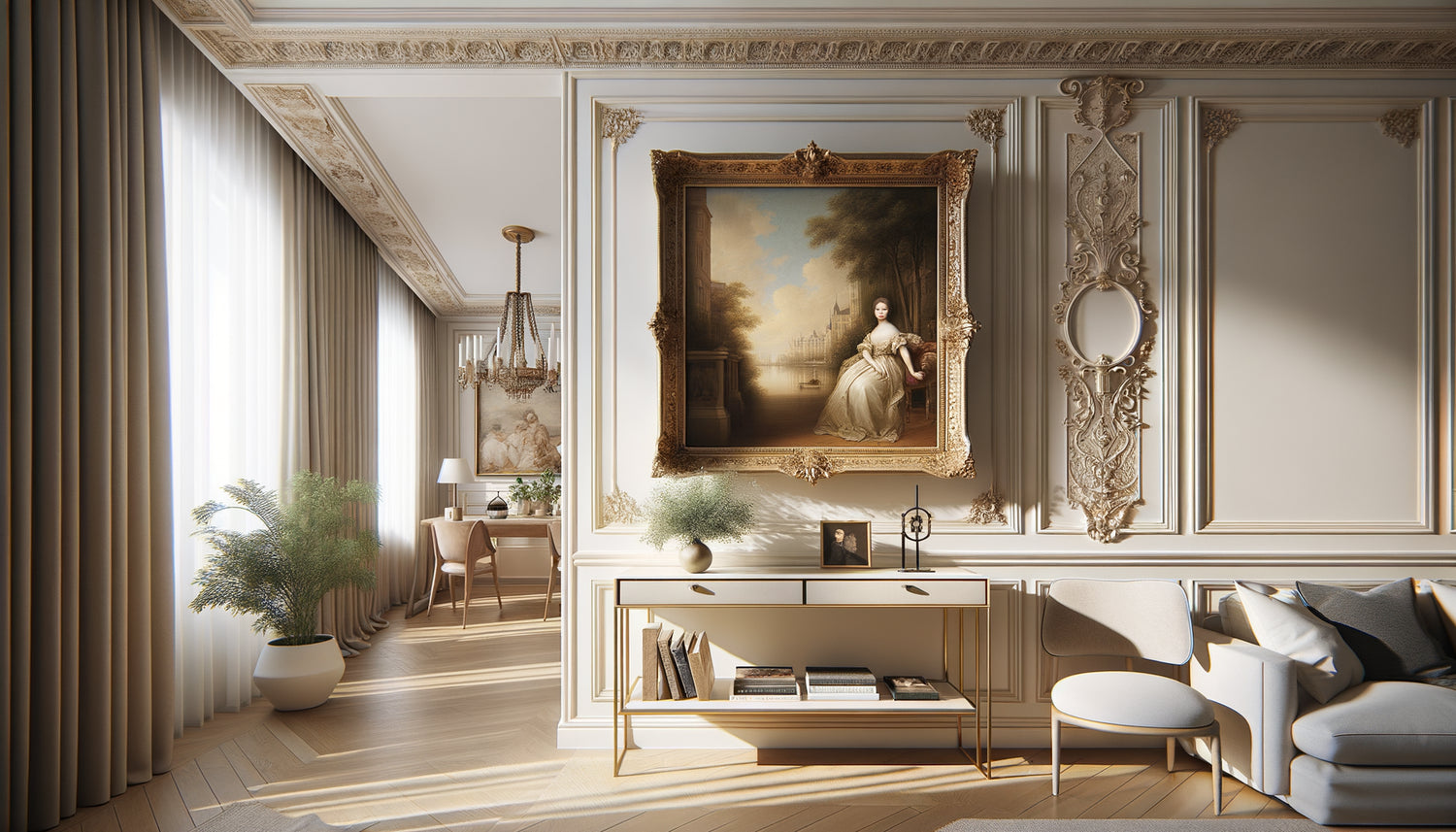
This bold approach deliberately plays on the temporal opposition. Imagine a large neoclassical portrait from the early 20th century in a gilded frame, hung above a sleek Scandinavian sofa, surrounded by pristine white walls. The contrast then becomes a force: your inherited painting is no longer a relic to be tolerated, but a centerpiece highlighted by its contemporary environment.
To succeed with this strategy in your apartment, isolate the inherited painting on a clear wall, without visual competition. Let the space around it breathe – at least 30 cm on each side. Lighting becomes crucial: a directional sconce or track lighting instantly transforms your family heritage into a work worthy of a gallery. The surrounding furniture should remain understated so that the contrast works without cacophony.
The Eclectic Gallery Wall
This method deliberately mixes inherited paintings and personal acquisitions into a dynamic wall composition. Your navy heirloom from Uncle Maurice is paired with a contemporary photograph taken during your trip to Berlin, itself alongside an exhibition poster and a small oil landscape passed down from your mother. The ensemble creates a unique visual narrative that simultaneously tells your family history and your personal journey.
The key to success lies in balancing masses and tones. Arrange your inherited paintings and recent works on the floor before drilling a single hole. Photograph different compositions. The goal is for the eye to circulate harmoniously without bumping into abrupt breaks. Vary the sizes, but look for a connection – similar color palettes, common themes, or simply frames in the same range of tones. In an apartment, this type of wall works wonderfully in a hallway, staircase or behind a desk.
Thematic Distribution by Room
A more classic but effective approach: assign a distinct atmosphere to each room in your apartment where some inherited paintings naturally find their place. Soothing landscapes join the bedroom, still lifes the dining room, portraits or genre scenes the living room. This thematic logic creates an intuitive consistency that facilitates the visual acceptance of varied styles.
Your new apartment offers the opportunity to intelligently redistribute these heirlooms. That small melancholic portrait that you found oppressive in the living room of your previous home reveals all its strength in the intimacy of an office. This delicate floral watercolor, lost on a large wall, flourishes in the reduced space of an elegant bathroom. Rethink the allocation of each inherited painting according to the new proportions and functions of your rooms.
When Reframing Changes Everything
A secret that few people exploit: framing radically alters the perception of an inherited painting. That mountain landscape you considered irrevocably old-fashioned in its baroque gilded frame can become surprisingly contemporary in a thin matte black or light wood frame. The work remains identical, but its dialogue with your apartment changes completely.
Before condemning an inherited painting, consult a professional framer. Bring photos of your new apartment, your decorative palette. A good artisan will be able to offer creative solutions: a generous mat that aerates the composition, a minimalist frame that modernizes without betraying, or conversely an antique frame restored that fully assumes the patrimonial character of the work. The cost of custom framing varies between 80 and 300 euros depending on the dimensions, an investment largely justified for a family heirloom that you will keep for decades.
Some inherited artworks can even be freed from their original frames. Oil paintings from the 1950s-1970s, often trapped in heavy gold frames, become lighter simply stretched on their visible chassis. This option works particularly well in apartments with a clean or industrial style.

The mistakes that turn heritage into a decorative burden
The most common mistake is to group all inherited paintings in the same place out of moral obligation, thus freezing your apartment in a heavy nostalgia. These concentrations of old works form temporal islets that prevent your interior from breathing. Instead, disperse your legacies with discernment throughout different rooms, integrating them organically into your overall decor.
Another trap: hanging an inherited painting too high for fear that it will be obstructive. The center of the work should be at eye level, or about 1.55-1.60 m from the floor in an apartment with standard ceilings. A painting perched at 2 meters loses all its expressiveness and becomes a simple decorative element without soul. Respect classic hanging rules, even for family heirlooms.
Third mistake: neglecting lighting. An inherited painting poorly lit in a dark corner of your apartment will always appear sad and dated. Light reveals nuances, makes colors vibrate, gives depth. If natural light is lacking, invest in accent lighting. Current LEDs, with their adjustable color temperature, allow you to enhance any work without the risk of thermal degradation.
Your apartment deserves a gallery that truly resembles you
Discover our exclusive collection of paintings for Apartment that will harmoniously dialogue with your family heirlooms and create the perfect balance between memory and modernity.
Creating a dialogue between yesterday and today
The real success is not to choose between inherited paintings and contemporary works, but to orchestrate their harmonious coexistence in your new apartment. The most beautiful interiors are those that embrace their temporal complexity, where a 1920 landscape coexists with a recent abstraction without one overwhelming the other.
This coexistence requires sensitivity but not necessarily expertise in art history. Trust your instincts: if, upon entering your apartment, your gaze lingers with pleasure on this inherited painting, if you can share its story with your guests without embarrassment, if it gives you that subtle feeling of being at home, then it has found its rightful place. Conversely, if you constantly have to justify or excuse its presence, perhaps it's time to find it another home.
Your new apartment is a blank page on which to write your own chapter while honoring those who came before you. Inherited paintings that deserve to accompany you are those that enrich your daily life rather than weigh it down, those that spark conversations rather than awkward silences, those that evolve with you rather than freeze you in the past. They are visual witnesses of a chosen continuity, not an imposed one.
Frequently Asked Questions About Inherited Paintings
Can I modify an inherited painting to better integrate it into my apartment?
This question touches on the delicate balance between respect for heritage and personal appropriation. Modifying the frame is not only acceptable but often recommended – that's precisely its role, to serve as an interface between the artwork and its environment. However, intervening directly on the canvas itself (cropping, retouching, amateur varnishing) poses a problem, both for the heritage value and for preservation. If an inherited painting seems dull or damaged, consult a professional restorer who will know how to clean and stabilize the work without altering its integrity. Some paintings reveal unsuspected colors after a simple surface cleaning. For works with little sentimental value, you can consider more daring transformations such as extracting an interesting detail, but always keep the original intact in case you change your mind. In your apartment, a well-restored and re-framed inherited painting will much more easily find its place than a neglected or clumsily modified work.
How can I know if an inherited painting has significant value before displaying it in my apartment?
The question of financial value deserves attention, especially if you are considering transformations. Three clues suggest that professional expertise is necessary: a legible artist's signature, documented provenance (purchase invoice, certificate, mention in a will), or a sophisticated technical invoice (old canvas, period frame, quality pigments). For an initial free assessment, photograph the painting from several angles – overall view, signature, back of the frame, details – and contact a local auctioneer or use online specialist forums. If significant value is confirmed, several options are available to you: insure it specifically in your apartment, deposit it in a safe and hang a quality reproduction, or lend it to a museum that will ensure its optimal preservation. Many inherited paintings have primarily sentimental value, which frees up your creativity to integrate them without excessive constraint into your decor. Remember that a painting with no market value may have local or family historical value that deserves to be documented and preserved for future generations.
What to do with inherited paintings that I don't want to hang but can’t throw away?
This emotional dilemma touches many people when moving into a new apartment. Fortunately, many intermediate solutions exist between permanent exhibition and destruction. Seasonal rotation is a first option: keep some inherited paintings in reserve and alternate their display every six months or each year, thus renewing your decor while preserving the entirety of your heritage. High-definition digitization allows you to create a “virtual family museum” accessible to all family members, while freeing up physical space. Some platforms even allow these digitizations to be printed on demand on various supports. Long-term lending to other interested family members turns your burden into their treasure. For works of local historical interest, contact the municipal archives, regional museums or heritage associations that sometimes accept donations. Retirement homes, public libraries and schools often seek artwork to decorate their spaces. Finally, professional climate-controlled storage represents a backup solution for paintings that you are not ready to part with but which do not have a place in your current apartment. The essential thing is to make a conscious decision rather than letting these works deteriorate in a damp cellar out of passive guilt.