The carton containing your framed memories has just been opened in your new apartment. These photographs of Prague, this vintage poster found in Brussels, your daughter's drawing... Each piece holds a spark of your story, but here they lie, waiting to be hung. How to transform these scattered fragments into a personal gallery that is not just wall decor, but a true visual narrative of your life?
Here’s what a well-thought-out personal gallery brings: it anchors your identity in your space, it creates authentic conversation starters with your guests, and it transforms anonymous walls into living chapters of your story. Too often, we pile up frames without thought or leave walls bare out of fear of doing it wrong. This hesitation is normal: composing a gallery can seem reserved for seasoned designers. Yet, creating a coherent and moving wall of memories is accessible to everyone. I will show you how to make your new space the guardian of your memory, piece by piece, emotion by emotion.
The principle of narrative thread: your gallery as an open book
A successful personal gallery is never a random patchwork. It follows an invisible guiding thread that directs the eye and tells something. In my own living room, I organized my gallery around the theme of time travel: the images evolve chronologically from left to right, from my first student escapades to recent family adventures. This temporal progression creates a sense of movement, almost cinematic.
You could also choose other narrative threads: thematic (nature, urban architecture, portraits), chromatic (a color progression that unifies the whole), or emotional (from melancholy to joy). The important thing is that this thread exists, even subtly. Ask yourself this essential question: what story do you want to tell through your gallery? Are you an explorer of the world? A guardian of family traditions? A collector of fleeting moments?
Identifying your visual chapters
Before hanging anything, spread all your pieces on the floor. You will naturally see thematic groupings emerge. These mountain photographs form one chapter. These three black and white portraits of your grandparents constitute another. This series of botanical illustrations that you have been collecting for years forms a third. These chapters will become the sections of your wall gallery, creating visual breaths while maintaining narrative coherence.
The art of composition: geometry and breathing
The physical arrangement of your personal gallery determines its emotional impact. I used to believe that a gallery had to be perfectly symmetrical to be successful. Monumental mistake. The most memorable compositions play with controlled asymmetry, creating dynamism while preserving balance.
For a harmonious gallery wall, start by defining an invisible guideline – generally at eye level, or about 150-160 cm from the floor. This line will be your central axis, even if not all frames align exactly on it. First arrange your masterpieces, those that carry the strongest emotional weight: this photograph of your wedding, this painting inherited from your artist aunt, this art print brought back from Tokyo.
The paper template method
Here's a technique that has saved me from countless unnecessary holes in walls: cut out rectangles of kraft paper to the exact dimensions of your frames. Attach them to the wall with reusable masking tape. For several days, live with this temporary composition. Move the templates, swap them, adjust the spacing. You will immediately see what works and what creates imbalances. This experimentation phase is crucial for creating a gallery that tells your story smoothly.
The spacing between frames deserves as much attention as the images themselves. Too tight, your gallery suffocates; too wide, it fragments. I recommend 5 to 8 cm between each frame for dense compositions, up to 15 cm for more airy arrangements. Visual breathing room allows each piece to express itself while maintaining conversation between them.

Frames as language: uniformity or eclecticism?
The choice of frames profoundly influences the personality of your personal wall gallery. Two schools clash: total uniformity or mastered eclecticism. Neither is superior to the other; it all depends on the desired effect.
Uniformity – all frames in the same finish, same color, same style – creates a contemporary elegance and emphasizes the images themselves. This is the art gallery approach, minimalist and sophisticated. It works beautifully in clean interiors and modern spaces. I used this method in my office with identical matte black frames: the result is sharp, professional, almost architectural.
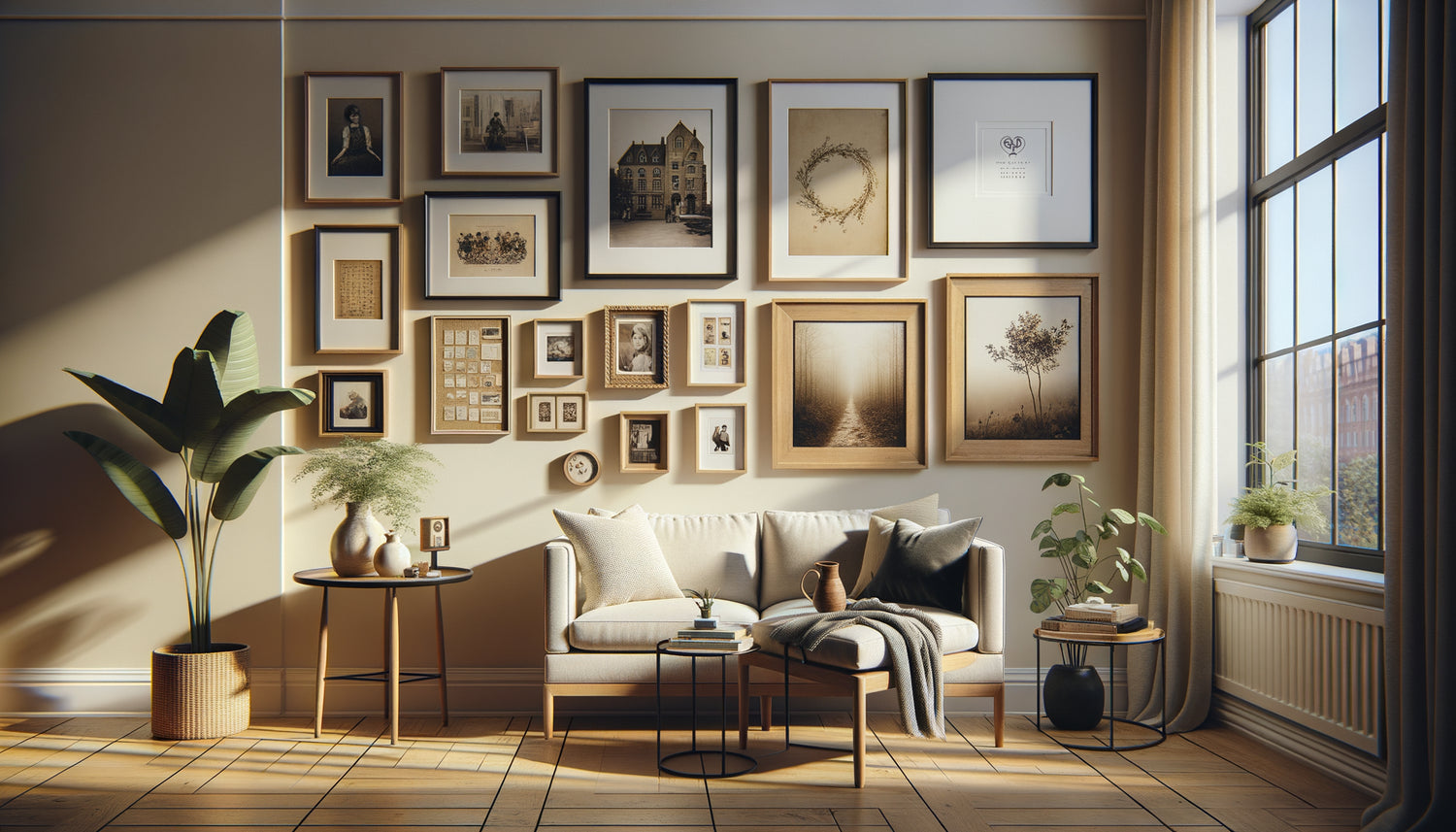
Eclecticism, on the other hand, mixes antique wood, gilded metal, white frames, varied formats. This more bohemian approach tells a story of patient collection, objects found over time. It is perfect for eclectic interiors, industrial lofts or Haussmann apartments. The trick to succeeding with eclecticism? Maintain a unifying element: a restricted color palette in the images, or a repetition of certain motifs.
When Memories Meet Art
Your personal gallery gains depth when you combine intimate photographs with artistic pieces. This dialogue between the autobiographical and the universal elevates it beyond a simple wall photo album. I have integrated an antique engraving depicting the village where my great-grandparents came from into my family gallery. This piece echoes family photos without duplicating them: it contextualizes, it adds a historical layer.
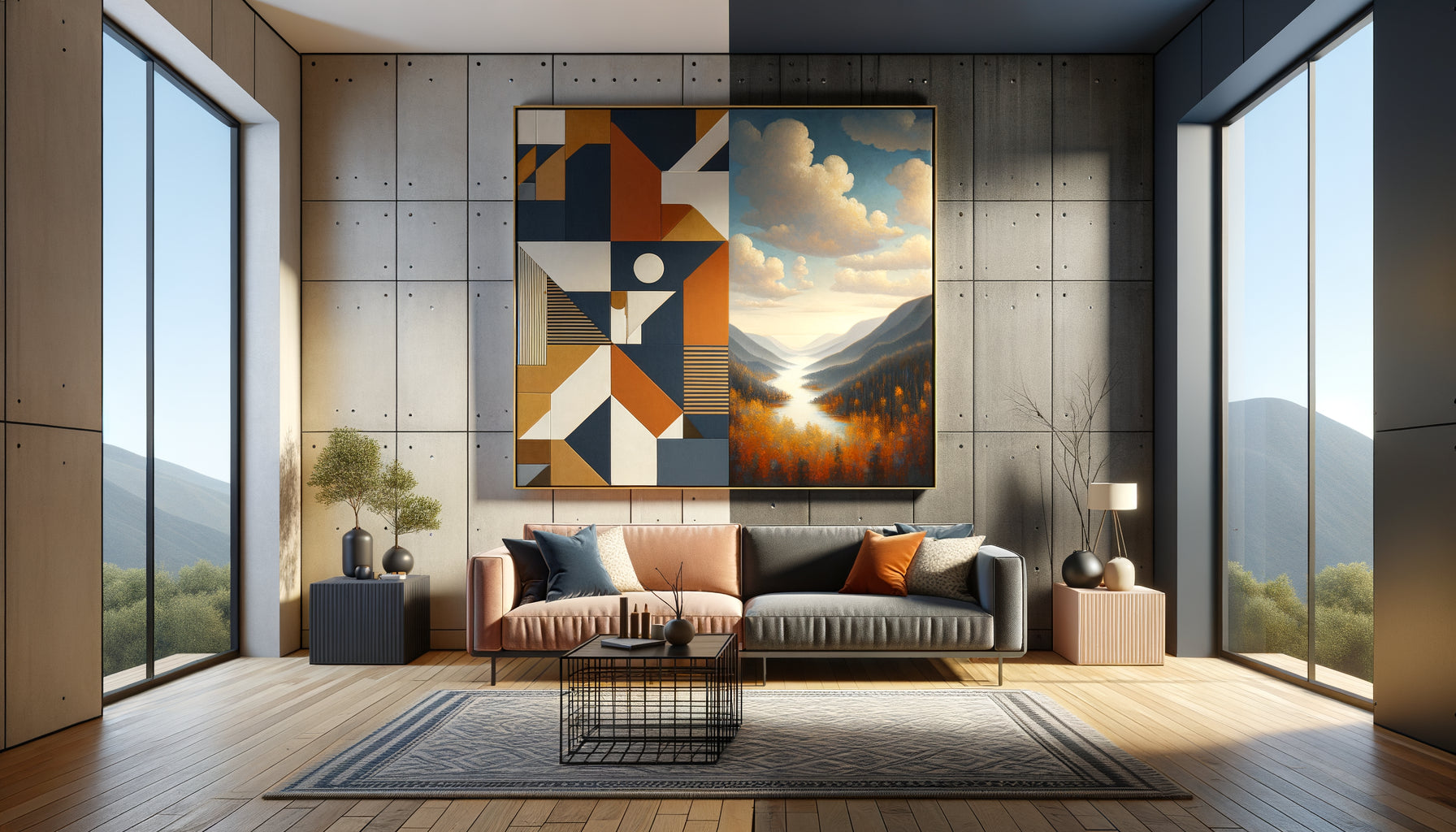
You could pair your travel photographs with old maps of the places visited, or intersperse portraits of family members with abstract works whose colors echo the dominant tones of your memories. This layering creates a narrative richness that transforms your gallery into a true artistic installation. Visitors no longer just look at your vacations; they contemplate a thoughtful composition that reveals your aesthetic sensibility.
The Importance of Seemingly Storyless Pieces
Paradoxically, incorporating purely decorative elements – a botanical illustration, inspiring typography, a contemporary art print – allows the emotionally charged pieces to breathe. These neutral visuals act as commas in your wall narrative, offering contemplative pauses between the denser chapters of your personal story.

Adapting Your Gallery to the Architecture of Your New Space
Each space has its architectural personality, and your personal gallery should dialogue with it rather than fight it. In an apartment with high ceilings and old moldings, dare a vertical composition that embraces the height of the place. Conversely, in a studio with more modest proportions, prioritize a horizontal development that visually widens the space.
Architectural constraints become creative opportunities. That unsightly radiator? Integrate it into your composition by framing it on either side. That door that breaks your wall? Use it as a natural boundary, creating two distinct galleries that respond to each other. I recently worked in a loft with exposed metal beams: rather than avoiding them, I built the gallery around them, creating visual compartments that structured the space.
Lighting: Revealing Stories
A gallery without proper lighting loses 50% of its impact. Lighting transforms your memory wall into a focal point, especially in the evening. Adjustable LED spotlights, sconces, or even a track lighting system create zones of light that guide the eye and add a theatrical dimension. Warm light (2700-3000K) is suitable for intimate and nostalgic galleries; neutral light (4000K) for more contemporary and graphic compositions.
Your story deserves a setting worthy of it
Discover our exclusive collection of wall art for Apartment that will harmoniously dialogue with your most precious memories and elevate your personal gallery to the rank of work of art.
Evolving Your Gallery: A Living Narrative
It would be a mistake to consider your personal gallery as fixed once installed. The best galleries evolve with you, are enriched by new chapters, and reorganize over the course of your life. Provide for a few free spaces from the start, some extra hooks that will welcome future pieces of your story.
I adopt a simple rule: every year, I add at least one new piece and remove another that resonates less with who I have become. This rotation keeps the gallery alive, breathing, authentically representative of my present rather than mummified in a bygone past. Some pieces go to other rooms in the house, creating satellite galleries that extend the main narrative.
Your new space awaits to become the theater of your memory. These white walls are just waiting to bear the traces of your laughter, your travels, your loves and your dreams. By creating a thoughtful personal gallery, you are not simply decorating: you are inscribing your identity in architecture, transforming a place into an intimate territory. Start small if the scope of the project intimidates you – one wall, a few essential pieces. Then let your gallery grow organically, at the pace of your life. In six months, when a friend stops in front of your wall asking about the story behind this photograph, you will know that you have succeeded: your gallery speaks, tells, moves. It has become that magical bridge between who you were, who you are, and who you are becoming.
Frequently Asked Questions About Creating a Personal Gallery
How many pieces do you need to create a true personal gallery?
There’s no magic number, and that’s great news for those just starting out. A gallery can begin with only 3 to 5 pieces if they are well-chosen and intentionally arranged. The key lies in narrative consistency rather than quantity. I've seen 3-frame galleries perfectly composed that told more than a wall overloaded with 30 disparate elements. For a first gallery wall, aim for between 5 and 9 pieces – enough to create visual impact without overwhelming you during installation. You can always enrich your composition gradually. Remember that the empty spaces around your frames are an integral part of the composition: they allow the eye to breathe and each piece to fully express itself.
How do I incorporate three-dimensional objects into my gallery wall?
Adding relief elements transforms a flat gallery into a truly sculptural installation and adds a tactile dimension to your narrative. You can integrate floating shelves that hold small, meaningful objects: this stone picked up on an Icelandic beach, this Venetian mask, this inherited figurine. Antique mirrors interspersed between frames also create depth and reflect light. Framed textiles – a kimono fragment, a family embroidery, a tapestry piece – bring texture and warmth. The key is to maintain scale consistency: three-dimensional objects should not visually overwhelm the framed pieces. Limit yourself to a maximum of 20-30% relief elements to preserve harmony. This mixed approach creates a more museum-like gallery, almost a cabinet of curiosities, which invites close observation and progressive discovery.
What should I do if my memories don’t stylistically match my current decor?
This apparent tension actually hides a magnificent opportunity to create aesthetic bridges. Your authentic memories bring precisely what perfectly coordinated décor cannot offer: life, imperfection, humanity. To harmonize without betraying, work on the frames rather than the images themselves. Frames with simple lines and neutral finishes visually unify heterogeneous content. You can also create a dedicated zone where stylistic rules are relaxed – a freedom wall that embraces its eclecticism while the rest of the space maintains your main decorative line. Alternatively, convert some color photographs to black and white: this timeless transformation facilitates integration into practically any interior. Remember that the most memorable spaces embrace a certain unpredictability: your personal gallery can be just that element of authenticity that prevents your decor from tipping into the coldness of a catalog.