The first time I contemplated a Song dynasty huaniao hua at the Zhejiang Provincial Museum, I held my breath. A grey heron captured in mid-flight, each feather rendered with almost photographic precision, the shadow of its wings projected onto the reeds. Then my gaze lingered: the bird ascended towards an empty, asymmetrical corner, carrying all the nostalgia for an impossible return. That day, I understood that Song masters had never chosen between science and poetry.
Here's what migratory birds in Song art reveal: a naturalist observation of astonishing precision serving a universal philosophical symbolism, a pictorial technique that transforms each bird into a meditation on the passage of time, and an inexhaustible source of inspiration for our contemporary interiors seeking authenticity.
Many admire Chinese bird paintings without grasping their dual nature. One is content to appreciate the formal beauty, or one falls into the easy exoticism of symbols. One believes that you have to choose: either it was primitive science, or decorative philosophy. This misunderstanding deprives us of their true richness.
Yet, Song artists themselves never separated these dimensions. For them, meticulously observing the curve of a beak or the movement of a wing was a philosophical act. Capturing the precise moment when a wild goose leaves the formation to dive towards the water was meditating on individual freedom within the cosmic order.
In this article, I take you to the heart of this unified vision that fascinated Emperor Huizong and his court painters. You will discover how this understanding transforms our relationship with works of art, and why these millennial principles still speak to our modern living spaces.
The Imperial Academy: when observation becomes spiritual discipline
Under the Song dynasty (960-1279), the Hanlin Academy trained its painters according to methods that would make our contemporary art schools pale in comparison. Candidates had to spend weeks observing migratory birds in their natural habitat. Not from a comfortable workshop: in the frozen marshes of the Yellow River in November, in the rice fields of Jiangnan at dawn, when cranes awaken.
Emperor Huizong himself demanded this rigor. It is said that one day he rejected a painting of a peacock because the artist had depicted the bird raising its right leg first when climbing onto a rock. 'A peacock always starts with the left', he reportedly commented. This anecdote illustrates the Song obsession with naturalist truth.
But this observation was never cold. The painters spent so much time with migratory birds that they ended up perceiving their qi, their vital energy. They captured the precise moment when a tense goose detects danger, when a heron imperceptibly adjusts its balance before harpooning a fish. This intimacy transformed scientific observation into communion.
The rediscovered field notebooks
Preparatory sketches by Song have been found in the cellars of the Taipei Palace Museum. They show dozens of studies of mandarin duck wings from different angles, notes on plumage variations according to the seasons, quick sketches capturing the dynamics of flight formation. These documents prove that artists were conducting real ethological studies before composing their works.
The secret language of migratory birds in Song cosmology
Alongside this naturalist rigor, each migratory bird carried precise philosophical meanings, inherited from the Yi Jing (Book of Changes) and Taoism. But be warned: it was not an arbitrary code. The symbolism stemmed directly from observed behaviors.
The crane, which can fly thousands of kilometers and lives up to 60 years, naturally embodied longevity and spiritual elevation. Song painters often depicted it alone, ascending, in a space evoking infinity. This solitude was not melancholic but noble, an image of the sage detached from worldly affairs.
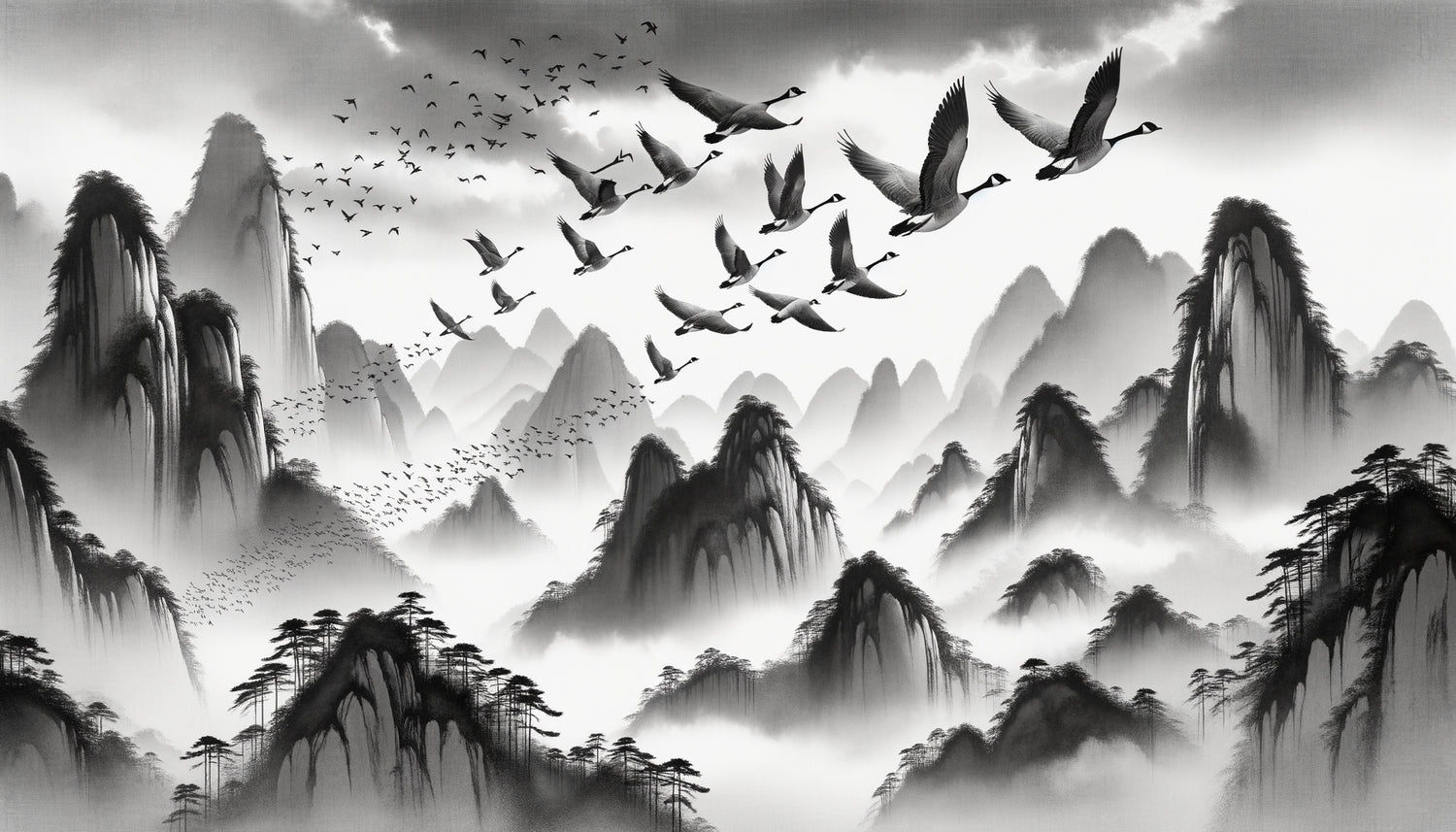
The wild geese, always painted in a V formation, symbolized loyalty and harmonious social order. Artists observed how these migratory birds alternate positions to save collective energy, how they slow down for an injured companion. This natural ethic resonated with Confucian values of loyalty and mutual responsibility.
The kingfisher, which dives with dazzling precision, evoked perfect concentration, the moment when thought and action become one. Chan (Zen) masters particularly appreciated this motif to illustrate sudden enlightenment.
Migration as an existential metaphor
More deeply, the phenomenon of migration itself obsessed Song scholars. These birds that leave and return according to immutable cycles embodied change within permanence, a central principle of the Yi Jing. They materialized nostalgia for homecoming (gui), a universal sentiment in a China where officials were constantly transferred away from their native province.
A painting of migratory birds at dusk thus became a meditation on time, exile, and the hope of return. No explanations needed: any scholar contemplating these works projected his own separations, his own expectations onto them.

Revolutionary pictorial techniques in the service of double vision
How did Song artists fuse observation and symbolism on silk? Through astonishing technical innovations that remain unparalleled.
The gongbi ('meticulous brush') method allowed for rendering each feather barb with microscopic precision. Painters used brushes with one or two weasel hairs for the finest details. Some works required months of labor. This accuracy served the naturalistic dimension.
Simultaneously, the composition utilized active void (liu bai) inherited from Taoism. Unlike Western painting which fills space, Song artworks left vast areas of virgin silk. A migratory bird sometimes occupied less than one-tenth of the surface. This void was not absence but presence: mist, distance, infinity, unspoken words. It activated the symbolic and meditative dimension.
The paradox of frozen movement
Song masters excelled at capturing the decisive moment: a migratory bird at the apex of its flight, between ascent and descent, in an impossible balance that seems to defy gravity. Technically, this required a perfect understanding of anatomy and aerodynamics. Philosophically, it evoked the eternal instant, the absolute present cherished by Chan Buddhism.
This suspension of time transformed each work into a visual koan, Zen riddles designed to short-circuit rational thought to provoke direct intuition.
Three masterpieces that embody perfect synthesis
‘Auspicious Cranes’ attributed to Emperor Huizong (Liaoning Museum): twenty cranes in a golden sky, some in flight, others perched on the roofs of the palace. Each bird is anatomically perfect and individualized. Yet, the composition creates an ascending circular movement that irresistibly evokes cosmic harmony. Science and symbol merge.
‘Sparrow and bamboo under the snow’ by Emperor Huizong: a tiny sparrow ruffled on a branch of bamboo bent under the snow. Pitiless observation of cold and fragility, but also allegory of the resilience of the scholar in the face of political adversity. Emotion arises from this double reading.
‘Mandarin Ducks’ anonymous 12th century (National Palace Museum, Taipei): a couple on a rock near the water. The rendering of iridescent plumage reaches an hallucinatory virtuosity. But their tactile proximity, their converging gazes create intimacy that has inspired generations of lovers. These migratory birds, faithful for life, become silent witnesses to all human commitments.

Why This Duality Captivates Our Contemporary Interiors
This fertile tension between precision and poetry explains why Song bird paintings (and their modern interpretations) transform our living spaces in a unique way.
In a minimalist living room, a silk crane reproduction brings a contemplative presence without ever visually saturating the space. The emptiness of the Song composition naturally dialogues with contemporary austerity. Unlike loaded Western works, it breathes.
In a bedroom, mandarin ducks create a silent intimacy. Their realism prevents a faded decorative effect; their symbolism of fidelity adds a discreet but perceptible emotional depth.
In an office, a formation of geese in migration subtly inspires perseverance and long-term vision. Not through a vulgar motivational slogan, but through the natural example of these tireless travelers.
The Soothing Effect Demonstrated
Environmental psychology studies have shown that naturalist representations of animals reduce stress and improve concentration. But works inspired by the Song aesthetic add an additional benefit: their asymmetrical composition and empty spaces invite productive reverie, that mental state where the mind wanders creatively without agitation.
Let Migratory Birds Transform Your Daily Life
Discover our exclusive collection of animal paintings that capture this perfect alliance between naturalist observation and symbolic depth to enrich your living spaces.
How to View a Song Bird Painting (or Inspired by This Tradition)
To fully benefit from this double dimension, here is the method I learned from conservators specializing in Song art.
First Glance (30 seconds) : Observe the migratory bird itself. Note the anatomical precision, the details of the plumage, the body posture. Admire the technical mastery. Let your naturalist eye marvel.
Second Glance (2 minutes) : Expand to the context. Where is the bird located in the composition? In which direction is it heading? What season does the setting suggest? What time of day is it? Let the atmosphere penetrate you.
Third look (as long as necessary): Close your eyes halfway. Stop trying to analyze. Let the work resonate with your inner state. Perhaps you will suddenly perceive the noble solitude of the crane, or the collective energy of the geese, or the concentration of the heron. Maybe it will remind you of a departure, a wait, a return. It is here that philosophical symbolism operates, not as an intellectual concept but as lived experience.
This three-step approach honors the two intentions of the Song masters: to truly see, then to feel deeply.
Integrating this wisdom into your decor
You don't need an authentic Song work (they are worth millions and belong in museums). Quality contemporary interpretations that respect fundamental aesthetic principles create the same effects.
Prioritize asymmetrical compositions with plenty of white space. Avoid reproductions that add decorative elements to 'fill': this betrays the Song spirit.
Choose naturalistic representations, not stylized cartoon-like ones. The precision of detail is not superfluous: it anchors the work in reality before opening it up to symbolism.
Respect the scale. A traditional Song migratory bird painting is often a narrow vertical scroll (30-40 cm) but tall (100-150 cm). This elongated format creates a meditative verticality. Wide horizontal transpositions lose this effect.
Position it at eye level, in a space where you pass slowly, not in a fast circulation corridor. These works require a steady gaze, not a fleeting glance.
Imagine: every morning, while preparing your tea, you meet the gaze of a heron motionless watching for its prey. For three seconds, his absolute attention contaminates yours. Your day begins differently, with more presence. That is the subtle but real influence of a work that unites observation and philosophy.
The Song masters did not ask themselves whether they were doing science or art, observation or meditation. For them, these activities formed a natural continuum. Really watching a migratory bird was already philosophizing. Philosophizing about time and return was already painting with accuracy the feathers ruffled by the autumn wind.
This unified vision still speaks to our fragmented lives between efficiency and meaning, between material and spiritual. A Song crane on your wall gently murmurs: 'Look really at what surrounds you. Depth is always in precision. The symbol is born of attention.'
Perhaps this is the most valuable lesson of this millennial art: right contemplation erases false oppositions. It reveals that truth and beauty, accuracy and poetry, observation and transcendence are only different words for describing the same amazed gaze upon the mystery of life.
Frequently Asked Questions
How to recognize a quality reproduction of a Song bird painting?
First, look for the quality of emptiness. A good reproduction respects the unpainted spaces, without adding decorative filling. Then, check the finesse of detail: you should be able to distinguish individual feather barbs, not just blocks of color. The composition should be asymmetrical and dynamic, creating a natural visual movement. Avoid overly colorful versions: the Song artists favored subtle inks and discreet pigments. Finally, find out about the support: a print on cotton paper or textured silk better respects the original spirit than a glossy plastic poster. A quality work costs between 80 and 300 euros depending on size and printing technique, a reasonable investment for an element that will transform your living space for years.
Which migratory bird to choose according to the room in my house?
For a bedroom, prioritize mandarin ducks (symbol of fidelity and marital harmony) or a solitary heron at dusk (conducive to introspection and rest). In a living room or reception area, a formation of wild geese evokes a harmonious community and creates a welcoming dynamic. For a home office or workspace, opt for a rising crane (elevation, long-term perspective) or a kingfisher diving (concentration, quick decision making). In an entrance hall, birds in ascending migration create an effect of openness and optimism from the moment you step through the threshold. The essential thing is that the work resonates with the energy you want to cultivate in this space, keeping in mind that Song symbolism works by subtle suggestion, never by aggressive affirmation.
Do Song bird paintings fit into a non-Asian modern interior?
Absolutely, and that's where they shine the most today. The Song aesthetic is based on minimalism, asymmetry and negative space, three fundamental principles of contemporary Western design. A Song crane fits perfectly into a stripped-down industrial loft, a Scandinavian apartment or a modernized Japanese minimalist interior. The mistake would be to create a folkloric 'Asian corner' with bamboo decorations and lanterns: this ghettoizes the work. Treat it rather as a piece of contemporary art: white or light gray wall, simple frame (or no frame, just a mat mounting), discreet lighting. The dialogue between the antiquity of the Song inspiration and the modernity of the context creates a fascinating tension. Many collectors of contemporary art integrate authentic or inspired Song works into their ultramodern spaces: the timeless accuracy of naturalistic observation and the sophistication of the composition transcend eras and geographies. Trust in the universal quality of these works.